
On this page
Start here
Quick answer
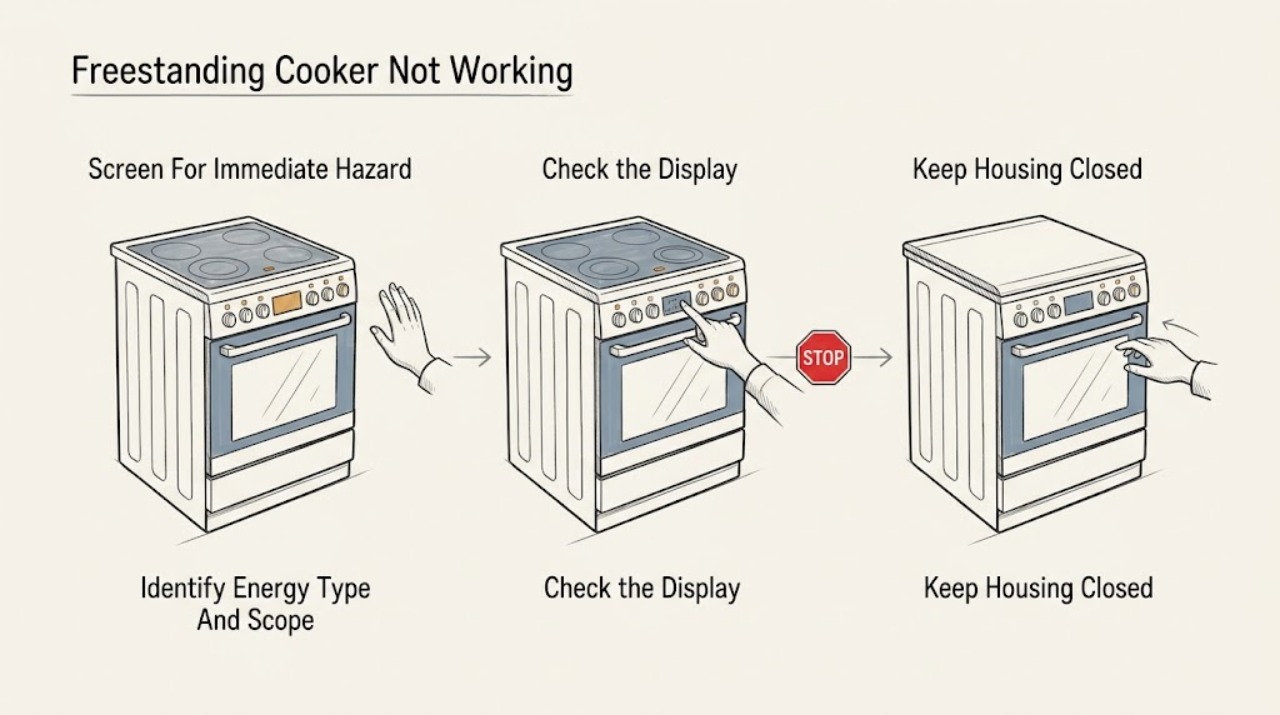
First decide whether the whole freestanding cooker is without power or only the oven, cooktop, or one heating zone has stopped working. Do not troubleshoot a gas cooker if you smell gas: avoid flames, switches, plugs, and controls, leave the area, and contact emergency or gas-leak help from a safe location. If there is no gas odor, smoke, arcing, water near electrics, or visible damage, identify whether the cooker is gas, electric, dual-fuel, or induction; check the dedicated supply and external cord or plug only as the manual permits; and note whether the display is blank, locked, in demonstration mode, or showing an exact code. A gas burner that will not ignite, an electric element that stays cold, or an induction zone that does not recognize a suitable pan needs model-specific diagnosis when the safe external checks do not restore operation.
Before you begin
Safety first
- This article supports hazard screening, identification of fuel type and affected function, manual-approved front-panel checks, limited external supply observation, and documentation only. Do not work on gas lines, live electrical parts, internal controls, heating elements, igniters, or safety devices.
Work through in order
Diagnostic checks
Use only checks that match the exact appliance or system and its official guide.
-
Check 1
Before touching a control, check from a safe position for gas odor, smoke, flame outside the normal burner area, arcing, a damaged cord, water near electrical parts, or a carbon-monoxide alarm.
Expected result: Classify the cooker as showing an immediate gas, fire, electrical, water, or carbon-monoxide warning, or as having none of those warnings.
Next step: For any warning, leave the appliance and area as directed in the emergency branch; only continue after qualified responders make the area safe.
Stop if: Do not operate switches, plugs, controls, breakers, flames, or the cooker when gas, smoke, arcing, water contact, or a carbon-monoxide alarm is present.
Why this matters
Why: A warning changes the job from troubleshooting to emergency isolation; a quiet cooker may proceed to limited external checks.
-
Check 2
With the cooker off and safe, identify the energy type from the rating label or manual as gas, electric, dual-fuel, or induction, and determine whether the entire appliance or only the oven, cooktop, one burner, or one zone is affected.
Expected result: Record the exact model, fuel type, whether the display or indicator lights work, and which functions still respond.
Next step: Use the matching power, gas, electric-heating, or induction branch and follow the exact model manual; do not substitute instructions for another fuel type.
Stop if: Do not move the cooker to read a hidden label, expose a gas hose, open a service panel, or assume an unconfirmed fuel type.
Why this matters
Why: No display or response on every function points toward supply or controls; a working display with one failed function narrows the issue to that mode, heating circuit, ignition path, or pan-recognition system.
-
Check 3
If there is no immediate hazard and the display responds, inspect the selected mode, clock or timer state, control lock, child lock, demonstration mode, door indication, and exact error text; use only the manual's normal front-panel steps.
Expected result: Record a blank display, lock or demo indication, missing clock, door-lock indication, an exact code, or a normal ready display that still will not start heating.
Next step: Apply the manual's permitted unlock, clock, mode, or cancel procedure once; if the control remains unresponsive or the code returns, stop and arrange service.
Stop if: Do not bypass a control or door lock, repeatedly cancel and restart a gas ignition sequence, or apply a code meaning from a different model.
Why this matters
Why: A lock, demo state, unset clock, open-door indication, or mode selection can prevent a cycle without proving that a heating or gas component has failed. An exact code is model-specific evidence.
-
Check 4
For an electric, induction, or dual-fuel cooker with no hazard, inspect the accessible plug, cord, wall outlet, and dedicated isolation switch for a loose fit, scorch mark, damage, or a tripped breaker; perform at most one normal reset only if the installation manual permits it and there is no damage or water.
Expected result: Record whether the outlet or switch appears powered, the breaker is tripped, the plug is loose, the cord is damaged, or the cooker stays dead after one safe reset.
Next step: Leave the cooker off and use qualified electrical service for damaged, loose, hot, or repeatedly tripping connections; arrange appliance service when the external supply is sound but the cooker remains dead.
Stop if: Do not remove outlet covers, probe live terminals, use an extension cord or power strip, tape a damaged cord, or repeatedly reset a breaker.
Why this matters
Why: A damaged or hot connection is an electrical stop condition. A clean supply with a blank display points toward the cooker connection, fuse, control, or internal power circuit.
-
Check 5
For a gas or dual-fuel cooker that is safe to approach, record whether the affected burner or oven produces a normal control response, clicking, or no response without repeatedly attempting ignition; do not disassemble the burner or gas path.
Expected result: Record whether one burner fails while others work, all gas functions fail, clicking continues without ignition, ignition is delayed, or any gas odor, pop, soot, or abnormal flame occurred.
Next step: Keep the cooker off and request qualified gas-appliance service for any ignition, flame, gas-control, or repeated failure symptom; use the emergency branch for a current odor.
Stop if: Do not relight repeatedly, use a match as a test, adjust gas pressure, disconnect a gas line, or continue after a gas smell, bang, soot, or unstable flame.
Why this matters
Why: A single-function failure may be a model-specific igniter, burner, or control issue; continued clicking, delayed ignition, soot, abnormal flame, or any gas odor can indicate unsafe fuel or combustion behavior.
-
Check 6
If an electric or induction cooker has power and the controls respond, confirm the selected heating zone and setting; for induction, place only a dry, suitable pan of the size and material specified by the manual on the zone without covering the controls.
Expected result: Record whether the indicator turns on, the zone recognizes the pan, the element heats evenly, the oven heats, or a warning appears; do not touch a surface to test temperature.
Next step: Stop using the affected zone and arrange model-specific appliance service if the correct setting and pan do not restore operation or if the glass is damaged.
Stop if: Do not use cracked glass, place metal objects on an induction surface, scrape live residue, bypass pan detection, or open the cooktop to test an element.
Why this matters
Why: A pan-recognition warning is different from a dead control or supply. A control that responds but produces no heat may require diagnosis of the element, sensor, inverter, relay, or control circuit.
-
Check 7
When the safe external checks do not restore the cooker, leave it off and give a qualified technician the exact model, fuel type, affected function, display or code, supply observations, and the sequence of events.
Expected result: Confirm whether the failure is total or partial, whether a reset changed anything, and whether there was gas odor, smoke, arcing, a hot connection, a trip, a delayed ignition, or an alarm.
Next step: Arrange appliance repair, qualified gas-appliance service, or qualified electrical service according to the evidence and keep the cooker out of service until cleared.
Stop if: Do not remove panels, work on gas or live electrical parts, bypass a thermal or door safety, or install a part based only on the symptom name.
Why this matters
Why: Persistent failure after safe supply and control checks can involve internal wiring, a heating element, sensor, igniter, gas valve, burner, induction electronics, or control board; these require model-specific testing.
Use your observations
Decision map
Find the observation that best matches what you see, then follow the next safe action.
-
PATH 01Safety boundary
What you see
Gas odor, hissing, or an unexplained fuel smell is present or its source is uncertain.
Do this next
Avoid flames, switches, plugs, phones, and vehicles near the area; leave by foot and contact emergency or gas-leak help from a safe location.
Why this path and its safety boundary
Why it matters: Treat this as a possible gas leak or unsafe combustion event, not as a failed-igniter test.
Safety stop: Do not re-enter, turn a valve, relight a burner, or restart the cooker until qualified responders declare the area safe.
-
PATH 02Safety boundary
What you see
There is smoke, flame outside normal operation, arcing, scorch damage, melting, a hot plug, or a burning electrical odor.
Do this next
Leave people clear of danger, follow local emergency instructions for smoke or fire, and arrange qualified appliance or electrical service after the area is safe.
Why this path and its safety boundary
Why it matters: The cooker has a fire or electrical hazard and should not be tested again.
Safety stop: Do not reset power repeatedly, touch a damaged connection, open the cooker, or continue cooking.
-
PATH 03Safety boundary
What you see
A carbon-monoxide alarm sounds or anyone has headache, nausea, dizziness, shortness of breath, confusion, or weakness while a fuel-burning cooker is operating or has operated.
Do this next
Move outside to fresh air, seek emergency help, and do not re-enter or operate fuel-burning appliances until responders permit it and trained personnel inspect them.
Why this path and its safety boundary
Why it matters: Carbon monoxide is odorless and may be present even when no gas smell is noticed.
Safety stop: Do not silence the alarm, search indoors for the source, or run the cooker to reproduce the condition.
-
PATH 04Safety boundary
What you see
The display, indicators, oven, and cooktop are all dead, with no gas, smoke, water, or electrical damage warning.
Do this next
Check the accessible supply and perform no more than one manual-approved reset; use qualified electrical or appliance service if it stays dead or the breaker trips again.
Why this path and its safety boundary
Why it matters: The likely decision path is the external supply, isolation switch, breaker, plug, fuse, or appliance power/control circuit rather than one heating zone.
Safety stop: Do not use an extension cord, open the outlet or cooker, or repeatedly reset a breaker.
-
PATH 05Safety boundary
What you see
The display works but a lock, demo mode, missing clock, door indication, selected mode, or exact code prevents starting.
Do this next
Follow the exact model manual's normal front-panel procedure once; arrange service if the control remains locked, unresponsive, or returns the code.
Why this path and its safety boundary
Why it matters: The cooker may be waiting for a normal control condition rather than having a failed heating part.
Safety stop: Do not bypass the lock, short a control, or apply instructions from another model.
-
PATH 06Safety boundary
What you see
The display and supply work but one burner, oven, element, or induction zone remains cold, does not ignite, or does not recognize the correct pan.
Do this next
Use only the model manual's safe external checks, then arrange qualified appliance service if the fault remains or any gas, smoke, heat-damage, or glass warning appears.
Why this path and its safety boundary
Why it matters: The failure is localized to a mode, pan-recognition, ignition, heating, sensor, or control path; the appliance is not proven safe for continued use.
Safety stop: Do not repeatedly ignite gas, touch a heating surface, bypass pan detection, remove panels, or replace an internal component without diagnosis.
Helpful context
Understand the symptom
Separate a total power failure from a cooking-function failure
A blank display and no response from every control suggest a supply, isolation switch, plug, fuse, breaker, or control problem. A lit display with one cold zone or an oven that will not heat points to a selected mode, lock, pan-recognition, ignition, heating element, sensor, or control issue. That distinction is useful only after the cooker passes a safety screen: any gas odor, smoke, flame outside the normal burner pattern, arcing, damaged cord, or water near electrical parts is a stop condition.
Use the exact manual for controls and fuel type
Freestanding cookers may be gas, electric, dual-fuel, or induction, and the same symptom has different safe checks on each type. Confirm the data plate or manual without moving the appliance, then record any lock symbol, clock requirement, demonstration mode, selected function, or exact error text. Do not infer a gas-valve, igniter, element, or induction fault from a generic code or from another model's instructions.
A cooker that remains dead or unsafe needs qualified service
The safe homeowner boundary is limited to external observation, the manual's permitted control steps, and one normal supply reset when there is no hazard and the installation instructions allow it. Do not remove panels, test live wiring, adjust gas pressure, bypass a door or control lock, defeat a safety device, or repeatedly relight a burner. If the symptom persists, provide the technician with the appliance type, model, exact display, affected function, and what changed immediately before the failure.
Safety boundary
Stop conditions
- For gas odor, hissing, or an uncertain fuel smell, avoid flames, switches, plugs, phones, and vehicles near the area; leave and contact emergency or gas-leak help from a safe location.
- Stop for smoke, abnormal flame, delayed ignition, a bang, soot, arcing, a burning smell, a hot or damaged cord or outlet, water near electrical parts, or a carbon-monoxide alarm or compatible symptoms.
- Do not repeatedly reset breakers, relight burners, test with a match, bypass a control or door lock, or run the cooker to reproduce a hazardous symptom.
- Do not open panels, probe live wiring, adjust gas pressure, disconnect gas piping, defeat pan detection, or work on heating, ignition, or control components as a homeowner test.
- Do not use an extension cord or power strip for the cooker, and do not use a cracked induction or glass cooking surface.
Only after diagnosis
Potential parts
- cooker control, timer, or lock component
Consider this category only if the exact model remains locked, unresponsive, or fails its clock/control sequence after the manual-approved steps and a technician confirms the control fault.
Confirm the exact model and professional diagnosis; do not bypass a lock or substitute a control from another cooker. - cooker heating element or sensor
Consider this category only when a qualified diagnosis finds a cold oven or zone with a sound supply and a failed element or sensor.
Confirm the exact model, energy type, voltage, and technician diagnosis before ordering; installation involves electrical safety. - cooker igniter, burner, or gas-control component
Consider this category only after a qualified gas-appliance technician identifies an ignition, burner, or gas-control fault and confirms there is no unresolved leak.
Confirm the exact model and fuel type; do not adjust, disconnect, or replace gas-path parts as a homeowner test. - induction pan-recognition or power module
Consider this category only when a suitable pan and correct controls are confirmed but the zone still fails to recognize or heat, and a qualified technician diagnoses the electronics.
Confirm the exact induction model and professional diagnosis; do not open the cooktop or bypass pan detection.
When checks do not resolve it
Need a professional?
Use emergency or gas-leak help immediately for a current or uncertain gas odor, smoke, fire, or a carbon-monoxide alarm or symptoms. After the area is safe, arrange qualified electrical service for a damaged or hot cord, plug, outlet, breaker, arcing, or repeated trip; arrange qualified gas-appliance service for ignition, flame, gas odor, delayed ignition, soot, or gas-control symptoms; and arrange appliance service for a persistent blank display, locked control, exact error, dead heating zone, cold oven, or failed induction pan recognition.
Safety scope: This article supports hazard screening, identification of fuel type and affected function, manual-approved front-panel checks, limited external supply observation, and documentation only. Do not work on gas lines, live electrical parts, internal controls, heating elements, igniters, or safety devices.
Common questions
FAQ
What should I check first when a freestanding cooker stops working?
First screen for gas odor, smoke, arcing, water near electrical parts, visible damage, or a carbon-monoxide alarm. If there is no hazard, identify the fuel type and whether the entire cooker or only one function is affected before checking the manual's normal control and supply steps.
Why does the display work but the oven or burner not heat?
A working display shows that some control power is present, but a selected mode, clock, lock, pan-recognition condition, ignition path, heating element, sensor, or control circuit may still prevent heating. Record the exact model and display, make only the manual-approved external checks, and arrange service if the function remains dead.
Can I relight a cooker burner to test it?
Do not use repeated relighting as a diagnostic. For any gas odor, delayed ignition, bang, soot, or abnormal flame, leave the area and use qualified gas-appliance or emergency help. A professional must diagnose gas-path and combustion faults.
What if the breaker trips again after a reset?
Leave the cooker off and stop resetting the breaker. A repeated trip, hot or damaged connection, arcing, or burning odor needs qualified electrical or appliance service; do not use an extension cord or open the outlet or cooker.
Read the exact guide
Official sources
- Carbon Monoxide Fact SheetU.S. Consumer Product Safety Commission · U.S. government consumer-safety guidance for carbon monoxide from fuel-burning products, including cooking appliances.
- Range and Oven SafetyU.S. Consumer Product Safety Commission · Official CPSC range and oven safety resource for household cooking appliances; model manuals and local safety requirements still apply.
- Appliance and Electrical Fire SafetyU.S. Fire Administration · U.S. government household appliance and electrical fire-prevention guidance applicable to freestanding cookers.
- Pipeline Leak Recognition and What to DoU.S. Department of Transportation, Pipeline and Hazardous Materials Safety Administration · U.S. government safety guidance for suspected gas leaks near a home or appliance; local emergency instructions also apply.
Community feedback
Share a repair observation
Share a plain-text repair observation. Accepted observations are published automatically; this page may take a moment to update.