
On this page
Start here
Quick answer
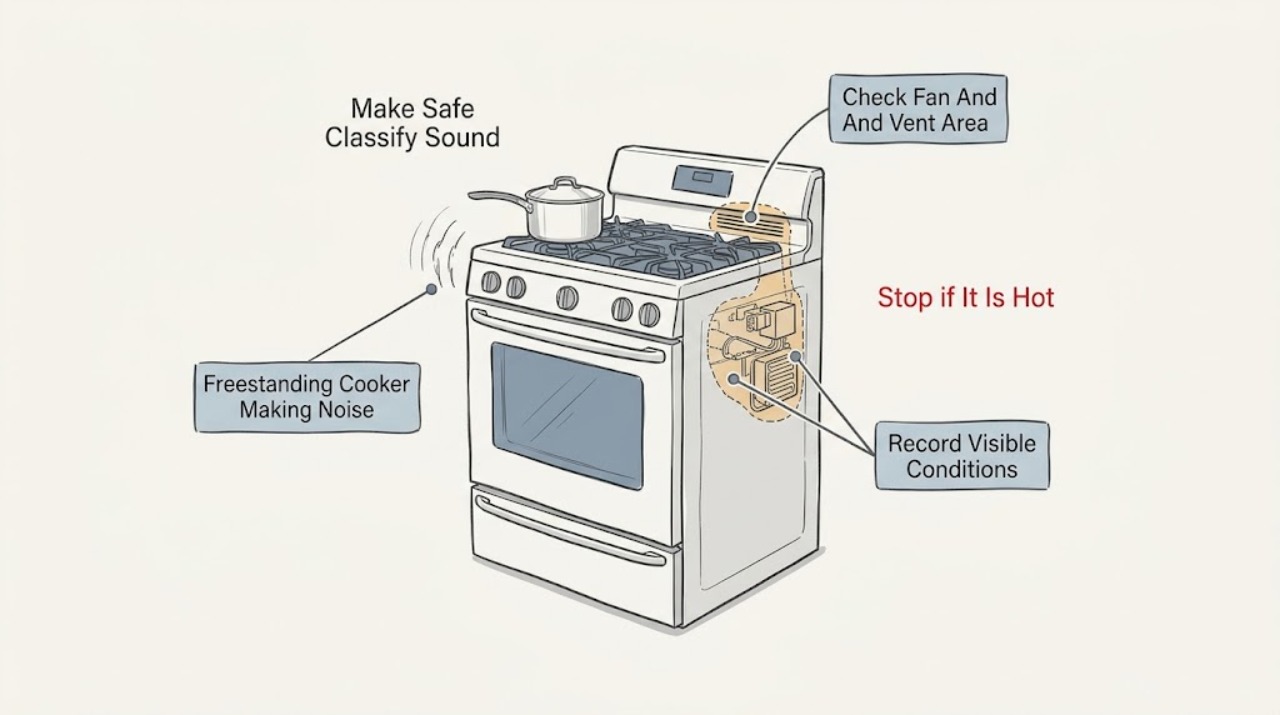
First identify the cooker type and when the sound occurs: a fan during or after oven use, a relay or temperature-control click, metal popping as the appliance heats or cools, and short gas ignition clicks can be normal on suitable models. Continuous clicking after ignition, grinding or scraping, a loud electrical buzz, repeated arcing, an abnormal flame, smoke, a burning or gas odor, a hot control area, or a circuit trip is not a normal operating sound. Turn controls off, keep away from hot surfaces, and isolate energy only from a dry safe position when appropriate. Do not open the cooker, defeat a door or flame safety, adjust gas pressure, or keep testing an appliance that shows a fire, gas, or electrical warning.
Work through in order
Diagnostic checks
Use only checks that match the exact appliance or system and its official guide.
-
Check 1
Turn all controls off and identify the sound without touching the hot appliance: note whether it is a fan, click, hum, pop, hiss, buzz, scrape, grind, impact, or continuous ignition sound. Record whether it comes from the oven, cooktop, control area, rear, or beneath the cooker, and whether smoke, odor, flame trouble, heat, or a trip is present.
Expected result: The sound is a short click, fan, or heat-related pop with no hazard, or it is continuous, harsh, electrical, mechanical, or paired with a safety warning.
Next step: Follow the relevant sound and cooker-type branch below. For smoke, gas or burning odor, arcing, scorching, melting, abnormal flame, or a trip, isolate energy only from a dry safe position when appropriate and arrange urgent qualified help.
Stop if: Stop for smoke, fire, gas odor, burning odor, sparks, arcing, a circuit trip, a hot control or supply, a cracked surface, or an unextinguishable flame.
Why this matters
Why: Timing and sound character can separate normal control, fan, ignition, and metal movement from a fault. A warning sign overrides any normal-sound explanation.
-
Check 2
After the cooker is cool, record the model, fuel or heating type, control setting, oven mode, and exact stage when the noise starts: knob movement, burner ignition, preheat, baking, convection, hob use, cooling, or switch-off. Note whether the sound stops when the control is turned off or continues afterward.
Expected result: The sound occurs only during a mode, at each heat cycle, only during ignition, throughout cooling, or while every control is off.
Next step: Use the exact manual to interpret the mode and sound. Do not repeat a cycle solely to obtain a recording if any hazard or abnormal heat is present.
Stop if: Stop for continuous clicking, a buzz with heat, grinding or impact, smoke, gas odor, burning smell, sparks, a trip, or controls that do not stop the appliance.
Why this matters
Why: A stage-specific sound may match a fan, relay, burner ignition, or heat expansion described for the model. A sound that continues with controls off, worsens, or does not fit the manual needs service.
-
Check 3
With the cooker cool and off, inspect only accessible oven vents, cooling-air openings, and the area around the control panel for objects, grease, or cookware blocking airflow. Do not insert tools, remove a fan cover, or obstruct a vent to change the sound. On an induction model, compare fan behavior with the exact manual.
Expected result: A vent or opening is blocked, a fan runs during or after heat, the fan sounds rough or scrapes, or airflow and sound appear normal for the model.
Next step: Remove only a loose external obstruction after cooling. If the fan remains rough, the controls become hot, the appliance overheats, or the sound continues abnormally, keep it off and request service.
Stop if: Stop for smoke, burning odor, abnormal cabinet heat, melting, a fan that contacts something, sparks, arcing, a trip, or any need to open the fan or control area.
Why this matters
Why: Fans may run or cycle to move cooking air or cool electronics, including after switch-off. A blocked path can increase heat, while a rough or scraping fan sound can indicate a mechanical issue.
-
Check 4
Once all surfaces are cool, inspect cookware placement, pan size, grates, racks, and removable trays for rocking, contact, or loose objects. On induction, use a suitable centered pan; on gas, center the pan over the correct burner. Do not leave empty cookware on a hot zone or move a pan while it is hot just to reproduce a noise.
Expected result: A pan, grate, rack, or tray is loose, warped, oversized, off-center, or touching a control or vent; or the cookware and removable parts are stable.
Next step: Correct only cool, visible placement under the model guide. If the noise persists without a loose external item, keep the cooker off and arrange qualified service.
Stop if: Stop for cracked glass, a pan or grate that may tip, oil or food smoke, abnormal heat, a sharp scrape or impact, sparks, or any need to reach into a hot or energized area.
Why this matters
Why: Cookware and metal can vibrate, transfer heat, or tick as they expand and contract. A stable setup with a new scrape, grind, electrical buzz, or impact sound points away from ordinary cookware movement.
-
Check 5
For a gas hob or gas oven only, after the burner is cool, inspect visible burner caps, bases, and ports for correct matching, seating, moisture, or spill residue. During normal attended use and only without gas odor, observe whether a brief ignition click ends after the flame is established and whether the flame is stable. Do not adjust gas pressure, enlarge ports, loosen fittings, or keep igniting a burner that misbehaves.
Expected result: The cap is wet or displaced, ports appear obstructed, clicking continues, the flame is yellow, noisy, uneven, too high, or the burner remains on after OFF.
Next step: Let visible removable parts dry and follow the exact manual for placement and cleaning. For persistent abnormal flame or clicking, conversion concern, gas odor, delayed ignition, or failure to extinguish, leave the area and arrange qualified gas service or emergency help.
Stop if: Stop for gas odor, flame outside the burner, delayed ignition, loud popping, unstable flame, continuous clicking, smoke, or any gas-line or pressure work.
Why this matters
Why: Whirlpool identifies cap seating, port condition, moisture, fuel type, and conversion as causes of abnormal flame behavior. Continuous ignition, delayed ignition, gas odor, or a burner that will not extinguish is a gas safety event.
-
Check 6
For an electric, induction, or dual-fuel cooker, when cool and safely isolated, inspect only the accessible plug, socket, switch, cord, and nearby cabinet for burn marks, discoloration, melted plastic, moisture, or a hot electrical smell. Do not remove a hardwired cover, test live conductors, reset protection repeatedly, or use an extension lead.
Expected result: There is visible supply damage or heat, the breaker or RCD trips, water is near electrical parts, or the accessible supply appears normal.
Next step: Leave a damaged or wet supply disconnected and arrange a registered electrician or qualified appliance technician. Do not energize the cooker again solely to compare outlets or reproduce the noise.
Stop if: Stop for scorch marks, arcing, a hot or wet socket, melting, exposed conductors, smoke, sparks, a repeated trip, or any need to open a hardwired or live area.
Why this matters
Why: A localized electrical buzz or supply heat can indicate a dangerous connection, overload, appliance fault, or installation problem. A normal visual check does not clear an internal element, relay, sensor, or power module.
-
Check 7
Only when the cooker is cool, dry, correctly installed, free of visible damage, and without any hazard sign, decide whether one short attended, model-approved check is appropriate. Stop as soon as the original noise returns or any heat, odor, flame, smoke, spark, trip, or control problem appears; skip the check when the sound was electrical, mechanical, or gas-related and abnormal.
Expected result: The sound matches the model's normal fan, click, ignition, or metal movement, the original abnormal sound returns, or a safety symptom appears.
Next step: Keep the cooker out of service for any recurrence and arrange qualified repair. Provide the model, type, sound, stage, setting, zone or burner, and every safe observation.
Stop if: Stop immediately for smoke, gas or burning odor, flame trouble, sparks, arcing, melting, abnormal heat, cracked glass, or a circuit trip.
Why this matters
Why: A normal brief check does not certify the cooker. A repeatable abnormal sound helps service locate a fan, relay, element, burner, drive, control, or supply issue; a safety symptom makes further operation unsafe.
Use your observations
Decision map
Find the observation that best matches what you see, then follow the next safe action.
-
PATH 01Next step
What you see
There is smoke, fire, gas odor, arcing, crackling, scorching, melting, a repeated trip, cracked glass, or a burner or zone cannot be turned off.
Do this next
Arrange qualified service and follow the exact model guidance.
Why this path and its safety boundary
Why it matters: Stop cooking and do not touch the hot appliance. From a dry safe position isolate energy when appropriate, keep clear, and use emergency or qualified electrical, gas, or appliance help; do not re-ignite or re-energize for a test.
-
PATH 02Next step
What you see
A fan runs during convection or oven use, cycles with the mode, or continues after switch-off while the appliance cools and no hazard is present.
Do this next
Arrange qualified service and follow the exact model guidance.
Why this path and its safety boundary
Why it matters: Compare the fan behavior with the exact manual. Keep vents clear and allow the appliance to cool; a rough, scraping, worsening, or heat-associated fan sound needs service.
-
PATH 03Next step
What you see
Short clicks occur as temperature controls or elements cycle, or crackling and popping occur while metal heats or cools without smoke or electrical signs.
Do this next
Arrange qualified service and follow the exact model guidance.
Why this path and its safety boundary
Why it matters: Treat the sound as potentially normal for that model, keep the appliance attended, and follow the manual. A new loud click, scrape, buzz, or sound that continues with controls off needs service.
-
PATH 04Next step
What you see
A gas burner clicks briefly during ignition and the flame establishes normally, or the clicking continues with an uneven, yellow, noisy, or delayed flame.
Do this next
Arrange qualified service and follow the exact model guidance.
Why this path and its safety boundary
Why it matters: For normal ignition, use the model procedure. For continuous clicking or abnormal flame, turn the burner off when safe and check only cool, visible cap, port, and moisture conditions; gas odor, delayed ignition, or failure to extinguish needs urgent qualified help.
-
PATH 05Next step
What you see
The sound is scraping, grinding, rubbing, rattling, or impact from the fan, rack, tray, grate, or another moving or vibrating area.
Do this next
Arrange qualified service and follow the exact model guidance.
Why this path and its safety boundary
Why it matters: Keep the cooker off and cool. Remove only a loose visible external item; do not run the appliance with a contact, seized fan, loose component, or worsening sound. Arrange qualified repair if the source is not obvious and safe.
-
PATH 06Next step
What you see
A loud buzz, crackle, or click comes from the control or supply area, especially with a hot plug or socket, scorch marks, sparks, or a circuit trip.
Do this next
Arrange qualified service and follow the exact model guidance.
Why this path and its safety boundary
Why it matters: Do not reconnect or reset protection repeatedly. Isolate energy only from a dry safe position and arrange a registered electrician or qualified appliance technician; do not open the control or supply area.
-
PATH 07Next step
What you see
The sound remains unexplained, returns after a safe external review, or the cooker type, manual, or sound stage is uncertain.
Do this next
Arrange qualified service and follow the exact model guidance.
Why this path and its safety boundary
Why it matters: Keep the cooker out of service and provide the model, fuel type, mode, setting, sound description, location, duration, and safety symptoms to qualified repair. Do not guess at a fan, relay, element, igniter, burner, or control replacement.
Helpful context
Understand the symptom
Make the noise safe before identifying it
Turn every burner, oven, and grill control off and keep hands away from hot grates, glass, cookware, vents, and the oven opening. A short click during temperature control or ignition may be expected, but a sound paired with smoke, a gas odor, arcing, scorching, melting, an abnormal flame, or a trip is an immediate stop condition. Do not reach behind the cooker or remove a panel while it is energized or hot.
When the sound happens changes its meaning
A fan that runs during or after cooking, a relay click as heat cycles, and metal ticking while the appliance warms or cools may be normal. A gas igniter can click while a burner lights, whereas continuous clicking after a flame is established may indicate a wet or misaligned burner or a fault. A scraping, grinding, impact, or electrical buzz that is new, loud, or worsening needs service rather than a longer test.
Separate gas, electric, dual-fuel, and induction paths
A freestanding cooker may combine a gas hob with an electric oven, or may use radiant electric or induction zones. Read the model manual before interpreting fans, relay clicks, hot-surface indicators, or ignition. Inspect only cool, accessible parts such as burner caps, visible vents, and cookware placement. Do not adjust gas pressure, probe wiring, or bypass an interlock.
Stop at the first safety change
If the same noise returns with smoke, a gas or burning odor, flame trouble, a hot control or plug, arcing, a trip, or a cracked surface, stop using the cooker. Give qualified service the model, fuel type, sound, stage, control setting, and any visible damage.
Safety boundary
Stop conditions
- Smoke, fire, gas odor, delayed ignition, an abnormal or unextinguishable flame, sparks, arcing, crackling, scorching, or melting.
- A circuit breaker or RCD trips, a plug, socket, cord, switch, control area, or cabinet becomes unusually hot, or water reaches electrical parts.
- A zone or burner remains energized after OFF, a control fails, a fan scrapes, or a mechanical sound worsens or is accompanied by heat.
- Cracked glass, unstable cookware or grates, grease smoke, a severe impact sound, or any need to reach into a hot appliance.
- Any need to remove the cooker, open a hardwired supply or control panel, adjust gas pressure, alter a burner fitting, or bypass a safety device.
- The noise returns after one safe external review or its source cannot be identified from the model guide.
Only after diagnosis
Potential parts
- oven or cooktop cooling fan
Consider this category only when the exact model guide and qualified diagnosis link a persistent rough or failed fan sound to the cooling system.
Confirm the complete model, fan location, voltage, and safe service procedure before selecting a component. - temperature control or relay
Consider this category only when a qualified diagnosis identifies a control or relay that is clicking abnormally, remaining energized, or failing to switch heat safely.
Confirm the exact model, control configuration, electrical rating, and qualified installation requirements. - gas burner cap or ignition component
Consider this category only when a gas model inspection and qualified diagnosis confirm a damaged visible cap or failed ignition component after gas safety checks.
Confirm the model, burner position, fuel type, and safe gas service procedure; do not select a component from appearance alone.
When checks do not resolve it
Need a professional?
The sound is continuous, new, loud, scraping, grinding, impact-like, electrical, or paired with smoke, odor, sparks, heat, or a trip., A gas burner clicks without settling, has an abnormal flame, smells of gas, ignites late, or will not turn off., A fan runs roughly, a control area overheats, a cooling path is blocked, or the cooker shuts down unexpectedly., A radiant, induction, or electric control or zone behaves unpredictably, heats while off, or has a persistent indicator fault., Diagnosis would require internal electrical, gas, element, relay, igniter, fan, sensor, or hardwired access.
Common questions
FAQ
Why does my freestanding cooker click while it is on?
Temperature controls and heating elements can click as they cycle, and gas igniters can click briefly while a burner lights. If clicking continues after ignition, becomes loud or electrical, occurs with a flame problem, smoke, odor, sparks, or a trip, turn the controls off and arrange qualified service.
Is a cooker fan running after switch-off normal?
On many electric, dual-fuel, and induction models, a convection or cooling fan can run during cooking and after switch-off while the appliance cools. Compare the sound and duration with the exact manual. A rough, scraping, hot, smoky, or worsening fan needs service.
What causes popping or crackling from an oven?
GE describes some crackling and popping as metal expanding and contracting during heating and cooling. A sudden explosive sound, flame, smoke, burning odor, arcing, or damage is not a normal expansion sound; stop using the cooker and seek qualified help.
Why does a gas burner keep clicking or make a strange sound?
A wet or poorly seated cap, obstructed port, incorrect cap, fuel or conversion issue can affect flame and ignition behavior. Let cool, inspect only visible cap and port condition, and follow the model guide. Gas odor, delayed ignition, an unstable flame, or failure to turn off requires urgent qualified gas help.
When is a cooker noise unsafe?
Stop for smoke, fire, gas or burning odor, arcing, crackling at the supply, a hot control or socket, repeated trips, an abnormal flame, a zone that will not turn off, cracked glass, grinding, or severe impact noise. Isolate energy only from a dry safe position when appropriate and arrange emergency or qualified repair.
Read the exact guide
Official sources
- Electrical Safety Advice for the KitchenElectrical Safety First · Kitchen electrical appliance wet-surface, heat, arcing, breaker, fire, and qualified repair safety guidance
- Range & Wall Oven - Clicking and Other NoisesGE Appliances · Range and oven relay clicks, burner cycling, fan sounds, and metal expansion or contraction noises
- Gas Burner Flame Level IncorrectWhirlpool · Gas cooktop abnormal flame and burner sound checks for ports, caps, moisture, fuel, and conversion
- Range & Wall Oven - Fan Noise and Normal OperationGE Appliances · Range and oven convection fan cycling, cooling fan operation, after-run behavior, and fuel-type model differences
- Fan Noise - Induction Range - Product Help | WhirlpoolWhirlpool · Induction range fan speed changes, temperature control, and normal post-use fan operation
- Lighting the Burners - Electronic IgnitionWhirlpool · Gas cooktop electronic ignition clicks, burner-cap placement, and normal lighting sequence
- Range & Wall Oven - Normal Sounds During UseGE Appliances · Range and oven normal temperature-control clicks, burner clicks, fan sounds, and metal heating or cooling sounds
Community feedback
Share a repair observation
Share a plain-text repair observation. Accepted observations are published automatically; this page may take a moment to update.