
On this page
Start here
Quick answer
A freestanding cooker that is not heating needs to be split by fuel type and by area: the oven, a gas burner, an electric hob, or an induction zone. First record whether the display and other zones have power, then confirm the correct mode, temperature, clock, lock, demo mode, and delayed-start state. On an electric or dual-fuel cooker, a supply or installation fault can leave controls lit while heating is unavailable; on a gas cooker, the oven may use electric ignition and still need power. For induction, confirm that the cookware is magnetic, flat, centered, and suitable for the zone. A gas odor, delayed ignition, abnormal flame, smoke, burning smell, arcing, cracked glass, liquid near electrics, abnormal heat, or repeated breaker trip means stop using the cooker and arrange appropriate emergency or qualified service. Do not open the terminal block, burner, control panel, or heating assembly, and do not choose an element, igniter, valve, sensor, or board until the exact model and measured service diagnosis support it.
Before you begin
Safety first
- This article supports model/fuel/area identification, display and setting observations, accessible supply observations, safe cookware placement, and one attended normal attempt only when hazard-free. Do not access live wiring, terminal blocks, gas connections, burners, igniters, valves, elements, sensors, control boards, or hot/cracked glass.
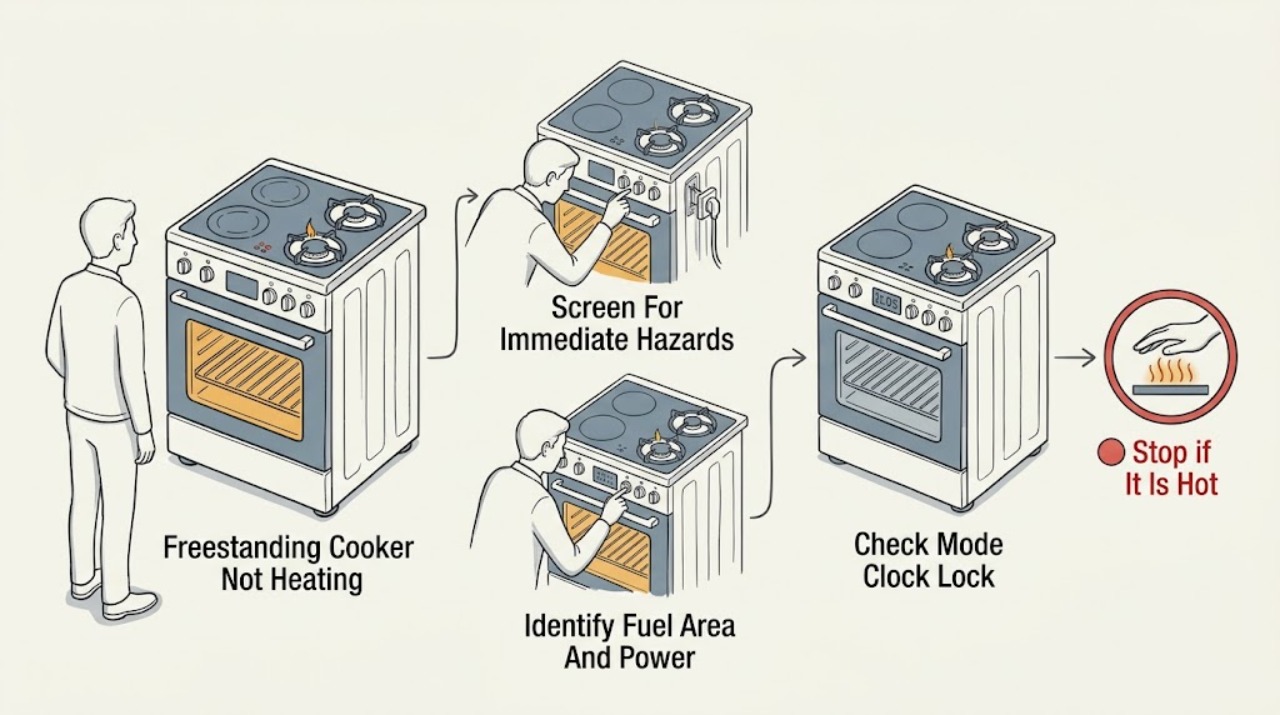
Work through in order
Diagnostic checks
Use only checks that match the exact appliance or system and its official guide.
-
Check 1
Turn the affected controls off and observe from a safe position for gas odor, flame outside the burner, delayed whoosh, smoke, burning smell, arcing, cracked or wet glass, a hot/damaged cord, liquid near electrics, or severe abnormal heat.
Expected result: Record whether the problem is confined to the oven, one hob zone, all heating areas, or the whole cooker, and whether any gas, fire, electrical, glass, or heat hazard is present.
Next step: For gas odor, smoke, sparks, arcing, a cracked hot surface, or uncontrolled heat, avoid flames and unsafe switching, leave the area if needed, and contact appropriate emergency, gas, electrical, or appliance help from safety. Otherwise record the cooker identity and fuel type.
Stop if: Do not relight, open the oven or burner area, touch wet controls or damaged glass, or continue heating with gas odor, delayed ignition, abnormal flame, smoke, arcing, or abnormal heat.
Why this matters
Why: A hazard symptom changes this from a no-heat check to an immediate safety escalation. A cooker with no hazard can proceed only through ordinary external observations.
-
Check 2
Read the rating label and controls to identify gas, electric, dual-fuel, or induction operation, then compare the affected area with the display, clock, lights, fans, and any other zone; inspect only the accessible plug, isolator, or breaker without opening the cooker.
Expected result: Record whether the display is blank, whether other burners or zones heat, whether the oven light/fan works, whether the cooker is newly installed, and whether a breaker or isolator is off or trips again.
Next step: If the supply is absent, the installation is uncertain, or a breaker trips again, leave the cooker off and arrange qualified electrical/service help. If controls work and no hazard is present, continue by area and fuel type.
Stop if: Do not measure live voltage, remove an isolator or terminal cover, use an extension cord, bypass a fuse, or repeatedly reset a breaker.
Why this matters
Why: A whole-cooker power symptom points toward supply or installation. A single cold zone with working controls points toward that zone's setting, detection, ignition, element, or internal circuit. Gas heat does not remove the need for electrical power on many models.
-
Check 3
Use the exact model manual to confirm the intended oven mode and temperature or hob setting, the clock, Control Lock/Demo Mode state, delayed start, and any separate Start or zone-selection control.
Expected result: Record whether the display shows the selected mode, temperature, lock/demo indicator, delay time, error, or active heating indicator, and whether the wrong mode affects only one area or the whole cooker.
Next step: Cancel an unintended delay or demo state and set the clock or mode only as the manual documents, then make one attended normal attempt. If heating does not begin or the state returns, stop and arrange service.
Stop if: Do not use undocumented key combinations, bypass a lock or door interlock, or continue if the cooker heats without a valid command or will not stop normally.
Why this matters
Why: Manufacturer support identifies a locked or demo control and delayed start as reasons an oven can be powered but not heat. A mode or clock error can also prevent a valid heat request without proving an element, igniter, or valve failure.
-
Check 4
For a gas cooker with no hazard, identify whether the affected area is an oven or surface burner and follow only the normal user-facing ignition sequence in the exact manual; observe through the designed viewing path without removing burner parts.
Expected result: Record whether the igniter clicks or glows, whether the burner lights promptly and remains stable, whether the cooktop works while the oven does not, and whether there is a delayed ignition, yellow/lifting flame, smoke, or gas odor.
Next step: Turn the control off after one normal attempt. With no hazard, report the timing and visible ignition behavior to a qualified appliance technician; with odor, delayed ignition, flare-up, or abnormal flame, leave the area if needed and use emergency gas guidance.
Stop if: Do not manually light an electric-ignition oven, hold a gas control open, relight repeatedly, adjust gas pressure or air shutters, loosen gas connections, or open the burner area.
Why this matters
Why: A working surface burner does not prove the oven ignition path is sound. A silent ignition path, spark/glow without flame, delayed light, or abnormal flame can involve supply, ignition, burner, valve, or control conditions and cannot select a part by itself.
-
Check 5
For an electric or induction cooker, identify whether the oven element, electric hob zone, or induction zone is cold; for induction, place only cookware that the exact manual accepts, with a flat magnetic base centered on the zone, and check for a pan/error indicator.
Expected result: Record whether other zones heat, whether an element glows or the oven begins preheating, whether the induction display recognizes the pan, and whether cookware, zone size, power sharing, glass, or an overheat message is involved.
Next step: Correct only an unsuitable pan, position, or documented setting and make one attended attempt. If a suitable pan remains undetected, an element stays cold, glass is damaged, or the error returns, turn it off and arrange service.
Stop if: Do not use cracked glass, place metal objects on an active induction surface, touch a hot element, open the cooktop, or continue after arcing, smoke, liquid, abnormal heat, or repeated trips.
Why this matters
Why: A single cold electric zone may have a zone-specific control or heating fault. An induction zone that does not detect suitable cookware may be operating normally; a whole-surface failure or error after suitable cookware and settings points to service.
-
Check 6
After documenting the model, fuel, area, settings, and symptom, make one attended normal heating attempt only when the cooker is dry, cool where appropriate, and free of hazards; then turn it off and decide whether service is required.
Expected result: Record whether the correct area heats and cycles normally, remains cold, heats unevenly, produces an ignition delay, shows an error, trips power, or develops an odor, smoke, flame, or abnormal heat condition.
Next step: Arrange qualified appliance service, a qualified electrician for supply faults, or a qualified gas professional for gas supply/ignition concerns. Provide the model, fuel type, affected area, controls, timing, and hazard observations.
Stop if: Do not perform additional test cycles, open the cooker, access wiring or gas parts, or continue after gas odor, delayed ignition, smoke, burning smell, arcing, cracked glass, abnormal heat, or repeated tripping.
Why this matters
Why: A normal result after correcting a setting or cookware condition supports an external cause. A persistent cold zone, failed ignition, uneven heating, error, or safety symptom requires model-specific diagnosis.
Use your observations
Decision map
Find the observation that best matches what you see, then follow the next safe action.
-
PATH 01Safety boundary
What you see
Gas odor, delayed ignition, abnormal flame, smoke, burning smell, arcing, cracked hot glass, liquid near electrics, abnormal heat, or repeated breaker trip is present.
Do this next
Turn controls off only if safe, avoid flame and unsafe switching, leave the area if needed, and contact appropriate emergency gas, fire, electrical, or qualified appliance help from safety.
Why this path and its safety boundary
Why it matters: This is a gas, fire, glass, or electrical safety event, not an ordinary no-heat diagnosis.
Safety stop: Do not relight, open the oven, touch wet/damaged parts, or run another heating cycle.
-
PATH 02Safety boundary
What you see
The display and heating areas are dead, the cooker is newly installed, or an accessible breaker/isolator is off or trips again.
Do this next
Leave the cooker off and arrange qualified electrical or appliance service to verify the installation and supply.
Why this path and its safety boundary
Why it matters: Supply, connection, or installation may be preventing heating; internal wiring cannot be safely diagnosed from the front.
Safety stop: Do not open the terminal block, probe live wiring, use an extension cord, or repeatedly reset the breaker.
-
PATH 03Safety boundary
What you see
The display works, but the oven or zone is not heating and shows a lock, demo, delayed-start, wrong-mode, clock, or incomplete-command state.
Do this next
Use the exact manual to correct the documented setting, then make one attended normal attempt.
Why this path and its safety boundary
Why it matters: The cooker may not have received a valid heating request; this does not prove a failed element, igniter, or control.
Safety stop: Do not bypass a lock, use an undocumented sequence, or continue if the cooker heats without a valid command or will not stop.
-
PATH 04Safety boundary
What you see
A gas oven or burner has power and a valid setting but no normal ignition, a signal without flame, delayed ignition, or an abnormal flame.
Do this next
Turn the control off after one normal attempt and arrange qualified gas/appliance service. Treat odor, delay, flare-up, yellow/lifting flame, or smoke as an immediate safety escalation.
Why this path and its safety boundary
Why it matters: Gas supply, igniter/spark, burner, valve, airflow, or control conditions may be involved; the observation cannot select a part safely.
Safety stop: Do not manually relight, hold a gas control open, adjust gas parts, or repeat failed ignition.
-
PATH 05Safety boundary
What you see
An electric element, oven, or induction zone is cold while controls work and no hazard is present.
Do this next
Check one documented setting and suitable cookware/position where applicable. If the zone remains cold or an error returns, request service.
Why this path and its safety boundary
Why it matters: A zone-specific element/control fault or, for induction, cookware detection, positioning, power-sharing, or protection state may be involved.
Safety stop: Do not use cracked glass, touch hot elements, place unsuitable objects on an active zone, open the cooktop, or continue after arcing, smoke, liquid, or abnormal heat.
Helpful context
Understand the symptom
Identify the heated area and fuel before troubleshooting
A freestanding cooker may combine a gas hob with an electric oven, or use gas, electric resistance, or induction throughout. A cold oven with a working hob is not the same diagnosis as one dead zone on an induction surface. Record the rating label, fuel type, exact area affected, display state, and control labels before using a model manual.
Controls can look normal while a setting prevents heat
Control Lock, Demo Mode, Delayed Start, an unset clock, or a mode that does not energize the expected element can make an otherwise powered cooker appear not to heat. Manufacturer support treats these as model-dependent settings. Correct only the state documented for the exact model, then make one attended normal attempt.
Gas ignition and induction detection need different evidence
A gas oven may require an electric igniter even though its heat source is gas. A gas odor or delayed ignition is a stop condition. An induction zone can remain cold when the pan is not magnetic, flat, centered, or recognized. Do not transfer a gas-burner check to an electric or induction cooker, or vice versa.
Safety boundary
Stop conditions
- Stop immediately for gas odor, delayed ignition, flare-up, abnormal flame, smoke, burning smell, arcing, cracked hot glass, liquid near electrics, abnormal heat, or repeated breaker trips.
- Do not manually light an electric-ignition oven, hold a gas control open, adjust gas pressure/air shutters, loosen gas connections, or relight repeatedly.
- Do not open the terminal, control, burner, element, or cooktop area; do not probe live wiring or bypass a door, lock, thermal, gas, or electrical safety device.
- Do not use an extension cord, operate an induction zone with cracked glass, touch a hot element, or place unsuitable metal objects on an active induction surface.
- Arrange qualified service when the cooker stays cold after one correct model-specific attempt, a code returns, a zone behaves differently from the manual, or the fuel type/installation is uncertain.
When checks do not resolve it
Need a professional?
Arrange qualified appliance service when a freestanding cooker remains cold after one exact-manual setting check, a single zone fails while others work, a gas ignition signal produces no flame, an induction zone does not recognize suitable cookware, or an error returns. Use a qualified electrician for supply, isolator, breaker, or installation faults and a qualified gas professional for gas supply, flame, valve, or delayed-ignition concerns. Treat gas odor, smoke, arcing, cracked hot glass, burning smell, abnormal heat, and repeated trips as immediate safety escalations.
Safety scope: This article supports model/fuel/area identification, display and setting observations, accessible supply observations, safe cookware placement, and one attended normal attempt only when hazard-free. Do not access live wiring, terminal blocks, gas connections, burners, igniters, valves, elements, sensors, control boards, or hot/cracked glass.
Common questions
FAQ
Why is only one part of my freestanding cooker not heating?
First identify whether the cold area is the oven, a gas burner, an electric zone, or an induction zone. If controls and other areas work, check one model-documented mode, clock, lock/demo, delayed-start, gas-ignition, or cookware condition as applicable. A persistent single-zone failure needs qualified service rather than a guessed element, igniter, valve, or board.
Can a freestanding cooker have power but still not heat?
Yes. A locked or demo control, delayed start, wrong mode, installation fault, zone-specific heating fault, or induction cookware-detection state can leave the display active while heat is unavailable. Use the exact model manual and do not open the terminal or control area.
What should I do if a gas oven does not ignite?
Do not keep retrying. Confirm only the model and ordinary control state when there is no odor or abnormal flame. Turn the control off after one normal attempt; gas odor, delayed ignition, a flare-up, smoke, or an abnormal flame requires leaving the area if needed and contacting appropriate emergency gas or qualified service help.
Why is my induction cooker not heating the pan?
An induction zone may not heat if the pan is not magnetic, flat, centered, large enough for the zone, or recognized by the model. Use only cookware and placement described by the exact manual. If suitable cookware remains undetected, or the glass is cracked or the zone arcs, stop and arrange service.
When should I stop troubleshooting a cooker that is not heating?
Stop for gas odor, delayed ignition, abnormal flame, smoke, burning smell, arcing, cracked hot glass, liquid near electrical parts, abnormal heat, or repeated breaker trips. Do not relight, open panels, touch live or hot parts, bypass safety devices, or keep resetting power. Give the technician the model, fuel type, affected area, settings, and exact symptom sequence.
Read the exact guide
Official sources
- Samsung Range FAQsSamsung US · Cross-manufacturer reference for distinct range technologies; use the exact cooker manual for controls and procedures.
- GAS RANGE DELAYED IGNITIONS Tests and Examinations of RangesU.S. Consumer Product Safety Commission · General safety research, not a cooker-specific diagnosis or repair procedure.
- Oven Not Heating - Powering On - Electric Range - Product HelpWhirlpool Product Help · Electric Whirlpool-family support reference; it does not define behavior for every freestanding cooker or gas/induction model.
Community feedback
Share a repair observation
Share a plain-text repair observation. Accepted observations are published automatically; this page may take a moment to update.