
On this page
Start here
Quick answer
Treat any gas smell from or near a Frigidaire gas dryer as a possible leak or unsafe combustion condition, not as a normal dryer odor. Do not start or restart the dryer, operate lights or switches, use a phone inside, light a match, smoke, move the appliance, or investigate the connector. Leave the building immediately, warn others without creating an ignition source, and call the gas supplier or emergency services from a safe location. Do not re-enter until the responsible utility or emergency professional says it is safe. If anyone has headache, dizziness, nausea, weakness, confusion, or breathing trouble, get to fresh air and seek emergency medical help. After the area is cleared, record the Frigidaire model and fuel type without moving the unit, then use the exact installation or owner guide and qualified appliance service; do not resume operation merely because the odor faded.
Before you begin
Safety first
- This article supports evacuation, safe-location reporting, documentation, and professional handoff only. Do not operate the dryer, move it, inspect or flex the connector, open panels, perform a leak test, or alter gas or combustion components.
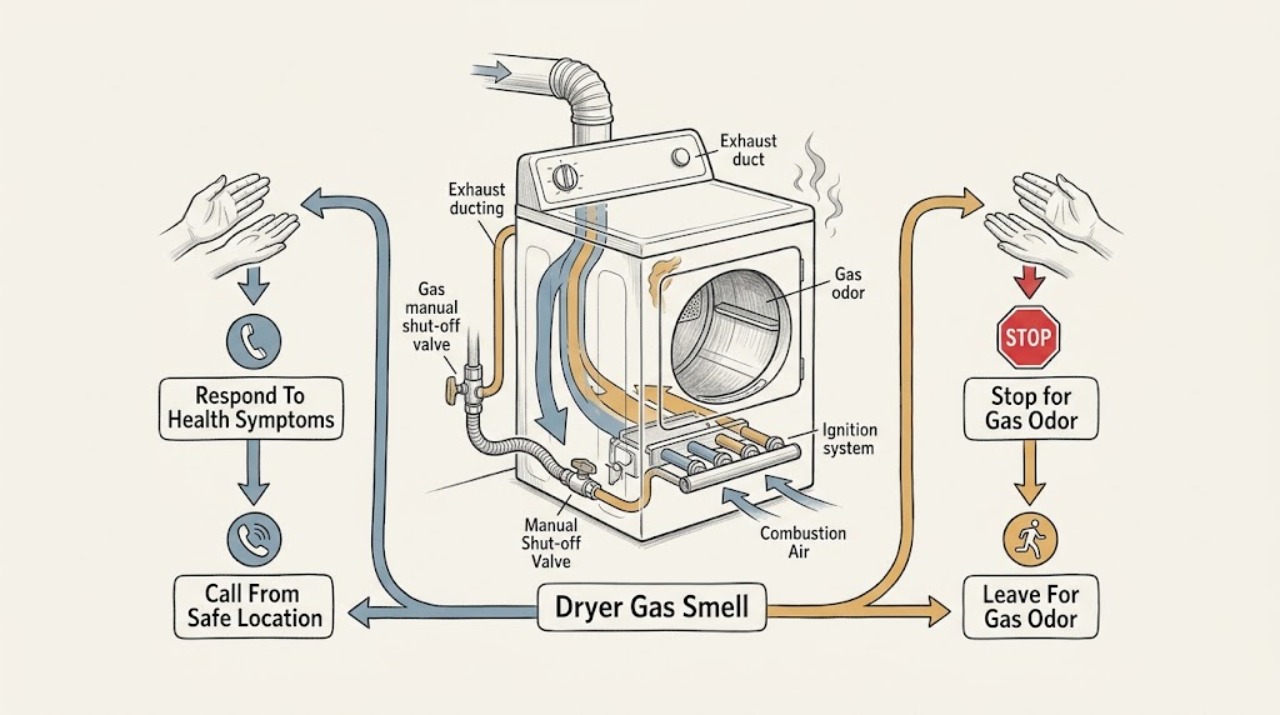
Work through in order
Diagnostic checks
Use only checks that match the exact appliance or system and its official guide.
-
Check 1
If gas is smelled near the Frigidaire dryer or anywhere in the building, stop using the appliance and leave immediately with everyone and pets, without operating lights, switches, appliances, matches, lighters, or a phone inside.
Expected result: From outside, record whether the odor is strong or faint, whether anyone hears escaping gas, and whether smoke, flame, or symptoms are present; do not go back inside to investigate these details.
Next step: Warn others from a safe location and contact the gas supplier or emergency services from outside or a neighbor's location; wait for their instructions.
Stop if: Do not re-enter to shut off the dryer, unplug it, close a valve, open windows, find the connector, or retrieve items.
Why this matters
Why: Any odor or sound consistent with escaping gas is sufficient to treat the space as unsafe. Odor strength and whether the dryer is running do not prove that a leak is absent.
-
Check 2
From outside the building or another safe location, report the gas odor and appliance location to the gas supplier or emergency services; tell them whether the odor continues outside, anyone is symptomatic, and whether the appliance was recently moved or serviced.
Expected result: Record the time of the call, the instructions received, and whether the responding professional cleared the building or required evacuation and inspection.
Next step: Follow the responder's evacuation, medical, and re-entry instructions; request qualified gas-appliance inspection before using the dryer again.
Stop if: Do not return or restart the dryer until the responsible professional explicitly says it is safe.
Why this matters
Why: The utility or emergency responder determines whether the building, supply, or appliance can be approached. A fading odor, a failed call, or a dryer that appears normal does not provide clearance.
-
Check 3
If anyone develops headache, dizziness, nausea, weakness, confusion, breathing trouble, or feels unwell after being near the gas dryer, move to fresh air and seek emergency medical assistance from a safe location.
Expected result: Tell responders who was exposed, when symptoms began, whether a carbon-monoxide alarm sounded, and whether symptoms improve outdoors; do not re-enter to retrieve an alarm or inspect the appliance.
Next step: Follow emergency medical and fire or utility instructions, and keep the building evacuated until cleared.
Stop if: Do not use fans, switches, phones, or fuel-burning equipment inside as a self-directed ventilation or diagnostic step.
Why this matters
Why: Illness can indicate a dangerous exposure or another emergency and cannot be distinguished safely at the dryer. A lack of symptoms does not clear the gas system.
-
Check 4
Only after the utility or emergency professional clears the area, collect the Frigidaire model and serial information from its normal accessible label and write down the fuel type, odor timing, cycle state, recent installation or movement, and any prior service without moving the dryer or removing covers.
Expected result: Record whether the odor occurred before ignition, during heat, after shutdown, when the appliance was idle, or only after recent movement or service; note whether the technician found a building or appliance issue.
Next step: Give the exact identity and history to Frigidaire support or a qualified gas-appliance technician and request model-specific inspection before operation.
Stop if: Do not move the dryer, inspect or flex the gas connector, remove a panel, or attempt a leak test even after the odor has stopped.
Why this matters
Why: Timing and installation history help qualified service distinguish a supply or connector concern from a burner, ignition, exhaust, or combustion-air concern, but they do not identify a safe owner repair.
-
Check 5
Ask the responding utility, fire professional, or qualified appliance technician to state whether the building and dryer are cleared separately, and whether the gas supply, connector, shutoff, burner, ignition, combustion air, and exhaust require inspection or repair.
Expected result: Record which party inspected what, whether a leak or combustion issue was found, what repair or replacement was required, and whether written or model-specific operating instructions were provided.
Next step: Keep the dryer off until appliance-specific clearance is given; follow the technician's repair and re-test instructions exactly.
Stop if: Do not treat a normal-looking flame, a quiet burner, or a cleared room as proof of safe operation without qualified inspection.
Why this matters
Why: Building clearance does not necessarily establish that the appliance is safe to operate. A dryer may remain out of service until its gas and exhaust installation is inspected and repaired.
-
Check 6
After qualified inspection and repair, provide the technician's findings and the exact Frigidaire guide to anyone responsible for the first supervised operating test; do not run an independent empty cycle to see whether the smell returns.
Expected result: Record whether the technician's supervised test has no odor, no alarm, normal ignition and shutdown, and adequate exhaust, or whether any odor or abnormal behavior returns.
Next step: If any odor returns, stop use, leave if gas may be present, and repeat the safe-location emergency call; otherwise retain the service record and model documentation.
Stop if: Do not bypass protective controls, alter the burner or gas train, or continue operation after any returning odor, flame abnormality, smoke, or alarm.
Why this matters
Why: A professional test that passes the documented installation and safety checks supports returning the appliance to service. Any returning odor or abnormal combustion is a new stop event, not a condition to monitor through more cycles.
Use your observations
Decision map
Find the observation that best matches what you see, then follow the next safe action.
-
PATH 01Safety boundary
What you see
Gas odor or an escaping-gas sound is present now, whether the dryer is running or idle.
Do this next
Leave immediately and contact the gas supplier or emergency services from outside or a neighbor's location.
Why this path and its safety boundary
Why it matters: The building and appliance must be treated as an immediate possible gas-leak hazard.
Safety stop: Do not operate switches, phones, lights, appliances, matches, or the dryer inside and do not re-enter until cleared.
-
PATH 02Safety boundary
What you see
Anyone has headache, dizziness, nausea, weakness, confusion, breathing trouble, or a carbon-monoxide or other safety alarm has sounded.
Do this next
Move to fresh air, seek emergency medical help, and tell responders about the gas dryer and symptoms or alarm.
Why this path and its safety boundary
Why it matters: This is an emergency exposure or fire-safety situation, not a dryer troubleshooting case.
Safety stop: Do not re-enter for inspection or rely on opening windows or running fans as a remedy.
-
PATH 03Safety boundary
What you see
The odor began after installation, the dryer was moved, the connector was disturbed, or gas work was recently performed.
Do this next
Keep the appliance off and tell the gas supplier and qualified technician exactly what changed; do not move it again.
Why this path and its safety boundary
Why it matters: The installation history raises concern for a supply or connector issue, but moving the dryer or inspecting the connector can create additional danger.
Safety stop: Do not bend, tighten, disconnect, or visually test the connector as a homeowner task.
-
PATH 04Safety boundary
What you see
A qualified responder has cleared the building, the odor is gone, and no emergency symptoms remain, but the dryer has not received appliance-specific inspection.
Do this next
Keep the dryer off, collect its model information without moving it, and arrange qualified gas-appliance service using the Frigidaire guide for the exact model.
Why this path and its safety boundary
Why it matters: Building clearance is not the same as clearance to operate the gas dryer.
Safety stop: Do not run a test cycle simply because the odor faded.
Helpful context
Understand the symptom
A gas odor is an emergency stop, not a troubleshooting invitation
A smell that appears during ignition, after a cycle, near the rear of the dryer, or elsewhere in the room cannot be safely classified by an ordinary visual check. The odorant may fade, ventilation may change the smell, or an intermittent leak may be absent when a technician arrives. The safe response is the same: stop using the appliance, leave without operating electrical equipment, and get help from outside.
Do not move a gas dryer to inspect its connector
The CPSC warns that moving an appliance can cause an older or weakened gas connector to fail and says connector inspection or replacement belongs to a qualified professional. Do not pull the dryer forward, bend the connector, remove a rear panel, sniff around fittings, apply a homemade leak test, or attempt to tighten a connection. A visible connector is not proof that the gas system is safe.
Use Frigidaire documentation only after the area is cleared
Frigidaire's official laundry support distinguishes gas-model installation requirements and directs owners to the complete guide and support resources. Once the utility or emergency professional has cleared the space, collect the exact model and serial information from its normal accessible label and provide the installation history, fuel type, odor timing, dryer state, and any recent movement or service to a qualified technician. Do not use a model guide as permission to relight, test, or operate the dryer while the odor is unresolved.
A gas dryer can also create a combustion-air or venting concern
After emergency clearance, the technician may need to assess the gas supply, connector, shutoff, burner and ignition sequence, combustion-air space, and exhaust installation. Frigidaire notes that gas laundry equipment needs adequate air supply and proper ventilation, but those checks require the correct installation instructions and professional judgment when an odor has occurred. Do not diagnose a fuel or combustion fault by running an empty cycle.
Safety boundary
Stop conditions
- For any gas odor or escaping-gas sound, leave immediately and call the gas supplier or emergency services from outside; do not use a phone, switch, light, match, or appliance inside.
- Do not move the dryer, inspect or flex its gas connector, remove covers, tighten fittings, apply a homemade leak test, or attempt a gas repair.
- Do not re-enter or restart the dryer until the utility, fire professional, or qualified appliance technician explicitly clears the building and appliance as applicable.
- If anyone has possible exposure symptoms or an alarm sounds, get to fresh air and seek emergency medical assistance; do not return for inspection.
- Do not diagnose a returning odor by running empty cycles, bypassing protective controls, or altering the burner, gas train, combustion-air path, or exhaust.
When checks do not resolve it
Need a professional?
Treat a gas smell as an immediate gas-safety call, not a normal appliance repair request: leave the building and contact the gas supplier or emergency services from outside. After emergency clearance, arrange qualified gas-appliance inspection before using the Frigidaire dryer, especially after movement, installation, or service. Provide the model and serial information, fuel type, odor timing, cycle state, recent changes, responder findings, and any alarm or health symptoms.
Safety scope: This article supports evacuation, safe-location reporting, documentation, and professional handoff only. Do not operate the dryer, move it, inspect or flex the connector, open panels, perform a leak test, or alter gas or combustion components.
Read the exact guide
Official sources
- What should I do if my Frigidaire Laundry Center is not properly heating or drying?Frigidaire · Frigidaire's official laundry-center support page provides general gas-model and ventilation context and directs owners to the complete guide and support; it does not authorize an owner to investigate a gas odor or connector.
- Certain Older Gas Connectors May Be DangerousU.S. Consumer Product Safety Commission · CPSC consumer gas-appliance safety bulletin; its emergency instructions apply when gas is smelled or a leak is suspected, while appliance-specific repair remains the responsibility of qualified professionals.
Community feedback
Share a repair observation
Share a plain-text repair observation. Accepted observations are published automatically; this page may take a moment to update.