
On this page
Start here
Quick answer
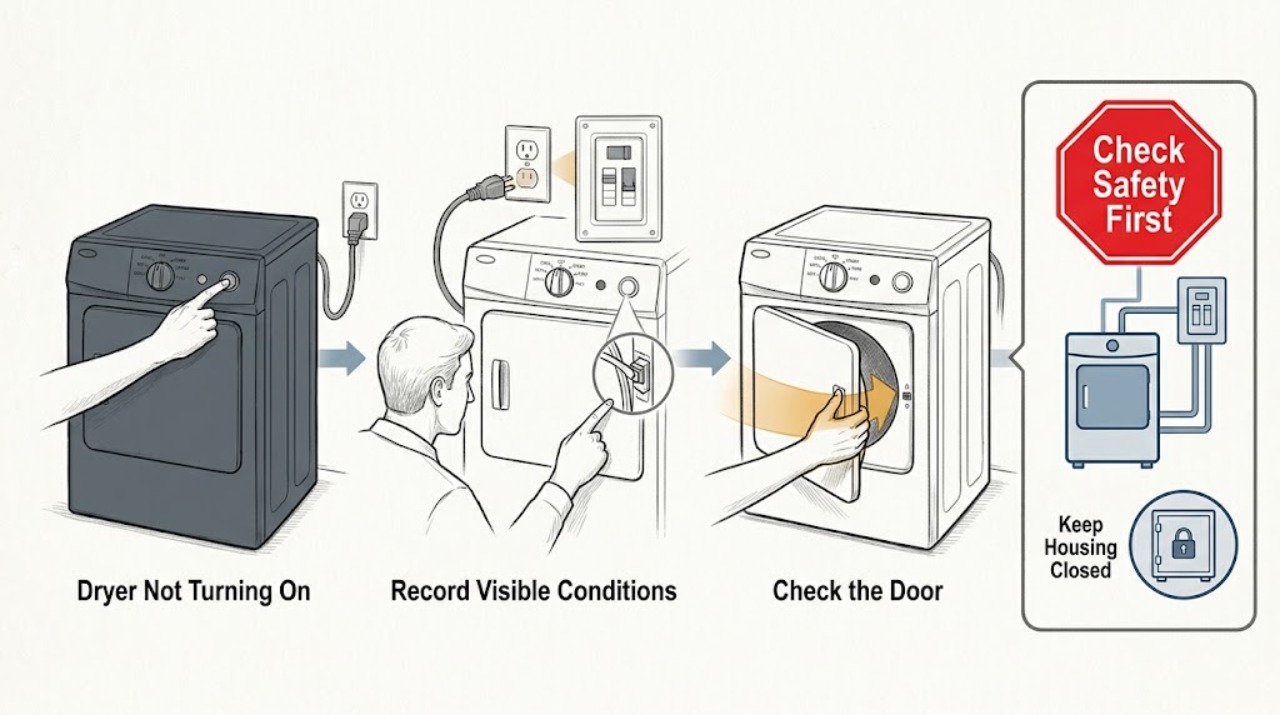
First determine whether the Frigidaire dryer is completely dead or has power but will not begin a cycle. Stop for gas odor, smoke, sparks, scorching, a hot or damaged cord or receptacle, standing water near electrical parts, or a drum that will not stop safely. If there is no hazard, confirm that the power cord is firmly connected without an extension cord, the accessible breaker or fuse is normal, the cycle selector is at a valid start position, the door is fully closed, and the Start control is used as the model guide specifies. Frigidaire's official support says some models require the Start control to be held for two seconds and identifies a door, loose plug, cycle position, blown fuse, or tripped breaker as possible no-start causes. If the dryer still does not respond, stops after overheating, the breaker trips again, the display is blank or erratic, or diagnosis requires opening the cabinet or testing live circuits, keep it off and arrange qualified appliance or electrical service.
Before you begin
Safety first
- This article supports ordinary-access observation and model-approved controls only. Do not open panels, measure live circuits, defeat the door or thermal safety system, disturb gas components, or operate with unsafe airflow.
Work through in order
Diagnostic checks
Use only checks that match the exact appliance or system and its official guide.
-
Check 1
Stop using the Frigidaire dryer and inspect only from a safe distance for gas odor, smoke, sparks, arcing, scorching, a hot or damaged cord or receptacle, standing water near electrical parts, or a drum that will not stop safely.
Expected result: Record whether a gas, fire, electrical, water, heat, or moving-part hazard is present without touching a hot, wet, or damaged area.
Next step: For gas odor, leave immediately and contact the gas supplier or emergency services from outside; for smoke, sparks, scorching, water near electricity, or electrical damage, keep the dryer off and arrange qualified service.
Stop if: Do not restart a gas-smelling, smoking, sparking, scorched, wet, overheated, or unsafe dryer.
Why this matters
Why: A hazard overrides no-start diagnosis. A normal exterior permits ordinary-access checks, but it does not make cabinet access or live testing appropriate.
-
Check 2
Record the Frigidaire model and serial information, display or alert, selected cycle, and whether the dryer has a blank panel, beeps, clicks, hums, tumbles, or remains completely silent when Start is used.
Expected result: Classify the event as no display, display but no motor, start attempt followed by stop, or normal motor movement with an unexpected pause; note whether the door or filter indicators appear.
Next step: Use the exact Frigidaire owner and installation guide for the model before resetting power or changing a control sequence.
Stop if: Stop if the model or display cannot be established without removing a panel or disturbing the installation.
Why this matters
Why: The scope separates accessible power and control conditions from a door switch, motor, thermal, or control fault. A symptom does not identify a safe replacement part.
-
Check 3
With no hazard present, set the cycle selector fully at a valid start position, select the intended cycle, close the dryer door completely, and press or turn Start exactly as the model guide requires; for models covered by Frigidaire's generic guidance, hold the Start control for two seconds.
Expected result: Record whether the door closes and latches evenly, the display changes, the drum begins to move, or the dryer remains silent or displays a door or control message.
Next step: Correct only a visible selector or door condition and make one start attempt; if the dryer still does not respond, stop repeating the control and continue to power escalation.
Stop if: Do not force the door, defeat the door switch, insert tools into the latch, or use an undocumented start sequence.
Why this matters
Why: A selector not at its start position, an incompletely closed door, or a short Start press can mimic a hardware failure. A closed door and valid cycle with no response points toward power, switch, motor, thermal, control, or wiring diagnosis.
-
Check 4
Inspect the power cord and accessible receptacle from the outside, confirm the plug is firmly seated without an extension cord, and check the accessible household breaker or fuse condition without opening an electrical enclosure.
Expected result: Record whether the display is dead, whether a breaker appears tripped or a fuse condition is indicated, whether other appliances on the circuit work, and whether the plug or receptacle is loose, hot, scorched, or damaged.
Next step: Follow the household and model instructions for one accessible reset only; if the dryer remains dead, the protection trips again, or damage is visible, keep it off and arrange service.
Stop if: Do not use an extension cord, remove the outlet or dryer cover, increase fuse capacity, measure live voltage, or repeatedly reset a tripping breaker.
Why this matters
Why: Frigidaire identifies a loose plug, blown fuse, or tripped breaker as possible no-start causes, but heat damage, a repeat trip, or normal external power with a dead dryer requires qualified electrical or appliance diagnosis.
-
Check 5
If the dryer stopped after running, turn it off normally, let it cool as the model guide permits, and compare the load with the guide's loading instructions; do not restart while a scorched odor, abnormal heat, or restricted exhaust is present.
Expected result: Record whether the motor was hot, the load was tightly packed, the dryer restarts after cooling, and whether it stops again with a reasonable load or an empty test only when the manual allows it.
Next step: Make one model-approved start attempt after cooling and load correction; if it does not start or stops again, keep the dryer off and request service.
Stop if: Do not bypass a thermal limiter, continue through overheating, run with a scorched odor, or open the cabinet to inspect the motor or thermal device.
Why this matters
Why: Frigidaire says an overloaded dryer can overheat its motor and advises cooling and reducing load size. A repeat stop can indicate thermal protection, motor, airflow, control, or another fault that cooling alone does not repair.
-
Check 6
With the dryer off and cool, check that the lint filter is present and not visibly blocked or damaged and inspect the visible exhaust outlet for an obvious obstruction without dismantling the duct or moving the appliance.
Expected result: Record whether lint is excessive, the filter is missing or damaged, the outlet is obstructed, and whether prior operation included weak exhaust, overheating, or unexpected shutdown.
Next step: Restore only the documented filter or external vent condition, then make one model-approved start attempt; arrange qualified vent or appliance service if airflow remains weak or shutdown recurs.
Stop if: Do not operate without the filter, insert tools into the duct, dismantle the vent as an ordinary-user repair, or continue with overheating or a scorched odor.
Why this matters
Why: A restricted airflow path can contribute to overheating and thermal shutdown. A clear visible path with persistent no-start points toward the start, power, motor, control, or internal safety system.
-
Check 7
After the applicable setting, door, power, cooling, load, and visible airflow checks are complete, make one supervised start attempt and stop at the first abnormal sound, odor, heat, display behavior, or shutdown.
Expected result: Record whether the display remains stable, the motor and drum start, the cycle continues, and the same no-start or stop symptom returns immediately or after warming.
Next step: Keep the dryer off and provide service with the model, cycle, door, power, load, airflow, sound, heat, and test notes.
Stop if: Do not repeat failed attempts, bypass a door or thermal safety device, open panels, or replace a motor, switch, limiter, control, or wiring by symptom alone.
Why this matters
Why: A stable start after an external correction supports that condition as a contributor. No response, recurring stop, a returning alert, or abnormal operation requires professional diagnosis and does not identify a specific part.
Use your observations
Decision map
Find the observation that best matches what you see, then follow the next safe action.
-
PATH 01Safety boundary
What you see
Gas odor, smoke, sparks, arcing, scorching, a hot or damaged cord or receptacle, water near electrical parts, or unsafe drum movement is present.
Do this next
For gas odor, leave immediately and contact the gas supplier or emergency services from outside; for fire, water, or electrical signs, keep the dryer off and arrange qualified service.
Why this path and its safety boundary
Why it matters: This is a safety stop, not an ordinary no-start path.
Safety stop: Do not restart, move the dryer, operate switches inside a gas-smelling space, or open a panel.
-
PATH 02Safety boundary
What you see
The dryer has a stable display and no hazard, but the selector, Start control, or door closure is not in the documented start state.
Do this next
Set the documented cycle, close the door, and use the model-approved Start procedure once.
Why this path and its safety boundary
Why it matters: A user-facing start condition can prevent operation without proving a failed motor or control.
Safety stop: If the dryer remains silent or the door message returns, stop and request service; do not force or defeat the switch.
-
PATH 03Safety boundary
What you see
The display is dead or the accessible breaker, fuse, plug, or receptacle is abnormal.
Do this next
Follow one accessible household reset only, or arrange qualified electrical service for heat damage, overload, or a repeat trip.
Why this path and its safety boundary
Why it matters: An external supply issue may be involved, but normal-looking external power does not exclude an internal fault.
Safety stop: Do not increase fuse capacity, use an extension cord, open an enclosure, or measure live voltage.
-
PATH 04Safety boundary
What you see
The dryer ran and stopped, the motor is hot, the load was excessive, or airflow and heat behavior were abnormal.
Do this next
Allow the documented cool-down, correct only the load or visible filter condition, and make one supervised start attempt.
Why this path and its safety boundary
Why it matters: Motor overheating or thermal protection may be involved, but cooling and load reduction do not prove the appliance is repaired.
Safety stop: If it stops again, smells scorched, overheats, or has weak exhaust, keep it off and request service.
-
PATH 05Safety boundary
What you see
The door, selector, Start procedure, accessible power, load, cooling, and visible filter or vent checks are normal, but the dryer remains silent or repeatedly stops.
Do this next
Keep the dryer off and arrange qualified Frigidaire appliance service with the complete symptom and test record.
Why this path and its safety boundary
Why it matters: A door switch, motor, thermal limiter, control, wiring, or installation fault remains possible; the symptom does not identify a part.
Safety stop: Do not open panels, perform live electrical tests, bypass protective devices, or substitute parts by symptom alone.
Helpful context
Understand the symptom
Separate no power from no start
A blank display, a dryer that beeps but does not run, a cycle that pauses, and a motor that starts then stops are different symptoms. Record the display, selected cycle, door state, drum movement, sounds, and whether the dryer recently overheated. Frigidaire's guidance is model-specific enough to make the model and installation guide the authority for the exact controls.
Start and door checks are ordinary-access checks
Frigidaire says some dryers require the Start control to be pressed or turned and held for two seconds, the cycle selector to be positioned correctly, and the door to be completely closed. A loose power connection, extension cord, blown fuse, or tripped breaker can also prevent starting. Correct only visible user conditions; do not bypass the door switch or infer that a start failure proves a motor or control part is bad.
An unexpected stop may be thermal protection
If the dryer ran and then stopped, an overheated motor or a thermal limiter may be involved. Frigidaire advises allowing an overheated motor to cool and reducing an excessive load, while directing owners to service when the condition persists; a thermal limiter condition is not a reason to open the dryer. Repeated stopping, a scorched odor, or restricted airflow requires the dryer to remain off.
Use one supervised start attempt, then escalate
After correcting a clearly documented setting, door, or accessible power condition, make one start attempt using the model guide and stay nearby. Record whether the motor starts, whether the drum turns, whether the display changes, and whether the problem or a hazard returns. Persistent no-start can involve the door switch, motor, thermal protection, control, wiring, or installation and needs qualified diagnosis rather than a guessed replacement.
Safety boundary
Stop conditions
- Stop for gas odor, smoke, sparks, arcing, scorching, a hot or damaged cord or receptacle, standing water near electrical parts, severe overheating, or unsafe drum movement.
- For gas odor, leave immediately and contact the gas supplier or emergency services from outside; do not use switches, phones, matches, or the dryer inside.
- Do not force or defeat the door switch, use an extension cord, increase fuse capacity, open panels, measure live circuits, or bypass thermal protection.
- Do not operate without the lint filter, with a blocked or damaged exhaust, after a scorched odor, or through repeated thermal shutdown.
- Stop repeating start attempts when the dryer remains silent, the display is dead or erratic, protection trips again, or the exact model guide does not explain the result.
When checks do not resolve it
Need a professional?
Arrange qualified Frigidaire appliance service when the dryer remains dead or does not start after the exact model's documented Start, door, cycle, accessible power, cooling, load, and visible airflow checks; when it stops repeatedly, a thermal limiter may be involved, the breaker trips again, or diagnosis requires cabinet access or electrical testing. For gas odor, leave immediately and contact the gas supplier or emergency services from outside. Provide the model and serial information, display, selected cycle, door behavior, power observations, load, airflow, temperature, sounds, and test result.
Safety scope: This article supports ordinary-access observation and model-approved controls only. Do not open panels, measure live circuits, defeat the door or thermal safety system, disturb gas components, or operate with unsafe airflow.
Read the exact guide
Official sources
- What should I do if my dryer stops operating?Frigidaire · Frigidaire's official dryer support page provides general stopped-operation guidance; model-specific service documentation controls diagnosis and repair.
- Certain Older Gas Connectors May Be DangerousU.S. Consumer Product Safety Commission · CPSC consumer gas-appliance safety bulletin; its evacuation and no-ignition-source instructions apply when gas is smelled or suspected, while connector inspection belongs to qualified professionals.
- What should I do if my dryer does not start?Frigidaire · Frigidaire's official dryer support page provides general no-start guidance; the exact model's owner and installation instructions control the installed appliance.
Community feedback
Share a repair observation
Share a plain-text repair observation. Accepted observations are published automatically; this page may take a moment to update.