
On this page
Start here
Quick answer
The flap on the meeting edge of a Frigidaire French door is commonly called a flipper or articulating mullion; the hinge, pin, mounting clip, door plastic, and complete mullion are different identity possibilities. Confirm the full model before ordering anything. Inspect only from outside, keep the doors from being forced, and check that the gasket and doors still close and seal. If the flap hangs, catches, leaves a gap, the door will not close, or the mounting plastic is broken, stop using the affected door as a repair experiment and arrange model-specific service.
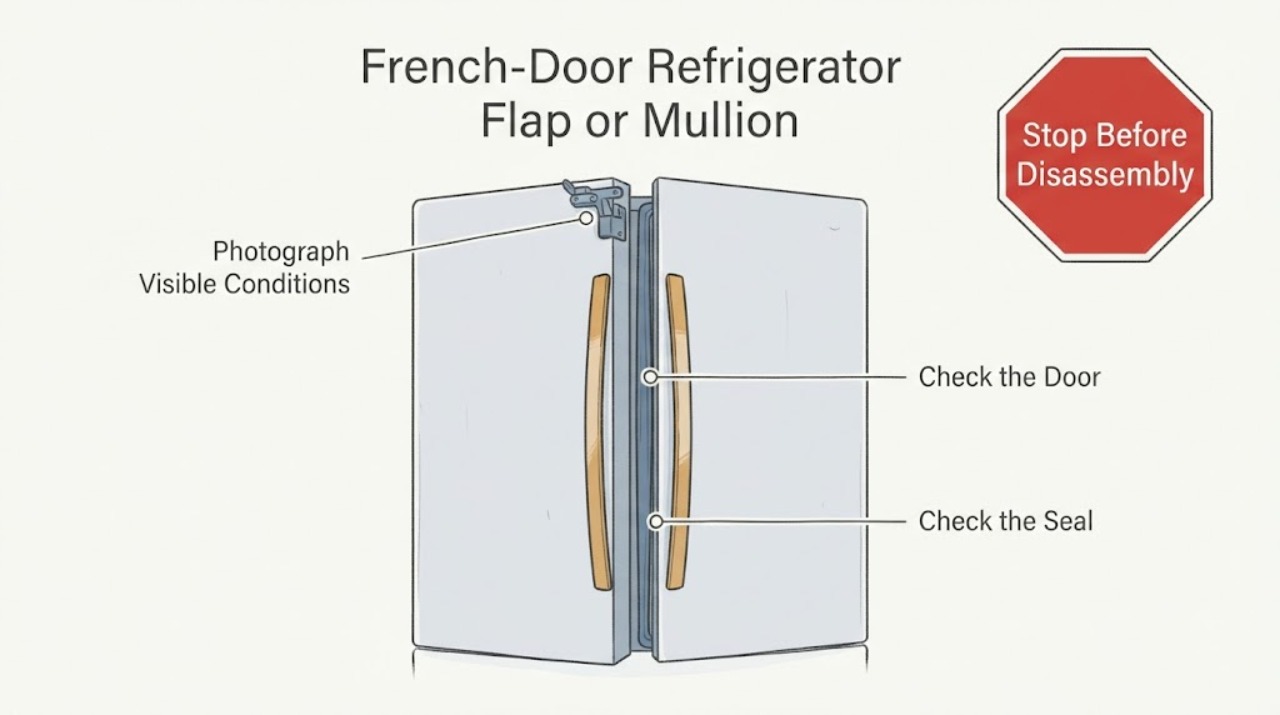
Work through in order
Diagnostic checks
Use only checks that match the exact appliance or system and its official guide.
-
Check 1
Open the fresh-food door only far enough to photograph the full Frigidaire model and serial label, which Frigidaire places along the upper right side of a French-door fresh-food compartment.
Expected result: The complete identity is readable, or only the Frigidaire brand and a broken flap are known.
Next step: Use the exact model manual or an authorized service route. If the identity is missing, do not order a generic flap or hinge and do not transfer a part number from another Frigidaire family.
Why this matters
Why: A complete model is the basis for the correct door diagram and for distinguishing a mullion assembly from a hinge, pin, clip, or door assembly.
-
Check 2
With both doors unloaded as needed, inspect the flap/mullion, its visible pivot area, the top and bottom mounting points, and the receiving guide without removing the door or trim.
Expected result: The flap is present and moves freely, hangs or catches, a hinge/pin is missing, or the door plastic or mounting clip is cracked or pulled out.
Next step: Do not force the flap or close a door against a loose part. Photograph the defect and have the exact model assessed before selecting a replacement.
Why this matters
Why: These observations separate a visible alignment or obstruction problem from an unresolved component identity; the same visible flap can be supported by different model-specific parts.
-
Check 3
Check the door path and gasket from outside: remove food or shelving that blocks closure, wipe the gasket with a soft damp cloth, and inspect whether the gasket contacts the cabinet evenly.
Expected result: The door closes after an obstruction or gasket cleaning, or it still leaves a gap, springs back, or catches on the flap.
Next step: If the door still will not close completely, stop using the affected door as a test and contact Frigidaire service. Do not adjust hidden hardware from a generic instruction.
Why this matters
Why: Frigidaire says blocked doors and dirty gaskets can prevent complete closure. A continued gap or catch means the broken flap or door geometry remains unresolved.
-
Check 4
Check whether both fresh-food doors remain level and whether the flap meets its guide through the normal opening and closing motion, without forcing the doors together.
Expected result: The doors are visibly uneven, the flap does not fold or meet the guide, or the doors move normally but the mounting point is broken.
Next step: Use an exact model guide only for an explicitly documented adjustment. For a broken hinge, pivot, clip, or door mount, request model-specific service rather than improvising a fastener or adhesive repair.
Why this matters
Why: Frigidaire provides a French-door alignment procedure for some refrigerator families, but alignment cannot repair a snapped flap hinge, pivot, or door mount and the exact model controls the permitted adjustment.
-
Check 5
Before arranging service, record whether the doors seal, whether interior temperature or frost has changed, and whether the flap or hinge can move without resistance; include close photographs of every broken mount.
Expected result: The doors seal normally with no visible damage, or the door cannot seal or the broken piece interferes with closure.
Next step: Keep the refrigerator door closed without force and send the model, serial, photos, and symptom sequence to Frigidaire or qualified service. Do not remove the door to inspect the hidden hinge.
Why this matters
Why: A cosmetic loose piece and a door that cannot seal have different urgency, but neither observation establishes a compatible part without the model.
Use your observations
Decision map
Find the observation that best matches what you see, then follow the next safe action.
-
PATH 01Next step
What you see
The flap is loose or broken but both doors still close fully and the gaskets make an even seal.
Do this next
Limit use to normal gentle door movement, photograph the defect, and identify the model before ordering or repairing any part. Do not glue or drill the door.
Why this path and its safety boundary
Why it matters: The visible component may be a mullion/flapper assembly or its pivot, but the model and mounting construction remain unresolved.
-
PATH 02Next step
What you see
The flap catches, prevents the opposite door from closing, or leaves a visible gap in the center seal.
Do this next
Stop forcing the doors, remove anything that blocks them, and contact Frigidaire service if the gap or catch remains. Avoid using a workaround that holds the door shut.
Why this path and its safety boundary
Why it matters: The door system is not maintaining its intended closure, and Frigidaire's general guidance treats an unresolved closing problem as a service matter.
-
PATH 03Next step
What you see
The doors are uneven but the flap and mounting points appear intact.
Do this next
Use only the exact model's documented alignment method or request service. Stop if adjustment causes rubbing, a gap, or door instability.
Why this path and its safety boundary
Why it matters: An alignment condition may be present, but Frigidaire's adjustment steps are family-specific and do not prove the hinge is broken.
-
PATH 04Next step
What you see
A hinge, pivot, clip, or section of the door plastic is cracked, missing, or pulled out.
Do this next
Keep the affected door from being forced, photograph the damage, and arrange model-specific service. Do not apply adhesive, drill new holes, or fit a part from another model.
Why this path and its safety boundary
Why it matters: The broken mounting structure cannot be identified as a standalone replacement part without the model diagram and may involve the door assembly.
Helpful context
Understand the symptom
Identify the flap before identifying a part
On a French-door refrigerator, the narrow closing piece attached to one fresh-food door is commonly called a flipper mullion, articulating mullion, or flapper. The opened Frigidaire community report uses those terms, but the same report also shows why a name is not a parts match: the failure may involve the moving strip, its hinge or pin, a mounting clip, the door plastic, or a complete door assembly. Do not choose a component from the word flap alone.
Use the model number to narrow the repair
Frigidaire says the model number for a French-door refrigerator is along the upper right side of the fresh-food compartment and is visible with the door open. Photograph the entire label before searching for a manual or parts diagram. Without that identity, the correct hinge, pin, mullion, mounting bracket, or door assembly cannot be confirmed.
Protect the seal while deciding whether to use the refrigerator
A flap that does not fold or align can catch when the opposite door closes. Frigidaire's general door guidance says to remove anything blocking the doors and make sure the gaskets are clean; if the doors still do not close completely, contact service. A broken mounting point or gap is a service boundary, not an invitation to glue, drill, shim, or force the door.
When checks do not resolve it
Need a professional?
Request service when the flap catches, the doors cannot close completely, the center seal has a gap, or the mounting plastic, hinge, or pivot is cracked or missing., Keep the affected door from being forced and protect the food while arranging service if the refrigerator no longer seals or temperature rises., Do not glue, drill, shim, remove the door, or order a mullion/hinge/door assembly from another model without the complete Frigidaire identity and exact parts diagram.
Common questions
FAQ
What is the flap between French refrigerator doors called?
It is commonly called a flipper mullion, articulating mullion, or flapper. The name identifies the general component, not the correct hinge, pin, clip, or replacement assembly for a particular Frigidaire model.
Can I order a generic Frigidaire mullion hinge?
No. Confirm the full model first. Frigidaire places the French-door model label along the upper right side of the fresh-food compartment, and the visible break may be in the mullion, pivot, mounting clip, door plastic, or door assembly.
Can I close the door harder or glue the flap back on?
Do not force the door or improvise an adhesive or drilled repair. If the flap catches or the door will not seal, stop and arrange model-specific service so the broken mount and the correct repair can be identified.
What should I send with a service request?
Send the complete model and serial label, photographs of the flap, hinge or pivot, mounting points, door gap, and gasket, plus whether the doors still close and seal.
Read the exact guide
Official sources
- Refrigerators - How to align doorsFrigidaire · Official alignment guidance applies to listed French-door families and supports only documented door-level adjustment. It does not prove a broken flap hinge can be repaired by alignment or establish a part for an unidentified model.
- I need to repair/replace this closing flap on my FRIGIDAIRE fridge. But, I don’t even know what it’s called.Reddit r/appliancerepair · Used only to verify that the exact community discussion calls the closing flap a mullion, flapper, or articulating mullion and that the model is needed to distinguish parts. Community adhesive, screw, and outcome suggestions are not treated as verified instructions.
- Refrigerator Door IssuesFrigidaire · Official general refrigerator guidance supports removing obstructions and cleaning the gasket, then contacting service if the door remains unable to close. It does not identify or authorize a model-independent flap/hinge repair.
- Where can I find my model and serial number?Frigidaire · Official Frigidaire guidance says a French-door refrigerator model number is visible along the upper right side of the fresh-food compartment when the door is open. It supports identity confirmation only, not a generic flap or hinge fit.
Community feedback
Share a repair observation
Share a plain-text repair observation. Accepted observations are published automatically; this page may take a moment to update.