
On this page
Start here
Quick answer
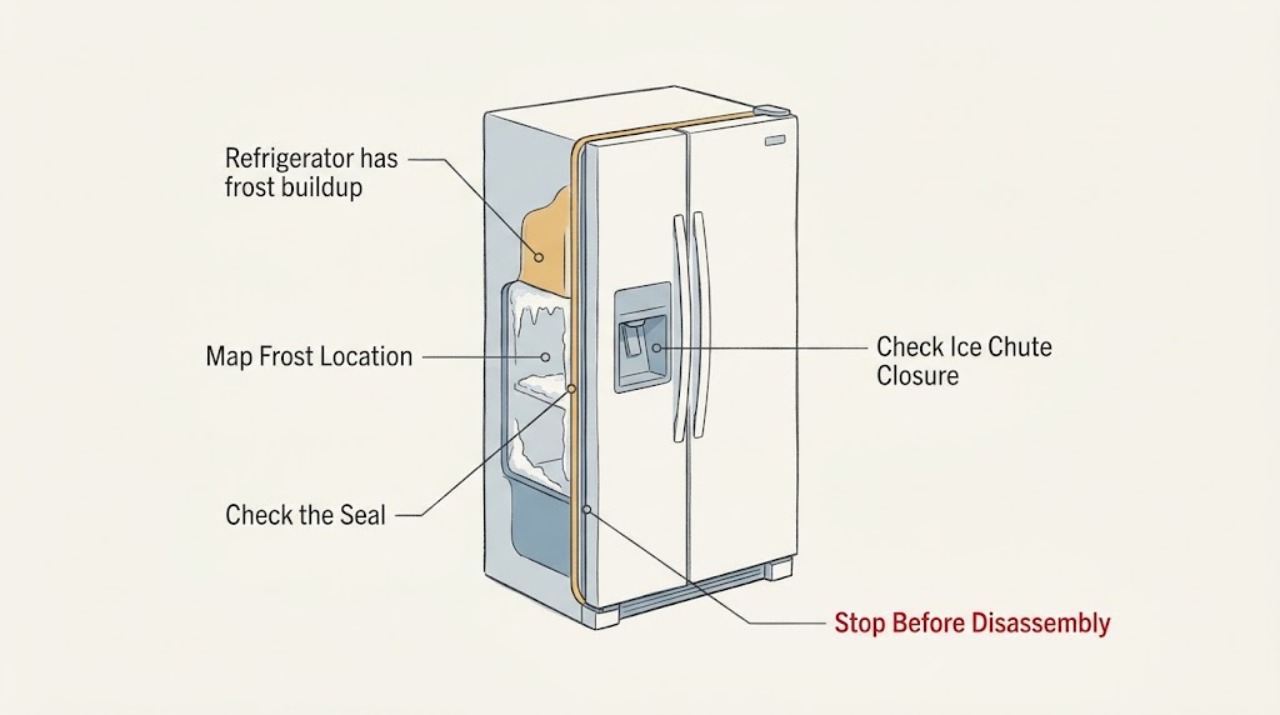
Frost in a Frigidaire refrigerator usually means warm, moist air is entering a below-freezing area or cold air is being distributed incorrectly. Start by noting where the frost is concentrated, then check from the outside whether a door or drawer is fully closing, the gasket is clean and contacting the cabinet, an ice chute flap is closing, and food is blocking an interior vent. Do not chip ice with a knife, use a heat gun or open a sealed refrigeration circuit. A thin, localized patch after a door was left open may clear after the cause is corrected, but frost that returns quickly, covers a rear panel, blocks a fan or vent, accompanies poor cooling, or remains after the door and airflow checks can indicate a defrost, fan, sensor, control, or sealed-system problem. Move vulnerable food only as needed, keep the refrigerator closed, and arrange qualified appliance service when the frost is heavy, recurring, or associated with water or temperature loss.
Work through in order
Diagnostic checks
Use only checks that match the exact appliance or system and its official guide.
-
Check 1
Without removing shelves, covers, or trim, photograph and map where frost is forming: a door edge, ice chute, one food package, an interior vent, the rear interior panel, the freezer section, or several areas.
Expected result: Record whether the frost is a thin localized patch, a thick sheet, a ring around an opening, or broad coverage; note whether it blocks a vent or fan path and whether the refrigerator section is getting warmer.
Next step: Use the location to choose a branch and keep the unit closed. Do not chip, scrape, or remove an interior cover to see behind the frost.
Stop if: Stop for a blocked fan, exposed wiring, water pooling, soft or cracked liner, rapidly rising food temperature, or any need to touch ice near an appliance component.
Why this matters
Why: A localized edge or chute patch supports an air-entry check, while broad rear-panel frost or airflow blockage makes a circulation or defrost problem more likely. Frost in both sections or with temperature loss raises the service priority.
-
Check 2
Check from the front that every refrigerator and freezer door or drawer closes fully without a container, shelf, ice bin, or package holding it open. Inspect the visible gasket for dirt, folds, gaps, tears, or a section pulled away from the cabinet; clean only the accessible gasket surface with a gentle method allowed by the manual.
Expected result: The door closes and stays closed with an even gasket contact, or a corner remains open, the gasket is dirty or damaged, or frost itself prevents the door from seating.
Next step: Remove only the harmless obstruction and close the door; do not force a warped door or gasket into position. Arrange service for a torn gasket, misalignment, frost that prevents closure, or frost that returns after the door seals.
Stop if: Stop for a damaged hinge, loose door, swollen liner, cracked gasket that cannot be seated, or any need to remove door hardware.
Why this matters
Why: A door or gasket gap lets warm moist air enter and can create recurring frost. A door that cannot close because frost or an object is in the way can be both a cause and a result. A clean, even seal makes a hidden airflow or defrost issue more likely if frost is broad.
-
Check 3
If the refrigerator has an ice dispenser, inspect the chute opening from the outside with the dispenser idle. Confirm the flap closes flush and that no visible ice is holding it open; do not insert a hand or tool into the chute or dispenser mechanism.
Expected result: The flap closes normally, or ice/frost remains at the flap and leaves a visible gap after dispensing.
Next step: Follow the model manual for safe, exterior ice removal only. If the flap will not close, frost returns around it, or the dispenser is damaged, stop using the dispenser and arrange service.
Stop if: Stop for a jammed mechanism, broken flap, water leak, exposed moving parts, or any need to disassemble the dispenser.
Why this matters
Why: An open chute can admit warm air and create frost around the chute or door. A closed chute shifts the focus back to door sealing, vent clearance, temperature setting, or the refrigerator's internal frost-control system.
-
Check 4
From inside the cabinet, identify the visible supply and return vents and move only food or containers that are directly touching or blocking them. Keep items clear without removing a vent cover, reaching behind a panel, or packing the compartment tightly against the rear wall.
Expected result: A vent or cold-air outlet was blocked, food is frozen directly in the airflow, or all visible airflow paths are clear while frost covers a rear panel or repeatedly returns.
Next step: Leave clear space and observe whether the frost stops increasing. If airflow remains weak, temperatures are abnormal, or frost covers a panel, keep the unit closed and call appliance service rather than opening the panel.
Stop if: Stop for a fan that is obstructed or noisy, exposed wiring, a frozen solid compartment, or any need to remove an interior cover.
Why this matters
Why: Frigidaire says blocked airflow can contribute to frost and can disrupt cooling. Clear vents support a low-risk correction; clear vents with broad recurring frost make a fan, sensor, defrost, or control problem more likely.
-
Check 5
Read the displayed temperature setting and compare it with the Frigidaire Use and Care information for the exact model. Note recent events such as a long-open door, a power interruption, a large warm load, a move, a new installation, or a setting change; do not make repeated large adjustments.
Expected result: The setting is colder than the model guidance, frost began after a door was left open or a power event, or no recent event explains the buildup and the setting is already appropriate.
Next step: If the manual supports a small setting correction, make only that model-specific change and allow the appliance to stabilize without repeatedly opening it. Call service for recurring frost, poor cooling, or a correct setting with heavy buildup.
Stop if: Stop for temperature alarms, food spoilage risk, a display fault, smoke, burning odor, or any need to bypass a sensor or control.
Why this matters
Why: A too-cold setting or warm-air event can produce temporary frost, while no clear trigger and a correct setting make a persistent defrost or airflow problem more concerning. A setting change cannot correct a door leak or a blocked internal system.
-
Check 6
After the door, chute, vent, and setting checks, observe over normal operation without forcing a defrost or opening the rear panel. Note whether frost slowly stops growing, returns in the same place, turns into water at the bottom, or is accompanied by a fan or cooling change.
Expected result: Frost stops increasing after the visible cause is corrected, returns quickly or covers the rear panel again, or melting frost produces water inside or on the floor.
Next step: Document the timing and location and arrange qualified appliance service for recurrence, poor cooling, or water. Do not manually force a defrost, remove a cover, or use a sharp tool or direct heat.
Stop if: Stop for water on the floor, electrical risk, a hot or burning smell, a fan that is inaccessible or damaged, or any frost that prevents the door from closing.
Why this matters
Why: A stable, localized patch after a corrected open-door event may be temporary. Rapid recurrence, broad coverage, fan blockage, or meltwater suggests a defrost drain, evaporator, sensor, fan, control, or door-seal problem needing model-specific service.
Use your observations
Decision map
Find the observation that best matches what you see, then follow the next safe action.
-
PATH 01Next step
What you see
Frost is concentrated along a door edge or corner, the gasket has a visible gap or dirt, or a package or ice buildup prevents the door from closing fully.
Do this next
Remove the harmless obstruction, clean the accessible gasket, close the door, and monitor without scraping the frost. Call service for a torn gasket, door misalignment, frost that prevents closure, or recurrence after a good seal.
-
PATH 02Next step
What you see
Frost is concentrated around the dispenser chute and the flap does not close flush or visible ice holds it open.
Do this next
Use only the model manual's exterior chute procedure and stop using the dispenser if the flap will not close. Arrange service for a broken or repeatedly icing flap; do not reach into or dismantle the chute.
-
PATH 03Next step
What you see
Frost is localized beside a visible vent or on food directly in a cold-air path, and containers are touching or blocking the vent.
Do this next
Move only the obstructing items and leave the vent cover intact. If frost remains broad, airflow is weak, or food temperatures are abnormal, arrange appliance service rather than removing the panel.
-
PATH 04Next step
What you see
A thick layer covers much of a rear interior panel, blocks airflow, returns quickly after visible door and vent checks, or appears with poor cooling.
Do this next
Keep the doors closed, protect temperature-sensitive food, and call qualified appliance service. Do not remove the rear panel, puncture ice, bypass a sensor, or use direct heat to accelerate defrosting.
-
PATH 05Next step
What you see
Frost melts into water inside the cabinet, near the ice maker, beneath the appliance, or on the floor, or a water connection is wet.
Do this next
Keep the area dry, avoid moving a heavy refrigerator across water, and arrange appliance service when water recurs or reaches the floor. Inspect only clearly visible connections without disconnecting them.
-
PATH 06Next step
What you see
The door, gasket, chute, vents, and model setting appear correct, but frost continues or the refrigerator is warm, noisy in an abnormal way, or showing an alarm.
Do this next
Record the model, frost location, temperature symptoms, sounds, alarms, and recent events and call qualified appliance service. Do not open panels or test energized components.
Helpful context
Understand the symptom
The frost pattern is more useful than the word frost
A small patch at a door edge, ice chute, or food-facing vent points to an air-entry or airflow problem. A broad, thick layer on a rear interior panel, frost that blocks a fan, or frost that returns soon after a safe defrost can indicate that the automatic defrost or air-circulation system needs service. Frigidaire's own troubleshooting separates door and gasket checks from vent and temperature checks; use those visible clues before assuming a failed part.
Keep food and the appliance safe while checking
Keep the doors closed as much as practical and do not scrape, pry, or puncture ice. A refrigerator can have hidden wiring, a fan, a heater, or refrigerant tubing behind an interior cover. Do not remove a rear panel, reach into a fan, or apply direct heat. If food temperature is rising, water is pooling, or the cabinet is becoming wet, protect the food and arrange service instead of extending a risky test.
A model manual controls the repair boundary
Frigidaire directs owners to the appliance manual and support resources when a frost issue is not resolved by the visible checks. Models differ in door style, ice chute arrangement, vent layout, sensors, and defrost controls. A generic part, forced reset, or improvised manual-defrost method can damage the liner or leave the original fault in place. Record the model number and use model-specific guidance or qualified appliance service.
Safety boundary
Stop conditions
- Stop and arrange appliance service for heavy or recurring frost, a rear panel covered in ice, a blocked fan or vent, poor cooling, temperature alarms, or frost that prevents a door from closing.
- Do not chip, puncture, pry, or scrape ice; do not use a heat gun, open flame, or direct high heat; do not remove interior panels or access sealed refrigeration tubing.
- Stop for water on the floor, exposed wiring, smoke, a burning odor, a damaged cord, or a refrigerator that has tipped or cannot be moved safely.
- Do not bypass sensors, force a defrost, reach into a fan or ice chute, or make a generic part substitution. Use the exact model manual or qualified service.
Only after diagnosis
Potential parts
- refrigerator door gasket
Consider this only when frost is concentrated at a door or drawer edge, the gasket is torn or warped, and the door cannot make an even seal after harmless obstructions are removed.
Confirm the exact Frigidaire model, door style, gasket profile, and installation method; a generic gasket may not seal or align correctly. - ice dispenser chute flap or seal
Consider this only when frost is localized around the dispenser chute and the flap is visibly unable to close or a qualified technician confirms the chute boundary is the air-entry path.
Match the exact dispenser and refrigerator model; do not substitute a flap or seal based on appearance or dismantle the chute as a first check. - evaporator fan or fan motor
This is relevant only when broad frost blocks airflow or the fan is abnormal and a technician confirms a fan or motor fault after safe power isolation.
Verify the exact model, fan assembly, connector, and service procedure; do not reach into or test an energized fan. - defrost sensor, heater, or control component
Consider this category only when frost repeatedly covers the evaporator or rear panel after door, chute, vent, and setting causes are excluded and service confirms a defrost-control fault.
The correct component depends on the model's defrost design and diagnosis; do not bypass a sensor or replace a control without model-specific service information. - defrost drain or drain-path component
This may apply when recurring frost is followed by meltwater inside or beneath the unit and a technician confirms a restricted or damaged defrost-drain path.
Confirm the exact model, drain arrangement, and safe access before selecting a part; a drain component will not correct a door leak or defrost-control fault.
When checks do not resolve it
Need a professional?
Call qualified appliance service when frost returns quickly after the door, chute, vent, and model-setting checks; covers a rear panel; blocks airflow; accompanies warm food, alarms, unusual fan or compressor behavior, or water; or requires removing a panel. Call promptly for a floor leak, electrical concern, smoke, burning odor, or a door that cannot close. A thin, localized patch after a confirmed long-open door may be monitored after the cause is corrected, but do not use tools or direct heat to remove it.
Have this ready
- Frigidaire model number and refrigerator style
- Frost location, thickness, and whether it returns after the door and vent checks
- Whether the door or drawer closes evenly and whether the gasket has gaps or damage
- Whether an ice chute flap closes and whether visible vents are blocked
- Temperature symptoms, alarms, water, unusual sounds, and recent power or installation events
- Photos taken before disturbing the frost
Common questions
FAQ
Why does my Frigidaire refrigerator have frost buildup?
Frigidaire identifies warm air entering through a door or gasket, an ice chute flap that does not close, a colder-than-recommended setting, and blocked airflow as possible causes. The frost location and whether it returns quickly help separate those accessible causes from an internal defrost or fan problem.
Can I scrape the frost off with a knife?
No. A knife or other sharp tool can puncture the liner or hidden tubing and can create an electrical or refrigerant hazard. Keep the doors closed and use the model manual or qualified service for heavy or recurring ice.
Should I use a hair dryer to melt refrigerator frost?
Avoid improvised direct heat. Water and electricity can create a shock or damage risk, and excessive heat can harm the liner, gasket, or nearby parts. Do not force a defrost; arrange model-specific service when the buildup is substantial or recurring.
How do I know whether the door gasket is causing the frost?
Look for a dirty, folded, torn, warped, or visibly gapped gasket and confirm that no container, shelf, drawer, or ice buildup holds the door open. Frost concentrated along that edge supports an air-leak diagnosis, but recurring frost with an even seal needs further service evaluation.
What does frost covering the rear panel mean?
A broad rear-panel layer can block airflow and may indicate a persistent air leak, fan issue, defrost sensor or heater problem, drain issue, or control fault. Do not remove the panel; photograph the pattern and call qualified appliance service if it recurs or cooling is affected.
Can blocked vents cause frost in a Frigidaire refrigerator?
Yes. Frigidaire says food placement that blocks airflow pathways can promote frost and can disrupt cooling. Move only items touching visible vents, keep covers in place, and call service if airflow remains weak or frost is broad.
Read the exact guide
Official sources
- Refrigerator Too ColdFrigidaire · Frigidaire refrigerator temperature setting and visible vent-clearance guidance
- Refrigerator Runs Too MuchFrigidaire · Frigidaire refrigerator operating-time context for door, temperature, and ambient conditions
- Refrigerators Noise GuideFrigidaire · Frigidaire refrigerator fan, defrost, compressor, and water-drip sound context
- Refrigerators / Freezer - Frost Build UpFrigidaire · Frigidaire refrigerator and freezer frost buildup causes and visible corrective checks
- Refrigerator Door IssuesFrigidaire · Frigidaire refrigerator door closure and gasket inspection
- Refrigerator Water LeaksFrigidaire · Frigidaire refrigerator water-leak and frost-related meltwater context
Community feedback
Share a repair observation
Share a plain-text repair observation. Accepted observations are published automatically; this page may take a moment to update.