
On this page
Start here
Quick answer
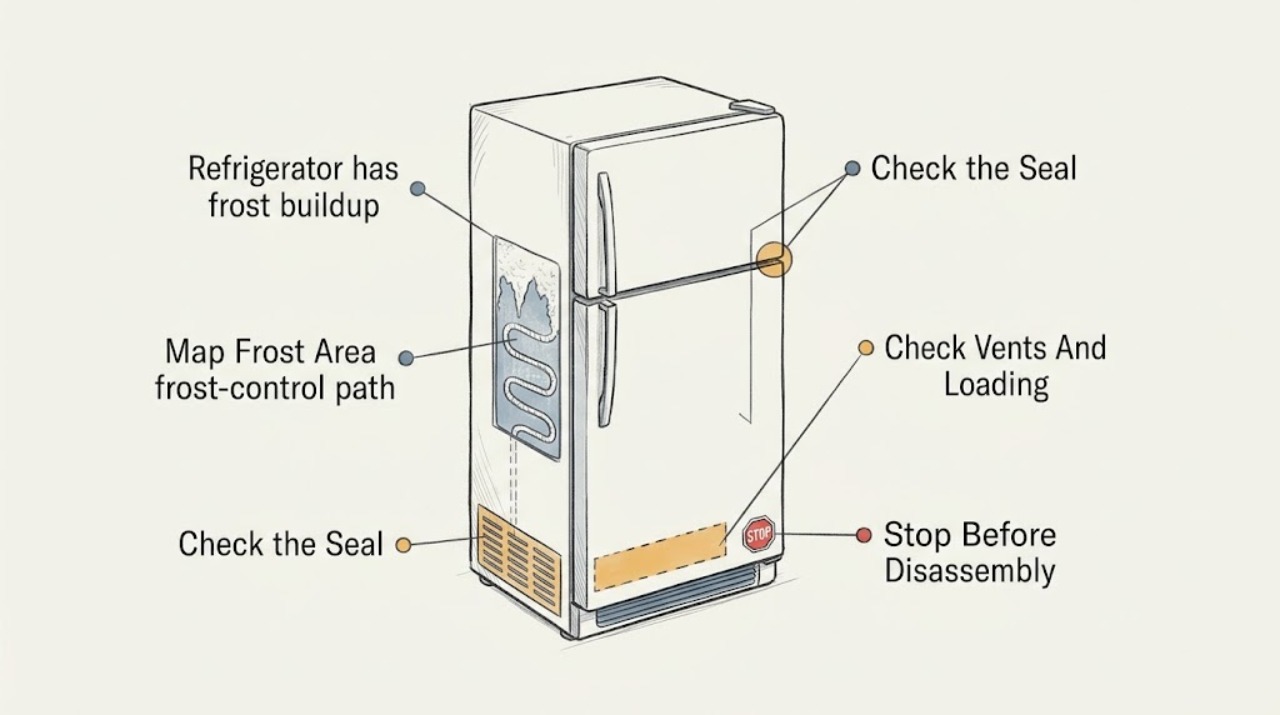
Some light frost or condensation can be normal in a Maytag refrigerator, especially after humid-air exposure, but heavy or recurring frost needs a cause check. First map whether it is at a door edge, on food beside a vent, near the freezer-to-refrigerator vents, or broadly across a rear panel. Then check from the outside that doors and drawers close fully, the gasket is clean and contacting the cabinet, no package blocks closure, and food is not covering visible vents. Minimize door openings and follow the exact model manual for settings. Do not chip ice with a knife, use a hair dryer or heater, remove an interior panel, reach into a fan, or bypass a control. If frost returns after the visible checks, blocks airflow, prevents closure, accompanies temperature fluctuation or water, or covers a rear panel, protect the food and arrange qualified appliance service.
Work through in order
Diagnostic checks
Use only checks that match the exact appliance or system and its official guide.
-
Check 1
Without removing shelves, covers, or trim, photograph and map the frost in the refrigerator and freezer sections. Note whether it is at a door edge, on the back wall, around a vent, on one package, near an ice-maker or dispenser area, or spread across many surfaces.
Expected result: Record whether the layer is light and localized or thick and broad, whether it blocks a vent or fan opening, and whether the compartment is warmer, colder, or fluctuating.
Next step: Use the pattern to select a branch and keep the doors closed as much as practical. Do not scrape or chip the frost to inspect behind it.
Stop if: Stop for a blocked fan, exposed wiring, a damaged liner, water pooling, unsafe food temperature, or any need to touch an interior component.
Why this matters
Why: A small localized pattern supports an air-entry or loading check; broad rear-panel frost, blocked airflow, or temperature loss makes an internal frost-control issue more likely. The pattern is a clue, not proof of a failed part.
-
Check 2
Check from the front that every refrigerator door, freezer door, and drawer closes fully without a package, shelf, bin, ice container, or frost holding it open. Inspect the accessible gasket for dirt, folds, cracks, gaps, or sections pulled away from the cabinet; clean it gently with the model-approved method.
Expected result: The door closes with an even gasket contact, or a corner remains open, the gasket is dirty or damaged, the cabinet is not level, or frost prevents the door from seating.
Next step: Remove only a harmless obstruction and close the door. Refer to the manual or service for alignment, leveling, a damaged gasket, or frost that prevents closure; do not force the door or hinge.
Stop if: Stop for a loose hinge, warped door, swollen liner, a gasket that cannot seat, or any need to remove door hardware.
Why this matters
Why: A poor seal lets humid room air enter and can cause frost, temperature fluctuation, and longer operation. A door blocked by frost can be both a result and a cause. A clean, even seal shifts suspicion toward airflow, settings, or an internal frost-control system.
-
Check 3
Locate only the visible supply and return vents in the freezer and refrigerator compartments and move food or containers that are directly touching or blocking them. Keep items away from the rear wall as directed by the model manual without removing a vent cover or reaching behind a panel.
Expected result: A container or bag blocked a vent, food is frozen beside a cold-air outlet, or every visible vent is clear while frost remains broad or airflow sounds abnormal.
Next step: Leave the vents open and observe without repeatedly opening the doors. Call service for persistent frost, weak or unusual airflow, or any fan blockage; do not remove an interior panel.
Stop if: Stop for a fan that is inaccessible, noisy, or blocked by ice, exposed wiring, or any need to reach into the airflow assembly.
Why this matters
Why: Maytag says blocked vents can cause moisture buildup or excessive frost and can create hot or frozen spots. Clear vents support a low-risk correction; clear vents with broad frost, weak airflow, or unusual fan sound makes a service issue more likely.
-
Check 4
Note recent conditions that can add moisture: a door left open, frequent openings, a large warm grocery load, uncovered food, a power interruption, moving the refrigerator, or unusually humid room air. Check that liquids and food are covered and that the doors can close without a long-open search.
Expected result: Frost began after a clear warm-air or humidity event and is light, or no event explains the frost and the buildup is increasing or returning in the same place.
Next step: Minimize openings and allow normal operation only after doors and vents are clear. Arrange service when the frost continues, the compartment temperature changes, or the cause is not an ordinary moisture event.
Stop if: Stop for food spoilage risk, a temperature alarm, water pooling, smoke, burning odor, or any need to bypass a control.
Why this matters
Why: A short-lived light pattern after warm humid air may be normal condensation that settles after closure. No clear trigger, rapid recurrence, or thickening frost makes a sealing, airflow, defrost, or control problem more concerning.
-
Check 5
Record the Maytag model number and compare the temperature and humidity-control settings with the exact Owner's Manual. Make only the small, manual-approved adjustment for the model; do not repeatedly move controls or use a service diagnostic mode.
Expected result: The setting is outside the manual's normal guidance, a humidity or energy-saving feature applies to the model, or the controls are appropriate while frost continues.
Next step: Keep a note of the original setting, make only the model-approved change, and allow the appliance to stabilize without repeated door openings. Call service for recurring frost, temperature fluctuation, or a control that will not respond.
Stop if: Stop for an alarm, display fault, a need to bypass a sensor, or any instruction that requires opening the control housing.
Why this matters
Why: A setting that is too cold or a model feature that changes moisture management can affect condensation, but a correct setting does not rule out a door, airflow, defrost, or sensor issue. Controls vary by refrigeration type.
-
Check 6
After the visible door, gasket, vent, and setting checks, observe normal operation without forcing a defrost or opening panels. Note whether frost stops increasing, returns in the same area, turns into water inside or below the appliance, or coincides with a change in fan or cooling behavior.
Expected result: The frost remains light and stable after the cause is corrected, returns quickly or covers a rear panel, or melting frost produces recurring water.
Next step: Document the timing, location, temperatures, and water pattern and contact qualified appliance service. Do not manually force defrost, remove a panel, or use direct heat or a sharp tool.
Stop if: Stop for water on the floor, electrical risk, a hot or burning odor, a fan obstruction, or frost that prevents a door from closing.
Why this matters
Why: A stable localized patch after a corrected open-door event may be temporary. Rapid recurrence, broad coverage, water, airflow loss, or cooling change suggests a defrost, drain, fan, sensor, control, or continued seal issue that needs service.
Use your observations
Decision map
Find the observation that best matches what you see, then follow the next safe action.
-
PATH 01Next step
What you see
Only a light, short-lived film or a few droplets appear after humid conditions or frequent door opening, the gasket closes evenly, vents are clear, and temperatures remain stable.
Do this next
Minimize openings, organize items, close the door promptly, and wipe accessible moisture dry. Escalate if the pattern becomes thick, broad, recurring, or affects food temperature.
-
PATH 02Next step
What you see
Frost is concentrated along a door or drawer edge, a package or bin blocks closure, or the gasket is dirty, folded, torn, or visibly gapped.
Do this next
Remove only the harmless obstruction and clean the accessible gasket. Call service for a damaged gasket, misalignment, leveling problem, frost that prevents closure, or recurrence after the seal is clean and even.
-
PATH 03Next step
What you see
Frost or frozen food is beside a visible supply or return vent, and containers or bags are blocking the airflow path.
Do this next
Move only the blocking items and keep the vent cover in place. If airflow remains weak, frost spreads, or temperatures are inconsistent, arrange service rather than reaching behind the panel.
-
PATH 04Next step
What you see
A thick layer covers much of the rear panel, blocks airflow, returns after the door and vent checks, or appears with warm spots, temperature fluctuation, or long unusual operation.
Do this next
Keep the doors closed, protect temperature-sensitive food, photograph the pattern, and call qualified appliance service. Do not remove the rear panel or force a defrost.
-
PATH 05Next step
What you see
Frost melts into recurring water inside the compartment, beneath the appliance, or on the floor, or the water appears with a blocked drain or ice-maker area.
Do this next
Keep the area dry, avoid moving the appliance across water, and arrange service when water returns or reaches the floor. Do not open panels or pour water into a drain to test it.
-
PATH 06Next step
What you see
Doors seal, vents are clear, the model setting is appropriate, and no humidity event explains the buildup, yet frost returns or the refrigerator has a fan, temperature, alarm, or control symptom.
Do this next
Record the model, frost pattern, temperatures, sounds, alarms, and recent events and call qualified appliance service. Do not test energized parts, bypass controls, or open the sealed system.
Helpful context
Understand the symptom
Read the frost pattern before looking for a part
A light, even film or a few droplets after humid conditions may be normal, especially in a manual-defrost or recently opened compartment. Frost concentrated along a door edge points toward an air leak or closure problem. Frost beside a vent or on food in the airflow points toward loading or circulation. A thick sheet over a rear panel, frost that returns quickly, or frost with warm spots and temperature swings needs service evaluation because the defrost, fan, sensor, control, drain, or sealed system may be involved.
Start with door closure and airflow that can be seen
Maytag's troubleshooting identifies a door that does not seal, dirty or obstructed gaskets, and blocked vents as causes of frost and moisture. Move only harmless packages that hold a door, drawer, or vent open, and clean accessible gasket surfaces gently. Do not force hinges, level the cabinet by guesswork, remove a vent cover, or reach behind a frozen panel. If the visible seal and vents are correct but frost persists, the next safe step is model-specific service.
Defrosting has a strict safety boundary
Maytag's defrost guidance warns against electrical appliances such as hair dryers or heaters and against ice picks, knives, and other sharp tools. It also directs owners to the Owner's Manual for model-specific information. For a full-size refrigerator with recurring or heavy frost, do not improvise a defrost or remove an interior panel; protect the food and arrange appliance service instead.
Safety boundary
Stop conditions
- Stop and arrange appliance service for heavy or recurring frost, a rear panel covered in ice, a blocked fan or vent, temperature fluctuation, food warming, water, an alarm, or frost that prevents a door from closing.
- Do not chip, puncture, pry, or scrape ice; do not use a hair dryer, heater, open flame, or other direct heat; do not remove interior panels or access refrigerant tubing.
- Stop for water on the floor, exposed wiring, smoke, burning odor, a damaged cord, a loose door, or an appliance that cannot be moved safely.
- Do not bypass a sensor, force a defrost, reach into a fan, or substitute a part from another Maytag model. Use the exact Owner's Manual or qualified service.
Only after diagnosis
Potential parts
- refrigerator door gasket
Consider this only when frost is concentrated at a door or drawer edge and the gasket is torn, warped, dirty beyond cleaning, or unable to seal after harmless obstructions are removed.
Confirm the exact Maytag model, door style, gasket profile, and installation method; a generic gasket may not seal or align correctly. - evaporator fan or fan motor
This is relevant only when airflow is weak or abnormal, broad frost blocks the fan path, and a technician confirms a fan or motor fault after safe power isolation.
Verify the exact model, fan assembly, connector, and service procedure; do not reach into or test an energized fan. - defrost sensor, heater, or control component
Consider this category only when frost repeatedly covers the rear or evaporator area after door, vent, loading, humidity, and setting causes are excluded and service confirms a defrost-control fault.
The correct component depends on the model's defrost design and diagnosis; do not bypass a sensor or replace a control without model-specific service information. - defrost drain or drain-path component
This may apply when recurring frost is followed by meltwater inside or beneath the refrigerator and a technician confirms a restricted or damaged drain path.
Confirm the exact model, drain arrangement, and safe access before selecting a part; a drain component will not correct a door leak or defrost-control fault.
When checks do not resolve it
Need a professional?
Call qualified appliance service when frost returns after the door, gasket, vent, humidity, and model-setting checks; covers a rear panel; blocks airflow; accompanies poor cooling, temperature fluctuation, water, an alarm, or unusual fan behavior; or requires a panel to be removed. Call promptly for floor water, electrical risk, smoke, burning odor, or a door that cannot close. A light, localized pattern after a confirmed long-open door may be monitored after the cause is corrected, but do not use tools or direct heat to remove it.
Have this ready
- Maytag model number and refrigerator style
- Frost location, thickness, and whether it returns after the visible checks
- Whether doors or drawers close evenly and whether gasket contact is continuous
- Whether vents are blocked and whether any fan sound is abnormal
- Temperature symptoms, water, alarms, unusual sounds, and recent power or installation events
- Photos taken before disturbing the frost
Common questions
FAQ
Is some frost normal in a Maytag refrigerator?
Maytag says small ice droplets and minimal condensation can be normal, especially with humidity or frequent door openings. Heavy, broad, recurring, or airflow-blocking frost is different and should be investigated for sealing, loading, airflow, or an internal frost-control issue.
Can a dirty door gasket cause frost buildup?
Yes. Dirt can prevent the gasket from making a proper seal, allowing humid air into the compartment. Clean the accessible gasket gently and check for objects holding the door open; arrange service for a torn, warped, or still-leaking gasket.
Can blocked vents cause frost in a Maytag refrigerator?
Yes. Maytag says containers placed in front of refrigerator vents can disrupt airflow and cause moisture, excessive frost, hot spots, or frozen food. Move only the blocking items and do not remove a vent cover.
Should I use a hair dryer or knife to remove the frost?
No. Maytag warns against hair dryers, heaters, ice picks, knives, and other sharp tools. They can damage the appliance or create an electrical hazard. Use the model manual or qualified service for heavy frost instead.
What does frost that comes back after defrosting mean?
Quick recurrence suggests the original air leak, airflow restriction, drain, fan, defrost, sensor, or control problem remains. Do not repeatedly force a defrost or remove panels; document the pattern and call appliance service.
Does lowering the temperature fix frost buildup?
Not usually. Maytag notes that controls set too low can contribute to moisture, while a blocked vent or poor door seal needs a different correction. Follow the exact model manual and avoid repeated or extreme adjustments.
Read the exact guide
Official sources
- How to Defrost the FreezerMaytag · Maytag defrost safety boundaries and model-manual requirement
- Doors Not Sealing - RefrigeratorMaytag · Maytag refrigerator door and gasket sealing, alignment, obstructions, and frost consequences
- What's Normal Condensation or FrostMaytag · Maytag guidance distinguishing light normal frost or condensation from excess moisture
- How to Help Eliminate Condensation and FrostMaytag · Maytag refrigerator and freezer condensation, frost, door-seal, humidity, and vent guidance
- How to Check the Air Vents for Blockage-Ensuring Proper Air FlowMaytag · Maytag refrigerator airflow, vent locations, frost signs, and loading checks
Community feedback
Share a repair observation
Share a plain-text repair observation. Accepted observations are published automatically; this page may take a moment to update.