
On this page
Start here
Quick answer
A small, light frost layer can be normal in an Amana refrigerator or freezer, but heavy, spreading, or recurring frost usually means warm humid air is entering, a door is not sealing, food is blocking an air vent, or an automatic-defrost or airflow problem needs service. First photograph where the frost is located and whether it is thin and even or packed around a back panel, vent, door edge, or food. Check that shelves and packages let the door close, inspect and clean the gasket, and keep the freezer-to-refrigerator vents clear without scraping ice. Amana says the exact vent locations and control instructions vary by model. Follow the owner's manual for any defrost procedure; do not chip ice with a sharp tool, apply direct heat, or remove panels. If frost returns after the door and airflow checks, food temperatures are unstable, the fan is noisy or stopped, or ice blocks the evaporator area, arrange qualified appliance service.
Before you begin
Safety first
- This article supports ordinary-access observation, door and gasket inspection, moving loose food from vents, and model-specific control review. Do not chip or heat ice, remove panels, reach into fans, bypass controls, or test energized parts.
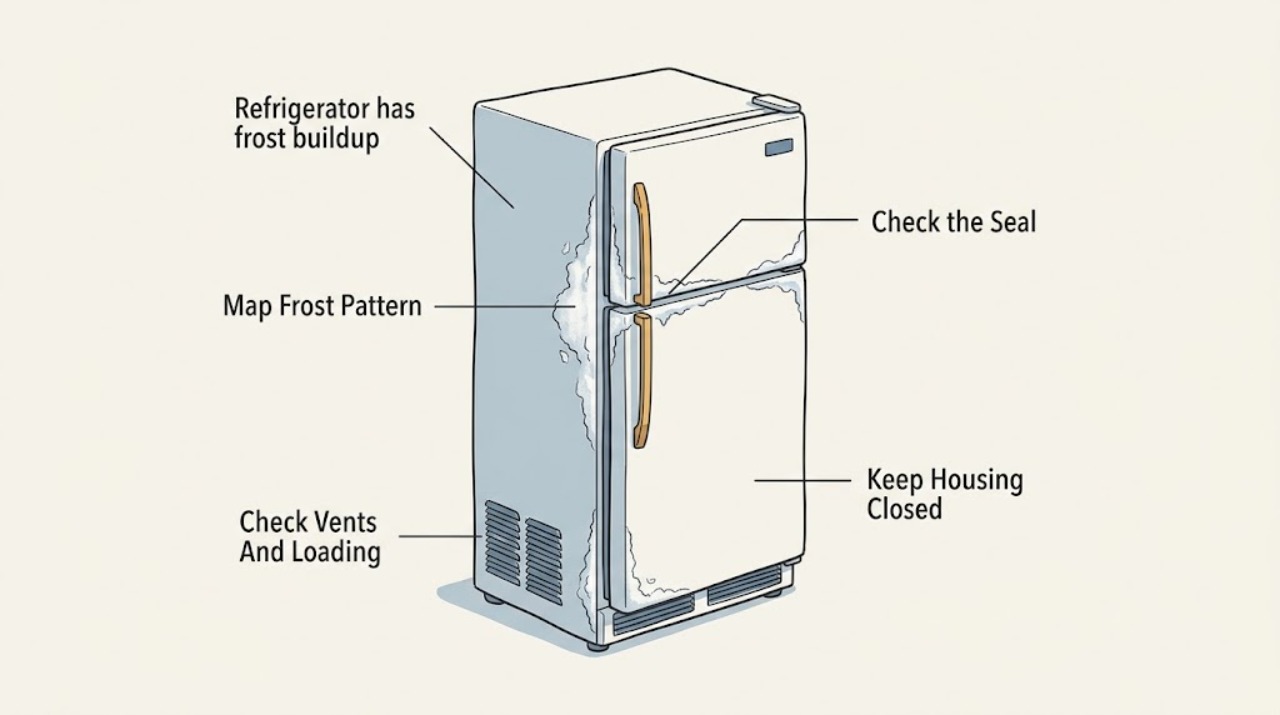
Work through in order
Diagnostic checks
Use only checks that match the exact appliance or system and its official guide.
-
Check 1
Open the Amana refrigerator or freezer briefly and photograph the frost before moving food; inspect from a stable position without touching the ice or removing an interior panel.
Expected result: Record whether frost is a thin even layer, light dust near a vent, a thick sheet on the rear wall, a localized block around a vent or fan cover, ice along the door edge, or frost on packages; note which compartment is affected and whether food temperatures are changing.
Next step: Keep the photos and frost location with the model information, then continue to the door and airflow checks only if the appliance is safe and food remains cold; arrange service for heavy ice or unstable temperatures.
Stop if: Stop for a burning smell, smoke, sparking, damaged wiring, a hot cabinet, spoiled food, or frost that requires panel removal or force to inspect.
Why this matters
Why: A light, temporary pattern can be normal condensation or a recent humidity event. Thick or spreading frost, a door-edge pattern, a blocked-airflow pattern, or unstable cooling makes a seal, vent, defrost, or control problem more likely.
-
Check 2
Check that no package, shelf, bin, or drawer prevents the door from closing, then inspect the visible Amana door gasket for dirt, tears, flattening, gaps, or a section pulled out of position; clean only as directed by the owner's manual.
Expected result: The door closes fully and the gasket contacts the cabinet around its perimeter, or a corner remains open, the gasket is damaged, the door is misaligned, or frost is concentrated along the leaking edge.
Next step: Remove only the obstruction and restore the door arrangement without bending the gasket. If the gasket is damaged, the door will not align, or frost returns after closure improves, arrange model-specific service.
Stop if: Do not pull the gasket from its channel, adjust hinges, force the door, or use heat to reshape it unless the exact Amana manual authorizes that procedure.
Why this matters
Why: An obstruction or poor seal allows humid room air to enter and can produce frost buildup and temperature fluctuation. A clean, continuous seal with frost elsewhere makes a vent, control, or defrost issue more relevant, but it does not prove one.
-
Check 3
Using the model manual to locate the vents, move only loose food packages or containers that are directly blocking the freezer-to-refrigerator airflow path; do not remove the vent cover or scrape ice.
Expected result: The vents are clear and air can circulate, or a package blocks a supply or return vent, food is packed against a rear wall, or ice physically blocks the vent or fan area; note any warm or unusually cold spots.
Next step: Leave clearance around the vents and monitor the frost pattern. If ice blocks a fan or rear panel, or temperatures remain uneven after loading is corrected, stop and arrange qualified appliance service.
Stop if: Do not chip ice, remove an evaporator or fan cover, reach into a running fan, or use direct heat to open the airflow path.
Why this matters
Why: Amana says blocked vents can cause moisture buildup, excessive frost, warm spots, or frozen items because cold air must circulate between compartments. If the vent path is clear but ice still blocks it, an internal airflow or defrost fault is more likely than loading alone.
-
Check 4
Review recent use and the displayed controls: note whether the door was left open, warm or uncovered food was loaded, the room is unusually humid, a power interruption occurred, or the controls were recently changed; use only the exact Amana manual for any control adjustment.
Expected result: The frost followed a one-time humidity or loading event and is light, or it persists despite normal closure and loading; note whether the control display, interior temperature, or cooling run behavior is abnormal.
Next step: Cover liquids, let hot food cool before storage, minimize door-open time, and follow the model manual for settings. If frost or temperature problems persist, provide the history to a qualified technician.
Stop if: Do not open electrical covers, test live components, bypass a sensor or defrost control, or repeatedly change settings while food temperatures are unsafe.
Why this matters
Why: A one-time humidity event can create temporary light frost. Persistent heavy buildup despite normal use points toward a seal, airflow, defrost, sensor, or control issue; controls vary by model, so a generic setting is not a diagnosis.
-
Check 5
After correcting only an obstruction or use-related cause, close the doors fully and monitor the same frost area, cooling behavior, and gasket edge during normal use; do not remove frost with a sharp tool or direct heat.
Expected result: The frost stops spreading and temperatures remain stable, or frost returns in the same pattern, airflow remains blocked, a fan becomes noisy or stops, or the refrigerator cannot maintain safe cooling.
Next step: Keep the doors closed and food protected. Arrange qualified appliance service for recurring frost, a stopped or abnormal fan, unstable temperature, or ice that reaches an internal cover.
Stop if: Stop using the appliance and seek prompt service for smoke, burning odor, electrical damage, severe overheating, spoiled food, or water leaking onto electrical components.
Why this matters
Why: A stable dry pattern after a documented door or loading correction supports a moisture-entry contribution. Recurrence in the same location or a blocked rear compartment makes an internal defrost, fan, sensor, or control issue more likely and is not fixed by repeatedly clearing ice.
Use your observations
Decision map
Find the observation that best matches what you see, then follow the next safe action.
-
PATH 01Safety boundary
What you see
Frost is light, localized near a vent or package, followed a humid or prolonged door-open event, and clears without spreading while temperatures remain stable.
Do this next
Keep doors closed promptly, cover liquids, let hot food cool before storage, keep vents clear, and monitor the same area during normal use.
Why this path and its safety boundary
Why it matters: A temporary condensation or humidity event is more likely than a component failure.
Safety stop: Arrange service if frost becomes heavy, returns repeatedly, or cooling becomes unstable.
-
PATH 02Safety boundary
What you see
Frost or moisture is concentrated along the door edge and the gasket has a gap, dirt, tear, flattened section, or an obstruction prevents full closure.
Do this next
Remove the obstruction and clean the gasket only as directed; arrange model-specific gasket or door service if contact remains uneven or frost returns.
Why this path and its safety boundary
Why it matters: Warm humid air entering at the door seal is more likely than a primary defrost fault.
Safety stop: Do not pull the gasket out, force hinges, reshape it with heat, or continue using the appliance if the door cannot close.
-
PATH 03Safety boundary
What you see
Food blocks a supply or return vent, items are packed against the rear wall, or a clear loading change improves warm or frozen spots.
Do this next
Maintain clearance around the model-specific vents and monitor the result; request service if ice, a fan cover, or the rear panel remains blocked.
Why this path and its safety boundary
Why it matters: Restricted air circulation is a plausible contributor to moisture buildup, excessive frost, and uneven compartment temperatures.
Safety stop: Do not chip ice, reach into a fan, remove panels, or apply direct heat.
-
PATH 04Safety boundary
What you see
A thick or snow-like layer covers the rear panel, returns after ordinary door and loading checks, or the evaporator or fan area is encased in ice.
Do this next
Protect food, follow only the exact manual's defrost instructions, and arrange qualified appliance diagnosis rather than removing the cover or melting ice with heat.
Why this path and its safety boundary
Why it matters: An internal defrost, airflow, sensor, or control problem is more likely than a one-time humidity event.
Safety stop: Do not use sharp tools, open flame, heat guns, hair dryers, boiling water, or panel removal as a frost test.
-
PATH 05Safety boundary
What you see
Frost is accompanied by warm spots, frozen refrigerator food, unusually long or noisy runs, a stopped fan, or temperatures that do not recover normally.
Do this next
Keep food protected and arrange qualified appliance service with the frost location, temperature history, vent condition, and fan observations.
Why this path and its safety boundary
Why it matters: The frost may be obstructing circulation or may be a sign of a broader cooling, fan, defrost, sensor, or control fault.
Safety stop: Stop using the appliance for smoke, burning odor, hot wiring, sparking, water near electrical parts, or unsafe food temperatures.
-
PATH 06Safety boundary
What you see
Frost is temporarily removed according to the manual but returns in the same location, or the door and vents are clear while buildup continues.
Do this next
Stop repeating improvised defrosts, keep the model information and photos, and arrange a qualified appliance service visit.
Why this path and its safety boundary
Why it matters: Clearing ice did not correct the cause; recurring frost makes a seal, defrost, airflow, sensor, or control diagnosis necessary.
Safety stop: Do not repeatedly unplug the unit, bypass defrost components, remove panels, or continue if food temperatures are unstable.
Helpful context
Understand the symptom
Decide whether the frost is normal or excessive
Amana describes a small amount of moisture or frost as expected. In a freezer, a thin even layer on the back wall of a manual-defrost model or a light dusting near vents in an automatic-defrost model may clear during the defrost cycle. Heavy sheets, a snow-like coating that spreads, ice around the door, or frost that returns after it is removed is a different pattern. Photograph the location before disturbing it, because the pattern helps separate air leakage from airflow or defrost concerns.
Warm humid air is the first ordinary-access check
A door left open, frequent openings, warm or uncovered food, or a gasket that cannot seal lets moisture enter and freeze on cold surfaces. Check for a package, shelf, bin, or misaligned door blocking closure, then inspect the gasket for dirt, tears, gaps, or a section pulled out of its channel. Amana also notes that humidity and recent loading can temporarily increase condensation, so one brief episode after a door was left open does not prove an internal failure.
Airflow and defrost parts need different decisions
Amana's vents move cold air between the freezer and refrigerator compartments, and blocked vents can create moisture buildup, excessive frost, warm spots, or frozen items. Clear only movable food packages from the vent path and use the model manual to identify the vents. If ice is packed around a fan, evaporator cover, or rear panel, do not remove the cover or melt it with direct heat; the appliance may need a controlled defrost or a technician's check of the defrost and airflow system.
Protect food and stop unsafe ice removal
Keep the refrigerator closed as much as possible while checking it and move perishable food to a safe cold location if the compartment is no longer maintaining temperature. Do not use a knife, screwdriver, pick, boiling water, heat gun, or hair dryer to break or melt frost, and do not repeatedly reset or unplug an appliance without following its manual. A frost diagnosis is complete when the pattern, door seal, airflow, and recurrence are documented—not when ice has merely been forced away.
Safety boundary
Stop conditions
- Do not chip, scrape, drill, or pry frost or ice with a knife, screwdriver, pick, or other sharp tool.
- Do not use an open flame, heat gun, hair dryer, boiling water, or other direct heat to melt ice near the refrigerator liner, wiring, fan, or controls.
- Do not remove interior panels, reach into a fan, bypass a defrost control or sensor, or test energized appliance parts as a user check.
- Stop for smoke, burning odor, sparking, hot or damaged wiring, water near electrical parts, an unusually hot cabinet, or food temperatures that are no longer safe.
- Arrange qualified appliance service for thick recurring rear-panel frost, a stopped or abnormal fan, blocked evaporator area, unstable cooling, or frost that returns after the door and vent checks.
Only after diagnosis
Potential parts
- Amana refrigerator or freezer door gasket
Consider this category only when inspection confirms a damaged or persistently unseated gasket is preventing a continuous door seal and causing edge frost.
Confirm the exact Amana model, compartment, gasket profile, and installation instructions; do not reshape or substitute a seal by appearance alone. - Amana refrigerator evaporator fan or airflow component
Consider this category only after a qualified diagnosis finds a stopped or abnormal fan or another failed airflow component associated with rear-panel frost and uneven temperatures.
Confirm the exact model and electrical specification through the manufacturer or technician; do not access a fan while energized. - Amana refrigerator defrost system component
Consider this category only when recurring rear-panel frost remains after door and vent checks and a qualified technician identifies a defrost, sensor, or control fault.
Confirm the exact model and diagnosed component before ordering; frost alone does not identify a particular defrost part.
When checks do not resolve it
Need a professional?
Arrange qualified Amana appliance service when frost is thick, spreading, or recurring; the door gasket or alignment cannot be restored; the vents or fan area are iced; temperatures are unstable; a fan is noisy or stopped; or the exact manual calls for internal defrost or component access. Request prompt help for smoke, burning odor, electrical damage, water near electrical parts, a hot cabinet, or unsafe food temperatures. Provide the refrigerator model, frost location and photos, door and gasket observations, vent and loading condition, recent power or humidity event, temperature history, and any authorized defrost result.
Safety scope: This article supports ordinary-access observation, door and gasket inspection, moving loose food from vents, and model-specific control review. Do not chip or heat ice, remove panels, reach into fans, bypass controls, or test energized parts.
Common questions
FAQ
Is any frost in an Amana refrigerator normal?
A small amount of light frost or condensation can be normal, especially after humid air enters or warm food is loaded. Heavy, spreading, door-edge, or recurring frost is a different pattern and calls for door, airflow, and model-specific service checks.
Why is frost building up on the back wall?
Humidity entering through the door, a poor gasket seal, blocked vents, or a defrost or airflow issue can contribute. If the rear panel becomes heavily iced or the frost returns after the door and vent checks, arrange qualified appliance service.
Can I use a hair dryer or knife to remove refrigerator frost?
Do not use a knife, sharp tool, direct heat, boiling water, or a hair dryer near the liner, fan, wiring, or controls. Follow only the exact Amana manual's defrost procedure and use a technician when ice blocks an internal area.
Does a bad door gasket cause frost and temperature fluctuation?
It can. A gap or obstruction lets humid room air enter, which can create frost and unstable temperatures. Check closure and visible gasket condition without pulling or heating the seal, then arrange model-specific service if it cannot seal.
Read the exact guide
Official sources
- How to Check the Air Vents for Blockage-Ensuring Proper Air FlowAmana Product Help · Use for checking and clearing loose food from accessible vent paths; vent locations and internal service are model-specific.
- What's Normal Condensation or FrostAmana Product Help · Use for distinguishing light temporary frost from excessive buildup and for ordinary-access humidity, gasket, airflow, and control checks across Amana refrigerator types.
- How to Help Eliminate Condensation and FrostAmana Product Help · Use for door-open, humidity, gasket, airflow, and model-manual boundaries; it does not identify an internal component failure without model-specific diagnosis.
- Frosting in the Freezer Section - Top Freezer RefrigeratorAmana Product Help · Use for the symptom-led frost branches; top-freezer layout details are model-specific and do not prove the user's refrigerator has that configuration.
- Doors Not Sealing - RefrigeratorAmana Product Help · Use for the gasket and closure inspection; exact door layout and adjustment procedure remain model-specific.
Community feedback
Share a repair observation
Share a plain-text repair observation. Accepted observations are published automatically; this page may take a moment to update.