
On this page
Start here
Quick answer
Frost in a GE refrigerator most often starts when warm, humid air enters through a door or drawer that is left open, blocked, misaligned, or not sealing; food or packaging against the rear wall can also restrict airflow. GE says ice accumulating on the wall of a frost-free refrigerator is not expected. First note whether frost is on the freezer wall, around the door opening, on packages, or in the fresh-food compartment. Remove only visible frost with a dry towel, check that doors close fully and the gasket touches the frame, move packages away from the door and rear wall, and use the exact model manual for temperature and leveling guidance. If frost returns after those checks, the freezer fan does not run, the gasket is torn, or frost blocks normal operation, stop repeated defrosting and arrange qualified appliance service.
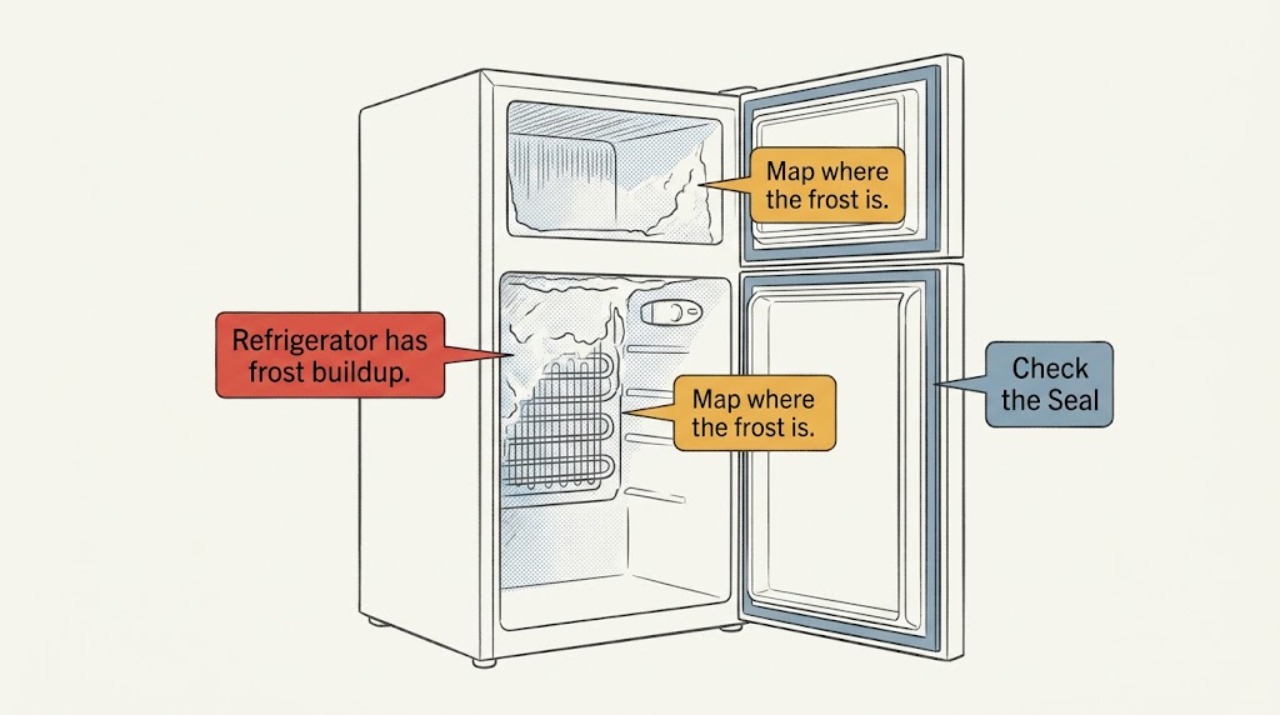
Work through in order
Diagnostic checks
Use only checks that match the exact appliance or system and its official guide.
-
Map where the frost is forming
Without scraping the ice or moving a connected refrigerator, note whether frost is on the freezer rear wall, ceiling, shelves, food packages, door opening, gasket, or fresh-food compartment. Record whether it is a thin coating, one concentrated patch, or a thick layer that blocks a drawer or vent.
Expected result: Frost is on packages after an open-door event; concentrated on the rear wall; around the door or drawer edge; widespread inside the freezer; or present in the fresh-food compartment.
Next step: Use the matching branch below and photograph the pattern before defrosting. Keep food safely cold and arrange service if ice blocks the door, vents, or normal operation.
Stop if: Do not chip frost with a knife or sharp tool, force a frozen drawer, or remove interior panels to find the source.
Why this matters
Why: Frost on packages after warm-air exposure favors a door or loading event. A rear-wall sheet or widespread frost in a frost-free section is more concerning for ongoing air entry, blocked airflow, or a defrost or fan problem. Fresh-food frost requires model-specific guidance because the air path differs by refrigerator design.
-
Check door, drawer, and gasket closure
Close each refrigerator and freezer door or drawer slowly and look for a package, bin, basket, ice buildup, or shipping material holding it open. With the door open and power disconnected if you will clean or adjust anything, inspect whether the gasket is seated in its groove, touches the frame evenly, and has no tear, split, fold, or loose section.
Expected result: A package holds the door open; the gasket is loose, folded, torn, or uneven; the drawer basket is not seated; or the door closes and seals evenly.
Next step: Remove the obstruction and reseat only a gasket section that the GE model guidance permits. Do not use the refrigerator normally with a torn gasket or door that cannot seal; arrange a model-specific gasket or alignment repair.
Stop if: Do not force hinges, bend the door, remove a gasket retainer, or use heat against a plastic liner unless the exact GE instructions permit it.
Why this matters
Why: A closure or gasket gap lets humid room air enter and can create frost near the opening or on the adjacent wall. A sound, even seal makes repeated air entry less likely and shifts attention to loading, airflow, or automatic defrost.
-
Correct the humidity and loading pattern
Move food and containers away from the rear freezer wall, vents, and door edge. Note whether the frost began after loading warm food, frequent or prolonged door openings, a humid period, or an installation event; make sure packages do not prevent the door or drawer from closing.
Expected result: Packages touch the rear wall, block an air passage, or hold the door open; warm food was recently loaded; the door was opened often; or none of those patterns apply.
Next step: Rearrange the load and allow the model's normal cooling and defrost behavior to work. If frost continues after the loading and closure pattern is corrected, continue to the fan and service branch.
Stop if: Do not block vents, overpack the freezer, or keep opening the door to inspect frost while the appliance is trying to recover.
Why this matters
Why: GE lists high humidity, frequent door openings, warm food loads, rear-wall contact, and packages holding the door open as causes or contributors to freezer-wall ice. If none applies and frost is concentrated on a frost-free wall, an appliance-side fault is more plausible.
-
Check accessible airflow and the freezer fan clue
With the refrigerator door open only briefly and without touching the fan or removing a cover, look for packages blocking the documented air passages. If the model's normal operation makes the freezer fan audible or otherwise observable, note whether it runs; do not reach into the fan or defeat a door switch.
Expected result: A package blocks an air passage; the fan does not run when the model should circulate air; the fan is noisy or obstructed; or airflow and fan behavior appear normal.
Next step: Move only an accessible package obstruction. If the fan is absent, noisy, obstructed, or the frost returns with clear airflow, keep the refrigerator out of service as needed and arrange qualified repair.
Stop if: Do not remove fan covers, touch a fan blade, bypass a door switch, or continue operation with ice contacting the fan.
Why this matters
Why: Blocked airflow can create a local frost pattern, while GE says a freezer fan that is not running is a service clue when ice remains on a frost-free wall. Normal visible airflow does not rule out a hidden defrost or temperature-control fault.
-
Use the exact model manual for temperature and leveling
Find the full GE model number and use the owner manual or installation instructions to confirm the recommended temperature-control range, door alignment, and leveling checks. Do not change settings repeatedly while the refrigerator is heavily iced, and do not use a generic adjustment procedure from another GE family.
Expected result: The temperature control was changed recently, the door is visibly uneven, the refrigerator is not level, the model manual identifies a different adjustment, or settings and alignment are already correct.
Next step: Apply only a model-documented, low-risk setting or leveling check. If the door still does not seal or frost returns after the documented correction, call qualified service.
Stop if: Do not tilt or move a large refrigerator alone, remove a door, or alter sealed-system or control wiring as a leveling or temperature check.
Why this matters
Why: GE directs owners to the model manual for temperature adjustment, door adjustment, and leveling. A misaligned or unlevel refrigerator can compromise closure; correct settings and alignment make a persistent frost-free-wall buildup more likely to need service.
-
Remove visible frost safely and monitor recurrence
If the frost is accessible and the model guidance permits it, disconnect refrigerator power before maintenance and remove visible frost with a dry towel. Restore only the documented normal setup, then photograph the previously affected area and monitor whether frost returns after the door seal, load, and airflow issues are corrected.
Expected result: The frost clears and does not return after the cause is corrected; it returns on the same wall; it returns around the gasket; or it blocks a vent, fan, drawer, or door again.
Next step: Keep food protected and arrange qualified appliance service for recurring or obstructive frost. Give the technician the frost location, recurrence pattern, model number, door-seal findings, and fan observations.
Stop if: Do not use knives, picks, heat guns, hair dryers, or other improvised tools to melt or chip frost, and do not remove interior panels.
Why this matters
Why: No recurrence after correcting warm-air entry supports a door, loading, or humidity cause. Frost that returns in the same frost-free location or interferes with airflow points toward a fan, defrost, temperature, or sealed-system problem requiring diagnosis.
-
Escalate persistent frost or a damaged seal
If frost continues after the door, gasket, load, airflow, temperature, and leveling checks, or if the gasket is torn, the freezer fan does not run, the door will not close, or frost returns on a frost-free wall, stop repeated defrosting. Keep the doors closed as much as practical and arrange qualified service.
Expected result: The issue resolves after a closure or loading correction; the gasket or fan is damaged; frost repeatedly returns in a frost-free section; or no safe cause is identified.
Next step: Schedule model-specific appliance repair and provide the exact model, frost location, photos, recurrence timing, temperature observations, door and gasket condition, and fan behavior.
Stop if: Do not run the refrigerator indefinitely with frost blocking the fan or vents, and do not test defrost components, wiring, or refrigerant circuits as a homeowner.
Why this matters
Why: Resolution after correcting warm-air entry supports a user-correctable cause. A damaged gasket, failed fan, recurring frost, or unexplained buildup is more consistent with a part, defrost, airflow, control, or sealed-system issue.
Use your observations
Decision map
Find the observation that best matches what you see, then follow the next safe action.
-
PATH 01Next step
What you see
Frost is on packages or near the door opening after frequent openings, a warm load, high humidity, a package against the rear wall, or a package holding the door or drawer open, and the gasket closes evenly.
Do this next
Rearrange the load, close the door fully, reduce unnecessary openings, and remove only accessible frost with the model-approved method. Monitor whether the buildup stops.
Why this path and its safety boundary
Why it matters: Warm, humid air entry or blocked circulation is more likely than an automatic-defrost failure.
-
PATH 02Next step
What you see
Frost traces the gasket or door edge, the gasket is loose, torn, folded, or uneven, or the door or drawer does not meet the frame evenly.
Do this next
Remove obstructions and reseat only what the exact GE instructions permit. Keep the appliance out of normal use and arrange gasket or door-alignment service for a torn seal, damaged frame, or persistent gap.
Why this path and its safety boundary
Why it matters: A sealing or alignment gap is allowing humid air into the compartment and is more likely than a load-only issue.
-
PATH 03Next step
What you see
Frost is concentrated near a rear wall or vent, packages blocked the air path, or the freezer fan is not running or is obstructed.
Do this next
Move only accessible package obstructions. If the fan is absent, noisy, blocked by ice, or the pattern returns, stop and arrange qualified service.
Why this path and its safety boundary
Why it matters: Restricted circulation or a fan problem is more likely; frost can worsen if cold air cannot move through the compartment.
-
PATH 04Next step
What you see
The refrigerator is described as frost-free, but frost or ice returns on the freezer wall after door, gasket, load, airflow, temperature, and leveling checks are correct.
Do this next
Keep the refrigerator doors closed and schedule qualified appliance diagnosis rather than repeatedly removing the ice or changing settings.
Why this path and its safety boundary
Why it matters: GE says this is not expected; a defrost, fan, sensor, control, or other appliance-side fault is more likely than normal frost.
-
PATH 05Safety boundary
What you see
Frost is in the fresh-food compartment, blocks a fan or vent, prevents a door or drawer from closing, or causes temperature or food-storage concerns.
Do this next
Protect perishable food, avoid forcing the door or removing interior panels, and call qualified appliance service with the model number and frost photos.
Why this path and its safety boundary
Why it matters: The pattern is outside the simple freezer-wall checks or is interfering with operation; model-specific airflow and defrost service is needed.
Safety stop: Do not continue operation when ice contacts a fan, blocks a vent, or keeps a door from sealing.
Helpful context
Understand the symptom
The location and shape of the frost matter
A light coating on frozen packages after a door was left open is a different pattern from a thick sheet on one freezer wall, frost around the gasket, or ice in the fresh-food compartment. Record where it starts, whether it is one-sided or widespread, whether food touches the rear wall, and whether the door or drawer closes evenly. GE's refrigerator support library directs owners to model-specific manuals and support for the appliance type.
Air enters through a sealing or loading problem
Frequent openings, warm food, high humidity, packages that hold a door open, and food pressed against the rear wall can all create a frost pattern. A gasket that is torn, folded, loose, or not touching the frame evenly can let humid air in continuously. Correct the safe loading and closure issue first; do not assume the defrost system has failed from frost alone.
A frost-free wall that keeps icing needs service
GE says ice on the wall of a frost-free refrigerator is not expected. If correcting the door, load, humidity, and airflow clues does not stop the buildup, or if the freezer fan is not running, the cause may be beyond a homeowner adjustment. Do not keep removing the same frost without addressing the reason it returns.
Defrost and clean without damaging the appliance
Before maintenance or cleaning, GE recommends disconnecting power to minimize electric-shock risk. Remove only visible frost with a dry towel as directed for the frost concern, and use the exact owner manual for any complete defrost procedure. Never puncture the liner or cooling system, and do not disassemble the evaporator, fan, or defrost controls as a first check.
Safety boundary
Stop conditions
- Disconnect refrigerator power before maintenance or cleaning as GE advises; do not touch fans, wiring, or internal components while energized.
- Do not chip frost with a knife, pick, or sharp tool, and do not use improvised heat or puncture the liner or cooling system.
- Stop normal use and call service for a torn gasket, door that will not seal, fan that does not run, frost blocking vents or a drawer, or recurring frost on a frost-free wall.
- Do not remove interior panels, test defrost components, alter sealed-system parts, or move a large refrigerator without model-specific instructions and proper help.
Only after diagnosis
Potential parts
- refrigerator or freezer door gasket
Consider this category only when the gasket is torn, split, loose, permanently deformed, or fails the model-specific closure check and frost traces the door opening.
Confirm the complete GE model and door or drawer configuration before selecting a gasket; do not order by refrigerator appearance alone. - freezer evaporator fan motor or blade assembly
Consider this category only when a qualified diagnosis confirms the fan is not running or is damaged after accessible airflow obstructions are removed.
Verify the exact GE model and diagnosed fan assembly before ordering; do not touch or replace a fan behind an interior cover as a first check. - automatic defrost sensor, heater, or control component
Consider this category only when recurring frost on a frost-free wall remains after sealing and airflow checks and qualified testing identifies a defrost or control fault.
Defrost components vary by GE model and require model-specific diagnosis; do not select a part from the frost symptom alone.
When checks do not resolve it
Need a professional?
Arrange qualified appliance service when frost returns after the door, gasket, load, airflow, temperature, and leveling checks; when a freezer fan is not running; when a gasket is torn or the door will not seal; when frost blocks a fan, vent, or drawer; or when frost appears in a fresh-food compartment and the model manual does not resolve it. Keep food protected and provide the full GE model number and frost pattern.
Have this ready
- Provide the full GE model number, refrigerator type, frost location and photos, whether it is on the wall, packages, gasket, or fresh-food side, door and drawer closure observations, recent loading or installation changes, temperature concerns, and whether the freezer fan runs when expected.
Common questions
FAQ
Is frost on a GE refrigerator freezer wall normal?
GE says ice accumulating on the wall of a frost-free refrigerator or freezer is not expected. Check door closure, gasket condition, humidity, warm food loads, packages against the rear wall, and freezer-fan operation. If frost returns after those checks, arrange service.
Can a GE refrigerator door gasket cause frost buildup?
Yes. A torn, split, loose, folded, or uneven gasket can let humid air enter. Remove packages that hold the door or drawer open, confirm the gasket is seated and touches the frame evenly, and use the exact GE model instructions for adjustment or replacement.
Why is frost forming on food or the freezer rear wall?
GE lists frequent door openings, high humidity, warm food, packages against the rear wall, and packages that prevent closure as possible contributors. Move food away from the wall and vents, correct the closure issue, and monitor whether the pattern stops. A recurring frost-free-wall sheet needs service.
Should I scrape the frost off a GE refrigerator?
Use only the model-approved method. GE's frost guidance says to remove visible buildup with a dry towel and its safety guidance recommends disconnecting power before maintenance. Do not chip ice with a sharp tool or remove interior panels; call service if frost returns or blocks airflow.
Read the exact guide
Official sources
- Refrigerator & Freezer - Ice on Freezer WallGE Appliances · GE frost-free refrigerator freezer-wall ice causes, electrical safety, gasket, airflow, fan, and service escalation
- Top Freezer Refrigerator - Adjusting or Replacing the Door GasketsGE Appliances · GE top-freezer refrigerator gasket power isolation, seating, damage, and model-specific adjustment or replacement guidance
- Bottom Freezer Refrigerator - Freezer Drawer Not Sealing ProperlyGE Appliances · GE French-door and bottom-freezer drawer closure, gasket seating, frame contact, and frost-formation guidance
- Refrigerator and Freezer Troubleshooting and SupportGE Appliances · GE refrigerator and freezer model-specific support, manuals, troubleshooting, and qualified service routing
- Refrigerator - Frost in FreezerGE Appliances · GE refrigerator freezer frost, door closure, gasket, alignment, leveling, and service guidance
Community feedback
Share a repair observation
Share a plain-text repair observation. Accepted observations are published automatically; this page may take a moment to update.