
On this page
Start here
Quick answer
Frost buildup in a KitchenAid refrigerator usually starts with humid air entering through a door that is left open, blocked, or not sealing, but blocked vents, leveling, temperature settings, or an internal cooling or defrost problem can also be involved. First record where the frost is forming, confirm the doors close and the gaskets make contact, clear the model-specific air vents, and check that food is not holding a door open. Use the exact owner's manual for temperature and defrost instructions. If a thick layer returns quickly after a permitted defrost, the freezer is warm, a fan or control is abnormal, or the gasket is damaged, stop removing panels and arrange qualified appliance service.
Before you begin
Safety first
- Do not remove panels, probe energized wiring, chip ice near liners or tubing, use flame or directed heat, or continue operating through a leak, damaged seal, abnormal fan, error, or unsafe temperature condition.
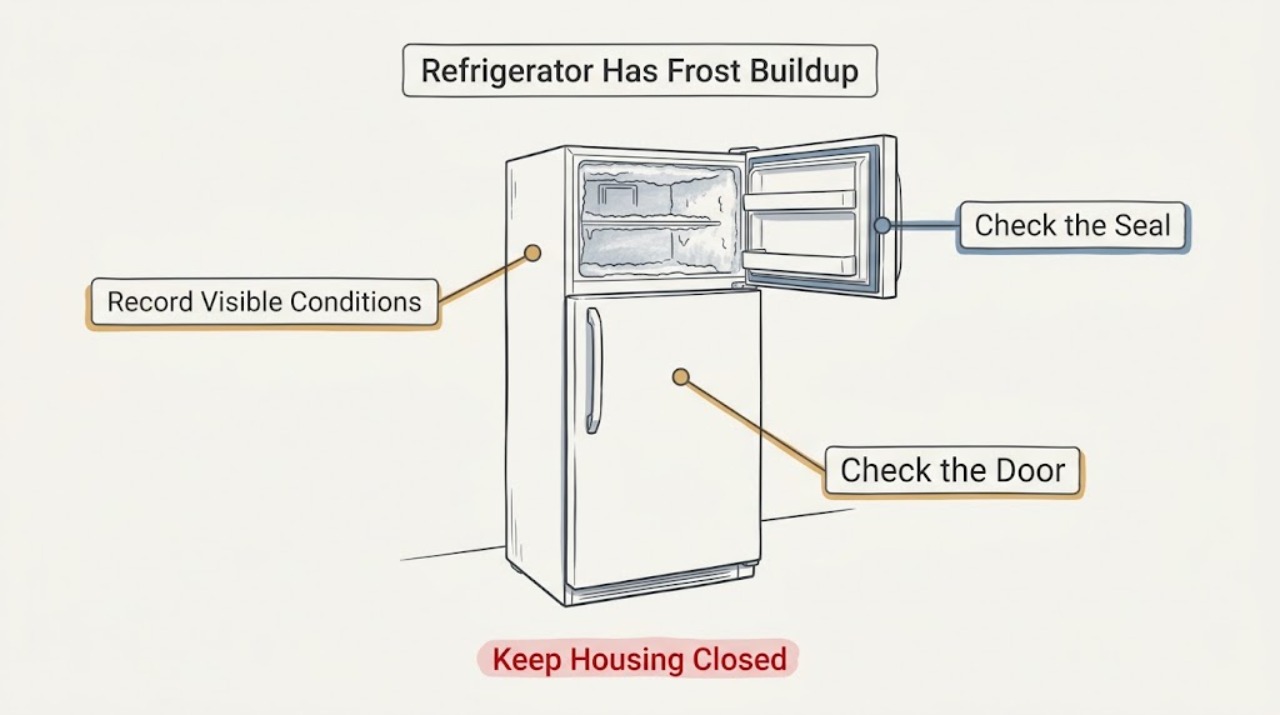
Work through in order
Diagnostic checks
Use only checks that match the exact appliance or system and its official guide.
-
Check 1
Map the frost before disturbing it: record whether it is in the freezer, on the refrigerator back wall, around a door edge, beside an air vent, on packages, or spread across an entire panel. Note whether the freezer is cold, whether food is softening, and whether the same area frosts again.
Expected result: Frost is limited to a door edge or vent, is a light surface film after frequent opening, covers a broad panel, or returns quickly while temperatures are abnormal.
Next step: Photograph the pattern and continue with the matching door, airflow, and control checks without prying at the ice or removing covers.
Why this matters
Why: A localized edge pattern makes a door seal or obstruction more likely, while a broad or rapidly returning pattern needs airflow, control, or professional diagnosis. Frost location alone cannot identify a failed defrost part.
-
Check 2
Check both refrigerator and freezer doors for a package, shelf, drawer, ice bin, or misaligned door that prevents complete closure. Wipe the gasket with warm water, inspect it for tears or gaps, and check whether it makes continuous contact with the cabinet when the door is closed.
Expected result: A package blocks the door, the gasket is dirty but intact, the gasket has a tear or gap, or the door closes squarely with full gasket contact.
Next step: Move the obstruction and clean the gasket, then observe whether the door closes fully. If the seal is torn, loose, or still does not contact the cabinet, arrange service and avoid relying on a temporary seal adjustment.
Why this matters
Why: An obstruction, dirty seal, or poor alignment can let humid room air enter and create frost. A damaged gasket or door that will not seal is a repair issue, not a reason to keep defrosting repeatedly.
-
Check 3
Review recent use: note long or frequent door openings, a door left ajar, hot food or uncovered liquid added to the cabinet, and unusually humid room conditions. Close the doors promptly and keep containers covered while you monitor the same frost location.
Expected result: Frost appeared after a door was left open or opened often, after a humid event, or without any change in use.
Next step: Reduce door openings and correct uncovered moisture, then monitor. If frost continues to grow under normal use, proceed to vent, level, and model-specific temperature checks.
Why this matters
Why: KitchenAid explains that humid air entering through open doors can produce frost and that some frost or sweating can be normal in high humidity. Frost that appears without an air-intrusion event is less likely to be explained by usage alone.
-
Check 4
Find every air vent in the refrigerator and freezer using the exact owner's manual. Move food, bins, and packages away from the openings without forcing a shelf or covering a vent, and listen for any abnormal fan noise without removing an interior panel.
Expected result: A vent is blocked, airflow is unobstructed, a fan sounds abnormal, or the vent location cannot be confirmed for the model.
Next step: Restore clearance and monitor. If a fan is scraping, silent when the manual indicates it should run, or inaccessible behind a cover, stop and arrange qualified service instead of disassembling the liner.
Why this matters
Why: KitchenAid says blocked vents can contribute to moisture buildup or excessive frost and that vent locations vary. An unobstructed vent with abnormal fan behavior or continuing frost needs more than rearranging food.
-
Check 5
Check that the refrigerator is level front-to-back and side-to-side as described in the KitchenAid manual, and observe whether the doors sit squarely and close by themselves as intended. Do not pull out a built-in unit or adjust leveling hardware without the model's instructions and safe access.
Expected result: The cabinet or floor is visibly out of level, a door is misaligned, or the refrigerator and doors appear level while frost persists.
Next step: Correct only a clearly identified leveling issue using the exact instructions. If the door cannot align or frost remains after the seal and level checks, arrange service rather than repeatedly adjusting the feet.
Why this matters
Why: KitchenAid links leveling and door alignment with proper sealing and frost or moisture concerns. A level cabinet makes a door-seal or internal cooling issue more relevant, but it does not prove a particular part has failed.
-
Check 6
Verify the refrigerator and freezer controls against the exact owner's manual and make only the model-approved small adjustment, if one is needed. Allow the manual's stabilization period before judging the result, and do not use a colder setting to conceal a frost pattern while the refrigerator section is warming.
Expected result: A control was set outside the model's guidance, temperatures stabilize after the permitted adjustment, or frost continues while food temperatures are abnormal.
Next step: Return to the model-recommended setting and monitor. If the refrigerator is warm, the freezer is not holding temperature, an error appears, or the frost returns rapidly, stop adjusting controls and arrange qualified appliance service.
Why this matters
Why: Incorrect settings can contribute to temperature and moisture problems, but a persistent frost pattern with abnormal temperatures may involve an airflow, sensor, defrost, or sealed-system issue that settings cannot safely diagnose.
-
Check 7
If the exact manual permits an owner defrost, follow it with food safely relocated, cooling turned off as directed, and the unit protected from meltwater. Let ice melt by the manual's method; never chip ice with a sharp tool, apply a flame, or direct heat into the cabinet, and do not remove panels to reach hidden components.
Expected result: Frost clears and stays away after the door, vent, and use checks, or a thick layer returns quickly after the permitted defrost.
Next step: If frost returns quickly, temperatures are abnormal, meltwater leaks, or the manual does not provide a safe defrost procedure, stop and arrange qualified service. Keep the frost photos and timing for the technician.
Why this matters
Why: A one-time buildup after humid-air entry may resolve when the source is corrected. Rapid recurrence or a solid, repeating frost pattern is a service clue, not proof that a defrost heater, sensor, fan, or control should be replaced by the homeowner.
Use your observations
Decision map
Find the observation that best matches what you see, then follow the next safe action.
-
PATH 01Next step
What you see
Frost is concentrated along a door edge, and a package, dirty gasket, or misaligned door prevents continuous gasket contact.
Do this next
Clear the obstruction and clean the gasket, then verify full closure. Arrange service for a torn gasket or a door that remains misaligned.
Why this path and its safety boundary
Why it matters: Humid-air entry through the door seal is more likely than an internal defrost failure.
-
PATH 02Next step
What you see
A light frost film follows frequent or prolonged door openings in a humid room, while the doors seal and temperatures remain normal.
Do this next
Minimize openings, close doors promptly, keep liquids covered, and monitor the same location rather than repeatedly scraping the surface.
Why this path and its safety boundary
Why it matters: Recent humidity entering the cabinet is a plausible explanation, and some frost or sweating can occur in high humidity.
-
PATH 03Next step
What you see
Frost forms beside or across an air vent, and food or a bin is blocking the vent.
Do this next
Use the exact manual to restore vent clearance and monitor. Do not remove a cover to inspect the fan or hidden air duct.
Why this path and its safety boundary
Why it matters: Restricted airflow is more likely, and the obstruction can affect moisture and temperature distribution.
-
PATH 04Next step
What you see
A level and sealed refrigerator develops a thick sheet that returns quickly after an allowed defrost, or the freezer is warm while frost grows.
Do this next
Stop repeated defrosting and arrange qualified appliance diagnosis. Provide the model number, frost location and rate of return, temperatures, and any fan noise or error.
Why this path and its safety boundary
Why it matters: An internal airflow, defrost, sensor, control, or sealed-system issue becomes more plausible, but the frost pattern cannot select a failed part.
-
PATH 05Next step
What you see
The cabinet is out of level, doors do not align, or the gasket will not make full contact even after accessible obstructions are removed.
Do this next
Follow only the exact model's leveling instructions if safe to access; otherwise arrange service. Do not force a door or move a built-in refrigerator alone.
Why this path and its safety boundary
Why it matters: Leveling or door hardware is preventing a reliable seal and can sustain frost or moisture problems.
-
PATH 06Next step
What you see
There is water leaking onto wiring or the floor, an exposed or damaged liner, a scraping or silent fan, an error, food temperatures are unsafe, or the door seal is torn.
Do this next
Stop using the affected functions, protect food and flooring, disconnect power only if safe and directed by the manual, and arrange qualified appliance service. Do not open panels or continue operating through a leak or abnormal heat.
Why this path and its safety boundary
Why it matters: The condition exceeds routine frost and airflow checks and may cause water, electrical, food-safety, or mechanical risk.
Helpful context
Understand the symptom
The frost pattern changes the next check
A light film after a humid day, frost around a door edge, a patch beside a vent, and a thick sheet across the freezer back wall are different observations. Note the compartment, location, thickness, whether the freezer is still cold, and how quickly frost returns after it is removed. This record prevents a door-seal issue from being confused with an airflow or internal service problem.
Model-specific details matter
KitchenAid refrigerator layouts place vents, controls, drawers, and door hardware differently. Use the model number and matching owner's manual before changing temperature settings, leveling the cabinet, or attempting a defrost. Do not remove an interior cover to reach a fan or heater as a first troubleshooting step.
Safety boundary
Stop conditions
- Do not chip frost with a knife or other sharp tool, use a flame or directed heat, remove interior panels, or test a hidden fan, heater, sensor, or control as a first troubleshooting step.
- Stop and arrange qualified appliance service for a thick frost layer that returns quickly, a warm freezer or refrigerator, abnormal fan noise, an error, damaged liner or gasket, meltwater near electrical parts, or a refrigerator that cannot close and seal.
- If the owner's manual does not provide a safe defrost or leveling procedure for the exact model, do not improvise. Keep the model number, frost photos, temperature observations, and timing for the technician.
Only after diagnosis
Potential parts
- KitchenAid refrigerator door gasket
Consider only when the exact model's gasket is torn, deformed, loose, or unable to make full contact after accessible obstructions and cleaning are addressed.
Gasket profile and door configuration vary by KitchenAid model. Confirm the exact model and service diagnosis before selecting a replacement. - KitchenAid refrigerator defrost sensor or thermostat
Consider only after qualified diagnosis finds a defrost-sensing fault associated with rapidly returning frost and rules out door, humidity, vent, leveling, and control-setting causes.
Defrost components and access differ by KitchenAid model. Do not choose or test one from frost appearance alone. - KitchenAid refrigerator evaporator fan or defrost heating component
Consider only when qualified service identifies an airflow or defrost-component failure after the external checks and model-specific procedure are complete.
Fan and defrost assemblies vary by refrigerator configuration and may require panel removal and electrical diagnosis. Confirm exact model fit and professional installation.
When checks do not resolve it
Need a professional?
Arrange qualified appliance service when frost returns quickly after the exact model's permitted defrost and external checks, when the freezer or refrigerator is not maintaining temperature, when a fan is scraping or silent abnormally, when an error appears, when the gasket or liner is damaged, when meltwater reaches electrical components, or when doors cannot be aligned and sealed. Provide the model number, compartment and frost location, thickness and rate of return, door and gasket findings, vent clearance, temperature settings, and any abnormal sounds or leaks.
Safety scope: Do not remove panels, probe energized wiring, chip ice near liners or tubing, use flame or directed heat, or continue operating through a leak, damaged seal, abnormal fan, error, or unsafe temperature condition.
Common questions
FAQ
Why does my KitchenAid refrigerator have frost buildup?
Start with humid-air entry: check for a door left open, a blocked door, a dirty or damaged gasket, and frequent openings. Then clear model-specific vents and verify level and settings. Frost that returns quickly or accompanies abnormal temperatures needs qualified service rather than repeated scraping.
Can a bad KitchenAid refrigerator door seal cause frost?
Yes. KitchenAid says an improper gasket seal can allow humidity to form, and its maintenance guidance recommends inspecting and cleaning the gasket. Confirm full contact around the closed door; a torn or loose gasket should be evaluated for replacement using the exact model.
What should I do if frost is blocking a KitchenAid refrigerator vent?
Do not chip at the vent or remove its cover. Move food and bins away from the opening using the exact manual to locate vents, and follow the manual if it provides a safe defrost procedure. If the frost returns or airflow is abnormal, arrange service.
Should I replace a KitchenAid defrost heater or sensor because of frost?
Not from frost appearance alone. Door sealing, humidity, blocked vents, leveling, controls, airflow, and several internal faults can look similar. Have a qualified technician identify the failed component and confirm the exact model before selecting a part.
Read the exact guide
Official sources
- REFRIGERATOR USER INSTRUCTIONSKitchenAid · Official KitchenAid owner manual for the referenced refrigerator family; use the manual matching the exact model for controls, defrost, and component access.
- Unable to Level - Refrigerator - Product Help | KitchenAidKitchenAid · Official KitchenAid Product Help guide for full-size French-door bottom-freezer refrigerators; leveling and door-adjustment instructions are model-specific.
- Preventative Maintenance for Refrigerators - Product Help | KitchenAidKitchenAid · Official KitchenAid refrigerator maintenance guidance covering gasket inspection and model-specific care instructions.
- Frosting in the Freezer Section - Refrigerator - Product Help | KitchenAidKitchenAid · Official KitchenAid Product Help guide for full-size French-door bottom-freezer refrigerators; the model manual controls differences in layout and features.
Community feedback
Share a repair observation
Share a plain-text repair observation. Accepted observations are published automatically; this page may take a moment to update.