
On this page
Start here
Quick answer
Start by locating the odor rather than treating every smell as a failed refrigerator. A spoiled-food or spill odor usually follows the fresh-food or freezer compartment, drawer, gasket, ice bin, or a container; remove the source and clean only accessible surfaces. Frigidaire says freezer odor can come from strong foods or wrapping materials and recommends cleaning the interior with warm water and baking soda. If the odor is mainly from ice or water, consider old ice, a recently installed filter, or newly installed water lines; follow the exact model's prime-and-purge instructions and use the model's filter guidance. A musty odor with visible moisture or residue suggests a wet, inaccessible, or mold-contaminated area and needs model-specific cleaning guidance or service if it is behind panels, below the cabinet, or in a drain path. A burning, melting-plastic, solvent-like, or chemical odor, smoke, sparks, hot cord, repeated breaker operation, refrigerant hiss, or water near electrical parts is a stop condition: keep the refrigerator off, isolate power only from a dry safe location, ventilate without entering a hazardous area, and arrange qualified service. Do not use bleach or ammonia around the refrigerator, mix cleaners, open the sealed system, or dismantle the compressor compartment.
Before you begin
Safety first
- The user may locate the odor, remove spoiled food or old ice, wipe accessible surfaces with the model-authorized method, check an accessible filter and visible water condition, and follow model-authorized prime-and-purge steps. Rear-cover, drain-pan, compressor, wiring, refrigerant, live electrical, water-line disconnection, and inaccessible mold or condensate work belong to qualified service.
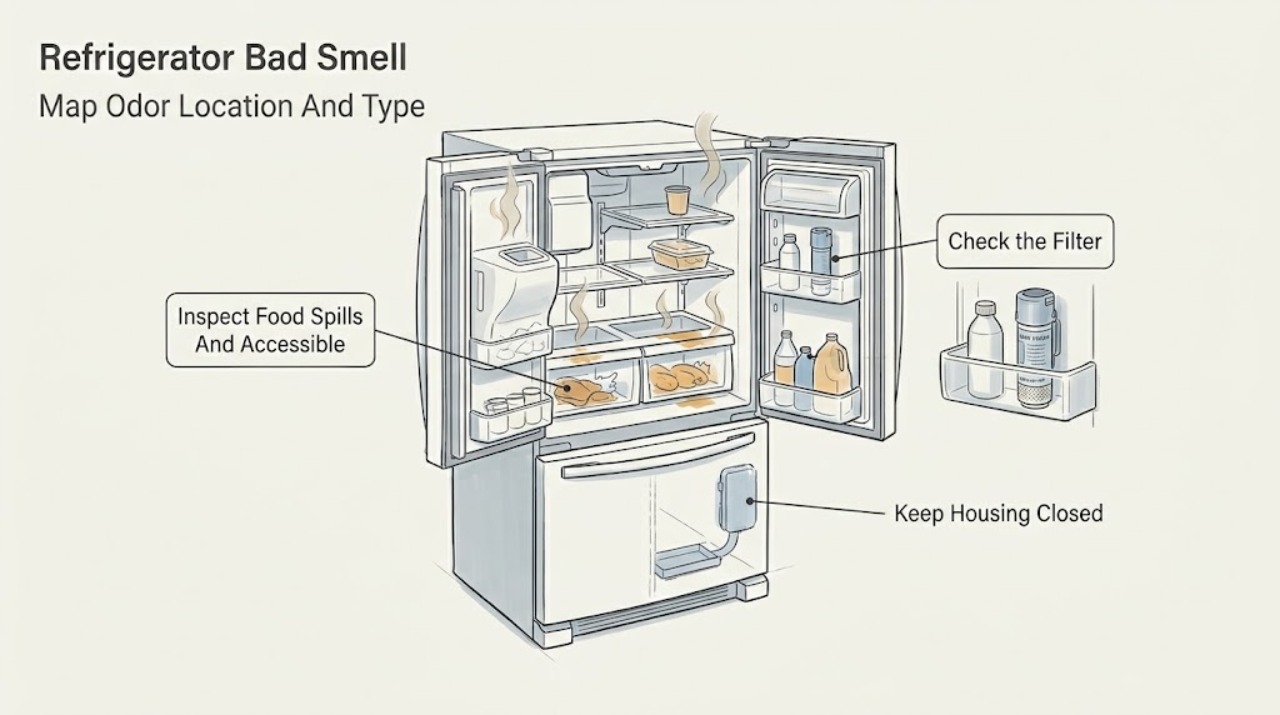
Work through in order
Diagnostic checks
Use only checks that match the exact appliance or system and its official guide.
-
Check 1
From a safe position, identify whether the odor is stale or spoiled-food-like, musty, sour, limited to ice or water, or sharp like burning plastic or chemicals. Compare the fresh-food compartment, freezer, ice bin, dispenser area, gasket folds, and floor area without removing panels or placing your face near vents.
Expected result: The smell follows one food/container or shelf, is strongest in the freezer or ice bin, is present in water and ice, is musty with moisture, or is sharp, chemical, smoky, or electrical.
Next step: For food or residue, move to the accessible cleaning check. For ice/water or musty moisture, use the water/filter or wet-area branch. For burning, chemical, smoky, or electrical odor, stop operation and arrange service.
Stop if: Do not taste questionable water or food, use an open flame to find a leak, sniff inside a sealed compartment, or continue operating a hazardous appliance.
Why this matters
Why: Location and character narrow the branch: food and residue, ice or water, wet/musty residue, and electrical or sealed-system hazards require different next steps. Odor alone cannot identify a failed part.
-
Check 2
If the odor is in a food compartment, switch to a safe cleaning state and remove only clearly spoiled food, old ice, leaking containers, and visible residue. Wipe shelves, drawers, liners, door bins, gasket folds, and the accessible freezer interior with the cleaning method allowed by the exact manual; use a wrung-out cloth around controls, lights, and electrical parts, then dry the surfaces.
Expected result: A spoiled item or spill is found, old ice smells stale, the gasket or drawer contains residue, or accessible surfaces are clean but the odor remains.
Next step: Discard the source, clean and dry the affected accessible parts, and recheck after the compartment returns to normal operation. If odor remains or returns with no visible source, continue to the model and filter checks rather than adding stronger chemicals.
Stop if: Do not mix cleaners, use bleach or ammonia around the refrigerator, flood the interior, wash removable bins in a dishwasher unless the manual permits it, or clean around energized electrical parts with a wet cloth.
Why this matters
Why: A localized source that disappears after removal makes food or residue the leading explanation. A persistent odor after accessible cleaning points toward a hidden wet area, air-filter issue, water/ice path, or non-food hazard.
-
Check 3
If the odor is in the air throughout the refrigerator or is present in dispensed water or ice, identify whether the model has an air filter and whether the water filter was recently installed, is overdue, loose, cracked, or frozen. Use the exact model manual for filter access and fit; do not open a filter housing under pressure or disconnect water tubing.
Expected result: An air filter is present and overdue, a water filter was recently changed or is not seated, the smell is only in ice/water, or both air and water remain odorous after the model-authorized filter checks.
Next step: Replace only a model-compatible filter after verifying the exact type and follow the manual. Use the prime-and-purge procedure after a new water filter or installation. If the odor remains, is accompanied by a leak, or access is not user-authorized, arrange service.
Stop if: Do not use a look-alike filter, force the housing, bypass the filter, pour chemicals into the water line, or continue using water or ice that may be contaminated.
Why this matters
Why: An overdue air filter can reduce odor filtration. A new water filter or new plumbing can temporarily affect water and ice taste or odor, while a cracked or poorly seated filter can create water problems. Persistent odor in both air and water is not proof of one failed filter.
-
Check 4
If the odor is musty or returns after cleaning, inspect only visible gasket channels, drawer areas, the floor beneath the refrigerator, and any accessible water connection without moving a heavy built-in unit. Record pooling, recurring condensation, slime, frost melt, a wet filter, or an odor strongest at the rear or below the cabinet. Use the exact model manual to identify any owner-authorized drain or defrost care.
Expected result: There is visible moisture or residue near a gasket, filter, dispenser, floor, or accessible connection; the smell is strongest behind or below the cabinet; or all visible areas are dry and clean.
Next step: Dry and clean only the accessible area authorized by the manual, and correct only an obvious model-authorized filter or connection issue. For recurring moisture, pooling, a rear/bottom odor, or no visible cause, keep the refrigerator in a safe state and arrange service.
Stop if: Do not pull out a built-in refrigerator, remove a rear cover or drain pan, probe a drain, pour cleaner into a drain, or work near the compressor or wiring.
Why this matters
Why: Visible moisture makes a wet gasket, water connection, filter, or condensate path more likely. An odor localized behind or below the cabinet can involve an inaccessible drain, drip area, compressor compartment, wiring, or sealed system and cannot be confirmed from smell alone.
-
Check 5
If the odor is burning, melting plastic, smoky, solvent-like, or strongly chemical, stop using the refrigerator and move away from the appliance. From a dry, safe position, note smoke, sparks, a hot or damaged plug/cord, water near electrical parts, repeated breaker operation, unusual hissing, or a recent leak. Do not restart to reproduce the smell.
Expected result: The odor clears after a documented food, filter, or accessible cleaning correction, remains without a visible source, or is accompanied by a heat, smoke, electrical, water, or sealed-system warning.
Next step: Keep the refrigerator off for any hazard and arrange qualified appliance or electrical service. If safe and needed, isolate power from a dry accessible disconnect and provide the model, odor location, timing, visible moisture, and any breaker or smoke history.
Stop if: Do not open panels, test live circuits, handle refrigerant, use flame, add chemicals, or repeatedly reset a breaker.
Why this matters
Why: A corrected food or filter source supports a benign source. A persistent unexplained odor or any hazard may involve wiring, compressor components, refrigerant or other internal parts and is not safe to diagnose by opening the cabinet.
Use your observations
Decision map
Find the observation that best matches what you see, then follow the next safe action.
-
PATH 01Safety boundary
What you see
The odor is strongest near one spoiled food, leaking container, drawer, shelf, gasket, or old ice and improves when that source is removed.
Do this next
Discard the source, clean and dry accessible surfaces with the model-authorized method, and monitor after the compartment returns to normal temperature.
Why this path and its safety boundary
Why it matters: Food, residue, wrapping, or stale ice is more likely than an internal refrigerator fault.
Safety stop: Do not use bleach or ammonia, mix cleaners, taste questionable food or ice, or flood the compartment.
-
PATH 02Safety boundary
What you see
The odor is distributed through the refrigerator air and the model has an overdue or visibly spent air filter, without water, smoke, heat, or electrical symptoms.
Do this next
Replace the filter only with the exact model-compatible type and follow the manual; recheck the food and freezer compartments for a source as well.
Why this path and its safety boundary
Why it matters: Reduced odor filtration is a plausible user-level contributor, but a filter does not explain every smell or a hazard.
Safety stop: Do not install an unverified filter, access the fan or evaporator, or use a filter change to dismiss a burning or chemical odor.
-
PATH 03Safety boundary
What you see
The odor or taste is mainly in dispensed water and ice, especially after a new refrigerator installation or water-filter replacement, and there is no leak or electrical hazard.
Do this next
Follow Frigidaire's model-authorized prime-and-purge instructions, verify filter seating and exact type, and discard affected water or ice as directed. Arrange service if odor persists, the filter is damaged, or water leaks.
Why this path and its safety boundary
Why it matters: New plumbing, a newly replaced filter, filter seating, or the water path is more likely than a food odor.
Safety stop: Do not drink questionable water, pour cleaner into the line, disconnect tubing, or continue if water is near electrical parts.
-
PATH 04Safety boundary
What you see
A musty odor remains after food and accessible surfaces are cleaned, or visible moisture, slime, pooling, recurring condensation, or a rear/bottom odor is present.
Do this next
Clean only model-authorized accessible surfaces and arrange service for recurring moisture, pooling, an inaccessible drain or pan, or an odor behind the cabinet.
Why this path and its safety boundary
Why it matters: A wet gasket, filter area, condensate or defrost path, or other inaccessible residue is more likely; the exact path varies by model.
Safety stop: Do not remove the rear cover or pan, probe or flush a drain, move a built-in unit, or open the compressor compartment.
-
PATH 05Safety boundary
What you see
The odor is burning, melting plastic, smoky, solvent-like, or strongly chemical, or occurs with smoke, sparks, hot cord, repeated breaker operation, water near electrical parts, or suspected sealed-system damage.
Do this next
Keep the refrigerator off, isolate power only from a dry safe position if necessary, move people away from the hazard, and arrange qualified appliance or electrical service.
Why this path and its safety boundary
Why it matters: An electrical, overheating, water/electrical, or sealed-system fault is possible and continued operation is unsafe.
Safety stop: Do not sniff closely, use flame, open panels, test live wiring, handle refrigerant, or restart to reproduce the odor.
Helpful context
Understand the symptom
Find the odor zone before cleaning
Smell the refrigerator from outside first, then compare the fresh-food compartment, drawers, door gasket area, freezer, ice bin, water dispenser, and floor area without removing panels. A smell that follows one container or a spill is a food or residue branch. A smell confined to ice or water suggests the water or filter path. A musty smell with moisture or visible residue is different from a sharp electrical or chemical odor. Keep doors open only as long as needed to inspect food, because prolonged warming can affect food safety and refrigerator operation.
Food, spills, gaskets, and old ice are the first user-level checks
Frigidaire identifies food storage as a common freezer-odor cause and recommends covering strong-smelling food and cleaning the freezer interior with warm water and baking soda. Inspect expiration dates, drawer bottoms, shelf edges, door bins, gasket folds, and the ice bin for spills or stale ice. Remove spoiled food and old ice, then wipe and dry accessible parts. Do not place removable bins or drawers in a dishwasher unless the exact manual says that model permits it.
Water and filter odors need a separate branch
An odor or taste that appears in both dispensed water and ice is not diagnosed by wiping the shelves. Frigidaire says newly installed plumbing and newly replaced filters can affect taste and odor and directs owners to prime and purge the water system. Check filter seating and visible cracks only as the model guide permits, and use the same filter type specified for the refrigerator. A leak, water around controls, or an inaccessible drain or water path is a service boundary rather than a reason to remove the rear cover.
Musty odor and moisture can indicate an inaccessible wet area
A musty or mold-like odor that remains after food, ice, and accessible surfaces are cleaned is more consistent with moisture or residue in a gasket channel, drain area, drip location, or other inaccessible space. The exact drain and defrost arrangement varies by refrigerator model. Clean only the surfaces and removable components authorized by the owner's manual; do not probe a drain, remove a drain pan, or pour cleaner into a drain unless the model guide explicitly instructs it. Recurrent moisture, pooling, or odor behind the cabinet should be evaluated by service.
Treat burning or chemical odors as a safety stop
A burning, melting-plastic, solvent-like, or chemical odor is not a normal food odor. Smoke, sparks, a hot plug or cord, repeated breaker operation, a strong unfamiliar chemical smell, a hissing sound with suspected sealed-system damage, or water near electrical parts requires stopping operation. Do not sniff closely, open the rear compartment, test wiring, handle refrigerant, or restart repeatedly. Keep people away from the hazard and arrange qualified appliance or electrical service from a safe position.
Safety boundary
Stop conditions
- Do not mix cleaners, use bleach or ammonia around the refrigerator, flood the interior, or pour chemicals into a water or drain path.
- Do not remove rear covers, drain pans, evaporator or compressor panels, or access wiring, fans, refrigerant, or sealed-system tubing.
- Do not test live circuits, use flame to find a leak, sniff closely at vents, or repeatedly reset a breaker.
- Do not drink questionable water or eat food or ice that may have absorbed a persistent odor; discard it according to the model guidance.
- Stop for smoke, burning odor, sparks, a hot or damaged cord, water near electrical parts, repeated breaker operation, or suspected refrigerant or sealed-system damage.
When checks do not resolve it
Need a professional?
Arrange service when a musty or food-like odor remains after safe accessible cleaning and filter or water checks, when moisture or pooling recurs, or when the odor is strongest behind or below the cabinet. Stop immediately for burning, melting-plastic, smoky, chemical, or solvent-like odor, smoke, sparks, a hot or damaged cord, water near electrical parts, repeated breaker operation, or suspected sealed-system damage; isolate power only from a dry, safe location.
Safety scope: The user may locate the odor, remove spoiled food or old ice, wipe accessible surfaces with the model-authorized method, check an accessible filter and visible water condition, and follow model-authorized prime-and-purge steps. Rear-cover, drain-pan, compressor, wiring, refrigerant, live electrical, water-line disconnection, and inaccessible mold or condensate work belong to qualified service.
Common questions
FAQ
What is the most common cause of a bad smell in a Frigidaire refrigerator?
Start with spoiled food, a spill, strong uncovered food, wrapping material, old ice, or residue in a drawer or gasket. Frigidaire specifically identifies food storage as a freezer-odor source and recommends cleaning the interior with warm water and baking soda. If the smell remains after accessible cleaning, check the model's air and water filters and look for moisture rather than assuming a compressor fault.
Can a refrigerator water filter cause a bad smell?
Yes, a recently replaced filter or new plumbing can temporarily affect water and ice taste or odor, while a loose, cracked, frozen, or overdue filter can create water-related problems. Use the exact model's filter type and follow Frigidaire's prime-and-purge guidance. Persistent odor, a leak, or water near electrical parts requires service.
What should I do about a musty smell that keeps returning?
Clean only accessible interior surfaces, drawers, gasket channels, and other parts authorized by the model manual, then look for recurring moisture, pooling, slime, or a smell strongest behind or below the cabinet. A hidden drain, defrost, or wet area is model-dependent and is not safe to probe or flush without instructions. Arrange service when the odor or moisture returns.
Should I keep using a refrigerator that smells like burning plastic or chemicals?
No. Stop operation for burning, melting-plastic, smoky, solvent-like, or strongly chemical odor, especially with smoke, sparks, a hot cord, water near electrical parts, or repeated breaker operation. Isolate power only from a dry safe position and arrange qualified appliance or electrical service. Do not open the rear compartment or restart to reproduce the smell.
When does a bad-smelling Frigidaire refrigerator need service?
Call for service when the odor remains after safe food, ice, accessible cleaning, air-filter, water-filter, and model-authorized purge checks; when moisture or pooling recurs; or when the odor is strongest behind or below the cabinet. Stop immediately for a burning or chemical odor, smoke, sparks, hot cord, water near electrical parts, or repeated breaker operation.
Read the exact guide
Official sources
- Refrigerator Clean and Care GuideFrigidaire · Supports accessible interior, gasket, drawer, and display cleaning and the moisture and chemical-cleaner safety boundary.
- Refrigerator No PowerFrigidaire · Supports the safe separation of a shared electrical problem and the stop boundary for a damaged cord, outlet, or recurring breaker issue.
- What can I do if I detect an odor in my freezer?Frigidaire · Supports strong-food, wrapping, and accessible freezer-cleaning checks for refrigerator odor; it does not diagnose electrical, drain, or sealed-system odors.
- Refrigerators - How often should I change my water filter?Frigidaire · Supports matching the filter type to the refrigerator and the model-dependent filter-status context; it does not diagnose a persistent odor by itself.
- RefrigeratorsFrigidaire · Supports the model-specific boundary by listing separate refrigerator guidance for cleaning, water, filters, odor-related topics, power, cooling, and other symptoms.
- Where can I find my model and serial number?Frigidaire · Supports obtaining the exact refrigerator identity needed for the correct filter, care, drain, and service instructions.
- Refrigerators - No WaterFrigidaire · Supports checking accessible power, water connection, display lock, and filter seating when water or ice is affected; it does not cover inaccessible odor sources.
- Refrigerator Prime and Purge GuideFrigidaire · Supports taste and odor checks after a new installation or water-filter replacement and the documented purge process; it does not authorize water-line disassembly.
- Refrigerators - When do I need to change my air filter?Frigidaire · Supports the model-dependent air-filter odor branch and matching the filter type to the exact refrigerator.
Community feedback
Share a repair observation
Share a plain-text repair observation. Accepted observations are published automatically; this page may take a moment to update.