
On this page
Start here
Quick answer
A bad smell in a GE Profile refrigerator is usually from uncovered or spoiled food, a spill hidden under a shelf or drawer, a dirty gasket, or an area that needs cleaning—not a mechanical part. Remove the source, clean the interior and gasket with the manufacturer-approved baking-soda solution, and avoid bleach, ammonia, petroleum products, and strongly scented cleaners. If the odor is only in ice or dispensed water, investigate the ice, water supply, and model-specific filter separately. A burning, electrical, solvent-like, or refrigerant-like odor is not a food-odor cleanup problem: stop using the refrigerator and arrange qualified service.
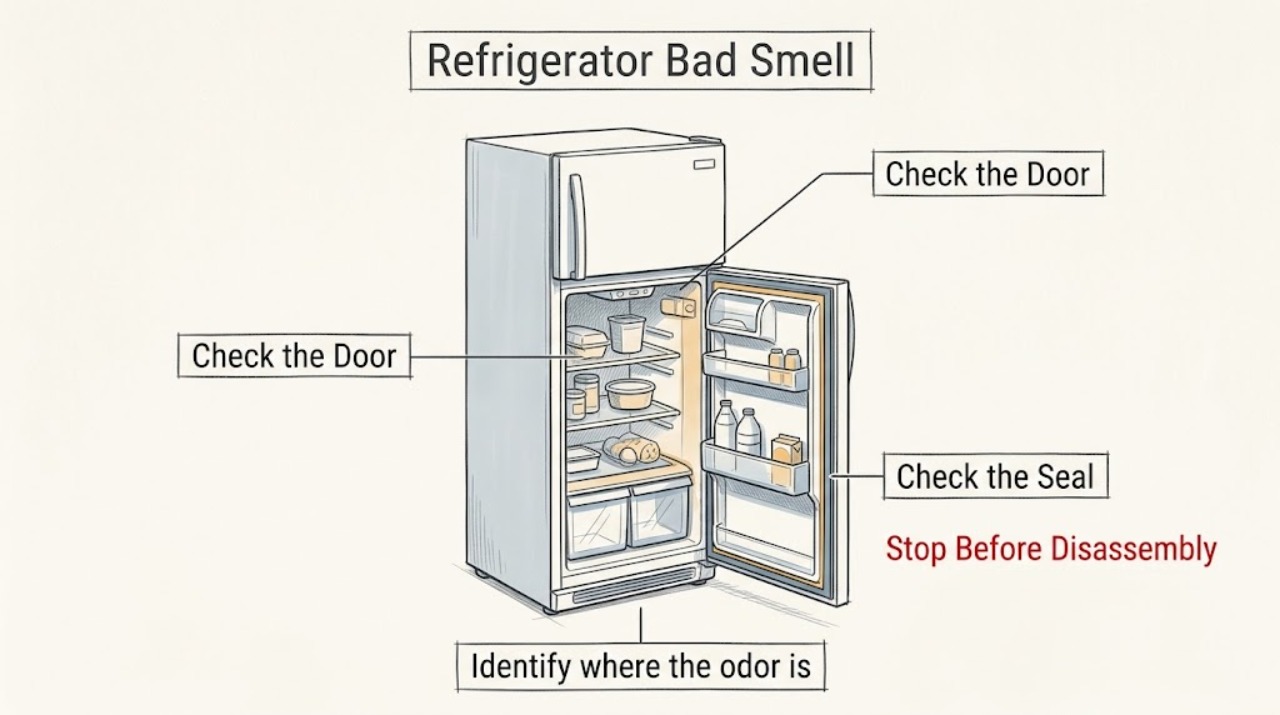
Work through in order
Diagnostic checks
Use only checks that match the exact appliance or system and its official guide.
-
Check 1
Identify where the odor is strongest and whether it is a food, sour or musty, new-plastic, ice or water, burning, electrical, or chemical smell. If there is smoke, heat, arcing, a burning odor, or a strong unknown chemical odor, stop using the refrigerator and isolate power only from a dry, safe position.
Expected result: Compare the fresh-food compartment, freezer, ice bin, dispenser water, rear or bottom exterior, and outlet area. Note whether the smell follows one food, appears only when dispensing, or is present even when the doors remain closed.
Next step: Continue only for a non-hazardous food, moisture, or new-appliance odor. For a hazardous or unexplained odor, keep the refrigerator out of service and arrange qualified appliance or electrical service.
Why this matters
Why: A localized food or cabinet odor supports a cleaning and source-removal path. An odor limited to ice or water points to a consumable water or ice path. A burning, electrical, or unknown chemical odor is outside normal food-odor troubleshooting.
-
Check 2
Remove expired, spoiled, uncovered, or strongly scented food from both the fresh-food and freezer compartments. Inspect the bottoms of containers, shelf edges, drawer tracks, door bins, and the area beneath removable drawers for dried spills.
Expected result: Check whether the odor is strongest beside a particular package or whether a sticky film, pooled liquid, mold-like residue, or food debris is visible in a hidden corner. Keep foods sealed while the source is being isolated.
Next step: Discard the confirmed source and proceed to a complete interior and gasket clean rather than treating only the visible shelf. If no source is found, continue to the moisture and drain check.
Why this matters
Why: GE states that odors commonly come from food items, unwrapped food, or spills on shelves and walls. A smell that drops after one source is removed is less consistent with a failed mechanical component.
-
Check 3
Clean accessible interior surfaces, shelves, bins, and the door gasket with the GE-recommended mixture of one tablespoon of baking soda in one quart of warm water, or the equivalent ratio in the exact owner manual. Wipe the gasket clean, rinse it, and dry it; keep liquid away from lights, controls, and wiring.
Expected result: Look for residue in gasket folds and under shelf lips, then check whether the smell returns after the surfaces are dry and the door has been closed for several hours. Do not use bleach, ammonia, petroleum distillates, harsh abrasives, or lemon-scented cleaners.
Next step: Leave the refrigerator clean and dry, then monitor with food sealed. If the odor persists or the drain area is inaccessible, consult the exact manual or arrange service; do not flood the cabinet or probe hidden tubing.
Why this matters
Why: A smell that fades after source removal and gentle cleaning supports contamination or gasket residue. A musty odor that returns with moisture or pooled water suggests a drain or hidden area that may require model-specific access.
-
Check 4
If the odor is musty or sour and strongest near the floor, rear interior wall, or beneath drawers, inspect only the drain or defrost-water area that the exact model owner's manual identifies as user-cleanable. Also check for standing water, recurring condensation, or a blocked air path without removing panels.
Expected result: The odor may coincide with a wet base, visible residue, or water that returns after defrosting. Some GE refrigerator guides list a defrost-water drainage system as a possible odor source, but the access and cleaning method vary by model.
Next step: Follow only the exact manual's accessible cleaning method and disconnect power first if the manual requires it. Do not remove the evaporator cover, force a tool into the drain, or pour cleaner into hidden passages; call service if water or odor returns.
Why this matters
Why: Moisture and a dirty or restricted defrost-water path can sustain a musty odor even after food is removed. A dry cabinet with no visible residue makes a hidden drain issue less certain and shifts attention to the ice, water, or service branches.
-
Check 5
If the smell or taste occurs only in ice or dispensed water, empty old ice, wash and dry the ice container as the model guide permits, and check the incoming water and filter status. Do not assume an odor-filter or water-filter part fits every GE Profile model.
Expected result: Compare a freshly made batch of ice or water with the cabinet air. Note whether the odor is absent from the cabinet but returns in old ice, after a filter change, or with the household water supply.
Next step: Use the exact model's filter and flushing instructions, and verify compatibility by model number before replacement. If fresh ice or water still smells abnormal, stop consuming it and arrange qualified water-system or appliance service.
Why this matters
Why: GE identifies old ice, food odors transferred to ice, incoming water, and an old filter as separate causes of ice or water odor. A cabinet that smells normal points away from interior cleaning as the only remedy.
Use your observations
Decision map
Find the observation that best matches what you see, then follow the next safe action.
-
PATH 01Next step
What you see
The smell is localized to a food package, spill, shelf, bin, or gasket.
Do this next
Remove the source and perform the manufacturer-approved interior and gasket cleaning, then monitor with foods sealed.
Why this path and its safety boundary
Why it matters: Food or surface contamination is more likely than a mechanical failure.
-
PATH 02Next step
What you see
The smell is new-plastic and the refrigerator is otherwise operating normally.
Do this next
Clean with the approved solution, keep food covered, and allow the odor to dissipate; use the exact manual if the smell does not lessen.
Why this path and its safety boundary
Why it matters: GE notes that a new refrigerator can have a plastic odor that dissipates with time.
-
PATH 03Next step
What you see
The smell is musty or sour near the cabinet base, rear wall, or under drawers.
Do this next
Use only the exact model's user-accessible drain or cleaning procedure; call service if the area is inaccessible or the odor returns.
Why this path and its safety boundary
Why it matters: A hidden spill, gasket moisture, or defrost-water drainage issue is more likely than an odor from a sealed cooling component.
-
PATH 04Next step
What you see
The odor is only in ice or dispensed water.
Do this next
Discard suspect ice, follow the model filter instructions, and stop using the water or ice if the odor persists after a fresh batch.
Why this path and its safety boundary
Why it matters: Food transfer, stale ice, incoming water, or a model-specific filter issue is more likely than a cabinet contamination problem.
-
PATH 05Next step
What you see
The odor is burning, electrical, solvent-like, or otherwise unknown.
Do this next
Stop using the refrigerator, isolate power only from a dry safe position, do not spray cleaner or open panels, and arrange qualified appliance or electrical service.
Why this path and its safety boundary
Why it matters: This is a safety or service condition, not an odor-absorber problem.
Helpful context
Understand the symptom
Start by separating the odor from the appliance
GE Profile refrigerators include different layouts and features, including smart controls, water filtration, ice makers, and adjustable drawers depending on the model. An odor in the fresh-food cabinet, freezer, ice, dispensed water, or outside electrical area does not have the same likely source. Identify the location before buying a filter or attempting any repair.
Use only gentle, model-safe cleaning
GE recommends warm water and baking soda for interior and gasket cleaning and warns that bleach, ammonia, petroleum distillates, and some scented products can damage liners or leave an absorbed odor. Follow the exact owner's manual for removable shelves, drawers, air filters, or any drain access; do not put plastic refrigerator parts in a dishwasher.
When odor means service
A persistent smell after the food, gasket, and accessible cleaning checks can come from a hidden spill, defrost-water path, water system, or a component that is not intended for user access. Burning or electrical smells, smoke, repeated breaker trips, or a chemical odor require stopping use rather than masking the smell with an air freshener.
When checks do not resolve it
Need a professional?
Stop and arrange qualified service for a burning, electrical, solvent-like, smoke, heat, or unknown odor; a smell that returns after food removal and approved cleaning; recurring moisture or a drain area that is not user-accessible; or ice and water that remain odorous after the exact model's documented filter and flushing steps. Do not use bleach, ammonia, petroleum-based cleaners, harsh abrasives, or unapproved filter parts, and do not remove panels for odor diagnosis.
Common questions
FAQ
Can a GE Profile refrigerator itself create a bad smell?
GE says refrigerators and freezers do not contain mechanical parts that normally produce an odor or bad taste. Look first for food, spills, gasket residue, new-plastic odor, defrost-water moisture, or an ice and water source; treat burning or chemical smells as a service concern.
What is safe to use to clean a smelly GE Profile refrigerator?
GE recommends a baking-soda and warm-water solution for interior surfaces and gaskets. Do not use bleach, ammonia, petroleum distillates, harsh abrasives, or strongly scented products that can damage the liner or leave an absorbed smell, and keep liquid away from electrical parts.
Why does only my GE Profile ice or water smell bad?
GE identifies old ice, food odors transferred to ice, incoming water quality, and an old filter as separate possibilities. Empty and clean old ice, then follow the exact model's filter and flushing instructions; do not assume a filter listed for another GE-family model is compatible.
Read the exact guide
Official sources
- Before you call for service…GE Appliances · GE refrigerator owner troubleshooting and odor problem solver
- Refrigerator - Ice Cubes Taste BadGE Appliances · GE Appliances refrigerator ice odor and taste troubleshooting
- GE Smart RefrigeratorsGE Appliances · GE Profile smart refrigerator controls, alerts, and model-dependent features
- Refrigerator & Freezer - OdorsGE Appliances · GE Appliances refrigerator and freezer odor troubleshooting
- GE Profile Smart RefrigeratorsGE Appliances · GE Profile refrigerator product family and model-dependent features
- Refrigerator, Freezer and Standalone Ice Maker - Care and Cleaning of Interior and GasketGE Appliances · GE Appliances refrigerator interior and gasket cleaning
Community feedback
Share a repair observation
Share a plain-text repair observation. Accepted observations are published automatically; this page may take a moment to update.