
On this page
Start here
Quick answer
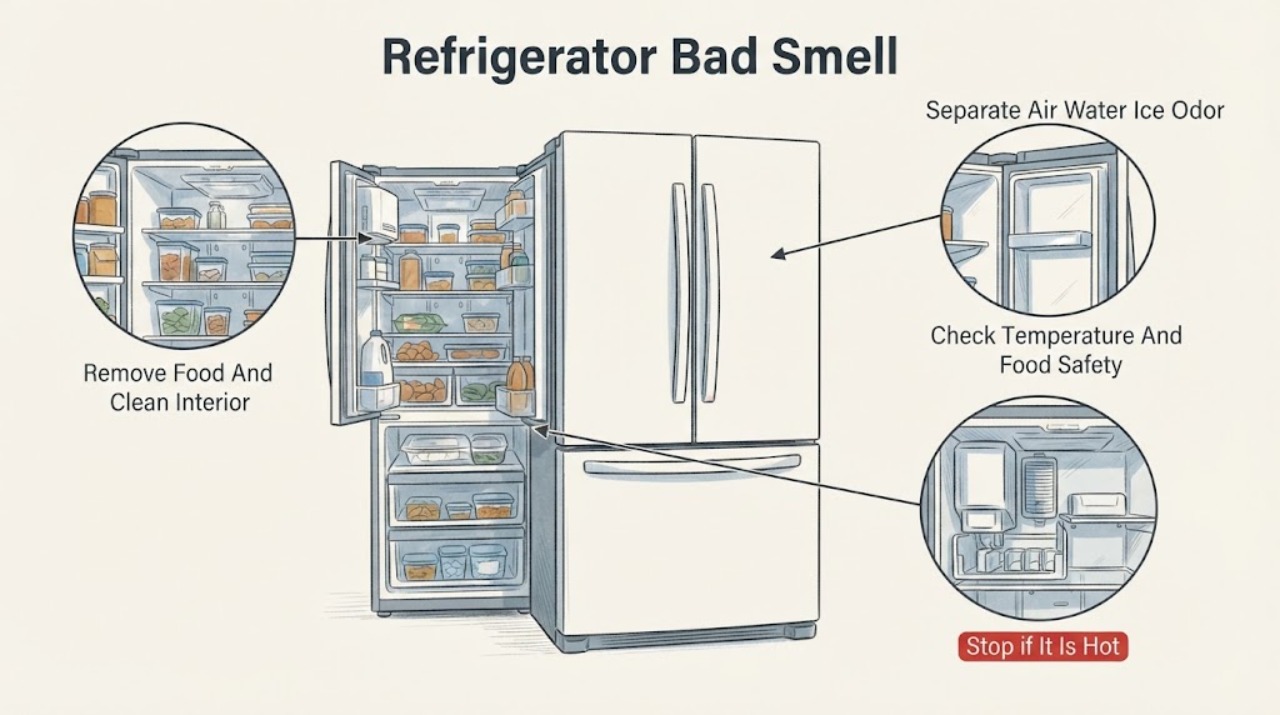
First separate an odor from the refrigerator compartment from an odor limited to dispensed water or ice, and record the exact model. Remove visibly spoiled or suspicious food, wipe up spills, clean the interior and drawers, and keep food covered. Kenmore describes a CleanFlow air filter on applicable refrigerators as reducing odor-causing particles, while its replacement filter pages state that particular water filters reduce chlorine taste and odor only in select compatible refrigerators; neither filter proves that every bad smell is a filter problem. Use the exact model manual before removing or replacing a filter. Check the refrigerator temperature with an appliance thermometer: FDA guidance says it should be at or below 40°F, and food that looks or smells suspicious should be discarded, but odor alone cannot prove that food is safe. If the smell is electrical, chemical, burning, or accompanied by unusual heat, smoke, a leak, loss of cooling, or food warming above a safe temperature, stop using the appliance as appropriate and arrange qualified service.
Work through in order
Diagnostic checks
Use only checks that match the exact appliance or system and its official guide.
-
Check 1
Record the exact Kenmore model and identify whether the odor is in the refrigerator air, a particular food or container, ice, or dispensed water. Use a clean glass and compare water from another safe source if the complaint is limited to the dispenser.
Expected result: Only the compartment smells, one food or drawer smells, ice smells, dispensed water smells, or both water and ice are affected.
Next step: Use the matching branch below. Find the exact model manual before locating, removing, or replacing an air or water filter.
Stop if: Stop and arrange service for a chemical, electrical, or burning smell, smoke, a leak near electrical parts, or a refrigerator that is becoming warm.
Why this matters
Why: A compartment odor points first to food, residue, or air filtration; a water or ice odor points to the water path or its compatible water filter. These are separate from one another and should not be treated with the wrong filter.
-
Check 2
Remove food one item at a time, discard anything visibly moldy, leaking, swollen, or suspicious, and inspect containers, drawers, shelf edges, door bins, and the door gasket for dried drips or residue. With food protected elsewhere, clean model-accessible interior surfaces and drawers using Kenmore's warm-water and baking-soda guidance, then wipe and dry thoroughly.
Expected result: The odor follows one item or container, residue is found in a drawer or gasket, the interior is visibly clean but still smells, or the odor returns after cleaning.
Next step: Clean the identified residue and monitor the compartment with food covered. If the smell persists, continue to the temperature and conditional-filter checks rather than adding stronger chemicals.
Stop if: Do not mix cleaning chemicals, use an unapproved chemical inside the food compartment, or keep questionable food for a taste test.
Why this matters
Why: A source-specific odor or spill is more likely than an air-filter failure. A returning odor after the source is removed makes the air path, drain area, filter feature, temperature, or another model-specific condition more relevant.
-
Check 3
Place or read an appliance thermometer in the refrigerator and record the temperature while the doors remain closed as much as practical. Check whether food has warmed, whether the door seals close, and whether the odor is accompanied by spoilage or a recent power interruption.
Expected result: The refrigerator is at or below 40°F, above 40°F, food is spoiling quickly, the door is not sealing, or the temperature cannot be established.
Next step: Discard suspicious perishables and keep the door closed while arranging service if the temperature is high, unstable, or unknown. If temperature is stable, continue with the air-versus-water filter branch.
Stop if: Do not eat questionable food because it smells normal, and do not leave perishables in a refrigerator that is not maintaining a safe temperature.
Why this matters
Why: A temperature at or below 40°F supports the refrigerator's food-safety target but does not make suspicious food safe. A warm or unknown temperature changes this from an odor-only complaint to a cooling and food-safety concern.
-
Check 4
If the odor is in the refrigerator air, check the exact model manual for an installed air-filter feature and its replacement interval. Only if the manual identifies a compatible filter, inspect or replace it as directed; do not assume that every Kenmore refrigerator accepts the Kenmore 9917 or CleanFlow filter.
Expected result: The model has a documented air filter that is due for replacement, has no air-filter feature, the filter is clean and current, or the odor remains after the model-approved filter change.
Next step: Use the exact compatible filter only when the manual confirms it, then monitor after the interior is clean. If there is no filter or the odor returns, arrange model-specific support rather than installing a different filter by appearance.
Stop if: Do not force a filter into a housing, run without a required cover, or use an incompatible filter as a diagnostic substitute.
Why this matters
Why: Kenmore describes applicable CleanFlow systems and the 9917 filter as reducing odor-causing particles, but model compatibility is explicit and a filter cannot remove the original spoiled-food or spill source.
-
Check 5
If only dispensed water or ice smells or tastes unusual, identify the refrigerator model and the installed water-filter type from the exact manual. Check the filter status or replacement interval and use only a documented compatible filter; compare the odor in water and ice separately after the model-approved change.
Expected result: The odor is limited to water, limited to ice, affects both, the filter is overdue or absent, or the water/ice odor remains after a compatible filter change.
Next step: Follow the exact manual for filter replacement, flushing, and ice disposal if those steps are documented. If the odor persists, stop consuming the affected water or ice and arrange qualified appliance or water-quality service.
Stop if: Do not drink questionable water, use an unverified cartridge, or treat a water-path odor as an interior-air problem.
Why this matters
Why: Kenmore's water-filter evidence is limited to particular compatible refrigerator systems and contaminants such as chlorine taste and odor. A persistent water or ice odor is not proof that the filter is the cause or that any Kenmore filter will fit.
-
Check 6
After source removal, model-approved cleaning, temperature measurement, and the applicable filter check, record whether the odor returns and whether there is poor cooling, constant running, unusual noise, frost, water, smoke, heat, or a chemical or electrical smell. Contact Kenmore support or qualified appliance service with the model and record.
Expected result: The odor is gone, returns with a clean interior, occurs with warming food, is accompanied by odd operation, or has a burning, chemical, or electrical character.
Next step: For a persistent nonhazardous odor, arrange model-specific appliance service. For smoke, sparking, burning odor, or water near electrical parts, leave the refrigerator off when safe and address the immediate electrical or fire hazard first.
Stop if: Do not open sealed refrigeration or electrical compartments, bypass controls, use the appliance with smoke or a burning smell, or replace an internal component by guesswork.
Why this matters
Why: A persistent or hazardous odor is outside a safe filter-only conclusion. Kenmore's maintenance guidance treats food spoilage, constant running, and odd noises as warning signs requiring the refrigerator to be checked.
Use your observations
Decision map
Find the observation that best matches what you see, then follow the next safe action.
-
PATH 01Safety boundary
What you see
The odor follows one container or food, or residue is found in a drawer, shelf edge, door bin, or gasket, while the refrigerator temperature is at or below 40°F.
Do this next
Discard suspicious food, clean the affected surfaces with the model-appropriate method, dry them, and keep remaining food covered. Recheck the compartment after the source is gone.
Why this path and its safety boundary
Why it matters: A food or spill source is more likely than a failed filter. Temperature does not make suspicious food safe, and FDA says not to rely on smell alone for food safety.
Safety stop: Do not taste questionable food or mix cleaning chemicals.
-
PATH 02Safety boundary
What you see
The interior and drawers are clean, the odor is in the compartment air rather than the dispenser, and the model manual identifies a compatible air-filter feature.
Do this next
Replace or service the documented compatible air filter as the exact manual directs, then monitor with food covered. If the odor returns, arrange service.
Why this path and its safety boundary
Why it matters: An overdue or saturated model-compatible air filter may contribute to odor. Kenmore's air-filter claims apply to the specified filter or applicable CleanFlow systems, not all refrigerators.
Safety stop: Do not install a filter based only on its shape or brand name.
-
PATH 03Safety boundary
What you see
The refrigerator compartment is acceptable but dispensed water, ice, or both have an unusual taste or odor, and the model uses a documented compatible water filter.
Do this next
Follow the exact manual for the compatible filter and any documented flushing or ice-disposal step. Do not consume affected water or ice if the odor persists; obtain appliance or water-quality service.
Why this path and its safety boundary
Why it matters: The water path or its filter is more relevant than the refrigerator air. Kenmore's filter claims concern selected compatible systems and specified reductions such as chlorine taste and odor.
Safety stop: Do not use an unverified cartridge or assume an air filter will correct water odor.
-
PATH 04Safety boundary
What you see
The odor is accompanied by a refrigerator temperature above 40°F, rapidly spoiling food, constant running, unusual noise, a door-seal problem, or an unknown temperature.
Do this next
Discard questionable perishables, keep the doors closed, and arrange qualified appliance service with the measured temperature and symptoms.
Why this path and its safety boundary
Why it matters: This is a cooling and food-safety concern, not an odor-only filter decision. FDA recommends keeping the refrigerator at or below 40°F, and Kenmore identifies food spoilage, constant running, and odd noises as warning signs.
Safety stop: Do not rely on odor to judge food safety or continue storing perishables in a refrigerator that is not maintaining a safe temperature.
-
PATH 05Safety boundary
What you see
The smell is chemical, electrical, or burning, or it remains after source removal and model-approved cleaning and filter checks, especially with smoke, heat, water, frost, or abnormal operation.
Do this next
Leave the appliance off when safe and arrange the appropriate qualified service; address smoke, sparking, fire, or electrical water hazards before any further troubleshooting.
Why this path and its safety boundary
Why it matters: The odor cannot be safely assigned to food, air filtration, or water filtration. Internal electrical, refrigeration, drain, insulation, or control conditions require model-specific professional diagnosis.
Safety stop: Do not open sealed or electrical compartments, bypass protection, or keep using the refrigerator to see whether the odor worsens.
Helpful context
Understand the symptom
Locate where the smell is actually coming from
A smell inside the fresh-food compartment is a different problem from water or ice that tastes or smells bad at the dispenser. Start with a clean glass of water away from the refrigerator if possible, then compare the refrigerator air, stored food, ice, and dispensed water. Kenmore sells both air-filter and water-filter products, but their functions and compatibility are different. Treat the model number and the affected medium—air, water, or ice—as part of the diagnosis.
Clean food residue before judging the filter
Kenmore's refrigerator cleaning guidance describes emptying the drawers, wiping interior surfaces with a warm-water and baking-soda solution, using a small amount of paste for stuck residue, making a final warm-water-and-lemon wipe, and drying the interior. Remove the food and container that caused the smell first; an air filter can reduce odor-causing particles but cannot replace removal of a spoiled food source or spill.
Use temperature and food-safety evidence, not smell alone
FDA guidance says to keep the refrigerator at or below 40°F and to discard food that looks or smells suspicious. It also warns that harmful foodborne organisms may be present even when food does not look, smell, or taste spoiled. Measure the refrigerator with an appliance thermometer and keep perishable food covered and cold while you clean; do not taste a questionable food to decide whether it is safe.
Filter claims are conditional by model and by medium
Kenmore's 9917 air filter is described as trapping odor-causing molecules and working for up to six months. Separate Kenmore water-filter pages describe reduction of chlorine taste and odor for select compatible refrigerators. Those statements support a conditional filter check when the odor is in the refrigerator air or dispensed water/ice and the exact model accepts that filter; they do not establish that a filter is installed, expired, or responsible on every Kenmore refrigerator.
Persistent odor or cooling loss needs service
After food removal, model-approved cleaning, and a properly matched filter check, an odor that returns—especially with poor cooling, unusual noise, water, frost, or a chemical or electrical smell—is not proof of one failed part. Kenmore's maintenance guidance treats food-spoiling, constant running, and odd noises as reasons to have the refrigerator checked. Use Kenmore support or qualified appliance service with the model, temperature, affected area, and what changed before the odor began.
Safety boundary
Stop conditions
- Discard food that is visibly moldy, leaking, swollen, or suspicious; do not taste questionable food to test it.
- Stop consuming water or ice with a persistent unusual odor or taste until the exact model's filter and water path have been checked.
- Leave the refrigerator off when safe for smoke, sparking, burning or chemical odor, water near electrical parts, or a damaged cord or outlet; obtain qualified help.
- Do not open sealed refrigeration or electrical compartments, bypass controls, mix cleaning chemicals, or install an incompatible filter.
Only after diagnosis
Potential parts
- compatible refrigerator air filter
Consider this only when the exact model manual confirms an air-filter feature and the odor is in the refrigerator compartment after food and spill sources have been removed.
Kenmore's air-filter products apply to specified or select refrigerator systems; confirm the complete model and documented fit before ordering or installing. - compatible refrigerator water filter
Consider this only when the odor is limited to dispensed water or ice and the exact model manual identifies a replaceable compatible water filter.
Kenmore water-filter claims and compatibility are model-specific; do not substitute an air filter or an unverified cartridge.
When checks do not resolve it
Need a professional?
Arrange qualified appliance service when the odor returns after source removal and model-approved cleaning, when the refrigerator is warm or food is spoiling, or when constant running, unusual noise, frost, water, or a door-seal problem accompanies the smell., Contact Kenmore support with the exact model, measured temperature, affected area, filter type and age if known, and the point at which the odor began., Use qualified electrical or emergency help for smoke, sparking, burning odor, or an immediate electrical or fire hazard.
Have this ready
- complete model number
- measured refrigerator temperature
- whether the odor is in air, water, ice, or food
- filter type and age if known
- cleaning and source-removal steps already completed
- cooling, noise, frost, leak, smoke, or electrical observations
Common questions
FAQ
Will replacing the Kenmore refrigerator filter remove a bad smell?
Only conditionally. Kenmore describes applicable CleanFlow or specified air filters as reducing odor-causing particles, and some compatible water filters as reducing chlorine taste and odor. First remove spoiled food and spills, identify whether the odor is in air or water/ice, and confirm the exact model and filter in the owner's manual.
How should I clean the inside of a Kenmore refrigerator that smells?
Protect the food elsewhere, remove the odor source, and follow the Kenmore refrigerator-cleaning guidance: wipe the interior and drawers with a warm-water and baking-soda solution, treat stuck residue gently, make a final wipe, and dry the surfaces thoroughly. Do not mix chemicals or use an unapproved cleaner in the food compartment.
Why does my Kenmore refrigerator water or ice smell bad while the inside seems fine?
Treat that as a water-path question rather than an air-odor question. Check the exact model's documented water-filter type and replacement status. Kenmore's filter claims apply only to compatible refrigerator systems; if the odor persists, stop consuming the affected water or ice and arrange appliance or water-quality service.
Can I tell whether food is safe by its smell?
No. FDA says suspicious-looking or suspicious-smelling food should be discarded, but harmful organisms may be present even when food does not look, smell, or taste spoiled. Keep the refrigerator at or below 40°F and use an appliance thermometer rather than relying on odor alone.
When is a bad refrigerator smell a service issue?
Arrange service when the odor returns after source removal and model-approved cleaning, or when it comes with a temperature above 40°F, rapidly spoiling food, constant running, unusual noise, frost, water, smoke, heat, or a chemical or electrical smell. Provide the exact model and measured temperature.
Read the exact guide
Official sources
- Appliance Maintenance Tips to Help Maximize EfficiencyKenmore · Kenmore-published general maintenance guidance; not a substitute for a model-specific service manual.
- Kenmore 9081 Replacement Refrigerator FilterKenmore · Specific 9081 filter for select compatible refrigerators; used only for conditional water/ice taste and odor guidance.
- Spring Cleaning Your RefrigeratorKenmore · Kenmore-published refrigerator cleaning guidance; follow the exact owner's manual for model-specific materials, removable parts, and restrictions.
- Refrigerators & Freezers | French Door, Side-by-Side | KenmoreKenmore · Brand-level refrigerator feature evidence; CleanFlow and other features apply only to models equipped with them.
- Are You Storing Food Safely?U.S. Food and Drug Administration · General food-safety boundary, not Kenmore appliance-mechanism evidence.
- Kenmore 9917 Refrigerator Air FilterKenmore · Specific Kenmore 9917 air-filter product; not evidence that every Kenmore refrigerator accepts this filter.
- Customer Care & Support | Kenmore AppliancesKenmore · Support handoff for persistent or hazardous symptoms; not evidence of a particular internal fault.
- Find Your Manual | Kenmore Appliance Manuals & GuidesKenmore · Model lookup and support routing; the matching refrigerator manual must be selected before applying filter or maintenance instructions.
Community feedback
Share a repair observation
Share a plain-text repair observation. Accepted observations are published automatically; this page may take a moment to update.