
On this page
Start here
Quick answer
First separate an ordinary food or moisture odor from a possible safety hazard. For a spoiled-food, spill, or musty smell with no smoke, heat, sparking, or cord damage, switch the Bosch refrigerator off using its normal control, remove and protect the food, clean the interior, packaging, bins, and seal with a soft cloth and mild soapy water, keep water out of the light and drain opening, and dry everything. If the smell remains after the cleaned refrigerator has run for 24 hours, check the exact model manual for an odor-filter procedure and compatible filter. A sharp electrical, hot-plastic, or burning odor, smoke, sparking, a hot or damaged cord, or a suspected refrigerant leak is different: stop using the refrigerator, disconnect it only from a safe dry position, keep ignition sources away and ventilate if a damaged refrigeration tube is suspected, and arrange qualified Bosch service. Do not open the sealed system, remove electrical covers, or keep restarting the appliance to identify the smell.
Before you begin
Safety first
- The user may remove food, inspect visible packaging and surfaces, clean accessible interior parts and the door seal as Bosch directs, and verify the exact model manual. Electrical diagnosis, sealed-system or refrigerant work, hidden drain/evaporator access, damaged wiring, and repairs are for qualified service personnel.
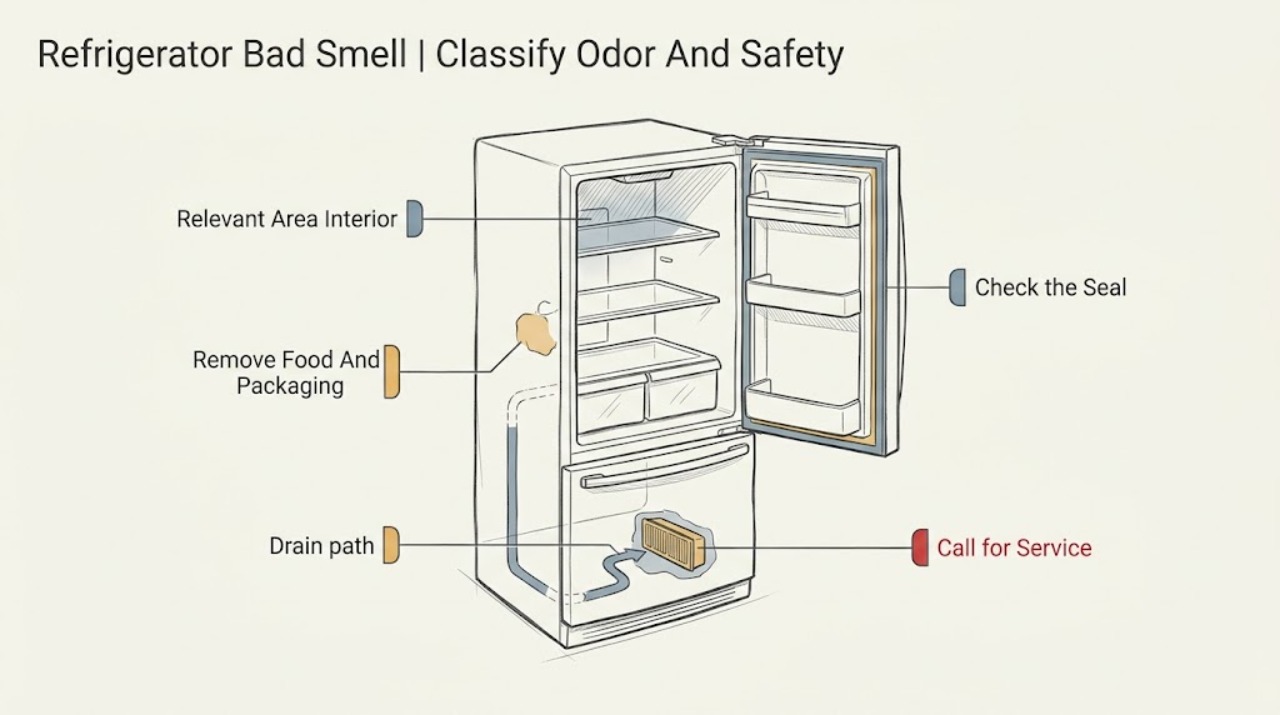
Work through in order
Diagnostic checks
Use only checks that match the exact appliance or system and its official guide.
-
Check 1
Without moving panels or touching hot parts, identify whether the odor is localized to food or a spill, damp or musty around a drawer or seal, or sharp and hot like burning plastic/electrical insulation. Look from outside for smoke, sparks, a hot or damaged cord, visible tube damage, or a sudden cooling problem.
Expected result: The smell is ordinary food or moisture odor with no hazard sign, or it is sharp/burning/electrical, accompanied by smoke, heat, sparking, cord damage, suspected tube damage, or unsafe cooling behavior.
Next step: For any smoke, sparking, hot or damaged cord, burning odor, or suspected damaged refrigeration tube, stop using the refrigerator, disconnect only from a safe dry position, keep ignition sources away, ventilate if safe when a tube is damaged, and arrange qualified service. If none is present, continue to inspect food, packaging, and accessible interior surfaces.
Stop if: Do not restart an appliance that is smoking, sparking, hot, or giving a burning/electrical smell, and do not touch or repair a damaged refrigeration tube.
Why this matters
Why: A localized food or moisture pattern permits the contained cleaning checks below. A burning/electrical pattern or a suspected refrigeration-circuit problem cannot be diagnosed safely by repeated operation and takes priority over odor removal.
-
Check 2
If there is no immediate hazard, switch the refrigerator off with its normal On/Off control, take all food out, and inspect containers, wrappers, produce drawers, drip residue, and the underside of shelves for a spoiled item or leak. Keep food in a cool location while cleaning, and clean or discard contaminated packaging according to the food-safety decision you can make safely.
Expected result: The smell follows one item, container, wrapper, or visible spill, or no source is found after the refrigerator is empty.
Next step: Remove the identified source and continue with the full interior, bin, and seal cleaning. If no source is found, clean all accessible surfaces and record whether the smell is stronger near the rear drain area or door seal without pouring liquid into either.
Stop if: Do not handle leaking, spoiled, or moldy material without suitable household precautions, and do not scrape or disassemble hidden panels to find an odor source.
Why this matters
Why: A smell that follows food or packaging is more likely an ordinary source than an appliance fault. No source after emptying makes trapped residue, seal moisture, drain/evaporation area, or an odor filter more likely, but it does not justify opening the cabinet.
-
Check 3
Clean accessible walls, shelves, drawers, bins, and the door seal with a soft cloth and mild soapy water; wash removable bins by hand, wipe the seal with clear water, and dry every part. Keep rinse water out of the light and out of the drain hole leading to the evaporation area.
Expected result: The odor decreases after residue is removed and the refrigerator is dry, or a damp/musty odor remains around the seal, drawer, or rear drain area.
Next step: Dry the refrigerator fully and inspect the seal for looseness or damage from the outside. Follow only the exact model manual for an accessible drain-area check; if moisture, mold-like residue, a loose seal, or odor persists, arrange service instead of removing panels or flushing the drain.
Stop if: Do not use chlorine-based, acidic, solvent, or abrasive cleaners, steam, a dishwasher for removable bins, or tools to open a hidden evaporator or drain assembly.
Why this matters
Why: A marked improvement supports food residue, packaging, or a surface spill as the source. A persistent damp or musty pattern makes retained moisture, a poor seal, or a drain/evaporation issue more likely; water entering the drain or light can damage the appliance and is not a cleaning method.
-
Check 4
After cleaning and drying, clean any odor-absorbing packaging, seal strong-smelling food in closed containers, restore food, and switch the refrigerator back on only if no safety symptom was found. Keep normal airflow openings clear and avoid placing food against surfaces that are still wet.
Expected result: The smell no longer returns during normal use, or it returns even though the interior and packaging are clean and dry.
Next step: If the smell recurs, leave the refrigerator running only if there is no hazard odor, then wait for the 24-hour check in the Bosch procedure. If the smell changes to burning/electrical or cooling is lost, switch it off and arrange service immediately.
Stop if: Do not run the refrigerator to mask a burning, electrical, or suspected refrigerant odor, and do not use loose deodorizers or chemicals that could contact food or appliance parts.
Why this matters
Why: A smell that stays away after cleaning supports a food or packaging source. Recurrence with a clean, dry interior makes an odor filter or an unresolved moisture path more likely and warrants the model-specific next check rather than stronger chemicals.
-
Check 5
If the ordinary odor is still present after the cleaned refrigerator has operated for 24 hours, identify the exact Bosch E-Nr. and open its owner manual or filter instructions. Check whether that model has a user-replaceable odor filter and verify compatibility before considering a replacement; do not force open a holder or panel that the manual does not identify as user-accessible.
Expected result: The exact manual confirms an odor filter and a compatible replacement path, or the model has no user-accessible filter or the odor remains after the documented filter step.
Next step: Use only the filter and access method documented for the exact Bosch model. If compatibility or access is uncertain, or the odor persists, stop parts experimentation and contact Bosch or a qualified appliance servicer.
Stop if: Do not order a filter by appearance alone, install an unverified substitute, or open electrical or sealed-system panels to reach an odor source.
Why this matters
Why: A compatible, model-documented filter can address residual odors after cleaning. A missing or inaccessible filter, an uncertain fit, or an odor that remains after the documented step points away from a simple filter replacement and toward service diagnosis.
-
Check 6
Stop the refrigerator and record the exact odor description, where it is strongest, when it began, whether cooling changed, and any smoke, sparking, heat, cord damage, hissing, visible tube damage, moisture, or error display. If a refrigeration tube may be damaged, keep flames and ignition sources away and ventilate the room only if doing so is safe.
Expected result: The odor persists after the documented cleaning/filter path, recurs with moisture or cooling problems, or has any burning/electrical, smoke, spark, hot-cord, or suspected refrigerant-circuit feature.
Next step: Keep the refrigerator out of service for a burning/electrical or suspected refrigerant symptom and arrange qualified Bosch service. For a non-hazardous odor that simply persists, contact Bosch support or a qualified servicer with the model and symptom record rather than opening the appliance.
Stop if: Do not remove covers, access wiring, puncture insulation, handle refrigerant, bypass controls, or repeatedly power-cycle the appliance to reproduce the smell.
Why this matters
Why: Persistence after a clean, dry interior makes a hidden moisture, electrical, fan, or sealed-system problem more likely, but the symptom does not identify a replaceable part. Burning/electrical signs or a suspected refrigerant leak are immediate stop conditions.
Use your observations
Decision map
Find the observation that best matches what you see, then follow the next safe action.
-
PATH 01Next step
What you see
The smell is sour, rotten, fishy, or localized to one food item, container, wrapper, bin, or visible spill, with no smoke, heat, sparking, or cooling fault.
Do this next
Remove the source, clean the interior and removable parts with Bosch's mild-soapy-water method, dry thoroughly, and seal strong-smelling food before returning it.
Why this path and its safety boundary
Why it matters: The pattern is more consistent with food residue or odor absorbed by packaging than with a refrigerator component.
-
PATH 02Next step
What you see
The smell is damp or musty, follows condensation or a wet drawer, or is strongest around the door seal or accessible rear drain opening.
Do this next
Clean and dry the accessible seal, shelves, drawers, and interior, keep water out of the drain hole and light, and use the exact model manual for any permitted drain check. Persistent moisture or mold-like residue needs qualified service.
Why this path and its safety boundary
Why it matters: Retained moisture, residue around the seal, or an issue in the drain/evaporation path is more likely than a single spoiled food source. A normal-looking surface does not prove a hidden drain is clear.
-
PATH 03Next step
What you see
The refrigerator is clean and dry, food and packaging have been checked, and the same ordinary odor remains after the Bosch 24-hour check.
Do this next
Verify the exact Bosch E-Nr. and manual, confirm whether the model has a compatible user-replaceable odor filter, and arrange service if the documented filter path is absent, inaccessible, or ineffective.
Why this path and its safety boundary
Why it matters: The odor filter or an unresolved moisture source becomes more likely, but a filter is not universal across Bosch refrigerators and the symptom alone does not prove which part is involved.
-
PATH 04Safety boundary
What you see
The odor is sharp, hot, electrical, or burning, or there is smoke, sparking, a hot/damaged cord, scorching, or repeated protection behavior.
Do this next
Stop using the refrigerator, isolate power only from a safe dry position, do not restart it, and arrange qualified Bosch or appliance service. If there is active fire or dangerous smoke, leave the area and contact emergency services.
Why this path and its safety boundary
Why it matters: The symptom is a potential electrical or fire hazard, not an odor-removal problem. A stopped smell does not prove the appliance is safe to re-energize.
Safety stop: Do not touch hot or damaged electrical parts or open a cover to locate the source.
-
PATH 05Safety boundary
What you see
A chemical-like odor is accompanied by visible damage to refrigeration tubing, hissing, sudden cooling loss, or another reason to suspect the sealed refrigeration circuit.
Do this next
Keep ignition sources away, ventilate the room if safe, switch off and unplug from a safe position, and contact qualified Bosch service. Do not puncture insulation, move the appliance unnecessarily, or attempt refrigerant work.
Why this path and its safety boundary
Why it matters: A smell cannot confirm a refrigerant leak, but suspected tube damage is a professional safety issue because Bosch identifies the refrigerant as flammable and warns against damaging the circuit.
Safety stop: Do not use flames, sparks, electrical tools, or DIY leak-repair products near a suspected damaged refrigeration circuit.
Helpful context
Understand the symptom
Classify the smell before cleaning
A sour, rotten, fishy, or localized food smell usually points to a spill, a forgotten item, or odor absorbed by packaging. A damp or musty smell that follows condensation or a wet drawer makes moisture, the door seal, or the accessible drain area more relevant. Those are different from a sharp hot-plastic or electrical smell, smoke, sparking, or an odor associated with a damaged tube or sudden cooling problem. Smell alone cannot identify a failed component, so stop first when the symptom sounds electrical, burning, or refrigerant-related.
Use Bosch's contained cleaning sequence
Bosch's owner guidance calls for removing the food, cleaning the inside and packaging, and sealing strong-smelling food. Use a soft cloth, lukewarm water, and a little pH-neutral dish liquid; clean removable bins by hand and wipe the door seal with clear water, then dry it thoroughly. Do not use chlorine-based, acidic, solvent, or abrasive cleaners, and do not let rinse water enter the light or run through the drain hole into the evaporation area.
Treat the odor filter as model-dependent
Some Bosch refrigerators have an odor filter, while filter style and access vary by model. Bosch's manual sequence checks whether the odor returns after 24 hours before changing a filter, and Bosch's filter page requires the appliance E-Nr. to confirm compatibility and points owners to the exact manual for insertion. Do not assume that a filter sold for one Bosch refrigerator fits another, and do not open an enclosed panel just to reach one.
Why electrical or refrigerant-like smells stop the workflow
A food odor can be cleaned; a hot, burning, or electrical odor can indicate a problem that cannot be safely localized from the outside. Bosch's manual also identifies flammable refrigerant in the refrigeration circuit and gives a specific response if tubing is damaged. If the smell is accompanied by smoke, heat, sparking, a damaged cord, hissing, visible tube damage, or loss of cooling, isolate the appliance only if that can be done without approaching danger and arrange professional service.
Safety boundary
Stop conditions
- Stop using the refrigerator for smoke, sparking, a burning or electrical odor, a hot or damaged cord, scorching, or any active fire; isolate power only from a safe dry position and arrange qualified service.
- If refrigeration tubing is damaged or a leak is suspected, keep ignition sources away, ventilate only if safe, switch off and unplug from a safe position, and contact qualified service.
- Do not open electrical covers, evaporator or sealed-system panels, puncture insulation, handle refrigerant, or perform live tests.
- Do not pour rinse water through the drain hole or into the light, use steam, or use chlorine-based or abrasive cleaners.
- Do not restart repeatedly to reproduce a hazardous odor or order a filter without checking the exact Bosch model and manual.
Only after diagnosis
Potential parts
- refrigerator odor filter
Only consider an odor filter after the interior, packaging, bins, and seal are clean and dry and the ordinary odor remains after the Bosch 24-hour check; the exact model must document that a replaceable filter is used.
Verify the exact Bosch E-Nr. and owner manual before ordering or opening a holder. Bosch's filter page requires an appliance model compatibility check, so do not infer fit from appearance or brand alone.
When checks do not resolve it
Need a professional?
Arrange Bosch or qualified appliance service when a burning/electrical odor, smoke, sparking, hot or damaged cord, suspected refrigerant-circuit damage, cooling loss, persistent moisture, a loose or damaged door seal, or an odor that remains after the documented cleaning and model-specific filter path is present. Use emergency services for active fire or dangerous smoke. Do not attempt sealed-system, electrical, refrigerant, or hidden drain repairs yourself.
Safety scope: The user may remove food, inspect visible packaging and surfaces, clean accessible interior parts and the door seal as Bosch directs, and verify the exact model manual. Electrical diagnosis, sealed-system or refrigerant work, hidden drain/evaporator access, damaged wiring, and repairs are for qualified service personnel.
Common questions
FAQ
Why does my Bosch refrigerator smell bad even after I cleaned it?
If the refrigerator is clean and dry but the same ordinary odor remains after 24 hours, check the exact Bosch manual for an odor-filter procedure and verify compatibility by the appliance E-Nr. Persistent damp or musty odor, cooling loss, or any burning/electrical smell needs service rather than stronger cleaners or repeated restarts.
Can a Bosch refrigerator drain or evaporation area cause a bad smell?
A damp or musty odor near a drawer or rear drain area can make retained moisture or a drain-path issue more likely, but the smell does not prove that the hidden drain is blocked. Clean only accessible surfaces as the exact manual allows, keep rinse water out of the drain hole and light, and call service if moisture or odor persists.
What should I do if my Bosch refrigerator smells like burning plastic or electricity?
Stop using it immediately. If there is smoke, sparking, heat, or a damaged cord, isolate power only from a safe dry position and arrange qualified service; do not open covers or restart the refrigerator to see whether the odor returns. Active fire or dangerous smoke requires leaving the area and contacting emergency services.
How do I tell a food smell from a refrigerant smell in a Bosch refrigerator?
A localized sour, rotten, or spill odor that improves after removing food and cleaning is more consistent with food residue. Smell alone cannot identify refrigerant; if a chemical-like odor comes with hissing, visible refrigeration-tube damage, sudden cooling loss, or another reason to suspect the circuit, keep ignition sources away, ventilate only if safe, switch off and unplug from a safe position, and contact qualified service.
Can I use chlorine cleaner, steam, or an abrasive scrubber to remove a Bosch refrigerator odor?
No. Bosch directs owners to use a soft cloth, lukewarm water, and a little mild or pH-neutral dish liquid, and warns against chlorine-based, acidic, solvent, abrasive, and steam cleaning. Keep water out of the light and drain opening, wash removable bins by hand, and dry the refrigerator thoroughly.
Read the exact guide
Official sources
- How to clean your refrigerator door sealBosch Home Appliances · Bosch refrigerator door seals; cleaning is limited to a soft cloth and mild soapy water, and loose or damaged seals require Bosch support.
- 00636459 Carbon Odor FilterBosch Home Appliances · Bosch refrigerator filter guidance; the listed filter is not presumed to fit every Bosch refrigerator and the page requires checking the appliance model.
- Bosch Customer ServiceBosch Home Appliances · Bosch owner support, service visits, manuals, troubleshooting, parts, and safety resources; the appropriate path depends on the model and symptom.
- Cleaning your fridge | Refrigerator Maintenance | Bosch Home AppliancesBosch Home Appliances · Bosch refrigerator cleaning guidance for accessible interior surfaces, food storage during cleaning, seals, bins, and water protection around lights and the evaporation drain.
- Use and Care ManualBosch Home Appliances · Bosch refrigerator odor-cleaning sequence, interior cleaning limits, odor-filter timing, refrigeration-circuit and electrical safety, and service boundary; controls and layouts are model-specific.
Community feedback
Share a repair observation
Share a plain-text repair observation. Accepted observations are published automatically; this page may take a moment to update.