
On this page
Start here
Quick answer
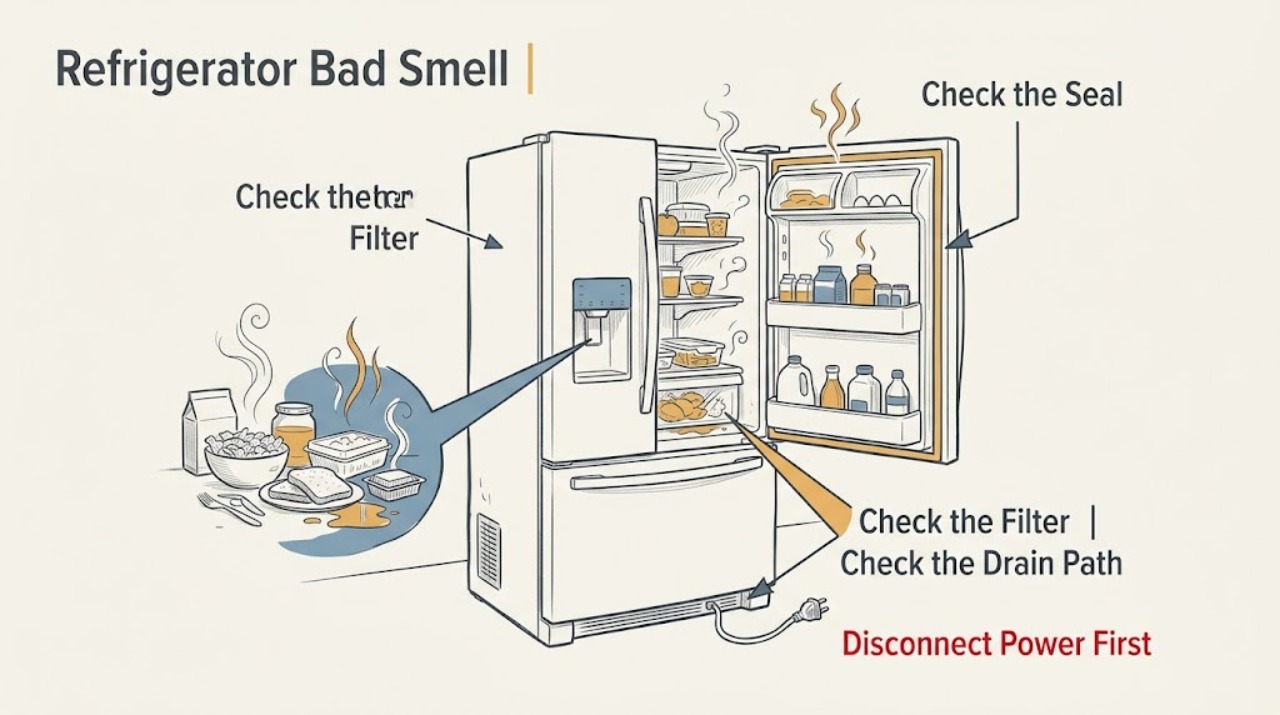
Start by deciding whether the odor is coming from food or ice, the gasket and interior, a drain or moisture path, or the outside of the appliance. GE says refrigerators do not contain mechanical parts that normally create a food odor, and lists unwrapped or spoiled food, spills, old ice, water quality, and an old water filter as common odor or taste sources. Unplug the refrigerator before cleaning, remove food and ice that may have absorbed the smell, and clean the interior, shelves, drawers, ice bin, and gasket with the GE-recommended baking-soda solution; do not use bleach, ammonia, abrasive products, or lemon-scented cleaners. If your model has GE's optional Café odor filter, use its model instructions rather than assuming every GE refrigerator has one. Odor that smells electrical, chemical, or like burning; appears with heat, smoke, a hot cord, water near electrical parts, spoiled-food illness risk, or returns after safe cleaning and drain checks needs immediate stop-use or qualified service. Do not remove fixed drip pans or open sealed refrigeration or electrical components.
Before you begin
Safety first
- The owner may remove food and ice, unplug before cleaning, wash accessible interior parts and gaskets with the model-approved method, inspect visible moisture, and follow model-approved filter or drain instructions. A qualified technician must assess hidden drains, fixed pans, water paths, electrical hardware, controls, and sealed refrigeration components.
Work through in order
Diagnostic checks
Use only checks that match the exact appliance or system and its official guide.
-
Check 1
From a safe position, classify the odor as food or sour, musty or mold-like, plastic, stale ice or water, drain or sewage-like, chemical, electrical, or burning. Note whether it is strongest in the fresh-food compartment, freezer, ice bin, gasket, under the cabinet, rear, cord, or outlet. Check for smoke, heat, water near electrical parts, or spoiled food that could make someone ill.
Expected result: The smell is localized to food or ice, a damp gasket or drain area, a new-plastic interior, an exterior/rear area, or electrical hardware; or the odor is accompanied by heat, smoke, or visible contamination.
Next step: Discard suspect food or ice and keep the refrigerator unplugged for any electrical, burning, chemical, smoke, or water hazard. Otherwise continue with the compartment, gasket, ice, and drain checks that match the observed source.
Stop if: Do not taste questionable food or ice, run the refrigerator to locate a burning smell, or touch wet cords, outlets, or rear components.
Why this matters
Why: Location and character separate a cleanable food or moisture source from a model-specific drain or odor-filter issue and from a safety hazard. GE says the refrigerator's mechanical parts do not normally create food odor, but an electrical or burning smell is not a food diagnosis.
-
Check 2
With the temperature control set to the model's OFF position and the refrigerator unplugged, remove spoiled, moldy, unwrapped, or strongly scented food. Inspect spills under shelves, in drawer tracks, beneath bins, and on the door gasket; clean and dry accessible surfaces with GE's baking-soda solution of one to two tablespoons per quart of water, following the model manual.
Expected result: A leaking container or spill is found, food has mold or spoilage, the gasket is dirty or mildewed, or the interior is clean but the odor remains.
Next step: Discard contaminated food, clean the affected surfaces and gasket, rinse where the manual requires, and dry completely before restoring food. Continue to the ice, water, filter, or drain branch if the odor remains.
Stop if: Do not use bleach, ammonia, abrasive or lemon-scented cleaners, put plastic parts in the dishwasher, or wash cold glass under hot water.
Why this matters
Why: Food and absorbed spills are the most direct odor source, and a gasket can retain moisture and mildew. If the smell remains after the complete accessible interior is cleaned and dried, it is less likely to be one visible shelf spill.
-
Check 3
If the odor is strongest in ice, the freezer, or the water dispenser, remove and discard old or exposed ice and inspect food packaging for leaks or strong odors. Check the exact manual and filter indicator for the water-filter condition; replace a filter only with the model-confirmed type and procedure, without treating replacement as proof of an appliance leak.
Expected result: Only ice or dispensed water tastes or smells bad, ice has been stored for a long time, food is unsealed, the water supply has an odor, the filter is old, or the entire cabinet smells.
Next step: Discard affected ice, seal food, and follow the model's filter replacement and water-flushing guidance. If fresh ice and water still have an odor, arrange water-system or refrigerator service instead of adding unapproved chemicals.
Stop if: Do not drink or serve questionable water or ice, use a non-approved filter, or open water-line or valve connections.
Why this matters
Why: GE lists open or spilled food, low ice usage, water-supply taste, and an old filter as causes of bad-tasting or smelling ice. A whole-cabinet odor points back to food, gasket, moisture, or drain inspection rather than the filter alone.
-
Check 4
Check the model manual for an odor-filtration feature. On applicable Café models, inspect the accessible odor-filter indicator or housing and follow the documented replacement or activation instructions; do not assume an odor filter is installed on every GE refrigerator or substitute a generic filter.
Expected result: The exact model documents an odor filter, the filter is past its stated service interval, the filter feature is absent, or the odor remains after the model-approved filter step.
Next step: Use only the exact model instructions for an applicable odor filter. If no filter exists or the smell remains, return to physical source and drain checks; stop and arrange service for any chemical, burning, or unexplained exterior odor.
Stop if: Do not place loose carbon, fragrance, or chemicals in a fan or air path, bypass the filter housing, or mask a burning or chemical smell.
Why this matters
Why: GE says an odor filter was offered on some Café refrigerators, uses a fan to draw odors through the filter, and has a model feature and service interval. A missing feature cannot explain the odor, and a filter cannot remove a continuing spill, drain, or electrical smell.
-
Check 5
If the odor is damp, sour, or drain-like and there is water or ice under the freezer or in front of the refrigerator, identify the refrigerator configuration and read the exact drain instructions. Do not remove a fixed drip pan or freezer panel unless the manual specifically makes the opening owner-accessible; for a supported side-by-side drain opening, use only the manual's unplugged cleaning method.
Expected result: Water or ice is under a freezer basket, in front of a bottom-freezer drawer, under a fresh-food drawer, at an accessible side-by-side drain opening, or there is no moisture evidence.
Next step: Follow only the exact model's drain guidance. Arrange service when the drain is hidden, the model requires disassembly, the smell returns with water, or the source is the fixed pan or cabinet; keep the unit unplugged for water near electrical parts.
Stop if: Do not drill into a liner, remove a fixed pan, use sharp tools or an open flame to clear ice, pour chemicals into a drain, or dismantle the freezer.
Why this matters
Why: GE says a clogged defrost drain can produce water and ice patterns, but access and owner repair differ by model: many bottom-freezer and built-in models require service, while some side-by-side models have an accessible drain opening. A drip pan is fixed on most newer refrigerators.
-
Check 6
After the source is removed, the accessible interior is cleaned and dry, and the model-approved filter or drain step is complete, restore operation only when there is no electrical or water hazard. Record whether the odor fades, returns with defrost or door operation, or remains strongest at the rear, cord, outlet, or sealed cabinet.
Expected result: The odor is gone, returns after moisture or defrost, remains in the ice or water, or is electrical/chemical/burning or strongest at the rear.
Next step: Monitor a resolved food odor without masking it. Arrange qualified refrigerator service for recurrence, hidden drain or water-path concerns, filter-independent ice odor, or any electrical, chemical, or burning smell.
Stop if: Do not continue operation to collect evidence of smoke, heat, or a burning odor, and do not open the rear cover or sealed system.
Why this matters
Why: A fading food or gasket odor supports a cleanable source. Return with water points toward a drain or moisture path; persistent ice odor can involve water or filter conditions. Rear or burning odors exceed safe cleaning diagnosis.
Use your observations
Decision map
Find the observation that best matches what you see, then follow the next safe action.
-
PATH 01Next step
What you see
The odor is food-like or musty and is localized to the cabinet, shelves, drawers, or gasket.
Do this next
Discard contaminated food, clean with the GE baking-soda solution, rinse and dry, then use an approved odor absorber only after the source is removed. Escalate a persistent smell.
Why this path and its safety boundary
Why it matters: Food transfer, absorbed spills, and gasket moisture are more likely than a mechanical source. A clean cabinet with persistent odor requires ice, filter, drain, or service evaluation.
-
PATH 02Next step
What you see
Only ice or dispenser water smells or tastes bad.
Do this next
Discard old ice, seal food, and follow the exact filter and water-flush instructions. Arrange service if fresh ice or water remains affected.
Why this path and its safety boundary
Why it matters: GE identifies food transfer, low ice usage, water supply, and old filtration as likely ice-odor or taste paths.
-
PATH 03Next step
What you see
The odor is damp or drain-like and accompanies water or ice under or in front of the refrigerator.
Do this next
Use only a model-approved accessible drain procedure; otherwise arrange service and do not remove panels or fixed drip pans.
Why this path and its safety boundary
Why it matters: A defrost drain or water path becomes more likely, but GE says model access differs and many bottom-freezer or built-in repairs require service.
-
PATH 04Next step
What you see
The exact model has an odor filter or the odor remains after interior cleaning.
Do this next
Follow the model's filter instructions only. If the feature is absent or the odor remains, locate the physical source and arrange service for recurrence or an unexplained odor.
Why this path and its safety boundary
Why it matters: An applicable filter can reduce circulating food odors, but GE documents it only on some Café models and it cannot correct spoiled food, drainage, water, or electrical sources.
-
PATH 05Safety boundary
What you see
The odor smells like burning, chemicals, or overheated plastic, or is strongest near the cord, outlet, or rear cabinet.
Do this next
Stop using the refrigerator, isolate power only from a safe accessible point, keep people away from the hazard, and arrange qualified electrical or appliance service.
Why this path and its safety boundary
Why it matters: This is not a food-odor branch. Electrical, water, or internal component diagnosis requires a qualified professional and continued operation can increase risk.
Safety stop: Do not open the rear cover, touch hot or wet hardware, or restore power to see whether the odor returns.
Helpful context
Understand the symptom
Locate the odor before trying to mask it
An odor in the fresh-food section, freezer, ice, gasket, drain area, and exterior can have different sources. GE says the appliance's mechanical parts do not normally create food odor, so inspect food, spills, ice, moisture, and cleaning history before assuming a compressor or control problem. A burning or chemical smell is a safety symptom and should not be treated with an odor absorber.
Clean with a food-safe, model-appropriate method
GE's interior guidance uses baking soda and water and requires the refrigerator to be turned off and unplugged. Wash and dry the gasket, shelves, drawers, and ice bin as directed. Do not use bleach, ammonia, abrasive cleaners, or lemon-scented products on the liner; do not put plastic parts in a dishwasher or place cold glass under hot water.
Drain and odor-filter features are not universal
Automatic-defrost refrigerators route meltwater through a drain tube to a drip pan, but access varies by configuration. GE says some bottom-freezer drain tubes require service, while only some side-by-side models have a drain opening that can be cleared according to the Owner's Manual. An odor filter was offered on some Café models, not every GE refrigerator, and its availability and procedure are model-specific.
Safety boundary
Stop conditions
- Stop using the refrigerator for burning, electrical, chemical, or overheated-plastic odor; smoke, heat, arcing, a hot or damaged cord or outlet, or water near electrical parts.
- Do not use bleach, ammonia, abrasive products, lemon-scented cleaners, fragrances, or unapproved chemicals to mask or clean the interior.
- Do not remove fixed drip pans or hidden freezer panels, drill into the liner, access rear electrical or sealed-system components, or clear ice with sharp tools or open flame.
- Discard food or ice that may be spoiled or odor-contaminated and use the exact GE Owner's Manual for cleaning, filters, defrost-drain access, and model-specific service instructions.
Only after diagnosis
Potential parts
- model-specified refrigerator water filter
Consider only when the odor is limited to ice or water and the exact model's filter is due for replacement or a qualified diagnosis confirms filtration is involved.
Filter type and replacement procedure are model-specific; confirm the model and do not use an unapproved cartridge. - Café odor filter
Consider only if the exact Café model documents the optional odor-filtration feature and the filter has reached its documented service interval.
GE offered this feature on some Café models, not every GE refrigerator; confirm the housing and model before replacement. - defrost drain or water-path component
Consider only after a qualified diagnosis links a recurring damp or drain-like odor and water pattern to a hidden drain, tube, pan, or related component.
Drain access and components vary by refrigerator style; do not order or access a hidden part from odor alone.
When checks do not resolve it
Need a professional?
Arrange qualified refrigerator service when a bad smell returns after complete safe cleaning and food or ice removal, is accompanied by water or a hidden defrost-drain symptom, persists in fresh ice or water after model-approved filter checks, or comes from a fixed pan, rear cabinet, electrical part, or sealed system. Treat burning, chemical, smoke, heat, arcing, a hot plug or outlet, and water near electrical parts as immediate stop-use conditions and obtain electrical or appliance help before restarting.
Safety scope: The owner may remove food and ice, unplug before cleaning, wash accessible interior parts and gaskets with the model-approved method, inspect visible moisture, and follow model-approved filter or drain instructions. A qualified technician must assess hidden drains, fixed pans, water paths, electrical hardware, controls, and sealed refrigeration components.
Common questions
FAQ
Why does my GE refrigerator smell bad even after I remove the food?
Inspect spills under shelves and drawers, the door gasket, ice bin, water/filter path, and any damp freezer-floor or drain pattern. GE recommends unplugged cleaning with baking soda and water and warns against bleach, ammonia, abrasives, and lemon-scented cleaners. A persistent or hidden drain odor needs service.
How do I safely clean a smelly GE refrigerator?
Turn the control to the model's OFF position, unplug the refrigerator, then clean walls, shelves, drawers, gasket, and ice bin with the GE-recommended baking-soda solution and dry everything. Do not use bleach, ammonia, abrasive products, or lemon-scented cleaners, and do not put plastic parts in the dishwasher.
Why does the ice in my GE refrigerator smell bad?
GE lists unsealed or spilled food, old ice, odors in the water supply, and an old water filter as possible causes. Discard affected ice, seal food, and follow the exact model's filter and water-flush instructions. If fresh ice still smells, arrange service or water-quality diagnosis.
Can a clogged GE refrigerator defrost drain cause a bad smell?
A drain problem can create a damp or drain-like odor when it is accompanied by water or ice under the freezer or in front of the refrigerator. GE says drain access varies: some side-by-side models have an accessible opening, while bottom-freezer and built-in models often require service. Use only the exact model manual.
Do all GE refrigerators have an odor filter?
No. GE says an odor filter was offered on some Café refrigerator models. Confirm the feature in the exact Owner's Manual; do not install a generic filter or use it to mask food, drain, water, chemical, or electrical odors.
Read the exact guide
Official sources
- Refrigerator - How to Clean the InteriorGE Appliances · Use for accessible cleaning steps and glass/plastic handling precautions; model manual controls details.
- Refrigerator, Freezer and Standalone Ice Maker - Care and Cleaning of Interior and GasketGE Appliances · Use for gasket and mildew cleaning on the accessible seal; exact model care instructions remain controlling.
- Bottom Freezer Refrigerator - Clogged Drain Tube, Ice on Freezer FloorGE Appliances · Use when a bottom-freezer unit has water or ice on the freezer floor or in front; GE says access requires service-level disassembly.
- Refrigerator - Locating Your Drip PanGE Appliances · Use to avoid telling owners to remove a fixed pan; exact model construction controls any service access.
- Refrigerator & Freezer - Drain TubesGE Appliances · Use for general drain and drip-pan architecture; the model manual controls access and cleaning.
- Refrigerator and Freezer Troubleshooting and SupportGE Appliances · Use for model/serial support routing and Café feature context; detailed cleaning and repair instructions come from the exact model.
- Side-by-Side Refrigerator - Water on Floor, Repairing a Clogged Defrost DrainGE Appliances · Use only for side-by-side models whose exact configuration has the described accessible drain opening; other styles require service.
- Refrigerator & Freezer - OdorsGE Appliances · Use for general GE refrigerator/freezer odor diagnosis and cleaning; exact model manual controls additional steps.
- Refrigerator - Ice Cubes Taste BadGE Appliances · Use when the odor is limited to ice or water; it does not prove a refrigerator cabinet or drain fault.
- GE Appliances Service and Support by Product LineGE Appliances · Use for escalation to exact model support and professional service when safe owner checks do not resolve the odor.
- Refrigerator - Odor FiltrationGE Appliances · Use only when the exact Café model has the documented odor-filtration feature; it is not a universal GE refrigerator component.
Community feedback
Share a repair observation
Share a plain-text repair observation. Accepted observations are published automatically; this page may take a moment to update.