
On this page
Start here
Quick answer
When a Frigidaire refrigerator ice maker is not making ice, first confirm that the ice maker is turned on, the bin is seated, the freezer is cold enough to operate normally, and the refrigerator has a water supply. Check water dispensing, the filter, and the rear water line for slow flow, a kink, or a recent installation that still contains air. Frigidaire says a new or newly filtered system may produce two or three empty cycles and that ice production can take time after the freezer stabilizes; it also says a clogged or overdue filter, restricted line, or warm freezer can reduce production. Do not force an ejector, pry ice from a fill tube, remove electrical covers, or replace a valve or ice-maker assembly without the exact model. Arrange service when the ice maker remains inactive after these checks, water leaks, wiring or sealed refrigeration parts are involved, or the refrigerator cannot maintain a safe cold temperature.
Before you begin
Safety first
- A qualified appliance technician should diagnose an inlet valve, fill tube, sensor, control, ice-maker assembly, wiring, sealed refrigeration system, or recurring frost condition that cannot be verified through external checks.
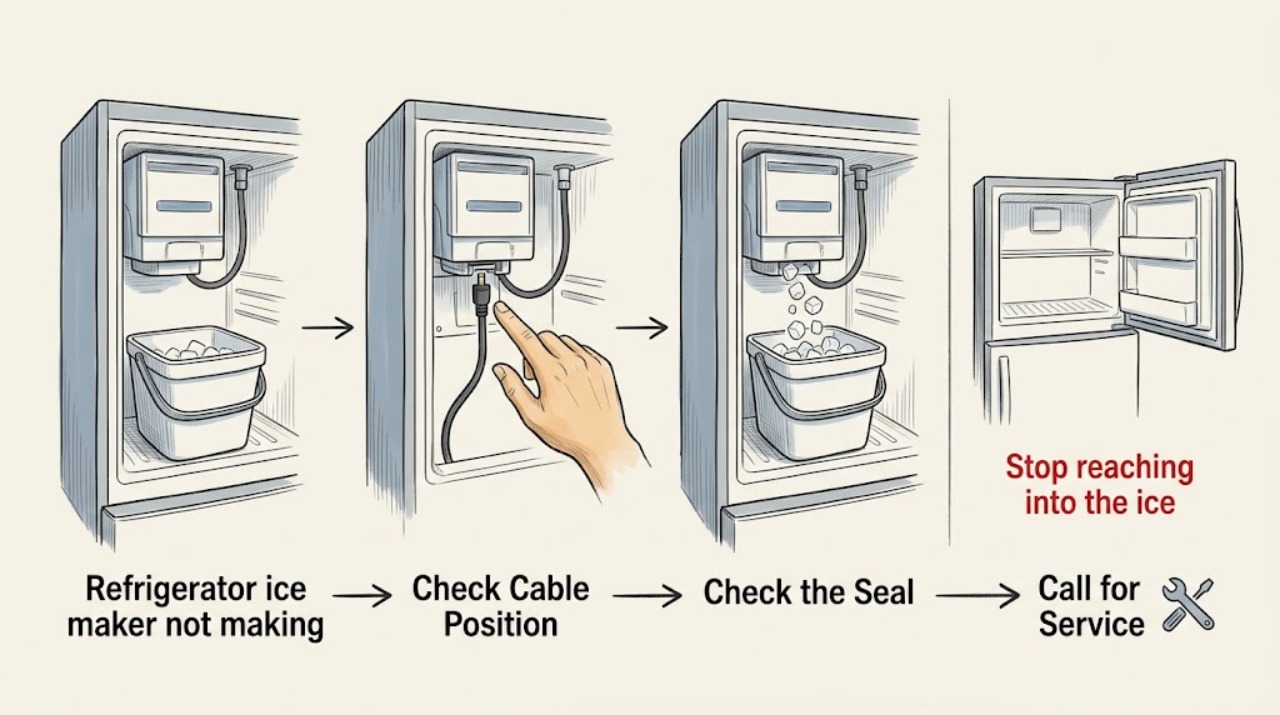
Work through in order
Diagnostic checks
Use only checks that match the exact appliance or system and its official guide.
-
Check 1
Stop reaching into the ice maker, remove loose items from around the bin, and unplug or isolate the refrigerator only when the model instructions require it; do not use a knife, heat gun, or electrical test on exposed wiring.
Expected result: There is a water leak, exposed wiring, heavy frost, a damaged water tube, an unstable refrigerator, or only an empty ice bin with no visible hazard.
Next step: For a leak, exposed wiring, damaged tubing, or heavy frost, stop and arrange appliance service. Otherwise continue without removing covers or forcing the ice-maker mechanism.
Why this matters
Why: Leaks, electrical exposure, and sealed or refrigeration-system work can cause shock, water damage, or appliance damage. A stable empty bin allows external control and water checks.
-
Check 2
Confirm the Frigidaire ice maker is ON, the ice bin is fully seated, and any model-specific wire arm or electronic control is in its operating position; remove only loose cubes that prevent the bin from seating.
Expected result: The maker was OFF, the bin was mis-seated or full, a wire arm was raised, an electronic control shows OFF, or the controls and bin are already correct.
Next step: Correct only the model-approved control or bin position, close the door, and observe for a new cycle. If the state was already correct, continue to the freezer and water checks instead of forcing the arm or ejector.
Why this matters
Why: An OFF control, full-bin signal, or mis-seated bin can stop production without a failed component. Correct controls and a seated bin shift suspicion to water, temperature, fill, or maker-cycle problems.
-
Check 3
Check the freezer condition and door closure without changing hidden settings; if the freezer is warmer than its normal operating condition or the door does not seal, correct the accessible cause and allow the appliance time to stabilize before judging ice production.
Expected result: The freezer is too warm, the door or gasket is not sealing, the refrigerator has just been installed or powered back on, or the freezer condition appears normal.
Next step: Restore a normal model-approved setting, close the door fully, and wait through the manufacturer's stabilization period before retesting. If temperature cannot be maintained or heavy frost returns, arrange service.
Why this matters
Why: Frigidaire says a freezer set too warm can reduce ice production and that a newly installed unit needs cooling time. A door-seal problem can also disturb temperature and produce frost or water symptoms.
-
Check 4
Dispense a small amount of water and inspect the accessible filter seating and rear water line for slow flow, a kink, or a connection that is visibly wet; do not disconnect a pressurized line or pull the refrigerator farther than the tubing permits.
Expected result: Water is slow or absent, the filter is overdue or not seated, the rear line is kinked, the line connection leaks, or dispenser flow is normal.
Next step: Reseat or replace the filter only according to the exact model guide and restore a kink-free accessible line. If a connection leaks or water remains absent, stop and arrange service; if flow is normal, continue to the installation and fill-path check.
Why this matters
Why: Slow or absent water supports a filter, supply-line, or inlet-water problem that can prevent the ice maker from filling. Normal dispenser flow narrows the issue to the ice-maker fill path, control, temperature, or maker assembly but does not prove any one part.
-
Check 5
If the refrigerator was recently installed or the filter was changed, prime and purge the water system according to Frigidaire's guide by dispensing water until it flows steadily, then allow the ice maker to cycle; do not judge the first empty cycles as a failed maker.
Expected result: The unit is newly installed, a filter was recently changed, water initially sputters or flows unevenly, two or three empty ice cycles occur, or the system has been established for some time.
Next step: Complete only the model-appropriate purge, keep the ice maker ON, and allow the freezer to stabilize. If an established system still never fills or harvests, continue to service escalation rather than repeatedly cycling controls.
Why this matters
Why: Air in new or recently serviced plumbing can delay filling and produce empty cycles. An established system with steady water and no ice after adequate cooling points away from a simple priming delay.
-
Check 6
Inspect the accessible ice bin, chute, and ice-maker fill area for a visible ice bridge, frost blockage, or a bin that is not aligned; thaw or clean only removable bin ice as the model instructions allow and never pry at the fill tube or remove electrical covers.
Expected result: The bin or chute is jammed, frost blocks the visible fill area, the bin is clear and seated, the maker has water but does not cycle, or no fill water reaches the mold.
Next step: Clear only loose, accessible bin ice and retest after the refrigerator is closed. For a frozen fill tube, inactive maker, visible leak, or suspected internal electrical fault, stop and arrange model-specific service.
Why this matters
Why: A bin or chute jam can hide newly made ice or stop dispensing, while a clear bin with no fill or cycle points toward the fill valve, tube, control, sensor, or ice-maker assembly. The observation alone does not identify a replacement part.
Use your observations
Decision map
Find the observation that best matches what you see, then follow the next safe action.
-
PATH 01Next step
What you see
The ice maker was OFF, the bin was full or mis-seated, or a top-freezer wire arm was raised, and no water or temperature fault is visible.
Do this next
Restore the model-approved ON and bin position, close the door, and allow a normal cycle before reassessing. Do not force the arm or ejector.
Why this path and its safety boundary
Why it matters: A control or bin-state condition is more likely than a failed ice-maker assembly.
-
PATH 02Next step
What you see
Water dispensing is slow or absent, the filter is overdue or poorly seated, or the rear water line is kinked.
Do this next
Correct only the accessible filter or line issue using the exact model guidance. If flow remains absent or a connection leaks, arrange service before replacing the ice maker.
Why this path and its safety boundary
Why it matters: A restricted water path is more likely than an immediately failed ice-maker motor or control.
-
PATH 03Next step
What you see
The refrigerator is newly installed or has a new filter, water flow was initially sputtering, and only the first few ice cycles were empty.
Do this next
Prime and purge according to the Frigidaire guide, keep the ice maker ON, and allow the freezer to cool and stabilize. Escalate if an established unit still never fills.
Why this path and its safety boundary
Why it matters: Air in the plumbing and normal post-installation stabilization are more likely than a failed component.
-
PATH 04Next step
What you see
The freezer is warm or the door does not seal, heavy frost returns, or the unit cannot maintain its normal cold condition.
Do this next
Stop repeated ice-maker tests, restore the accessible door and temperature condition, and arrange service if warmth or frost persists. Do not remove sealed-system covers.
Why this path and its safety boundary
Why it matters: Temperature or frost conditions can suppress ice production and may indicate a refrigeration or airflow problem beyond the ice maker.
-
PATH 05Next step
What you see
The bin and water flow are normal, the freezer is stable, the maker remains inactive or never fills, a fill tube is frozen, a leak appears, or wiring or an internal control is implicated.
Do this next
Stop disassembly and arrange appliance service. Provide the model, water-flow result, temperature/door observations, control state, and whether the maker ever fills, freezes, or harvests.
Why this path and its safety boundary
Why it matters: A model-specific ice-maker, inlet-valve, fill-tube, sensor, or control diagnosis is now more likely, and forcing the mechanism can cause damage or a leak.
Helpful context
Understand the symptom
First decide whether the failure is ice-making or dispensing
An empty ice bin can result from the maker not filling, from water not reaching the refrigerator, or from ice being made but jammed in the bin or chute. Check the bin and the water dispenser separately. If water dispenses normally but no new cubes form, focus on the ice-maker switch, freezer conditions, fill path, and maker cycle. If water is slow or absent too, start with the filter and supply line before replacing an ice-maker part.
Check the Frigidaire controls without forcing the mechanism
On applicable top-freezer models, Frigidaire describes a down wire arm as the ON position and says the bin can stop production when full. French-door and side-by-side models may use electronic controls or a different bin arrangement. Confirm the exact model's control state, seat the bin fully, and remove only loose ice that blocks the bin or chute. Do not bend a wire arm, rotate an auger by force, or reach into moving parts.
Water flow is a high-value fork
Frigidaire links slow or absent dispenser flow with a filter that is clogged or overdue and also warns that a refrigerator pushed too far against the wall can kink its water-supply line. A normal dispenser does not prove that the ice-maker inlet valve or fill tube is working, but slow or absent water makes the water path the first priority. Inspect only accessible external tubing and the filter seating; do not disconnect a pressurized line.
Recent installation or filter changes can delay the first batch
Frigidaire says air in new plumbing lines can cause two or three empty ice-maker cycles. Its prime-and-purge instructions call for dispensing water until flow begins and continuing long enough to flush the system after installation or a filter change. Follow the exact model guide and allow the refrigerator to cool and stabilize before deciding that the maker has failed.
Do not turn an ice blockage into a water leak
Visible frost or a frozen water path can prevent filling, but forcing ice out with a sharp tool or heating plastic and wiring can cause damage. Remove a bin only as the model instructions allow, keep it dry before reinstalling, and stop if a leak, damaged tubing, exposed wiring, or heavy frost pattern appears. An ice maker that remains inactive after the external checks needs model-specific service diagnosis.
Safety boundary
Stop conditions
- Stop and arrange appliance service for a water leak, damaged or kinked tubing that cannot be safely corrected, exposed wiring, heavy recurring frost, or a refrigerator that cannot maintain a safe cold condition.
- Do not use a knife, screwdriver, heat gun, or improvised electrical jumper to clear the ice-maker fill tube, ejector, mold, or wiring.
- Do not disconnect a pressurized water line, remove sealed refrigeration covers, or replace an inlet valve, sensor, control, or ice-maker assembly without the exact model and appropriate service procedure.
- Arrange service when water flow and freezer conditions are normal but the maker never fills, never cycles, or remains inactive after the model-approved control and bin checks.
- Stop repeated cycling if the ice bin or chute jams again, a filter change does not restore flow, or the refrigerator makes unusual electrical or water-valve noises with no supply connected.
Only after diagnosis
Potential parts
- refrigerator water filter
Consider this only when dispenser flow is slow or absent and the filter is overdue, clogged, cracked, or not seating correctly; normal flow or a kinked line points elsewhere.
Match the exact Frigidaire refrigerator model, filter family, installation direction, and the manufacturer's replacement instructions. - ice-maker water inlet valve
Consider this only after the ice maker is ON, the freezer is stable, the water supply and filter are adequate, and the maker does not receive or control fill water as verified by model-specific service testing.
Match the exact refrigerator model, valve ports, tubing connections, electrical connector, and approved service procedure; do not infer fit from appearance. - ice-maker assembly
Consider this only when the controls, bin, temperature, water path, and fill conditions are normal but the maker does not cycle or harvest after model-specific diagnosis.
Confirm the exact refrigerator model, ice-maker location and revision, connector, mounting, and manufacturer's fit information before ordering.
When checks do not resolve it
Need a professional?
Use appliance service for persistent no-ice after control, temperature, water-flow, and prime checks; leaks or damaged tubing; a frozen fill path; internal wiring or control faults; or a refrigerator that cannot maintain normal cooling.
Safety scope: A qualified appliance technician should diagnose an inlet valve, fill tube, sensor, control, ice-maker assembly, wiring, sealed refrigeration system, or recurring frost condition that cannot be verified through external checks.
Common questions
FAQ
Why is my Frigidaire refrigerator not making ice after installation?
Confirm the ice maker is ON, prime and purge the water system, and allow the refrigerator to cool and stabilize. Frigidaire says air in new plumbing lines can cause two or three empty ice cycles.
Can a water filter stop a Frigidaire ice maker from making ice?
Yes. Frigidaire says a clogged or overdue filter can reduce water flow and ice production. Check seating and model-specific replacement guidance, but also inspect the accessible supply line for a kink.
What does a down wire arm mean on a Frigidaire top-freezer ice maker?
On the top-freezer design covered by Frigidaire's guide, the down position is ON and the raised position is OFF. French-door and side-by-side models may use electronic controls, so follow the exact model instructions.
Why does the water dispenser work but the Frigidaire ice maker does not?
Normal dispenser flow makes a general supply restriction less likely, but it does not prove that the ice-maker fill path, control, sensor, or maker assembly works. Check the ice-maker state, freezer condition, bin, and visible fill area without forcing internal parts.
When should I call for Frigidaire refrigerator ice-maker service?
Arrange service when water and temperature checks are normal but the maker never fills or cycles, when a fill tube is frozen, a leak or exposed wiring is present, heavy frost returns, or the refrigerator cannot maintain normal cooling.
Read the exact guide
Official sources
- Refrigerator Water LeaksFrigidaire · Frigidaire refrigerators; exact filter housings, doors, and water paths vary by model
- What should I do if my ice maker is not making enough ice in my refrigerator?Frigidaire · Frigidaire French-door, side-by-side, and top-freezer refrigerators; exact controls and production vary by model
- My refrigerator was just installed and the ice maker is not working, how do I fix it?Frigidaire · Frigidaire refrigerator models covered by the support article; exact controls differ by model
- Refrigerators - How do I use my ice maker in my Top-Freezer refrigerator?Frigidaire · Top-freezer refrigerators with the described ice-maker design; French-door and side-by-side controls can differ
- Refrigerator Prime and Purge GuideFrigidaire · Frigidaire refrigerators with a water dispenser and ice system; follow the exact model guide where controls differ
Community feedback
Share a repair observation
Share a plain-text repair observation. Accepted observations are published automatically; this page may take a moment to update.