
On this page
Start here
Quick answer
When an LG refrigerator ice maker is not making ice, first confirm that the ice maker is on for the exact model, the control panel is unlocked, and the freezer is actually cooling normally. Then check whether the bin is full or clumped, the feeler arm or sensor is blocked, and the accessible water supply or filter is restricting fill. A new or recently restarted refrigerator may need time to cool and begin a cycle. If the model-specific ice-maker test shows no motor movement or no water, or if the unit leaks, the fill path, inlet valve, control, or ice-maker assembly needs qualified diagnosis; do not force the tray, bypass a sensor, remove the ice maker, or apply heat to internal tubing.
Before you begin
Safety first
- This article supports ordinary-access control, cooling, bin, sensor, water-supply, filter, and model-manual checks. Do not reach into a moving mechanism, jumper terminals, access live wiring, remove the ice maker, thaw internal tubing with heat, or disconnect water lines.
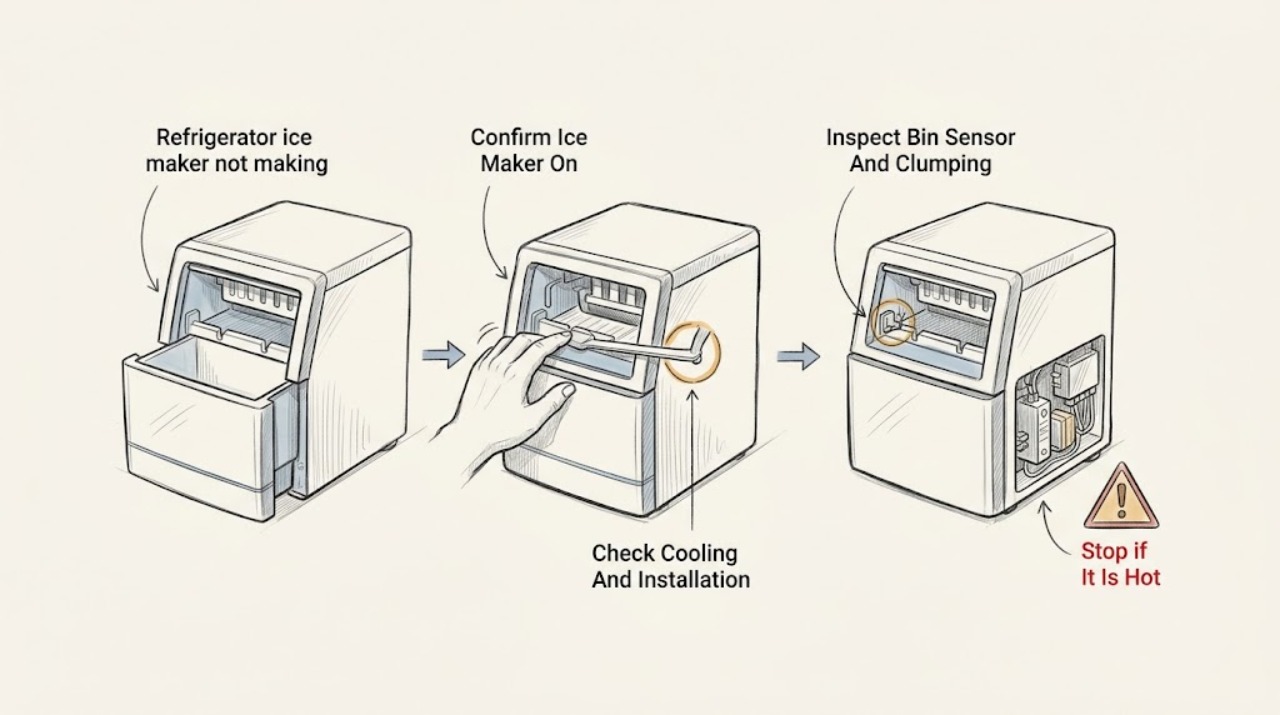
Work through in order
Diagnostic checks
Use only checks that match the exact appliance or system and its official guide.
-
Check 1
Use the LG owner's manual or the clearly labeled refrigerator control to confirm that the ice maker is on; unlock the control panel if the model requires it, and inspect the ice-bin area from ordinary access without removing covers, wiring, or the ice-maker assembly.
Expected result: Record whether the ice maker is off, on with no indicator, disabled by a locked panel, showing a warning, or controlled by an unfamiliar switch; note whether the model uses a feeler arm, paddle, or infrared sensor.
Next step: Turn the ice maker on only through the model-authorized control, clear only loose accessible ice without force, and continue to the cooling and bin checks when the model is identified; arrange service for a persistent fault indication.
Stop if: Stop for exposed wiring, a loose assembly, sparking, a burning odor, abnormal heat, or any need to remove a cover or reach into the mechanism.
Why this matters
Why: An off setting or locked panel can stop production without a failed component. A full-bin arm or sensor may also intentionally stop a cycle. An unfamiliar control or persistent warning requires the exact LG procedure rather than a generic reset.
-
Check 2
Check the freezer's displayed setting and actual cooling behavior against the LG manual; note whether the refrigerator was recently installed, powered off, or restarted, and compare other frozen food for signs that the compartment is warming.
Expected result: The freezer is not reaching its normal ice-making condition, the temperature is stable and cold, the unit is newly installed or recently restarted, or other frozen food is soft or warming.
Next step: Follow the exact LG manual for the temperature setting and stabilization period, keep vents and the door seal unobstructed, and arrange appliance service if the freezer remains warm or ice does not begin after stabilization.
Stop if: Do not dismantle the cooling system or continue storing food that is not maintaining a safely frozen condition.
Why this matters
Why: LG identifies insufficient freezer cooling as a reason for no ice and says a newly installed refrigerator needs time before ice production starts. Soft frozen food or a warm compartment points to a broader cooling issue rather than an ice-maker-only fault.
-
Check 3
From ordinary access and only while the ice maker is not moving, look for a full or clumped bin and check that the model's feeler arm, paddle, or sensor area is not blocked by ice; use the LG manual for any bin-removal or cleaning step and do not force the tray or arm.
Expected result: The bin is full or clumped, cubes hold an arm or block a sensor, the tray or rake is visibly obstructed, or the mold and sensing area are empty and unobstructed.
Next step: Use only the model-authorized loose-cube, bin-cleaning, and drying procedure, then allow a normal cycle; arrange service if the sensor, tray, or mechanism will not move normally or jams again.
Stop if: Do not pry cubes, pull an arm, rotate a tray, touch a sensor with tools, or reach into a moving or hot ice maker.
Why this matters
Why: LG notes that a full or clumped bin and a blocked sensing area can leave the ice maker paused or prevent usable cubes from being stored. An empty unobstructed mold shifts the check toward cooling, water delivery, or the ice-maker mechanism.
-
Check 4
Check the refrigerator's accessible water-supply valve and tubing for a normally open valve or visible kink without moving the appliance or loosening a connection; if the model has a filter, check its status and use only the LG-approved filter or bypass procedure for that model.
Expected result: The supply valve is closed or partly closed, dispenser flow is weak, the filter is due or restricted, a model-approved bypass improves flow, or the accessible supply and filter appear normal while the mold remains empty.
Next step: Restore only an accessible valve that operates normally, replace a filter only with the exact model procedure, and arrange service for a suspected internal blockage, valve fault, leak, or unresolved no-fill condition.
Stop if: Do not disconnect water tubing, apply direct heat to a frozen fill tube, force a valve, or continue if water is leaking behind the refrigerator.
Why this matters
Why: LG identifies water-supply and filter conditions as possible reasons for no ice. If accessible flow is normal but the ice maker receives no water, an internal fill tube, inlet valve, or control problem becomes more likely and may require service.
-
Check 5
After the power, cooling, bin, sensor, supply, and filter checks are complete, use only the exact LG manual's normal test or reset procedure for the installed ice maker; keep hands away from the tray and motor and catch water or ice as directed.
Expected result: The test starts and completes with water, the motor or tray moves but no water enters, the motor or tray does not move, a fault indication remains, or the test stops with abnormal heat, noise, or movement.
Next step: Stop the test and arrange qualified LG appliance diagnosis for no fill, no movement, persistent fault indication, leaking, or an abnormal test; provide the exact model and the observed sequence.
Stop if: Do not jumper terminals, measure live voltage, bypass a feeler arm or sensor, remove the ice maker, touch the tray during a cycle, or repeat a hot or abnormal test.
Why this matters
Why: A completed test with water supports normal ice-maker movement and shifts attention to cooling, bin, or storage timing. Movement without water points toward water delivery; no movement or a persistent abnormal indication points toward the ice-maker assembly, motor, control, or another service-level fault.
Use your observations
Decision map
Find the observation that best matches what you see, then follow the next safe action.
-
PATH 01Safety boundary
What you see
The LG ice maker is off, the control panel is locked, or an on/off control has been disabled for the model.
Do this next
Unlock or turn on the ice maker only through the exact LG control procedure, then allow a normal cycle and monitor; request service if the control will not respond or a fault remains.
Why this path and its safety boundary
Why it matters: Production is more likely paused by a control state than by a failed motor, valve, or ice-maker assembly.
Safety stop: Do not remove the control panel, bypass a lock, or improvise a reset sequence.
-
PATH 02Safety boundary
What you see
The freezer or other frozen food is warmer than expected, the ice maker never reaches its cycle condition, or the refrigerator was recently installed or restarted.
Do this next
Follow the exact LG manual for temperature and stabilization, protect food, and arrange service if the freezer remains warm or ice production does not resume.
Why this path and its safety boundary
Why it matters: A broader cooling or stabilization issue is more likely than an isolated ice-maker failure; LG says a new installation needs time before ice production starts.
Safety stop: Do not open the sealed cooling system or continue storing food that is not safely frozen.
-
PATH 03Safety boundary
What you see
The bin is full or clumped, cubes hold a feeler arm or paddle, or ice blocks an infrared-sensor area or tray path.
Do this next
Use the model-authorized bin, loose-cube, and drying procedure without force, then allow a normal cycle; request service if the sensor, tray, or rake jams again.
Why this path and its safety boundary
Why it matters: The maker may be intentionally paused or unable to complete transfer, so a failed water valve is not yet established.
Safety stop: Do not pry cubes, pull an arm, rotate a tray, or reach into a moving mechanism.
-
PATH 04Safety boundary
What you see
The accessible valve is not fully open, dispenser flow is weak, the filter is restricted, or an LG-approved bypass check improves water flow.
Do this next
Use the exact model's filter or bypass procedure, restore only a normally operating accessible valve, and allow normal cycles; arrange service if fill remains absent or a leak is present.
Why this path and its safety boundary
Why it matters: Insufficient water delivery is a plausible reason the timed ice-maker fill is empty or incomplete.
Safety stop: Do not force a valve, disconnect tubing, move the refrigerator to access a line, or run it with a water leak behind it.
-
PATH 05Safety boundary
What you see
The model-specific test starts the motor or tray but no water enters, while accessible supply and filter checks are normal.
Do this next
Do not remove the ice maker or thaw internal tubing with heat; arrange qualified service to inspect the fill path, inlet valve, and related controls.
Why this path and its safety boundary
Why it matters: A restricted or frozen fill path, inlet-valve fault, or related internal water-control problem is more likely than an off setting.
Safety stop: Do not disconnect water lines, apply a heat source, or access internal wiring as a user test.
-
PATH 06Safety boundary
What you see
The model-specific test does not move the tray or motor, a fault indication persists, or a cycle appears to complete but cubes do not remain in the bin.
Do this next
Stop testing and arrange qualified LG service for no movement, a persistent fault, leaking, overfill, or repeated failure to transfer cubes; give the technician the model and observed cycle.
Why this path and its safety boundary
Why it matters: No movement or a persistent fault makes an ice-maker assembly, motor, or control issue more likely. A completed cycle with no stored cubes shifts attention to transfer, clumping, bin, or sensing rather than water fill alone.
Safety stop: Do not jumper terminals, bypass sensors, force the tray, touch a moving mechanism, or repeat an abnormal or hot test.
Helpful context
Understand the symptom
Start by separating no cycle from no water
An empty LG ice bin does not identify one failed part. The ice maker may be off or locked out, waiting for the freezer to cool, paused because the bin is full or a feeler arm or sensor is blocked, or unable to receive water. Record whether the mold is empty, partly filled, frozen with cubes, or surrounded by clumped ice. That observation determines whether the next safe check is the control and cooling condition, the storage and sensing area, or water delivery.
Use the LG model manual for controls and reset steps
LG refrigerator ice makers use different switches, control-panel controls, feeler arms, infrared sensors, trays, and test buttons. The same-looking ice maker can therefore have a different on/off or reset procedure. Identify the refrigerator model and follow its manual before using a test or reset; do not transfer a tray position or button sequence from another LG model.
A working dispenser does not prove the ice fill path works
If the refrigerator has a dispenser, its water flow is a useful observation but not a complete ice-maker diagnosis. The ice maker has its own timed fill path, and a restricted filter, supply problem, frozen fill tube, or inlet-valve fault can leave the mold empty even when some water is available elsewhere. Check only accessible supply and filter conditions; leave internal water-path work to a qualified technician.
Treat the ice-maker test as a moving mechanism
LG describes more than one ice-maker test style, including a test or fill button on some models. A test may run the motor and may command water into the tray. Catch loose water or ice with a towel when the model instructions call for it, keep hands out of the tray and rake path, and stop if the procedure does not match the installed model or produces abnormal heat, noise, or movement.
Safety boundary
Stop conditions
- Do not reach into the ice maker, touch the tray or rake during a cycle, or force a feeler arm, sensor, bin, or clumped cubes.
- Do not jumper terminals, measure live voltage, bypass an infrared sensor or arm, remove the ice maker, or access wiring as a user test.
- Do not apply direct heat to a frozen fill tube or internal ice, disconnect water tubing, or loosen a connection that may leak.
- Stop for water leaking behind the refrigerator, exposed wiring, sparking, burning odor, abnormal heat or noise, or unsafe freezer temperatures.
- Arrange qualified LG appliance service for an unresolved no-fill or no-cycle condition after the model-specific power, cooling, bin, sensor, water-supply, and filter checks.
Only after diagnosis
Potential parts
- LG refrigerator water filter
Consider this category only when the model-authorized filter or bypass check shows restricted water flow and the filter is diagnosed as the cause of incomplete ice-maker filling.
Confirm the exact LG refrigerator model and filter design; a filter change does not correct a closed supply, frozen fill path, valve fault, or internal leak. - LG refrigerator ice-maker assembly
Consider this category only when a qualified diagnosis finds that the ice-maker motor, tray, heater, sensor, control, or assembly fails the model-specific test after cooling and water checks pass.
Confirm the exact LG model, ice-maker style, connector, and manual procedure before ordering or replacing; do not infer fit from housing appearance. - LG refrigerator water inlet valve or fill-path component
Consider this category only when service confirms that the ice maker requests a fill but water does not arrive because of an inlet valve, fill tube, or internal water-path fault.
Confirm the exact LG model and diagnosed water-path component; fill-path removal and water-line service are not ordinary user checks.
When checks do not resolve it
Need a professional?
Arrange qualified LG appliance service when the ice maker remains empty after the exact model's power, cooling, bin, sensor, water-supply, and filter checks; when a model-specific test moves without water; when the tray or motor does not move; when a fault indication persists; or when the unit leaks, overfills, jams, or requires removal. Request prompt help for water behind the refrigerator, exposed wiring, sparking, burning odor, abnormal heat, or a freezer that is not safely cold. Provide the LG model, control and sensor style, mold and bin state, freezer behavior, dispenser and filter result, supply-valve result, and any model-authorized test result.
Safety scope: This article supports ordinary-access control, cooling, bin, sensor, water-supply, filter, and model-manual checks. Do not reach into a moving mechanism, jumper terminals, access live wiring, remove the ice maker, thaw internal tubing with heat, or disconnect water lines.
Common questions
FAQ
Why is my LG refrigerator ice maker not making ice when the freezer seems cold?
Confirm that the ice maker is on and the panel is unlocked, then check the bin, feeler arm or sensor area, filter, and accessible water supply. LG uses different ice-maker styles, and a frozen fill path, inlet valve, control, or ice-maker assembly can still prevent filling even when the freezer feels cold.
Can an LG refrigerator water filter stop the ice maker?
Yes. LG includes the filter and water supply among the checks for water and ice problems. Use the exact model's approved filter or bypass procedure; arrange service if flow remains weak, a leak is present, or the ice maker still does not fill.
Why does my LG water dispenser work but the ice maker does not make ice?
Dispenser flow does not prove that the ice maker's timed fill path is clear. A restricted or frozen fill path, inlet valve, filter, or ice-maker control can leave the tray empty. Do not remove the ice maker or thaw internal tubing with heat; arrange qualified service for an unresolved no-fill result.
Should I reset my LG refrigerator ice maker?
Only use a reset or test sequence that matches the exact LG model and ice-maker style. LG documents different tray, feeler-arm, infrared-sensor, and test-button arrangements; stop if the procedure does not match or if the mechanism becomes abnormal, hot, noisy, or unsafe.
Read the exact guide
Official sources
- Tray Will Not Turn UprightLG Electronics · Use only when the installed LG ice maker matches the model-specific tray, arm, sensor, or test instructions; do not generalize one style to another.
- LG Refrigerator – Why is My Refrigerator Not Making Ice?LG Electronics · Use for general LG refrigerator no-ice checks; control layouts, ice-maker styles, and test procedures vary by model.
- [LG Refrigerator] Troubleshooting water, ice related issuesLG Electronics · Use for common LG water and ice observations; the exact model manual controls the applicable switch, filter, sensor, and test procedure.
Community feedback
Share a repair observation
Share a plain-text repair observation. Accepted observations are published automatically; this page may take a moment to update.