
On this page
Start here
Quick answer
An Amana refrigerator that is not making ice may have a shared water-flow problem, a warm freezer, an ice maker that is off, a misplaced bin, or a fill or harvest fault. Check the model-specific ice-maker setting and bin, confirm that the freezer is actually cold, compare dispenser flow when the model has one, and inspect only the accessible water line and filter condition. A kink, closed supply, recent filter installation, reverse-osmosis system, or weak dispenser can point upstream; normal water flow with a cold freezer shifts suspicion toward the ice-maker mechanism, inlet valve, fill path, or sensing control without identifying a replacement part. Stop for a leak, overfill, water near electrical parts, poor cooling, or a mechanism that jams or buzzes continuously, and arrange qualified service.
Before you begin
Safety first
- Stop for a leaking or disconnected line, filter-housing leak, overfill, water near electrical parts, exposed wiring, smoke, burning odor, a jammed mechanism, or a refrigerator that cannot maintain normal cooling. Do not open panels, loosen pressurized fittings, bypass a safety control, or restart after a hazard.
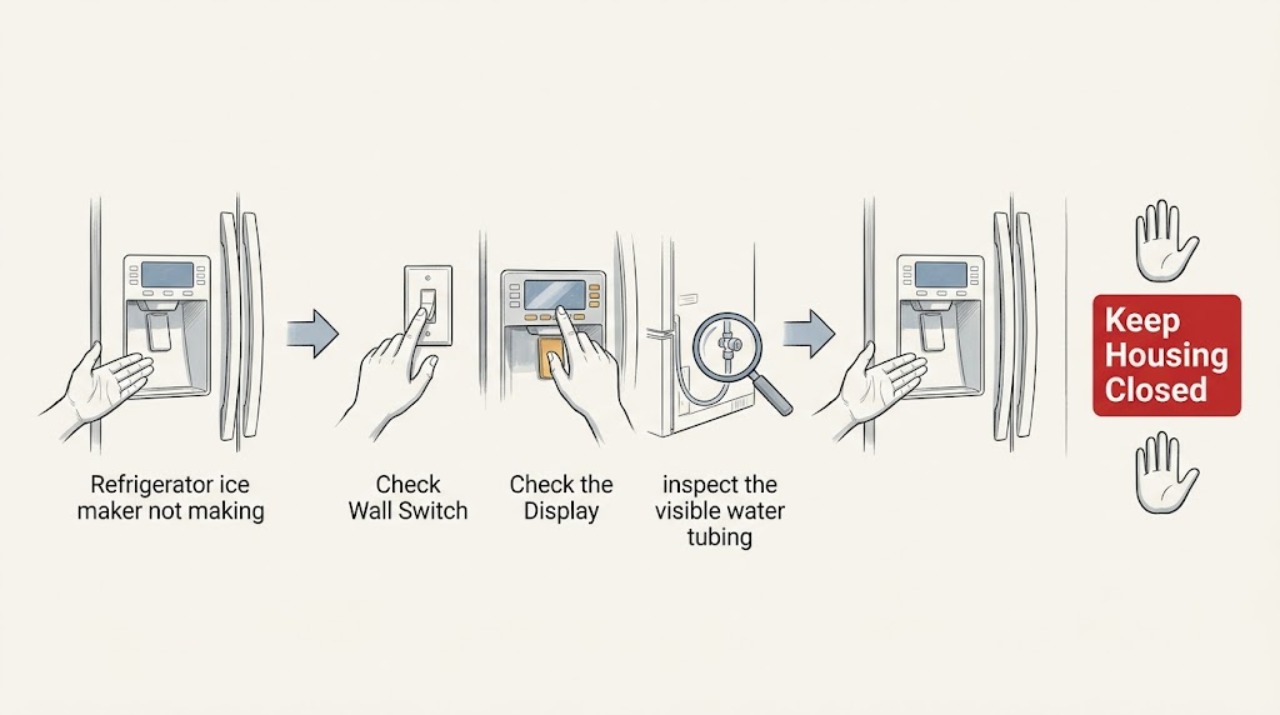
Work through in order
Diagnostic checks
Use only checks that match the exact appliance or system and its official guide.
-
Check 1
With the freezer door open and the mechanism still, compare the visible ice-maker switch, arm, or control and the ice bin position with the exact Amana owner's manual; remove only loose ice from the chute or bin area that is plainly reachable without force.
Expected result: The maker is switched off, the arm or control is not in the model's normal operating position, the bin is not fully seated, the chute is clogged, a cube is wedged in the ejector, or all visible items appear normal.
Next step: Do not force an arm, reach into moving parts, or use an unidentified reset or test sequence.
Stop if: If the setting and bin are normal, continue to the freezer-temperature and cooling check.
Why this matters
Why: An off state, bin interlock or position issue, or accessible obstruction can stop production without proving a failed part. A normal setting and seated bin move the investigation toward temperature, water flow, or the cycle itself.
-
Check 2
Check the freezer display or a reliable temperature reading without changing to an extreme setting, and note whether other frozen food is solid, the freezer has recently been loaded, or cooling has been unstable; use the model manual for the normal setting.
Expected result: The freezer is holding the model's normal range, is warmer than expected, has just been loaded or installed, shows a fault, or has frost and cooling behavior that is abnormal.
Next step: Keep doors closed during stabilization and do not open sealed refrigeration or electrical compartments.
Stop if: If the freezer is cold and stable, compare water flow and supply conditions rather than ordering an ice-maker part.
Why this matters
Why: A warm or unsettled freezer can suppress the ice-making cycle even when water is available. If the freezer is cold and stable, water delivery and the ice-maker cycle become more likely next checks.
-
Check 3
From a safe accessible position, inspect the visible water tubing and shutoff area for a kink, crushing against the wall, a wet connection, a crack, or a visibly closed valve; do not pull the refrigerator or loosen any fitting to reach it.
Expected result: The line is kinked or crushed, a connection is wet or damaged, the shutoff appears closed, the refrigerator was recently moved, or the accessible line is clear and dry.
Next step: Do not tighten an uncertain pressurized connection or push the appliance farther against the wall.
Stop if: If the visible supply is clear and dry, use the dispenser and filter comparison before inspecting the ice-maker cycle.
Why this matters
Why: A restricted, damaged, incorrectly installed, or closed supply can starve both the ice maker and dispenser. A clear, dry line does not rule out low household pressure, a filter restriction, or an internal valve problem.
-
Check 4
If the refrigerator has a water dispenser, make one brief normal dispense observation and compare its flow with the no-ice symptom; if the filter was recently installed, verify from the outside that it is the filter and seating specified by the model manual.
Expected result: The dispenser is slow or dry, normal, sputtering after a filter change, or leaking around the filter housing; the model has no dispenser or filter.
Next step: Do not bypass a filter or repeatedly dispense water as a substitute for finding a leak or restriction.
Stop if: If dispenser flow is normal, or the model has no dispenser, continue to the single-cycle observation; do not assume the inlet valve is proven good.
Why this matters
Why: Slow or absent dispenser flow alongside no ice points toward shared pressure, supply-line, filter, or reverse-osmosis restrictions. Normal flow makes an ice-maker-specific fill, valve, sensor, or harvest problem more plausible, while a post-filter leak or sputter points to installation or trapped air.
-
Check 5
Observe one ordinary ice-maker cycle from outside the mechanism, noting whether it calls for water, makes a brief fill sound, leaves water absent from the mold, or contains cubes that do not release; inspect a fill opening only when the exact manual identifies it as accessible.
Expected result: The maker fills and later fails to harvest, buzzes or clicks without water, never calls for water, has a visible frozen or obstructed fill opening, or shows no movement or sound.
Next step: Do not touch an ejector while it moves, insert tools, pour hot water into the maker, or disassemble the fill path.
Stop if: If there is no abnormal sound or visible cycle, document the result and move to model-specific service diagnosis rather than repeating the test.
Why this matters
Why: Filling without release makes the harvest mechanism or sensing more likely; a buzz without water keeps supply, filter, and inlet-valve restriction in consideration; no fill or movement needs model-specific diagnosis because the observation does not isolate the failed component.
-
Check 6
Record the complete Amana model number, freezer result, maker control position, bin condition, dispenser flow if present, filter history, supply-line findings, and the exact sound or fill/harvest behavior before requesting a diagnosis.
Expected result: The evidence points mainly to shared water flow, freezer cooling, filter installation, a fill attempt, a harvest failure, or a silent control or sensor condition.
Next step: Provide photos of accessible symptoms and the model information; do not order a component solely from a similar Amana refrigerator series.
Stop if: If the record shows only persistent no-ice production after safe checks, request model-specific diagnosis before selecting any part.
Why this matters
Why: This symptom sequence lets a technician distinguish an upstream water problem from an ice-maker assembly, fill tube, inlet valve, sensor, or control issue. Similar-looking Amana refrigerators can use different controls and parts, so appearance alone is not compatibility evidence.
Use your observations
Decision map
Find the observation that best matches what you see, then follow the next safe action.
-
PATH 01Next step
What you see
The ice maker is on, the freezer is cold, and the dispenser is also slow or unavailable, especially after a move, filter change, or use of reverse-osmosis water.
Do this next
Correct only a plainly visible kink or model-documented filter seating issue. Have a qualified person assess pressure, valve type, leaks, or RO performance when the accessible checks do not restore flow.
Why this path and its safety boundary
Why it matters: A shared supply, pressure, filter, or tubing restriction is more likely than an isolated ice harvest failure. The dispenser result is evidence about the path to the refrigerator, not proof that every internal valve is good.
-
PATH 02Next step
What you see
The freezer is cold and dispenser flow is normal, but the ice maker remains silent, never fills, fills without releasing cubes, or shows a recurring fill or harvest symptom.
Do this next
Use the complete model manual and the recorded cycle behavior for professional diagnosis. Keep the maker off if it jams, overfills, or buzzes without water; do not choose a replacement by visual similarity.
Why this path and its safety boundary
Why it matters: An ice-maker mechanism, sensing or control component, fill tube, or inlet valve is more plausible, but these observations do not identify which component failed.
-
PATH 03Next step
What you see
The freezer is warm, unstable, recently loaded or installed, or showing abnormal cooling while the water line and maker setting appear normal.
Do this next
Follow the owner manual's normal temperature and stabilization guidance. Arrange refrigerator service if cooling remains poor or a fault indication returns, and protect food as appropriate.
Why this path and its safety boundary
Why it matters: The operating condition is a stronger lead than a failed ice-maker part. Ice production may resume only after the refrigerator reaches its model-specific normal condition, but continued warming is a separate appliance fault.
-
PATH 04Next step
What you see
Water leaks from the line or filter housing, water reaches electrical parts, the maker overfills, a mechanism jams under tension, the freezer cannot cool, or smoke or a burning odor appears.
Do this next
Stop the maker and appliance when safe, keep clear of wet electrical areas, shut off the water supply before hose or overfill service, and obtain qualified appliance service. Do not restart to test the hazard.
Why this path and its safety boundary
Why it matters: Continued testing can increase water damage, shock, food-loss, or appliance risk. This is outside observation-only troubleshooting.
Helpful context
Understand the symptom
Start with the symptom split, not a replacement part
An empty Amana ice bin does not prove that the ice-maker assembly failed. Ice production depends on water reaching the refrigerator, a freezer cold enough for the cycle, the model's on or off control, and a mechanism that fills and releases the cubes. If the refrigerator has a dispenser, its flow is a useful comparison: a weak dispenser and an empty bin share more likely causes than a normal dispenser and a silent ice maker. Amana's controls, bin design, filter location, and safe reset procedure vary by model, so use the complete model number to find the owner's manual before touching a control that is not identified.
What the cycle observation can and cannot tell you
A brief fill sound, a valve buzz with no water, cubes that remain in the mold, and a maker with no movement are different observations. They narrow the next safe check, but none identifies a particular failed part by itself. Do not force the ejector, insert tools into the fill opening, thaw an enclosed passage with improvised heat, or repeatedly press an unfamiliar test control.
Keep water and electrical work outside the DIY boundary
Inspect only tubing and controls that are safely accessible from the front or without pulling the refrigerator. Amana notes that a damaged or kinked line can cause no ice or leaks, and its water-line instructions call for model-specific installation guidance. Do not loosen a pressurized fitting, move the refrigerator by its tubing, remove an electrical cover, or continue operating an overfilled or leaking maker.
Safety boundary
Stop conditions
- Stop testing for a leaking or disconnected water line, a filter-housing leak, water near electrical parts, exposed wiring, smoke, or a burning odor.
- Stop for an ice maker that overfills, jams under tension, buzzes continuously without water, or does not stop when its model-specific control is used.
- Before hose or overfill service, have the water supply safely shut off; do not loosen a pressurized connection or pull the refrigerator by its tubing.
- Do not force the ejector, insert tools into the fill opening, pour hot water into the mechanism, bypass a filter or safety control, or fit a part without the complete model and diagnosis.
Only after diagnosis
Potential parts
- refrigerator ice-maker assembly
Consider this only after the freezer condition, water path, filter, bin, and controls are confirmed normal and diagnosis shows that the maker does not fill or harvest correctly.
Amana ice-maker assemblies, connectors, controls, and freezer layouts vary by complete model number. A similar appearance is not a fit confirmation. - refrigerator water inlet valve
Consider this only when a qualified test shows the maker calls for water but the valve does not deliver it, after the supply line, filter, and pressure are addressed.
Valve outlets, connectors, and flow characteristics are model-specific. Water must be safely shut off before service. - ice-maker fill tube
Consider this only when model-specific inspection identifies a blocked, cracked, frozen, or misaligned fill path after safe external checks.
Fill-tube access and routing differ across Amana refrigerator designs; do not thaw, drill, or replace one by appearance.
When checks do not resolve it
Need a professional?
Arrange qualified Amana refrigerator service when no ice persists after the model-specific setting, freezer, water-line, filter, bin, and cycle checks; when both dispenser and ice maker have weak flow; or when a fill, harvest, valve, sensor, or control symptom repeats.
Safety scope: Stop for a leaking or disconnected line, filter-housing leak, overfill, water near electrical parts, exposed wiring, smoke, burning odor, a jammed mechanism, or a refrigerator that cannot maintain normal cooling. Do not open panels, loosen pressurized fittings, bypass a safety control, or restart after a hazard.
Have this ready
- Provide the complete model number, refrigerator style, maker location and control position, bin status, freezer result, dispenser result, filter history, line condition, cycle sounds, fill or harvest behavior, and photos of any accessible leak or obstruction.
Common questions
FAQ
Why is my Amana refrigerator ice maker not making ice when the freezer is cold?
A cold freezer rules out only one branch. Check the maker's model-specific on state and bin, compare dispenser flow, inspect the accessible line and filter condition, then observe whether the maker fills or harvests. Normal dispenser flow with a cold freezer points toward an ice-maker cycle or control diagnosis, not automatically a replacement assembly.
Can an Amana water filter stop the ice maker?
Yes. Amana says an improperly installed or clogged filter can reduce flow to the ice maker and dispenser. After a filter change, check the model-specific seating and flushing instructions; stop for a housing leak rather than repeatedly removing the filter or bypassing it.
What does it mean if the Amana ice maker buzzes but no ice appears?
A buzz during a fill attempt can mean the valve is trying to fill against an absent or restricted water supply. Check the visible supply, filter, and model control without opening a water connection. If buzzing continues, the maker is unconnected, or the maker overfills, turn it off using the identified control and arrange service.
Should I force a stuck cube out of the Amana ice maker?
No. Do not force the ejector or put tools into the mechanism. If the model manual does not describe a safe accessible clearing step, keep the maker off and request service, especially when the maker is overfilled or the mechanism is under tension.
Can a kinked water line cause no ice but normal refrigerator cooling?
Yes. Amana identifies kinks, damage, incorrect installation, and a closed or restricted supply as causes of reduced or absent water and ice flow. Ease only a plainly visible kink without moving the refrigerator; arrange service for leaks, disconnected tubing, or any pressurized connection.
Should I replace the Amana ice-maker assembly first?
Not from the empty-bin symptom alone. Confirm the freezer, water path, filter, bin, and control first. A technician should use the fill and harvest behavior plus the complete model number to distinguish an ice-maker assembly from a valve, fill tube, sensing, or control issue.
Read the exact guide
Official sources
- Ice Maker Not Working - TroubleshootingAmana · Amana refrigerator ice-maker causes and checks for water supply, freezer temperature, maker state, and water filters
- Ensuring Correct Water PressureAmana · Amana refrigerator water-pressure symptoms, supply-line kinks, filters, and reverse-osmosis effects on ice production
- REFRIGERATOR TROUBLESHOOTING: WATER AND ICE ISSUESAmana · Amana refrigerator water and ice dispenser checks for maker state, bin, ejector, chute, pressure, line, filter, and control lock
- How to Check the Water Supply LineAmana · Amana refrigerator water-line installation, kinks, shutoff, damage, leaks, and model-manual boundaries
- Refrigerator Noise - BuzzingAmana · Amana refrigerator buzzing from an ice-maker fill attempt when water is absent or restricted, plus cooling-load context
Community feedback
Share a repair observation
Share a plain-text repair observation. Accepted observations are published automatically; this page may take a moment to update.