
On this page
Start here
Quick answer
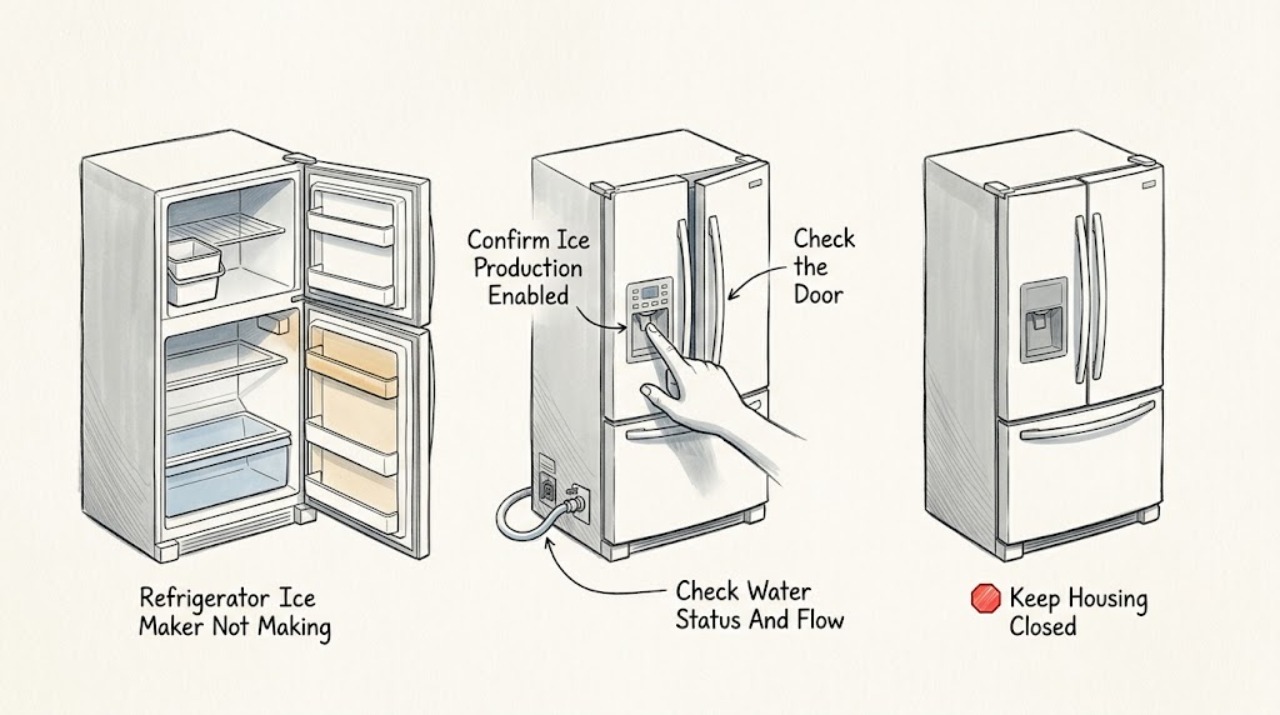
When a Bosch refrigerator ice maker is not making ice, start with the reversible checks: confirm ice production is enabled, the ice container and door are fully seated and closed, the freezer is cold enough according to the model manual, and the refrigerator has water with its shutoff open. A kinked water line, blocked or incorrectly installed filter, low supply flow, a blocked fill-level sensor or ejector, or a recent startup can stop or delay production. Bosch manuals also treat ice-maker faults and water-connection problems as service conditions. Do not pull the refrigerator, disconnect a water line, reach into an energized ice maker, or use heat or sharp tools to remove ice; arrange qualified appliance service for leaks, damaged tubing, repeated faults, or no improvement after model-safe checks.
Before you begin
Safety first
- This article covers normal controls, visible inspection, model-safe filter and bin handling, and cautious observation only. Qualified service must handle concealed water connections, internal ice-maker parts, sensors, wiring, valves, refrigerant or cooling faults, and any repair near electrical or water hazards.
Work through in order
Diagnostic checks
Use only checks that match the exact appliance or system and its official guide.
-
Check 1
From the refrigerator controls or the accessible ice-maker switch or arm, confirm that ice production is enabled; check the model manual if the control is not obvious, and do not reach behind a cover.
Expected result: The ice maker is off, the switch or arm is on but the status remains disabled, or production is enabled with no other visible fault.
Next step: Enable production only through the normal model control and allow the manual's stated production period. If the control will not enable or the fault returns, arrange Bosch service.
Stop if: Do not bypass a door or bin sensor, remove a cover, or reach into a moving or energized mechanism.
Why this matters
Why: An off setting can fully explain no ice. An enabled setting with no production shifts attention to container position, water, freezer temperature, filter, or an ice-maker fault.
-
Check 2
With hands clear of the ice maker, remove and reseat the accessible ice container only as the model manual allows; close the freezer door fully and check that food, shelving, or the container is not blocking the door or fill-level sensor.
Expected result: The container was not fully seated, the door stayed open or was obstructed, the sensor area was blocked, or everything is correctly positioned but no ice is produced.
Next step: Restore the documented position and observe whether production resumes after the model's normal wait. Stop and request service if a sensor, hinge, door seal, or container is damaged or the ice maker remains inactive.
Stop if: Do not force the container, bend a sensor arm, chip ice from the mechanism, or operate with a door that cannot close and seal.
Why this matters
Why: A mis-seated container, open door, or blocked sensor can suppress production without a failed ice-maker assembly. A correctly seated bin and door keep water, temperature, filter, and internal fault causes in consideration.
-
Check 3
Check the refrigerator's water-supply status and the accessible shutoff position without pulling the appliance or disconnecting tubing; if the model has a dispenser, observe whether its water flow is normal, weak, or absent.
Expected result: The supply is off or unknown, a visible hose is kinked, dispenser flow is weak or absent, or dispenser flow is normal while the ice maker remains dry.
Next step: Open an accessible shutoff only if it operates normally and follow the manual for a visible hose kink; otherwise arrange plumbing or appliance service. Do not disconnect the water line to test pressure.
Stop if: Stop for a leak, damaged hose, a stuck shutoff, water near electrical parts, or any need to move the refrigerator or loosen a connection.
Why this matters
Why: An unavailable or restricted water path can prevent the ice mold from filling. Normal dispenser flow narrows the issue toward the ice-maker control, fill path, sensor, or model-specific ice system, but does not prove a valve or assembly failure.
-
Check 4
Identify whether the Bosch refrigerator uses a water filter and read the exact model instructions for checking or replacing it; inspect the filter's visible seating and status without forcing the housing or leaving the water path open.
Expected result: The filter is blocked, overdue according to the model's indication, not seated, recently replaced, absent, or the model has no filter in the ice-maker path.
Next step: Use only the exact manual's filter and reset procedure, then allow the documented production period. If flow stays weak, a leak appears, or the filter cannot be identified, request service.
Stop if: Do not bypass a filter, use an unverified substitute, force the housing, or operate with a leaking filter connection.
Why this matters
Why: Bosch identifies a blocked or incorrectly installed filter as a possible restriction. A recent filter change can also require the model's documented flushing or reset sequence. A normal filter does not rule out supply, temperature, sensor, or ice-maker faults.
-
Check 5
Check the freezer temperature display and the refrigerator's level or tilt only through the normal controls and the owner's manual; inspect that the freezer door closes and the appliance is not visibly leaning, without adjusting feet or moving the appliance.
Expected result: The freezer is warmer than the model's ice-making requirement, the door does not close fully, the appliance is visibly out of level, or temperature and door position appear normal.
Next step: Correct only normal control or door-obstruction issues allowed by the manual and allow the documented recovery period. Arrange service for persistent temperature problems, an unlevel installation requiring adjustment, or a door seal or hinge issue.
Stop if: Do not move or tilt the refrigerator, adjust leveling hardware under load, or keep testing with a door that will not seal.
Why this matters
Why: Bosch says a freezer that is too warm, a door that does not close, or an appliance that is not level can interrupt or distort ice production. Normal temperature and closure keep water flow, filter, sensor, and ice-maker faults in consideration.
-
Check 6
Look at the accessible ice container and ejector area for a loose cube or obvious blockage; clear only a visible obstruction with the model-approved plastic utensil method, then allow the model's stated time after startup or a large ice removal before judging production.
Expected result: A visible cube blocks the ejector, the bin was recently emptied or the ice maker was newly enabled, no obstruction is present, or the mechanism remains stuck after the safe wait.
Next step: Follow the manual's wait and reset guidance once. If production does not resume or the mechanism binds, keep the ice maker off and arrange qualified Bosch appliance service.
Stop if: Do not chip, melt, pry, twist, or manually cycle the ice maker, and do not remove covers or test live parts.
Why this matters
Why: A visible blockage or normal recovery period can explain a temporary stop. No obstruction with continued silence, repeated failure, or a stalled mechanism makes a sensor, fill valve, ice-maker assembly, wiring, or control fault more likely.
Use your observations
Decision map
Find the observation that best matches what you see, then follow the next safe action.
-
PATH 01Safety boundary
What you see
Ice production was off, the container or door was not correctly positioned, or the fill-level sensor was blocked, and the issue clears after the documented correction.
Do this next
Leave the ice maker enabled and correctly seated, then allow the model's normal production period. Request service if the condition recurs without a new obstruction.
Why this path and its safety boundary
Why it matters: A control, seating, or sensor-position issue is more likely than an internal ice-maker failure.
Safety stop: Do not bypass sensors or force the bin or door.
-
PATH 02Safety boundary
What you see
The shutoff is closed or unknown, the hose is visibly kinked, dispenser flow is weak or absent, or ice production improves after the model-approved filter check.
Do this next
Restore only the accessible, documented water and filter condition; use a plumber or appliance technician for a hidden restriction, leak, or line connection.
Why this path and its safety boundary
Why it matters: A water-supply, filter, or flow restriction is more likely than a purely mechanical ejector problem.
Safety stop: Do not disconnect tubing, bypass filtration, or operate with a leaking connection.
-
PATH 03Safety boundary
What you see
The freezer is too warm, the door cannot close or seal, or the appliance is visibly out of level.
Do this next
Correct only ordinary door or control obstructions described by the manual and allow recovery. Arrange service when leveling, hinges, seals, cooling, or adjustment beyond ordinary access is involved.
Why this path and its safety boundary
Why it matters: Temperature, door, or installation conditions can prevent or distort ice production even when the ice-maker control is on.
Safety stop: Do not move or tilt the refrigerator or continue use with a damaged door seal or unstable appliance.
-
PATH 04Safety boundary
What you see
A visible ejector blockage is cleared safely, or the ice maker was recently enabled, installed, or heavily emptied, but the system otherwise appears normal.
Do this next
Use the model's documented wait period and observe whether a fresh cycle begins. If no ice appears after that period, arrange service rather than repeatedly cycling the mechanism.
Why this path and its safety boundary
Why it matters: A temporary obstruction or normal production delay is more likely than a failed component.
Safety stop: Do not use sharp tools, heat, or forced manual cycling.
-
PATH 05Safety boundary
What you see
The ice maker is enabled, the bin and door are correct, the water path and filter are normal, the freezer is cold enough, and no safe waiting or visible-obstruction check restores production.
Do this next
Keep the ice maker off if it is clicking, buzzing abnormally, leaking, or repeatedly faulting, and arrange qualified Bosch appliance service with the model and observations.
Why this path and its safety boundary
Why it matters: An internal ice-maker, fill-valve, sensor, wiring, or control fault becomes more likely, but the exact failed part cannot be determined from these checks.
Safety stop: Do not remove covers, probe wiring, force a harvest cycle, or replace a component without model-specific diagnosis.
Helpful context
Understand the symptom
First separate a disabled ice maker from a water or temperature problem
A Bosch ice maker can stop because its production setting is off, the container or fill sensor is not positioned correctly, water is unavailable, the freezer is too warm, or the appliance has not had time to restart production. The dispenser may still work while the ice maker has a separate problem, so check the ice-making status and the water path independently. Exact controls and locations vary by model.
Water flow and filtration affect ice production
Bosch manuals identify a closed supply, kinked hose, low water pressure, and a blocked or incorrectly installed water filter as possible causes of low or absent ice production. These clues do not authorize disconnecting a pressurized line. Compare the dispenser flow if the model has one, inspect only accessible connections, and use the model manual for filter handling.
Do not force an ice-maker mechanism
A visible ice blockage or a container that is not seated can stop production, but an ejector, fill sensor, tray, fan, or wiring fault needs a model-specific boundary. Use only a gentle plastic utensil if the owner's manual explicitly permits clearing a visible obstruction. Do not use a knife, heat gun, hair dryer, water spray, or electrical probe, and do not remove covers to reach the mechanism.
Safety boundary
Stop conditions
- Stop using the ice maker for a water leak, damaged tubing, repeated overfilling, abnormal electrical smell, sparking, or ice reaching wiring or controls.
- Do not pull the refrigerator, disconnect a water line, or test water pressure from a pressurized connection as a user check.
- Do not bypass the filter, door switch, bin sensor, or ice-maker shutoff, and do not force the container, ejector, tray, or fill mechanism.
- Do not use a knife, heat gun, hair dryer, boiling water, or electrical probe to clear ice or diagnose the ice maker.
- Stop after the model-safe checks and waiting period when production does not return; arrange qualified service instead of repeatedly resetting or disassembling the appliance.
Only after diagnosis
Potential parts
- Bosch-compatible refrigerator water filter
Consider this category only when the model manual and inspection indicate a blocked, incorrectly seated, or exhausted filter that restricts ice-maker flow.
Confirm the exact Bosch model, filter system, installation direction, and reset or flushing requirements; do not bypass the filter with an unverified substitute. - refrigerator ice maker assembly
Consider this category only after a qualified diagnosis confirms an internal ice-maker mechanism, sensor, or control fault with the water, temperature, door, and bin conditions normal.
Confirm the exact Bosch model, ice-maker location, revision, connectors, and manufacturer's fit information before ordering or replacing. - refrigerator water inlet valve
Consider this category only when qualified diagnosis finds that the ice-maker fill path or valve is not supplying water despite a correct setting, adequate supply, and model-approved filter condition.
Confirm the exact model, valve ports, tubing connections, and service procedure; do not disconnect or electrically test the valve as a user check.
When checks do not resolve it
Need a professional?
Arrange qualified Bosch appliance service when the ice maker remains inactive after the model-safe setting, bin, door, water, filter, freezer, obstruction, and waiting checks; when the appliance has a water leak, damaged hose, repeated fault, abnormal noise, or no power at the ice maker; or when diagnosis would require moving the refrigerator, opening covers, disconnecting water, or testing electrical parts. Use a plumber when the household water connection or shutoff is the unresolved cause.
Safety scope: This article covers normal controls, visible inspection, model-safe filter and bin handling, and cautious observation only. Qualified service must handle concealed water connections, internal ice-maker parts, sensors, wiring, valves, refrigerant or cooling faults, and any repair near electrical or water hazards.
Common questions
FAQ
Why is my Bosch refrigerator not making ice but still dispensing water?
The ice maker has a separate setting, bin sensor, fill path, freezer-temperature requirement, and waiting period. Confirm ice production is on, the bin and door are correctly positioned, and the model's water and filter checks pass before requesting service.
How long should I wait after turning on a Bosch ice maker?
Use the waiting period stated in your Bosch owner's manual. New installation, a recent filter change, or an emptied bin can delay production; if no ice appears after that documented period, stop repeated resets and arrange service.
Can a water filter stop a Bosch ice maker from making ice?
Yes. Bosch manuals identify a blocked or incorrectly installed filter as a possible restriction. Check the filter's seating and model instructions, but do not bypass the filter or force its housing.
Can I remove a stuck ice cube with a knife or hair dryer?
No. Use only the exact manual's safe method for a visible obstruction, such as a permitted plastic utensil, and never force the ejector or apply heat. Request service for a frozen or inaccessible mechanism.
When should I call for Bosch refrigerator ice-maker service?
Call when the safe setting, bin, door, water, filter, freezer, obstruction, and waiting checks do not restore ice, or immediately for a leak, damaged hose, abnormal electrical symptom, repeated fault, or any need to open covers or disconnect water.
Read the exact guide
Official sources
- Use and Care Manual B24...80Bosch Home Appliances · Official Bosch use-and-care manual for a model family; used to support the distinction between filter, fill-level sensor, water pressure, and internal ice-maker faults, not as a universal model procedure.
- W10577849A.fmBosch Home Appliances · Official Bosch refrigerator use-and-care manual; used for the documented troubleshooting categories, with all numeric settings and exact procedures deferred to the user's model manual.
- Refrigerator-freezerBosch Home Appliances · Official Bosch refrigerator-freezer manual; used for model-dependent ice-maker troubleshooting and the boundary for water-hose replacement or unresolved faults.
- Fridge is not making iceBosch Home Appliances · Official Bosch customer-support guidance for refrigerators that are not making ice or dispensing water; exact control locations and requirements remain model-specific.
Community feedback
Share a repair observation
Share a plain-text repair observation. Accepted observations are published automatically; this page may take a moment to update.