
On this page
Start here
Quick answer
If the lower drawer from a Frigidaire Gallery FGES3065PFD stove was removed and will not slide back in, leave it empty and do not force it. Hold the drawer at the height that leaves the normal front gap, look inside to confirm that both drawer arms or rollers are entering their matching tracks at the same time, and try a small height correction while keeping the drawer square. If a side release or locking toggle is visible, compare it with the model documentation before touching it. A bent rail, missing roller, obstruction, or damaged support needs model-specific service rather than a shove; do not work around a drawer that can drop, bind against the hot range, or expose sharp metal.
Before you begin
Safety first
- Owner checks are limited to a cool, empty drawer, visible track alignment, visible obstruction, and the model label. Do not remove the range, open electrical panels, work near energized wiring, drill or bend rails, improvise fasteners, or alter clearances around a warming or storage drawer.
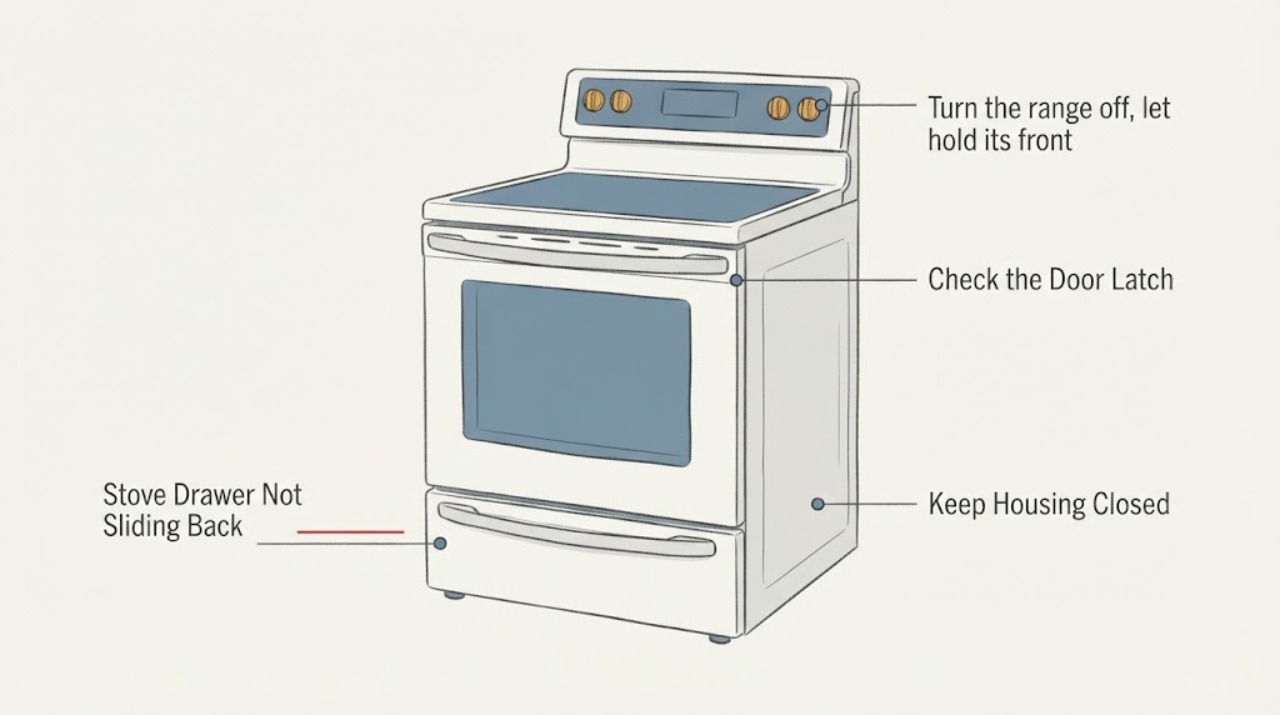
Work through in order
Diagnostic checks
Use only checks that match the exact appliance or system and its official guide.
-
Check 1
Turn the range off, let every nearby surface cool, remove anything from the lower drawer, and keep hands clear of the cooktop and oven opening. Support the drawer from both sides while you work; do not test the fit with cookware inside.
Expected result: The range is cool and the drawer is empty, or the range is hot, the drawer is loaded, or the drawer is difficult to support without twisting.
Next step: Continue only when the range is cool and the drawer can be held evenly. If it cannot be supported or has sharp/broken metal, stop and arrange service.
Stop if: Do not reach into a hot range, use the drawer as a step, or force a loaded or hanging drawer.
Why this matters
Why: An empty, cool drawer is easier to keep level and less likely to fall or contact a hot surface. A hot or unsupported drawer is a stop condition, not a reason to push harder.
-
Check 2
With the drawer just in front of the range, hold its front at the height that would leave the normal gap below the oven. Look from both sides and compare the drawer arms or rollers with the matching cabinet tracks before pushing it in.
Expected result: Both sides line up at the same height, one side is higher or farther forward, or an arm meets a stop immediately.
Next step: Lower or raise the drawer slightly while keeping it level, then try a short, gentle insertion with both sides entering together. If one side still catches, pull it back out and inspect rather than twisting it.
Stop if: Do not push one corner in while the other side is out, pry a rail, or bend an arm to make the drawer pass.
Why this matters
Why: The exact user report for this model describes a catch only during insertion; a height or side-to-side alignment error can keep a track arm from entering even when the drawer looks aligned from the front.
-
Check 3
Pull the drawer back out and inspect only the visible track entrances, rollers, supports, and the underside of the drawer. Look for a displaced roller, a bent rail, a screw or food fragment in the channel, a side latch/toggle in the wrong position, or a track that is not extended symmetrically.
Expected result: The tracks and rollers are straight and symmetric, a small release/toggle is visibly different on one side, or a rail, support, roller, fastener, or channel is damaged or obstructed.
Next step: Only compare a visible toggle with the exact model manual; do not force or disassemble it. Clear only a loose, cool, visible obstruction. For damage, missing hardware, or unequal track extension, leave the drawer out and obtain model-specific service.
Stop if: Do not remove the range, open electrical panels, drill new holes, substitute screws, or use adhesive on a rail or support.
Why this matters
Why: A small track release can prevent the drawer from locking into place, while a bent or missing component changes the fit and cannot be corrected safely by alignment alone. The available community report mentions a possible side-track toggle but does not identify a universal Frigidaire mechanism.
-
Check 4
If both sides enter smoothly, push the empty drawer only a few inches while keeping the front square, then stop and check that both sides advance together. Repeat in short movements rather than making one hard push.
Expected result: The drawer advances evenly and stays level, it advances only on one side, or it binds at the same point every time.
Next step: If it moves evenly, continue gently until the drawer is seated and verify that it cannot tip or drop. If it binds again, stop, document the exact location, and request service using the complete model.
Stop if: Do not slam the drawer, lift the range to change the angle, or keep cycling a binding mechanism.
Why this matters
Why: Even movement supports a simple alignment problem. One-sided travel or a repeatable bind points to a rail, roller, support, or drawer geometry issue; it does not establish which replacement part fits.
-
Check 5
Record the model label, whether the drawer was storage or warming equipment, the point where insertion stops, which side catches, and photos of the cool exterior and visible track hardware. Use the exact Frigidaire manual or support channel for the model before ordering a drawer, rail, roller, or support.
Expected result: The label confirms FGES3065PFD and the drawer hardware is intact, or the label, drawer type, hardware identity, or market cannot be confirmed.
Next step: Keep the drawer empty and out of use until the model-specific instructions or a qualified technician confirm the fit. Give service the model, photos, and the observed catch point.
Stop if: Do not order by appearance alone or install a substitute part that changes the drawer's support or clearance from the range.
Why this matters
Why: Frigidaire range platforms and lower-drawer arrangements vary. A visually similar rail or drawer from another model is not proof of compatibility, and an uncertain model prevents a reliable part decision.
Use your observations
Decision map
Find the observation that best matches what you see, then follow the next safe action.
-
PATH 01Next step
What you see
The range is cool, the empty drawer is supported evenly, both track entrances are intact, and a small height correction lets both sides slide in together.
Do this next
Seat the drawer gently, verify it stays level through its travel, and keep the drawer lightly loaded until normal movement is confirmed.
Why this path and its safety boundary
Why it matters: The immediate symptom is most consistent with insertion angle or track alignment, not a confirmed failed part.
-
PATH 02Next step
What you see
One side enters while the other catches, a track stops short, the drawer binds at the same point, or a roller, rail, support, or fastener is bent, loose, missing, or obstructed.
Do this next
Leave the drawer out, keep the range clear, and arrange Frigidaire or qualified appliance service with the full model and photos. Do not operate with a drawer that can drop or rub the range.
Why this path and its safety boundary
Why it matters: A mechanical track or drawer-support fault is more likely than a simple height error; the exact replacement cannot be selected from the symptom alone.
-
PATH 03Next step
What you see
The lower drawer is a warming configuration, touches a hot surface, has sharp exposed metal, or its identity and model-specific mounting cannot be confirmed.
Do this next
Stop using the drawer and obtain the exact manual or qualified service before refitting or ordering parts.
Why this path and its safety boundary
Why it matters: Heat clearance, falling parts, and model-specific hardware are safety and fit boundaries that a generic storage-drawer alignment tip cannot certify.
Helpful context
Understand the symptom
This is a lower-drawer fit problem on the Frigidaire Gallery FGES3065PFD, not a control-knob problem. The drawer may be a storage drawer or another lower-drawer configuration; do not assume its hardware or removal angle from a different Frigidaire range. Frigidaire's support page says a range model label can be on the front frame of the storage drawer, so confirm the complete model before ordering any rail or support.
A drawer that slides out normally but catches while being put back commonly needs the two sides to enter their tracks together at the correct height. That is a positioning hypothesis, not proof that the rails are undamaged. Stop if the drawer twists, a rail is bent, a roller is missing, or the drawer cannot be supported safely.
When checks do not resolve it
Need a professional?
Call qualified appliance service for persistent binding, damaged or missing drawer hardware, a drawer that drops or contacts heat, or any need to disassemble the range or identify a replacement rail or support.
Safety scope: Owner checks are limited to a cool, empty drawer, visible track alignment, visible obstruction, and the model label. Do not remove the range, open electrical panels, work near energized wiring, drill or bend rails, improvise fasteners, or alter clearances around a warming or storage drawer.
Have this ready
- Provide the complete FGES3065PFD model, market if known, storage-versus-warming drawer description, whether the drawer was removed, which side catches, the insertion position, and clear photos of the cool drawer and visible tracks.
Common questions
FAQ
Why does the FGES3065PFD drawer slide out but not back in?
If it was removed without damage, the first safe check is whether both sides are entering at the same height and angle. Keep it empty, hold it level, and inspect both track entrances. A repeatable one-sided catch can indicate a bent rail, roller, support, or obstruction rather than a simple alignment error.
Should I push the drawer harder or force one track into place?
No. Stop if one side catches or the drawer twists. Forcing it can bend the rail or make the drawer unstable. Pull it out, inspect the visible hardware, and get model-specific help if alignment does not solve it.
How do I know which Frigidaire drawer part to order?
Do not choose by appearance alone. Confirm the complete model label and whether the lower unit is a storage or warming drawer, then use the model-specific manual or a qualified technician to identify the rail, roller, support, or drawer assembly.
Read the exact guide
Official sources
- Support for RangesFrigidaire · Confirms that range guidance is model-dependent and routes users to manuals and range-specific support; it does not prove fit for another model's drawer hardware.
- help with drawer underneath stoveReddit r/appliancerepair · Exact-model lived-experience evidence for a lower drawer catching only during insertion. Community replies are used as troubleshooting hypotheses, not as manufacturer instructions or proof of part fit.
- Where can I find my model and serial number?Frigidaire · Supports confirming the range model FGES3065PFD from the storage-drawer frame or other listed label locations; it does not establish a universal drawer-removal procedure.
Community feedback
Share a repair observation
Share a plain-text repair observation. Accepted observations are published automatically; this page may take a moment to update.