
On this page
Start here
Quick answer
A loose Frigidaire stove knob may be only a cracked or poorly seated knob, but it can also mean the control shaft or the gas valve behind it is damaged. Keep the area clear, make sure the affected control is at OFF using only normal hand movement, and do not use that burner if the knob slips, points to the wrong setting, or cannot reliably turn the burner off. Identify the exact model from the range or stove label and use its Owner's Manual before removing or replacing a knob. If a gas flame will not stop, there is gas odor, or an electric burner remains energized with its control OFF, leave the stove out of service and obtain qualified appliance service; do not open the control panel or improvise a repair.
Before you begin
Safety first
- This article supports ordinary-access observation and model identification only. Do not open the stove, adjust gas controls, test energized wiring, bend a control shaft, or continue operation when OFF is unreliable.
Work through in order
Diagnostic checks
Use only checks that match the exact appliance or system and its official guide.
-
Put the stove in a safe state
Keep people, towels, paper, and cookware handles away from the affected area. Using normal hand movement only, place every surface control at OFF and do not touch a hot surface to test whether it is heating.
Expected result: All flames are out or all electric indicators are inactive, the surface is cooling, and there is no smoke, arcing, burning smell, gas odor, or visible damage; or one of those conditions is present.
Next step: For gas odor, smoke, fire, arcing, a flame that will not stop, or damaged glass, stop using the stove, leave the area when appropriate, and contact the relevant emergency or gas service from a safe location. Otherwise continue only after the surface is safe to observe.
Stop if: Do not force a knob to OFF, touch the hot surface, or keep testing an active hazard.
Why this matters
Why: A knob can be cosmetically loose while the appliance remains safe, but an active flame, persistent heat, smoke, arcing, gas odor, or damaged glass is not a loose-knob experiment.
-
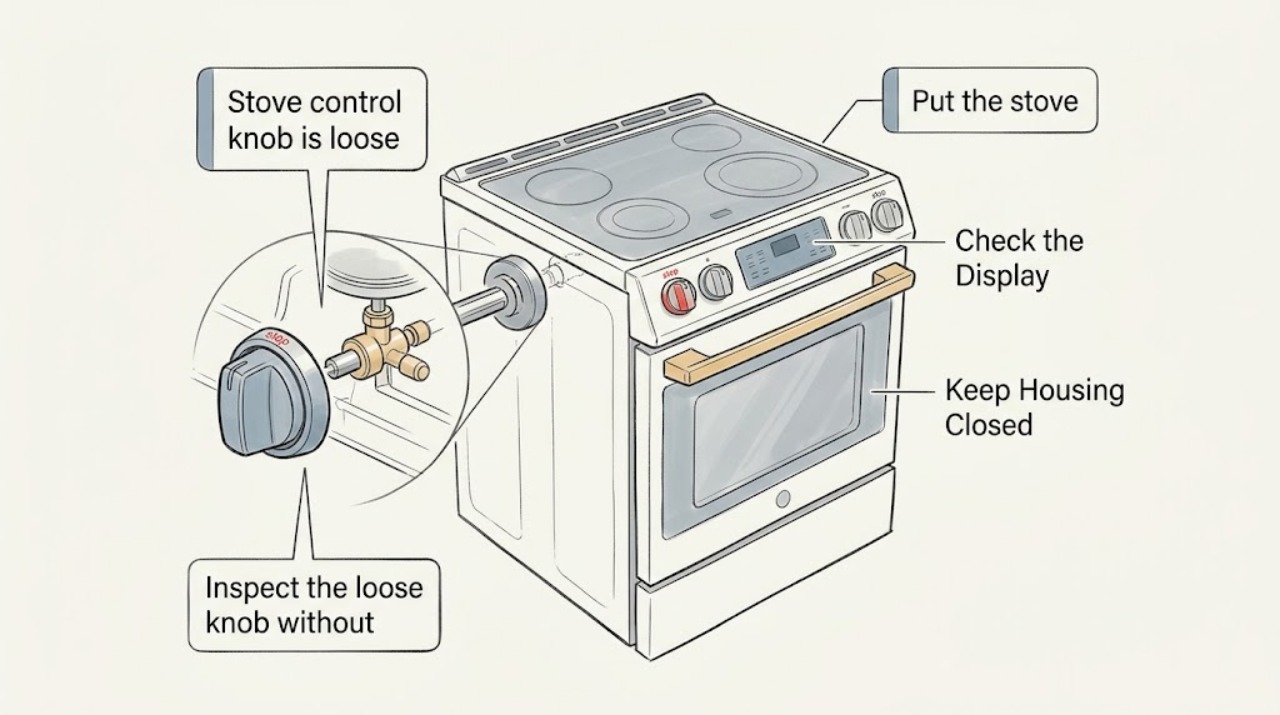
Inspect the loose knob without opening the stove
When the control and surrounding panel are cool and dry, view the knob from the front and note cracks, a missing center insert, a gap from the panel, wobble, a missing pointer, or a knob that rubs the panel; do not pry the panel or force the knob off.
Expected result: The knob body or pointer is damaged, the knob is loose but the pointer still aligns with OFF, the knob is missing, or the control appears to move with the knob.
Next step: Keep the affected burner or zone unused. Photograph the cool exterior and record the exact model; consult the Owner's Manual before any permitted knob removal or replacement, and arrange service for abnormal shaft movement or uncertain OFF control.
Stop if: Do not use glue, tape, pliers, a shim, or an improvised knob, and do not bend or pull the control shaft.
Why this matters
Why: A damaged or missing knob can prevent reliable position reading and may be a replaceable external part. Movement, rubbing, or an abnormal control shaft suggests the problem may extend behind the knob and cannot be confirmed by appearance alone.
-
Check whether the control still follows its marked positions
Only when no hazard is present and the model manual permits ordinary control operation, move the affected control through its marked range with light, normal pressure while watching the indicator or burner response from a safe position; do not hold a gas ignition position or continue if the knob slips.
Expected result: The control has a firm, repeatable range and the burner or zone changes as marked, the knob turns but the burner or zone does not respond, or the control slips, binds, rotates freely, or stops short of OFF.
Next step: If the response is not predictable or OFF cannot be confirmed, stop using that control and arrange qualified appliance service. Do not compensate by turning the knob harder or repeatedly cycling it.
Stop if: Stop immediately for flame that persists, gas odor, smoke, sparking, abnormal heat, or any need to remove the control panel.
Why this matters
Why: Predictable movement with matching output supports a loose external knob as the leading possibility. A mismatch between knob position and heat, free rotation, binding, or failure to reach OFF points to a shaft, switch, valve, ignition, or control fault.
-
Apply the correct gas or electric boundary
Identify whether the affected control operates a gas burner, an electric coil or radiant element, or an induction zone from the model manual and visible appliance design; do not remove a gas cap or electrical cover just to identify it.
Expected result: A gas flame goes out at OFF, an electric or induction zone stops requesting heat at OFF, or the flame or heating zone remains active after OFF.
Next step: For persistent gas flame, gas odor, smoke, or an uncontrolled condition, leave the area when appropriate and call gas or emergency service. For electric or induction heat after OFF, leave the stove out of service and arrange qualified appliance service; isolate a safe, dry, accessible disconnect only if it can be operated without exposure to heat, moisture, or wiring.
Stop if: Do not adjust a gas valve, relight repeatedly, open the appliance, or test energized wiring.
Why this matters
Why: A loose knob with reliable control can be an external fit issue. A burner or zone that remains active after OFF is evidence of a control, shaft, valve, relay, sensor, or power-module problem rather than a cosmetic knob issue.
-
Compare the affected control with the other controls
After the stove is cool enough for ordinary observation, compare the affected knob's seating, pointer alignment, resistance, and visible response with an unused control of the same style; do not swap knobs or force either shaft.
Expected result: Only one knob is loose or damaged, several knobs sit differently, all controls feel abnormal, or only the affected burner fails to follow its setting.
Next step: Keep the affected control unused and record the comparison for service. Use only the exact model manual to determine whether an external knob can be removed and replaced; do not infer fit from another control or brand.
Stop if: Do not operate a burner through a control that is loose enough to slip, cannot show OFF, or causes heat or flame to continue unexpectedly.
Why this matters
Why: One visibly damaged knob with otherwise normal control response makes an external knob issue more plausible. Multiple abnormal controls or one burner that does not follow the knob raises concern about the panel, shared control, receptacle, valve, or wiring.
-
Record the model and prepare the service handoff
Record the complete Frigidaire model number, fuel or cooking type, affected control, pointer position, whether OFF could be confirmed, whether the knob is cracked or missing, and any flame, heat, odor, or indicator behavior; photograph only cool exterior surfaces.
Expected result: The record supports a stable external knob fit, or it shows unreliable OFF control, shaft movement, an ongoing flame or heating zone, visible damage, or unresolved model identity.
Next step: Use the model-specific manual and arrange qualified service whenever the control is unreliable, the burner does not respond as marked, the knob cannot be safely retained, or any heat or flame continues after OFF.
Stop if: Do not open the appliance for photographs or continue operation to reproduce an unsafe fault.
Why this matters
Why: The model and symptom record lets the manufacturer or technician distinguish a knob from a control shaft, electric switch, gas valve, or electronic control. Uncertain identity is a reason to pause, not to order a visually similar part.
Use your observations
Decision map
Find the observation that best matches what you see, then follow the next safe action.
-
PATH 01Safety boundary
What you see
The knob is cracked, missing its pointer, or loose at the face, but the control shaft does not move abnormally, every marked position is repeatable, and the burner or zone stops at OFF.
Do this next
Keep the control at OFF when not in use, follow the exact Frigidaire manual for any permitted external knob replacement, and use qualified service if the replacement does not seat securely or if the shaft is uncertain.
Why this path and its safety boundary
Why it matters: An external knob fit or damaged knob is more likely than a valve or switch fault, but exact model fit still has to be confirmed.
Safety stop: Do not use an improvised knob, glue, tape, or a knob that can slip into an unintended setting.
-
PATH 02Safety boundary
What you see
The knob turns freely, binds, rotates past the marked range, moves the shaft, will not align with OFF, or the burner or heating zone does not match the knob position.
Do this next
Stop using that burner or zone and arrange qualified appliance service. Give the technician the model, control type, affected position, and whether any heat or flame remained after OFF.
Why this path and its safety boundary
Why it matters: A damaged control shaft, electric switch, gas valve, ignition control, or electronic control is more likely than a cosmetic knob problem.
Safety stop: Do not force the knob, bend the shaft, remove the manifold, adjust a gas valve, or test live wiring.
-
PATH 03Safety boundary
What you see
A gas flame remains on after the control is returned to OFF, the control cannot reliably reach OFF, or gas odor accompanies the loose knob.
Do this next
Stop using the stove, leave the area when appropriate, avoid switches, flames, and electrical equipment near a gas odor, and contact gas or emergency service from a safe location. Do not relight or disassemble the burner or valve.
Why this path and its safety boundary
Why it matters: This is an immediate stop-use condition. A gas valve or control problem cannot be safely diagnosed by repeated knob movement.
Safety stop: Do not keep turning the loose control, attempt a valve adjustment, or use another burner until the situation is made safe by qualified help.
-
PATH 04Safety boundary
What you see
An electric coil, radiant element, or induction zone remains energized or continues abnormal heating after its control is OFF, even though the knob appears seated.
Do this next
Keep the stove out of service and arrange qualified appliance service. If a dry, accessible disconnect can be operated safely, isolate the stove circuit and do not restore it for further testing.
Why this path and its safety boundary
Why it matters: The symptom points beyond the external knob to a switch, control, relay, sensor, or power module; residual warmth without ongoing energy can still remain after normal cooking.
Safety stop: Do not touch the heating surface, remove panels, probe wiring, or repeatedly reset power.
-
PATH 05Safety boundary
What you see
Several knobs are loose or misaligned, the panel moves, an indicator behaves unexpectedly, or the model and control technology cannot be confirmed.
Do this next
Keep the affected controls unused, record the model and visible symptoms, and request model-specific guidance or qualified appliance service before ordering parts.
Why this path and its safety boundary
Why it matters: A shared panel, mounting, control, installation, or model-specific issue is possible; a single replacement knob cannot be assumed to solve it.
Safety stop: Do not remove the panel, use a substitute control, or operate a burner whose setting cannot be read or reliably turned off.
Helpful context
Understand the symptom
A loose knob is not always a loose valve
The plastic knob can crack, wear at its internal socket, or sit out of alignment while the control shaft still turns normally. A bent or damaged shaft, a loose control behind the panel, or a gas valve problem is more serious. The visible knob alone cannot prove which part is at fault, so judge the result by whether the burner or heating zone responds predictably and stops at OFF. Never force the knob against a stop or use the appliance when the OFF position is uncertain.
Model identity controls the safe knob procedure
Frigidaire notes that range and cooktop controls vary by model and says to reference the Owner's Manual. Record the full model number from the range or stove frame, oven side trim, or storage-drawer frame before ordering a replacement knob or discussing a shaft or valve. A gas control knob, an electric surface-element control, and a front touch control are not interchangeable simply because they look similar.
Treat unreliable OFF control as a stop-use boundary
If the knob turns without changing the setting, falls off, rotates past the marked range, or cannot return the burner to OFF, stop using that control. For gas, an ongoing flame or gas odor needs immediate safe-area action and gas or emergency help. For electric or induction equipment, a zone that remains energized with its control OFF needs qualified appliance service. Do not remove the manifold or control panel, adjust a gas valve, or work on energized wiring.
Safety boundary
Stop conditions
- Stop using the stove immediately for gas odor, a flame that will not stop, smoke, fire, arcing, burning smell, damaged glass, or any uncontrolled heating; leave the area when appropriate and seek emergency or qualified gas/appliance help from a safe location.
- Do not use a burner or heating zone when its loose knob cannot reliably show or reach OFF, slips into another setting, or does not match the actual flame or heat.
- Do not force, bend, glue, tape, shim, or improvise a knob; do not remove the control panel, adjust a gas valve, or test energized wiring.
- Do not order a knob, shaft, switch, valve, or control from appearance alone. Confirm the exact Frigidaire model and technology using the Owner's Manual or a qualified technician.
- Do not keep cycling the control or reset power to reproduce an unsafe gas or electrical symptom.
Only after diagnosis
Potential parts
- Frigidaire control knob
Consider this category only when the exact model manual or technician confirms that the knob itself is cracked, missing, or no longer seats securely while the shaft and burner response remain normal.
Confirm the complete Frigidaire model, knob marking, shaft interface, and manufacturer fit information; a similar appearance does not establish compatibility. - electric surface control switch
Consider this category only after qualified diagnosis finds that an electric element does not follow a correctly operating control or remains active after OFF.
Confirm exact model, control position, electrical specification, and manufacturer fit information; do not substitute a switch by appearance. - gas burner control valve
Consider this category only when qualified gas-appliance service identifies a valve or control fault after the stove has been taken out of service safely.
Confirm the exact model and gas configuration with the manufacturer or qualified technician; gas components require qualified installation and leak verification. - range electronic control or zone module
Consider this category only when a qualified technician isolates a shared control, relay, sensor, or induction-zone fault rather than an external knob issue.
Confirm the exact model and module revision through the manufacturer or technician; do not open or test the module as a user.
When checks do not resolve it
Need a professional?
Arrange qualified appliance service when a Frigidaire control knob is loose enough to slip, cannot reliably reach OFF, turns without matching burner or zone response, causes a gas flame or electric heating zone to remain active after OFF, or is accompanied by shaft movement, damaged panel, smoke, arcing, gas odor, or an unknown model-specific control. For gas odor, smoke, fire, arcing, or an uncontrolled flame, leave the area when appropriate and contact the relevant emergency or gas service from a safe location.
Safety scope: This article supports ordinary-access observation and model identification only. Do not open the stove, adjust gas controls, test energized wiring, bend a control shaft, or continue operation when OFF is unreliable.
Common questions
FAQ
Can I keep using a Frigidaire stove if only the knob is loose?
Only if the exact model procedure confirms a secure external fit and the control moves predictably, shows its marked setting, and reliably returns the burner or zone to OFF. If the knob slips, the pointer is misleading, or OFF is uncertain, stop using that control and arrange service.
How can I tell whether the knob or the control shaft is damaged?
With the stove cool and closed up, look for a cracked knob, missing insert, wobble, or gap, then compare visible movement with the marked positions using light normal pressure only. Free rotation, binding, shaft movement, or a burner or zone that does not match the knob points beyond the external knob and needs qualified diagnosis.
What if the loose knob is on a Frigidaire gas range?
A gas flame should respond predictably to the surface control and go out at OFF. If it stays lit, the control cannot reliably reach OFF, or gas odor is present, stop using the range, leave the area when appropriate, avoid ignition sources and switches near an odor, and contact gas or emergency service from a safe location.
Should I order a replacement Frigidaire knob by appearance?
No. Frigidaire says controls and procedures vary by model. Use the complete model number and the Owner's Manual, and confirm the shaft interface and marking before any replacement; a similar-looking knob does not establish fit or safe operation.
Read the exact guide
Official sources
- Delivery and Installation Guide - Duel Fuel or Gas RangeFrigidaire · Brand gas-range safety reference supporting a qualified gas-service boundary; it does not authorize a user to adjust or disconnect the valve.
- What should I do if my gas flames are uneven or too high?Frigidaire · Brand gas-range reference for separating a knob setting or burner condition from an unsafe flame symptom; it does not authorize valve disassembly.
- Ranges - How do I clean my range?Frigidaire · Brand source supporting use of the model-specific care instructions for knobs and external range surfaces rather than improvised repair.
- How To Clean & Care for Your Induction RangeFrigidaire · Brand source used only to keep induction care and control interpretation model-specific; it does not authorize opening the induction surface.
- Ranges - No HeatingFrigidaire · Brand electric-range reference for distinguishing external control symptoms from a heating or power fault; it does not authorize live electrical testing.
- Gas Range / Cooktops - Burners are not lightingFrigidaire · Brand gas-range reference for the relationship between the surface control knob and burner operation, plus escalation when checks do not resolve the issue.
- Where can I find my model and serial number?Frigidaire · Brand source for locating the exact model before selecting a knob or control procedure.
- How do I use my display or controls?Frigidaire · Primary brand source stating that controls vary by model and that the Owner's Manual governs the exact operation, settings, and lock features.
Community feedback
Share a repair observation
Share a plain-text repair observation. Accepted observations are published automatically; this page may take a moment to update.