
On this page
Start here
Quick answer
A loose Amana stove control knob may be only a cracked or poorly seated knob, but it can also indicate a damaged gas valve stem or an electric surface-control shaft. Turn the control to OFF, remove cookware, and let the stove cool. With power and gas controls untouched beyond normal operation, check whether the knob is loose on the shaft, whether the shaft itself wobbles or turns without changing the setting, and whether the burner can be reliably turned off. Amana says knobs should be removed by pulling straight away and replaced with the control in OFF; its gas instructions require the knob to be pressed and turned to ignite, while electric coils use the control and can cycle normally. Do not use the stove if the knob cannot reliably reach OFF, a gas flame remains lit, an electric element stays energized after OFF, or wiring, heat, smoke, or glass damage is present. Do not open the console or adjust a gas valve; arrange qualified service when the shaft or control is suspect.
Before you begin
Safety first
- Keep the affected burner off and isolate gas or power at safe external controls for a persistent or hazardous fault. Do not open panels, test energized circuits, adjust gas components, bypass controls, or operate an appliance that cannot be turned off reliably.
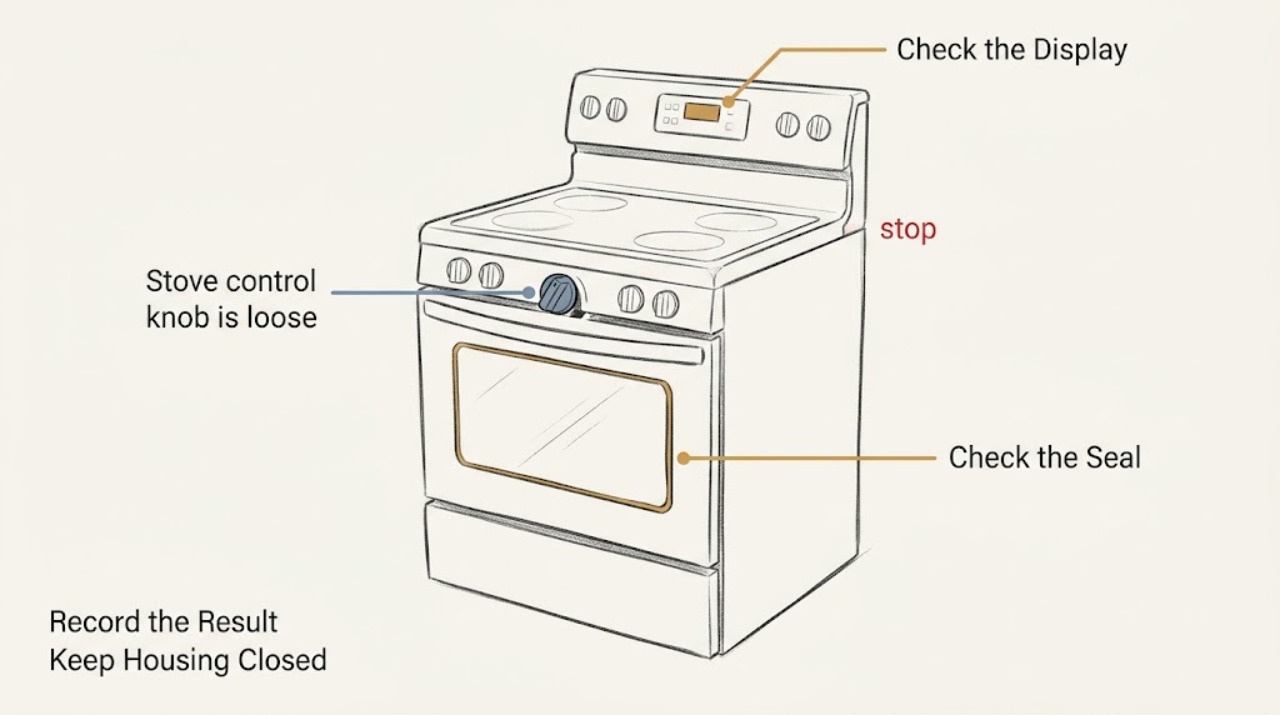
Work through in order
Diagnostic checks
Use only checks that match the exact appliance or system and its official guide.
-
Check 1
Turn every control to OFF, remove cookware, and let the stove cool. Identify whether the loose knob operates a gas burner, electric coil or radiant element, or another surface control, and note whether the burner output stops when the knob is placed at OFF.
Expected result: The knob is cool and removable, the shaft is visibly stable or wobbly, the burner stops at OFF or does not stop, or there is gas odor, hissing, smoke, burning odor, exposed wiring, or cracked glass.
Next step: If the burner cannot be reliably turned off or any hazard is present, stop using the stove immediately and isolate gas or power only from a safe external control; arrange qualified service. Otherwise continue only with a cool, model-appropriate external knob check.
Why this matters
Why: A stable shaft with a loose knob suggests an external fit problem. A wobbly shaft or output that does not stop indicates a valve, switch, control, or wiring fault. Odor, smoke, exposed wiring, and cracked glass are hazards rather than knob-adjustment problems.
-
Check 2
With all controls OFF and the cooktop cool, pull the loose Amana knob straight away from the panel without prying or twisting. Inspect the knob's insert and the exposed control shaft for a crack, missing insert, flattened interface, contamination, bent shaft, or movement independent of the panel; do not remove seals or open the console.
Expected result: The knob is cracked or slips on a stable shaft, the shaft and knob interface are intact, or the shaft itself wobbles, is bent, or turns without a clear setting.
Next step: If only the knob is damaged, clean and reinstall or replace it only in the OFF position using the model's fit information. If the shaft is damaged, loose, or uncertain, leave the appliance off and arrange qualified service; never tighten, bend, glue, or replace the shaft from the front.
Why this matters
Why: A damaged knob or insert can cause looseness while the control remains mechanically sound. Shaft movement, an unclear detent, or a control that turns without selecting the expected setting points to the gas valve stem or electric surface-control assembly rather than the knob alone.
-
Check 3
For a gas Amana burner with a stable shaft and no odor, reinstall the knob in OFF, then perform only a brief attended control check permitted by the Owner's Manual: press and turn to Ignite, confirm the flame appears, and move toward Lo before returning to OFF. Do not hold the knob at Ignite or continue if the flame is abnormal.
Expected result: The knob fits and the flame follows Ignite, Hi, and Lo and extinguishes at OFF; the knob slips or points incorrectly; the flame remains high at Lo; or the flame remains lit at OFF.
Next step: Stop use for an abnormal or uncontrollable flame. Do not adjust the valve stem, gas pressure, jets, or ignition parts. If the knob is the only failed interface and the burner reliably turns OFF, confirm the exact model before selecting a replacement knob; otherwise call qualified gas-appliance service.
Why this matters
Why: A flame that tracks the control suggests the loose part may be limited to knob fit, although cap, port, valve, or low-flame issues can still exist. A flame that does not reduce or extinguish indicates the gas valve or control is not being safely controlled and is not a knob-only repair.
-
Check 4
For an electric coil or radiant Amana burner, with the cool knob correctly seated, use the normal control briefly while attended and observe whether the element responds, cycles while ON, and stops heating when set to OFF. Do not remove panels or touch a receptacle, switch, or terminal.
Expected result: The element cycles while ON and stops at OFF, the knob slips while the shaft responds, the shaft turns without changing heat, or the element remains hot or glowing after OFF.
Next step: Treat normal cycling as expected and repair only the externally confirmed knob fit. If heat continues after OFF or the shaft does not regulate the burner, turn off the cooktop circuit at the breaker if safe, stop use, and arrange qualified appliance or electrical service.
Why this matters
Why: Amana notes that temperature-limiting coils can cycle on and off and may not glow as strongly; that is normal while the control is ON. A knob that slips on a stable shaft is different from a shaft or switch that ignores the setting. Energized heat after OFF suggests a surface control, element, or wiring fault.
-
Check 5
Compare the loose control with a known-good Amana control only from the outside: compare knob seating, shaft feel with power and gas off, marking alignment, and whether the neighboring burner responds normally. Record whether one control or several are affected and whether a recent spill, cleaning, or impact preceded the looseness.
Expected result: Only one knob is loose on a stable shaft, several knobs or shafts feel loose, the control panel is damaged, or the symptom affects burner output or OFF position.
Next step: Do not use internal parts from another control as a comparison and do not continue cooking with an unreliable OFF position. Photograph the cool external condition, record the full model number, and arrange service for any shaft, panel, or output fault.
Why this matters
Why: One loose knob with normal shaft travel favors an external knob or insert. Multiple loose controls, panel damage, or output changes make installation, control-panel, valve, switch, or wiring problems more likely and increase the need for service.
-
Check 6
Record the complete Amana model number, burner position, gas or electric surface type, knob marking and OFF alignment, whether the knob or shaft is loose, whether the burner ignites or heats, whether it responds through Hi/Lo or the electric setting, and whether it shuts off reliably. Use the model manual before selecting any part.
Expected result: The knob-only fault is confirmed, or the shaft, valve, switch, wiring, and burner behavior remain uncertain.
Next step: Provide the record to qualified Amana appliance service and keep the affected burner off until the control can be trusted. Select a replacement only after model and diagnosis are confirmed; do not work on a live or gas-connected control.
Why this matters
Why: Amana knob interfaces, gas valve stems, electric control shafts, and replacement components vary by model. Looseness alone does not prove a replacement knob, knob shaft, or infinite switch is appropriate.
Use your observations
Decision map
Find the observation that best matches what you see, then follow the next safe action.
-
PATH 01Next step
What you see
The knob rocks or slips, but the shaft is stable, markings align in OFF, and gas or electric output follows the control normally.
Do this next
With controls OFF and the stove cool, clean or replace the knob only according to the model instructions and seat it in OFF. Stop if the shaft starts to move or the burner no longer turns off reliably.
Why this path and its safety boundary
Why it matters: A cracked knob, worn insert, or incorrect seating is more likely than a failed valve or switch.
-
PATH 02Next step
What you see
The gas knob is loose and the valve stem wobbles, turns without a clear setting, leaves a large flame at Lo, or does not extinguish the flame at OFF.
Do this next
Stop using that burner immediately. If safe to approach, close the appliance's external gas shutoff and keep away from flame or odor; do not bend, tighten, adjust, or disassemble the valve stem. Arrange qualified gas-appliance service.
Why this path and its safety boundary
Why it matters: The gas valve or control is not being reliably controlled; a knob replacement alone cannot make an unsafe valve close.
-
PATH 03Next step
What you see
An electric control knob is loose on a stable shaft, and the element heats and shuts off normally when the control is moved to OFF.
Do this next
Keep power off while removing or reseating the cool knob, and verify the model's knob fit and OFF alignment. Consider a replacement knob only after the model is confirmed; escalate if the shaft or heat response changes.
Why this path and its safety boundary
Why it matters: The user-facing knob or insert is more likely at fault. Normal element cycling while ON should not be mistaken for a stuck control.
-
PATH 04Next step
What you see
An electric element remains hot or glowing after OFF, the shaft turns without changing the heat, or a breaker trips after the loose-knob complaint.
Do this next
Turn off the cooktop circuit at the breaker if safe, keep away from the hot surface, and arrange qualified appliance or electrical service. Do not operate the control repeatedly or probe terminals.
Why this path and its safety boundary
Why it matters: A surface-control switch, element, receptacle, or wiring fault is more likely than a loose plastic knob.
-
PATH 05Next step
What you see
Several knobs are loose, the control panel or shafts were hit or exposed to liquid, or gas/electric output is inconsistent across more than one burner.
Do this next
Stop using the affected controls, isolate gas or power at a safe external control, and arrange qualified service. Keep the model number and external photos for the technician; do not remove the console.
Why this path and its safety boundary
Why it matters: A panel, installation, shared control, wiring, or multiple-component problem is more likely and cannot be confirmed by replacing one knob.
-
PATH 06Next step
What you see
Gas odor or hissing, smoke or burning odor, exposed wiring, a cracked cooktop, or a burner that cannot be reliably turned OFF is present.
Do this next
Stop use, keep people away, and leave the area for gas odor or hissing. Use an external gas shutoff or breaker only if it is safe to approach; do not create sparks, relight, reset repeatedly, or open the appliance. Obtain qualified emergency or appliance service.
Why this path and its safety boundary
Why it matters: This is an immediate gas, fire, electrical, or hot-surface hazard, not a safe knob-maintenance question.
Helpful context
Understand the symptom
Separate a loose knob from a loose control shaft
The plastic knob is the user-facing part that fits over a control shaft. If the knob rocks, slips, or comes off while the shaft remains stable and the setting changes normally, the knob or its internal insert may be the problem. If the metal or plastic shaft itself wobbles, turns too freely, will not select the marked position, or does not control the burner, the fault is behind the knob and is not a simple knob fit. Gas ranges use a valve stem; electric ranges use a surface-control shaft, often connected to an infinite switch.
Fuel and surface technology change the risk
On an Amana gas range, the knob is pressed and turned to Ignite, then moved between Hi and Lo. A loose knob that can be put back at the wrong angle can make the displayed position misleading, and a gas valve that does not close is an immediate stop-use issue. On an electric coil or radiant surface, some cycling while ON is normal, but a burner must not remain energized after OFF. Do not treat a glowing indicator or residual surface heat alone as proof that the knob failed; confirm the actual control response and use the model manual.
Only make the external check the model allows
Amana's care guidance says controls should be OFF and the cooktop cool before a knob is pulled straight away, cleaned with mild soap and water, and replaced in OFF. That is different from opening the console or working at the valve stem, switch, wiring, or terminals. If the shaft is loose, a knob cannot safely repair it; record the model and arrange service with the appliance isolated as appropriate.
Safety boundary
Stop conditions
- Stop immediately if the knob cannot reliably reach OFF, a gas flame remains lit, gas odor or hissing is present, smoke or burning odor appears, or the valve stem wobbles or turns unpredictably. Use an external gas shutoff only if safe and leave gas diagnosis to qualified service.
- Stop using an electric burner if it remains hot or glowing after OFF, a breaker trips again, wiring or a receptacle is damaged, liquid entered the controls, or the cooktop is cracked. Isolate the circuit only from a safe external breaker.
- Do not pry or twist a knob, bend or glue a valve stem, adjust gas pressure or jets, open the control console, probe terminals, bypass an electric control, or use the stove while the OFF position is uncertain.
- Remove or reseat a knob only with controls OFF and the cooktop cool, and only from the front as the model instructions permit. A knob replacement is not a repair for a loose shaft, valve, switch, panel, or wiring fault.
Only after diagnosis
Potential parts
- stove replacement knob
Consider this only when the knob or its insert is cracked, slips on a stable shaft, and the burner output and OFF position respond normally.
Knob shape, insert, markings, shaft interface, and fuel-specific control layout vary by Amana model. Confirm the complete model and OFF alignment before selection. - stove knob shaft
Consider this only after qualified diagnosis confirms that the control shaft or valve-stem interface is damaged; a loose knob alone does not establish a shaft fault.
Gas valve stems and electric control shafts are different assemblies and model-specific. This is internal service work; confirm the exact model and fuel type before selection. - stove infinite switch
Consider this only when a qualified technician confirms that an electric surface control does not regulate or disconnect power while the element and supply are otherwise sound.
Infinite-switch terminals, ratings, and shaft interfaces vary by Amana model and do not apply to gas controls. Isolate power before service.
When checks do not resolve it
Need a professional?
Request service for a loose valve stem or electric control shaft, uncertain OFF position, abnormal gas flame, heat after electric OFF, recurrent breaker trips, liquid or impact damage, or any gas, electrical, smoke, or cracked-glass hazard.
Safety scope: Keep the affected burner off and isolate gas or power at safe external controls for a persistent or hazardous fault. Do not open panels, test energized circuits, adjust gas components, bypass controls, or operate an appliance that cannot be turned off reliably.
Have this ready
- Provide the complete Amana model number, gas or electric surface type, affected control position, knob and shaft observations, whether the knob can be reseated in OFF, gas flame or electric heat behavior through the settings, number of affected controls, and any recent spill, cleaning, impact, installation, or power event.
Common questions
FAQ
Why is my Amana stove control knob loose?
The knob may have a cracked or worn insert, may be seated at the wrong angle, or the control shaft behind it may be loose or damaged. Pull the cool knob straight away only with controls OFF and inspect the knob and shaft separately; shaft movement or unreliable burner control needs service.
Can I remove an Amana stove knob to check it?
Amana's guidance says to ensure controls are OFF and the cooktop is cool, then pull the knob straight away. Do not pry, twist, soak, or open the console. Replace the knob only in the OFF position and stop if the shaft is damaged or moves independently.
How do I know whether the Amana gas valve stem is loose?
With the cool knob removed and controls OFF, the valve stem should not wobble or turn without a clear control response. If the flame stays high at Lo, remains lit at OFF, or the stem turns unpredictably, stop using the burner and arrange qualified gas-appliance service rather than adjusting the stem.
Is a loose electric stove knob dangerous?
It can be if the burner setting or OFF position is unreliable. A knob that slips on a stable shaft may be an external part issue, but a shaft or switch that leaves an element energized after OFF is an electrical fault. Turn off the circuit if safe and stop use until serviced.
Why does my Amana coil burner cycle while I turn the knob?
Amana says temperature-limiting coil elements can cycle on and off and may not glow as strongly, which can be normal while the control is ON. The important check is whether the control changes heat and the element stops being energized when set to OFF.
Should I glue a loose Amana stove knob?
No. Glue can prevent correct OFF alignment or hide a damaged shaft and can make a gas or electric control harder to operate. Confirm the model and use a compatible replacement knob only when the shaft and burner control are known to work normally.
Can I replace the Amana infinite switch because the knob is loose?
Not from looseness alone. An infinite switch is relevant only for an electric surface when qualified diagnosis confirms that the control does not regulate or disconnect power. A loose plastic knob, gas valve stem, and electric switch are different parts and require model-specific confirmation.
What should I do if the loose knob will not turn the burner off?
Stop using the stove immediately. For a gas flame, use an external gas shutoff only if it is safe to approach and leave the area for odor or hissing; for an electric burner, turn off the circuit at the breaker if safe. Do not reach over a flame, repeatedly reset power, or open the control console; obtain qualified service.
Read the exact guide
Official sources
- Owner's ManualAmana · Amana gas range burner operation, low-flame behavior, model-specific controls, and gas/electrical safety
- Cleaning Control Knobs or Control PanelAmana · Amana cooktop control-knob removal, cleaning, cool-surface precautions, and OFF-position replacement
- Lighting the Burners - Electronic IgnitionAmana · Amana gas burner knob operation, ignition position, Hi/Lo setting, cap placement, and service guidance
- Knob Won't Turn - RangeAmana · Amana gas-range knob alignment, valve-stem fit, push-to-turn behavior, and service boundary
- Coil Element Not WorkingAmana · Amana electric coil control, power, element seating, and normal temperature-limiting cycling
Community feedback
Share a repair observation
Share a plain-text repair observation. Accepted observations are published automatically; this page may take a moment to update.