
On this page
Start here
Quick answer
A loose stove control knob that turns without changing the burner setting usually is not engaging the control shaft, or the shaft, switch, or gas valve is no longer transferring the knob movement. Turn every control off and stop using the affected burner until you can confirm the appliance is not heating or producing a flame. When the range is cool and dry, remove only a removable knob, inspect its rear opening and the exposed shaft for a crack, stripped opening, missing insert, or misalignment, and reseat it with the knob's flat side aligned to the shaft as the model instructions show. If the knob remains loose, the shaft turns without changing heat or flame, more than one control is affected, the control cannot be placed reliably in OFF, or the appliance is gas and an internal valve may be involved, leave the stove off and arrange qualified appliance or gas service. Do not glue the knob, force the shaft, adjust a gas valve, open the control panel, or keep cooking with an unreliable setting.
Before you begin
Safety first
- This article supports confirming the stove is cool and off, identifying the affected control, visually checking an accessible removable knob and stem, and gently reseating a clearly removable knob according to the model instructions. A qualified professional must handle control-panel disassembly, switches, electronic controls, hard-wired components, gas valves, adjustment screws, live testing, and wiring.
Work through in order
Diagnostic checks
Use only checks that match the exact appliance or system and its official guide.
-
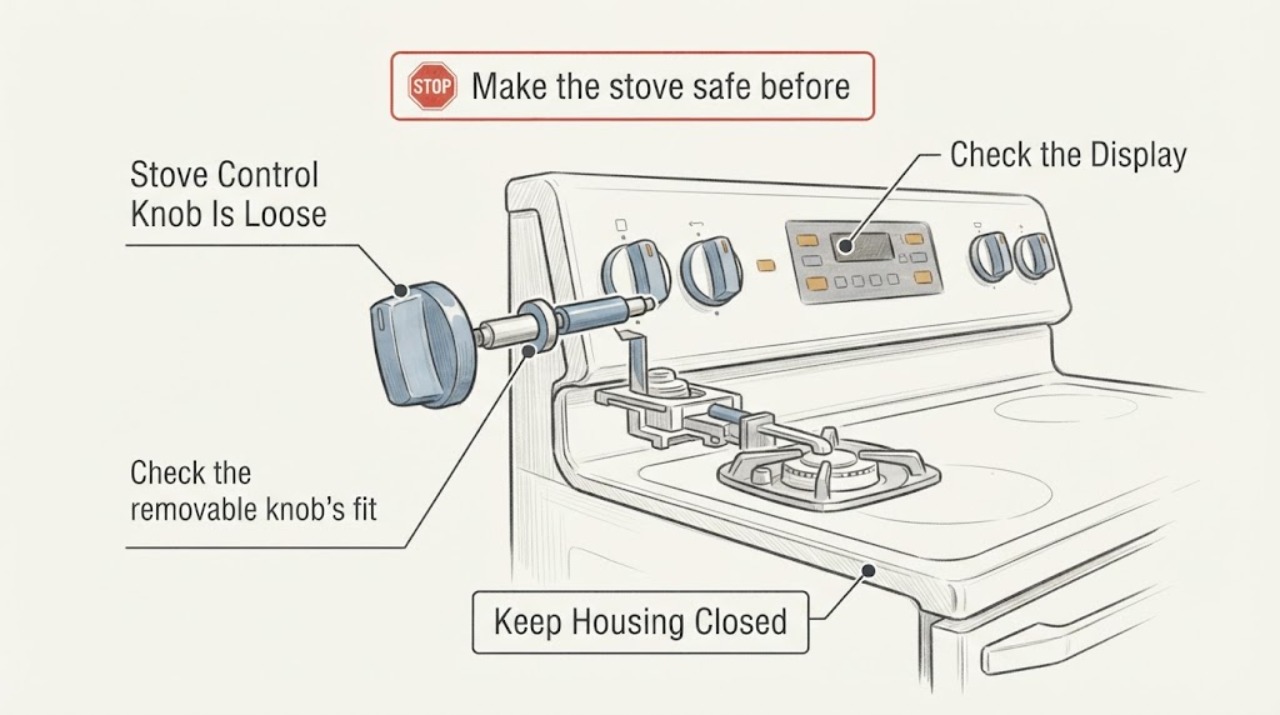
Make the stove safe before touching the knob
Turn all stove controls to their intended OFF positions, let the cooktop cool completely, and observe from a safe position whether any gas flame, glowing electric element, hot-surface indication, odor, smoke, or unexpected heating remains. Do not touch a hot knob or try to force the loose control.
Expected result: The burner is fully off and cool; a flame or element remains active; the knob cannot be placed confidently at OFF; there is a gas or burning odor; or smoke, sparking, or heat damage is present.
Next step: If the burner is not safely off or any hazard is present, stop using the stove, leave the area if needed, and arrange qualified appliance or gas service; seek emergency help for active fire or dangerous gas conditions.
Stop if: Do not keep cooking, reach behind the control panel, or test the knob while a burner is hot, lit, sparking, or producing an odor.
Why this matters
Why: A loose knob is only a low-risk fitment issue when the burner can be reliably turned off and no hazard is present. An active burner, uncertain OFF position, odor, smoke, or sparking means the control may not be operating safely.
-
Identify the control and affected scope
Record whether the stove is gas, electric, or dual-fuel; whether the loose knob controls a surface burner, oven, or electronic function; and whether one knob or several knobs behave this way. Compare the affected knob's movement and burner response with a normally operating control without forcing either control.
Expected result: Only one knob is loose; several knobs are loose; the knob spins while the shaft stays still; the shaft moves but the burner setting does not; or the control is a gas valve or electronic control.
Next step: Use the matching branch below. For gas valves, electronic controls, or a shaft that does not behave normally, stop at observation and arrange qualified service.
Stop if: Do not remove a gas valve, pull a control stem, or open the control panel to identify the mechanism.
Why this matters
Why: One loose knob with a stationary shaft suggests the knob's rear opening or insert. A shaft that moves without a setting change suggests the control switch or valve. Several affected controls suggest a panel, control, or installation issue rather than one damaged knob.
-
Check the removable knob's fit when the model permits removal
With the stove cool and all controls off, pull the knob straight off only if the model manual or manufacturer guidance identifies it as removable. Inspect the rear opening, flat side, insert, and visible control stem for a crack, stripped plastic, missing insert, debris, bent stem, or an opening that no longer matches the shaft. Do not soak, pry, or scrape the control stem.
Expected result: The knob is cracked or stripped; the flat side is misaligned; debris prevents seating; the stem is visibly bent or damaged; or the knob and stem look normal.
Next step: If the knob alone is damaged, identify the exact model before considering a replacement. If the stem is damaged or the knob looks normal, leave the control unused and arrange service.
Stop if: Do not use glue, tape, pliers, a file, or a generic knob to compensate for a damaged stem or control.
Why this matters
Why: A damaged or misaligned knob can turn without transmitting movement to the stem. A damaged stem or normal-looking knob shifts suspicion to the control switch, gas valve, electronic control, or internal mounting.
-
Reseat the knob without changing the control mechanism
If the knob is intact, the stem is undamaged, and the model instructions permit it, dry the knob completely and place its rear opening over the control stem with the flat side aligned. Press it into place gently, then turn it only through the normal range while the burner remains off; do not rotate an exposed stem with a tool.
Expected result: The knob fits firmly and the indicator tracks the setting; the knob still wobbles or spins freely; the burner responds only intermittently; or the knob cannot reach or confirm OFF.
Next step: If the control remains unreliable, stop using that burner and arrange qualified appliance service. Do not keep reseating the knob or operate the burner to compensate for uncertain settings.
Stop if: Do not force the knob onto the stem, turn a gas valve with pliers, or make a control adjustment through the knob opening.
Why this matters
Why: A firm fit with normal response supports a misaligned or incompletely seated knob. Continued looseness, intermittent response, or an unreliable OFF position indicates a damaged knob, stem, switch, valve, or mounting problem.
-
Separate a knob fit fault from a switch or valve fault
With the knob seated and the stove cool, observe whether turning the knob causes the shaft to move and whether the burner changes in the expected way. For a gas stove, observe only the normal external flame response; for an electric stove, observe only the expected element response. Stop immediately if the setting jumps, the burner remains on, there is sparking, or the control does not respond.
Expected result: The shaft does not move with the knob; the shaft moves but the flame or element does not change; the burner changes unpredictably; or the burner remains on after OFF.
Next step: Leave the affected burner or stove off and request qualified appliance service; a gas-valve concern requires a qualified gas technician. Do not open the panel or attempt calibration.
Stop if: Do not continue cycling the control, bypass the switch or valve, or use the stove if OFF cannot be confirmed.
Why this matters
Why: No shaft movement points to the knob fit or a broken stem. Shaft movement without a corresponding burner response points to a switch, valve, wiring, or electronic-control fault. Unpredictable or persistent heating is an unsafe control condition.
-
Document the model and arrange the correct repair boundary
Record the complete stove model, the control location, the knob's rear shape and markings, whether the stem moves, whether the burner responds, and any odor, heat, sparking, or recent cleaning or spill. Keep the affected control unused while waiting for service when the setting or OFF position is uncertain.
Expected result: The evidence points to a replaceable knob; a damaged shaft or mounting; a gas valve; an electric switch or limiter; an electronic control; or a multi-control installation problem.
Next step: Use appliance service for a knob, switch, control, or mounting diagnosis; use a qualified gas technician when a gas valve or flame-control fault is possible. Restore use only after the control reliably changes settings and reaches OFF.
Stop if: Do not order a part from a visual match, open the control panel, adjust a gas valve, or return the stove to service because the knob feels tighter.
Why this matters
Why: A model number and symptom pattern help the technician distinguish an external knob replacement from a control or valve repair and avoid an unsafe guess based only on appearance.
Use your observations
Decision map
Find the observation that best matches what you see, then follow the next safe action.
-
PATH 01Next step
What you see
One cool, removable knob has a cracked or misaligned rear opening, while the control stem is intact and the burner responds normally after correct reseating.
Do this next
Keep the burner off until the exact model-approved knob is identified; replace only with confirmed fitment and verify reliable OFF before use.
Why this path and its safety boundary
Why it matters: The knob fit or insert is more likely than a switch or valve fault.
-
PATH 02Next step
What you see
The knob is intact and seated, but the shaft is loose, the shaft turns without changing heat or flame, or the burner responds intermittently.
Do this next
Stop using the affected control and arrange qualified appliance service; use a qualified gas technician for a gas-valve concern.
Why this path and its safety boundary
Why it matters: A control stem, switch, gas valve, electronic control, or internal mounting fault is more likely than a removable knob problem.
-
PATH 03Next step
What you see
Several knobs turn without a reliable setting change, or the problem began after panel cleaning, a spill, installation, or control work.
Do this next
Leave the affected controls off and have the model-specific control assembly and installation checked by qualified service. Do not remove the panel to dry or realign it.
Why this path and its safety boundary
Why it matters: A shared control-panel, mounting, contamination, wiring, or installation issue is more likely than one worn knob.
-
PATH 04Safety boundary
What you see
A gas knob cannot reliably reach OFF, the flame does not follow the control, or a valve adjustment screw is visible after the knob is removed.
Do this next
Stop using the stove and arrange qualified gas service. Do not turn the adjustment screw or manipulate the valve shaft as a homeowner repair.
Why this path and its safety boundary
Why it matters: The gas control or valve cannot be treated as a simple knob-fit issue and may allow unintended gas flow or flame behavior.
Safety stop: If gas odor is present, avoid ignition sources, leave the area if needed, and follow local emergency or gas-utility guidance from a safe location.
-
PATH 05Safety boundary
What you see
An electric element heats unexpectedly, fails to follow the knob, or remains on after the control is moved to OFF.
Do this next
Stop using the stove and arrange qualified appliance or electrical service. Do not continue testing the element or open the control panel.
Why this path and its safety boundary
Why it matters: A switch, limiter, electronic control, or wiring fault is more likely than a loose cosmetic knob and creates a burn or fire risk.
Safety stop: For smoke, active sparking, or fire, leave the area and contact emergency services from a safe location.
Helpful context
Understand the symptom
A knob problem can be cosmetic or a control problem
If only the plastic knob is loose and the burner responds normally, the knob may be misaligned on the control stem. If the knob turns but the stem does not, or the stem moves without changing the flame or heat, the fault is deeper in the control. A gas valve or an electric switch should not be adjusted just because the knob feels loose; the control must reliably reach OFF before the stove is used.
Use the exact model instructions
Control knobs vary among electric, gas, dual-fuel, and electronic ranges. GE's care guidance allows removable knobs to be pulled straight off, washed gently, dried completely, and aligned to the shaft when reinstalled. That does not authorize removing a panel, pulling a valve stem, or treating a gas-control adjustment screw as a knob repair. If your model manual does not identify the knob as removable, stop at visual inspection and request service.
Do not operate with an uncertain OFF position
A knob that turns without a setting change can leave a burner at an unintended setting or make OFF hard to confirm. If a gas flame remains, an electric element heats unexpectedly, or a control will not reliably switch off, stop using the stove and arrange qualified service. Do not use adhesive, pliers, a substitute knob, or a forced shaft movement to make the control feel normal.
Safety boundary
Stop conditions
- Stop using the stove if the knob cannot reliably reach OFF, a gas flame or electric element remains on, the setting changes unpredictably, or there is gas odor, smoke, sparking, heat damage, or a burning odor.
- Do not open the control panel, remove a gas valve, turn an adjustment screw, pull a control stem, test live wiring, or use pliers, glue, tape, or a generic knob as a repair.
- Only remove and reseat a knob when it is cool, dry, clearly removable under the model instructions, and free of visible damage; do not remove electronic controls or hard-to-service components.
- Do not keep cycling a loose control to reproduce the fault, and do not return the stove to service merely because the knob feels tighter.
- Arrange qualified appliance service for a knob, shaft, switch, control, or mounting fault; arrange qualified gas service when a gas valve or flame-control fault is possible.
Only after diagnosis
Potential parts
- stove control knob
Consider this category only when the rear opening or insert is damaged and the control stem is confirmed intact and normally responsive.
Confirm the complete stove model, control position, shaft shape, and markings; a visual match is not enough. - control knob insert or stem interface
Consider this category only when the model-specific knob interface is damaged and the manufacturer or qualified technician identifies the replaceable component.
Confirm the model and approved component; do not glue or adapt the knob to a damaged shaft. - surface burner switch or gas control valve
Consider this category only after qualified diagnosis shows that a correctly seated knob and intact stem do not change the electric element or gas flame setting.
Confirm the appliance fuel type, complete model, control position, and professional diagnosis before ordering; gas-control work requires qualified service.
When checks do not resolve it
Need a professional?
Arrange qualified appliance service when the knob remains loose after model-approved reseating, the stem turns without changing the burner setting, the burner responds intermittently, several controls are affected, or the model-specific control or mounting may be damaged. For a gas stove, use qualified gas service when the knob cannot reliably reach OFF, the flame does not follow the control, or a valve adjustment or internal gas control may be involved. Stop immediately for gas odor, smoke, sparking, unexpected heating, a burner that remains on, or a burning odor.
Safety scope: This article supports confirming the stove is cool and off, identifying the affected control, visually checking an accessible removable knob and stem, and gently reseating a clearly removable knob according to the model instructions. A qualified professional must handle control-panel disassembly, switches, electronic controls, hard-wired components, gas valves, adjustment screws, live testing, and wiring.
Common questions
FAQ
Why does my stove knob turn without changing the setting?
The knob may not be engaging the control stem because its rear opening or insert is worn, cracked, or misaligned. If the stem moves but the flame or electric element does not follow, the switch, gas valve, electronic control, or mounting is more likely and needs qualified service.
Can I remove and reseat a loose stove knob?
Only when the stove is cool, all controls are off, and the model instructions identify the knob as removable. GE says removable knobs should be pulled straight off, dried completely, and reinstalled with the flat side aligned to the shaft. Do not remove a control panel or pull a gas valve stem.
Should I glue a loose control knob onto the stove shaft?
No. Glue can prevent reliable OFF operation, contaminate the control, or hide a damaged shaft. Identify the exact model and consider a model-confirmed knob only when the shaft and control respond normally; otherwise arrange service.
What if a gas stove knob turns but the flame does not change?
A correctly seated knob with no normal flame response can indicate a gas-control or valve problem rather than a loose plastic knob. GE notes that gas-control rotation and any adjustment screw are model-dependent and that valve adjustment belongs to a qualified gas technician. Stop using the control if OFF cannot be confirmed.
What if several stove knobs are loose?
Several affected controls make a shared panel, mounting, contamination, wiring, or installation issue more likely than one worn knob. Keep the affected controls off and have the model-specific control assembly checked; do not open the panel to realign it.
When should I call a professional for a loose stove knob?
Call when the knob remains loose after model-approved reseating, the shaft turns without changing heat or flame, the response is intermittent, several knobs are affected, or the control cannot reliably reach OFF. Stop immediately for gas odor, smoke, sparking, unexpected heating, a burner that remains on, or a burning odor.
Read the exact guide
Official sources
- Replacing A Control Knob on a Cooking ProductGE Appliances · Official GE Appliances support guidance for placing a replacement knob over the exposed control stem; model-specific manual instructions still apply.
- Gas Range & Cooktop - Degree Rotation and Adjustment of Gas Burner ControlsGE Appliances · Official GE Appliances guidance for differing gas-control rotation designs; it identifies valve adjustment as qualified gas-technician work.
- Range and Oven SafetyU.S. Consumer Product Safety Commission · Official CPSC range-safety page used for the stop boundary around unsafe stove operation and emergency escalation.
- Range & Cooktop - Care and Cleaning of Removable KnobsGE Appliances · Official GE Appliances care guidance for models with removable control knobs; exact model instructions control whether a knob may be removed.
Community feedback
Share a repair observation
Share a plain-text repair observation. Accepted observations are published automatically; this page may take a moment to update.