
On this page
Start here
Quick answer
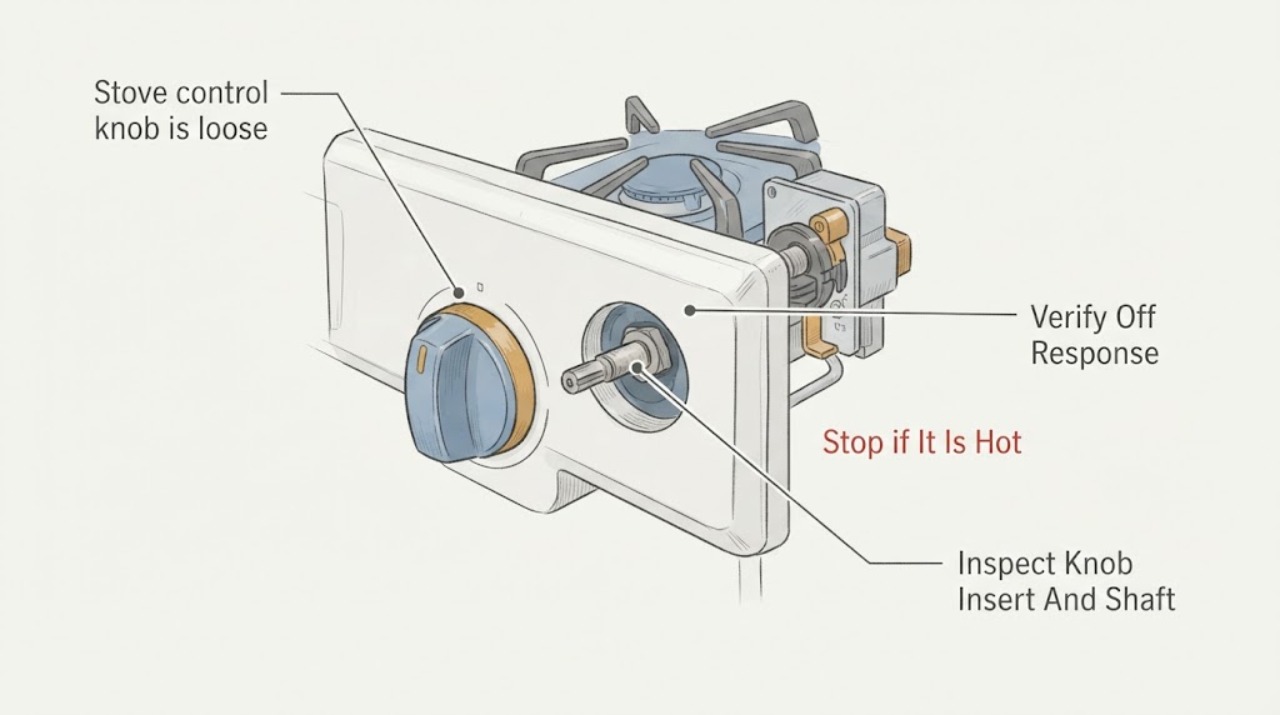
A loose stove control knob may have a cracked or worn knob insert, but a visibly worn, rounded, bent, slipping, or damaged control shaft is a separate control fault. Turn the control to Off and confirm that the burner actually stops; if the knob spins without reliably changing or shutting off the burner, stop using that burner and arrange qualified appliance service. With the stove cool, remove the knob only as the model instructions allow and compare its inner shape with the shaft without bending, gripping, lubricating, or modifying the shaft. A knob that is loose only because its insert is damaged may be replaced after exact model confirmation. A worn gas valve shaft, a shaft that moves independently of the valve, an exposed shaft, or an electric burner that does not respond to Off requires internal diagnosis rather than a universal knob or improvised spacer. Do not use a burner whose control position cannot be trusted.
Before you begin
Safety first
- This article supports safe Off verification, model identification, cool visible inspection, and a model-permitted knob fit check only. Do not access internal controls, work on live electrical parts, adjust gas valves, or use a burner with an unreliable Off position.
Work through in order
Diagnostic checks
Use only checks that match the exact appliance or system and its official guide.
-
Check 1
From a safe position, turn the affected control to Off using normal hand pressure and observe the burner without touching the hot surface; for gas, look only for a normal extinguished flame and for electric, wait for the element to cool normally.
Expected result: The burner stops and the control reaches a clear Off position, the knob turns without changing the burner, the burner remains on after Off, or a gas odor, smoke, sparking, or abnormal heat is present.
Next step: If the burner does not stop or any immediate hazard is present, stop using the stove and arrange qualified appliance or gas help from a safe location. Otherwise let the stove become fully cool before removing or inspecting the knob.
Stop if: Do not keep testing a control that will not turn the burner off, and stop for gas odor, smoke, sparking, uncontrolled flame, or a cracked or heat-damaged control area.
Why this matters
Why: A reliable Off response supports a loose-interface inspection. A burner that remains on or a knob that does not control the burner is a control fault, not a cosmetic looseness issue; gas odor, smoke, and sparking are immediate stop conditions.
-
Check 2
With all controls Off and the stove cool, identify whether the loose control operates a gas surface valve, electric coil or radiant element, induction zone, or oven function, and record the model number from the appliance label or manual without opening the appliance.
Expected result: The control is for gas, a removable electric element, a glass or induction zone, or an oven; the model identity is available, incomplete, or unknown.
Next step: Use the exact manual or manufacturer parts lookup for the identified model; if the model is unknown, photograph the knob and control panel and ask qualified service to identify the compatible control parts.
Stop if: Do not pull a knob from a hot control, open the panel to find the model, or assume that knobs from another burner or stove fit.
Why this matters
Why: A gas valve shaft and an electric burner switch have different service boundaries, while exact knob geometry and alignment are model-dependent. An unknown model makes a universal replacement or fit claim unsafe.
-
Check 3
After the stove is fully cool, remove the knob only by the straight, model-permitted method and inspect the knob's inner insert and the visible shaft for a split insert, missing piece, rounded or bent shaft, looseness, corrosion, or a mismatch between the knob cutout and shaft shape.
Expected result: The knob insert is visibly damaged while the shaft is intact, the shaft is visibly worn or bent, the shaft moves independently of the panel or valve, the parts are clean and aligned, or removal requires force.
Next step: Photograph the knob underside, shaft, control-panel position, and model label. Replace nothing until fit is confirmed; arrange service for shaft wear, movement, bending, damaged mounting, or any uncertain result.
Stop if: Do not bend, pry, drill, glue, shim, tape, lubricate, file, or otherwise modify the knob, insert, shaft, or control panel.
Why this matters
Why: A damaged insert with an intact shaft can explain looseness and may support a model-specific knob replacement. A worn, bent, independently moving, or inaccessible shaft points to the control assembly or mounting and cannot be corrected by a generic knob. Forced removal risks further shaft or panel damage.
-
Check 4
With the knob removed and the appliance still cool and inactive, observe only the visible shaft's normal direction and resistance as described by the manual; do not turn a gas valve shaft or internal control without the exact instructions and qualified boundary.
Expected result: The shaft is fixed and the knob engages its matching cutout, the shaft is loose or wobbles at the panel, the shaft turns too freely or binds, or an adjustment screw or internal control is visible.
Next step: Stop at the visible inspection and give the observations to a qualified appliance technician. For gas controls, do not attempt flame or low-setting adjustment; manufacturer guidance places such adjustment with a qualified gas technician.
Stop if: Do not adjust a gas valve, remove the control panel, access terminals, or turn an exposed control shaft as an experiment.
Why this matters
Why: A fixed shaft with a matching knob cutout supports a fit or insert issue. Wobble, binding, free rotation, an exposed adjustment feature, or a shaft that does not transmit control movement suggests a mounting, valve, switch, or control-assembly fault.
-
Check 5
Only when the exact model instructions confirm the knob is correctly aligned and the shaft is intact, reinstall the knob in Off and perform one brief normal-control check while watching the burner from a safe position; do not use a temporary spacer or improvised grip.
Expected result: The knob fits firmly, reaches Off and the intended settings, and the burner responds normally; the knob still slips, the burner response does not match the pointer, the burner remains on at Off, or the shaft shows further movement or damage.
Next step: Stop use of the affected control and arrange qualified appliance service for any persistent looseness, unreliable response, or shaft wear. Provide the model, control type, photos, and Off-response result.
Stop if: Do not operate the stove with a control that slips, cannot reach a reliable Off position, or leaves a burner energized or lit after Off.
Why this matters
Why: A stable response supports a removable knob or alignment issue. Continued slipping, incorrect response, or heat with the control Off indicates a control or shaft fault and is not solved by repeated reseating.
Use your observations
Decision map
Find the observation that best matches what you see, then follow the next safe action.
-
PATH 01Safety boundary
What you see
The knob insert is cracked, split, or worn, but the visible shaft is straight, secure, and matches the model's knob cutout; Off reliably stops the burner.
Do this next
Use the exact model manual or manufacturer parts documentation to identify a compatible replacement knob, install it only in the specified Off alignment, and make one controlled response check.
Why this path and its safety boundary
Why it matters: The removable knob is more likely to be the failed interface than the shaft or control assembly.
Safety stop: Do not use a generic knob, glue the damaged insert, or continue if the replacement does not reach a reliable Off position.
-
PATH 02Safety boundary
What you see
The shaft is visibly rounded, bent, cracked, loose at the panel, wobbles independently, or no longer reliably transmits the knob movement.
Do this next
Leave the affected control Off and arrange qualified appliance service, providing photos and the model identity without opening the control panel.
Why this path and its safety boundary
Why it matters: The control shaft, mounting, gas valve, burner switch, or related assembly may be worn; the knob alone is not an adequate diagnosis or repair.
Safety stop: Do not file, reshape, glue, shim, tape, lubricate, clamp, or replace the shaft or internal control as an ordinary user repair.
-
PATH 03Safety boundary
What you see
The knob spins, the pointer is misleading, or the burner remains energized or lit after the control is moved to Off.
Do this next
Stop using that burner and arrange qualified appliance service. For an immediate gas, fire, smoke, or sparking hazard, leave the area when safe and follow local emergency guidance.
Why this path and its safety boundary
Why it matters: The control cannot be trusted to interrupt heat or gas, creating a stop-use condition regardless of whether the external knob also looks loose.
Safety stop: Do not hold the knob in place, wedge it, use pliers, or continue cooking on the affected control.
-
PATH 04Safety boundary
What you see
The loose control is on a gas stove and an adjustment screw or valve feature is visible after the knob is removed, or flame response is weak, unstable, or otherwise abnormal.
Do this next
Keep the burner off and contact qualified gas or appliance service to assess the valve, shaft, mounting, and flame behavior.
Why this path and its safety boundary
Why it matters: The control may require gas-valve or burner diagnosis; the visible feature is not permission for an unqualified adjustment.
Safety stop: Do not turn the adjustment screw, alter gas pressure, enlarge an opening, or test with a flame if a leak is suspected.
-
PATH 05Safety boundary
What you see
The knob or shaft appears intact, but the model identity, cutout shape, shaft geometry, or correct Off alignment is unknown.
Do this next
Keep the control Off, record the model and part markings when safely accessible, and ask the manufacturer or qualified technician to identify the correct interface.
Why this path and its safety boundary
Why it matters: The loose fit cannot be separated safely from a compatibility or installation error, and a universal replacement claim is unsupported.
Safety stop: Do not force the knob onto the shaft, swap knobs between burners, or use an improvised spacer or adhesive.
-
PATH 06Safety boundary
What you see
The control panel or shaft is hot or cracked, wiring is exposed, there is smoke or sparking, a gas odor is present, or the knob or shaft is damaged after a spill or impact.
Do this next
Stop using the stove, keep people away, and arrange qualified appliance or gas help from a safe location; follow local emergency guidance for an immediate fire or gas hazard.
Why this path and its safety boundary
Why it matters: Heat, electrical, or gas damage may be active; ordinary knob inspection is no longer an appropriate next step.
Safety stop: Do not touch the damaged control, restore power, ignite a burner, or open the panel to investigate.
Helpful context
Understand the symptom
Separate a loose knob from a worn control shaft
The knob is the removable user interface; the shaft is the part behind it that transmits rotation to a burner switch or gas valve. A loose knob can result from a damaged insert or incorrect alignment. If the shaft itself is rounded, cracked, bent, loose in the panel, or no longer turns the control reliably, replacing the knob alone may not restore safe control. The key first question is whether Off really turns the burner off.
Use the model instructions for removal and fit
Manufacturer instructions differ. Some knobs pull straight off only when the control is Off, and the replacement must be aligned with the shaft; a knob that is installed in the wrong position can cause improper burner operation. Use the exact owner's manual or parts documentation for the stove, and do not force a knob that will not release. Do not hang towels on a knob or pull it sideways, because that can damage a gas valve shaft.
When a loose shaft is a service boundary
A shaft that is worn or moves without predictable burner response may be attached to an electric burner switch or a gas valve. A gas control that needs adjustment, or any control that requires access behind the panel, is not a generic knob repair. Leave the appliance out of service when the burner will not shut off, the control is hot or damaged, gas is smelled, wiring is exposed, or the shaft is loose in the panel.
Safety boundary
Stop conditions
- Stop using the affected burner if the control cannot reliably reach Off, the burner remains lit or energized after Off, or the knob spins without predictable response.
- Do not bend, pry, file, glue, shim, tape, lubricate, clamp, drill, or otherwise modify a loose knob, insert, shaft, valve, switch, or control panel.
- Do not open the control panel, touch terminals or wiring, adjust a gas valve or regulator, or use a flame to test for a gas leak.
- Stop for gas odor, smoke, sparking, uncontrolled flame, a hot or cracked control panel, exposed wiring, or damage after a spill or impact; follow local emergency guidance from a safe location.
- Do not use a universal knob or swap knobs between burners until the exact model, shaft geometry, control function, and Off alignment are confirmed.
Only after diagnosis
Potential parts
- stove control knob
Consider this part class only when the knob insert is damaged but the shaft is intact, secure, correctly shaped, and the model-specific fit is confirmed.
Confirm the exact stove model, control function, shaft geometry, pointer position, and manufacturer fit information before ordering; do not assume knobs from another burner or model fit. - control knob insert or sleeve
Consider this category only when the exact model uses a separately serviceable insert and diagnosis identifies the insert as damaged while the shaft and control remain sound.
Confirm the model-specific construction and manufacturer-approved repair path; do not glue, shim, or improvise an insert. - electric surface burner switch
Consider this part class only when an electric control has a secure knob but the shaft or control does not reliably switch the element, and qualified diagnosis identifies the switch assembly.
Confirm the exact model, burner position, electrical rating, terminal arrangement, and manufacturer fit information; internal replacement is qualified service work. - gas surface burner valve or control assembly
Consider this part class only when a gas control shaft is worn, loose, bent, or unreliable and qualified diagnosis identifies the valve or control assembly rather than the removable knob.
Confirm the exact model, burner position, gas type, valve arrangement, and manufacturer fit information; gas-valve work must be performed by qualified service.
When checks do not resolve it
Need a professional?
Arrange qualified appliance service when the control shaft is visibly worn, bent, cracked, loose, or wobbly; the knob still slips after a model-permitted fit check; the pointer does not match the burner response; the burner does not reliably turn Off; the control is on a gas valve; or the panel, wiring, flame, or surface is damaged. For gas odor, smoke, sparking, or an uncontrolled flame, leave the area when safe and follow local emergency or gas-provider guidance.
Safety scope: This article supports safe Off verification, model identification, cool visible inspection, and a model-permitted knob fit check only. Do not access internal controls, work on live electrical parts, adjust gas valves, or use a burner with an unreliable Off position.
Common questions
FAQ
Is a loose stove knob always the cause of a worn shaft?
No. The knob's inner insert may be cracked or worn while the shaft remains intact. Remove the knob only when the stove is cool and the exact model instructions permit it; a visibly rounded, bent, loose, or independently moving shaft needs qualified diagnosis rather than a replacement knob alone.
Can I glue a loose stove control knob to the shaft?
No. Adhesive, tape, a shim, or another improvised spacer can hide the control position or prevent a reliable Off response. Confirm the model-specific knob fit or arrange service when the shaft or control is worn.
What if the stove burner stays on after I turn the loose knob to Off?
Stop using that burner immediately. A control that does not reliably reach Off cannot be trusted, whether the stove is gas or electric. Keep people away from the hot area and arrange qualified appliance service; follow local emergency or gas guidance for smoke, fire, uncontrolled flame, or gas odor.
Can I adjust the gas control shaft myself?
Do not adjust a gas valve or an adjustment screw as a generic knob repair. Manufacturer guidance identifies gas-control adjustment as qualified gas-technician work. Leave the burner off and arrange qualified appliance or gas service when the shaft or flame response is abnormal.
Read the exact guide
Official sources
- Knob Won't Turn - RangeWhirlpool Product Help · Official Whirlpool range guidance used for checking that the knob cutout and valve stem align and for escalating a continuing control problem; the assigned stove has no brand or model.
- Electric Range Knob - AEZ75994629LG Canada · Official LG accessory guidance used for the general knob-versus-shaft inspection boundary; the assigned stove has no brand or model, so the installed manual controls.
- Gas Range & Cooktop - Degree Rotation and Adjustment of Gas Burner ControlsGE Appliances · Official GE gas-control guidance used to keep adjustment-screw and gas-valve work inside the qualified-technician boundary; it is not a model-specific repair instruction for this unbranded stove.
Community feedback
Share a repair observation
Share a plain-text repair observation. Accepted observations are published automatically; this page may take a moment to update.