
On this page
Start here
Quick answer
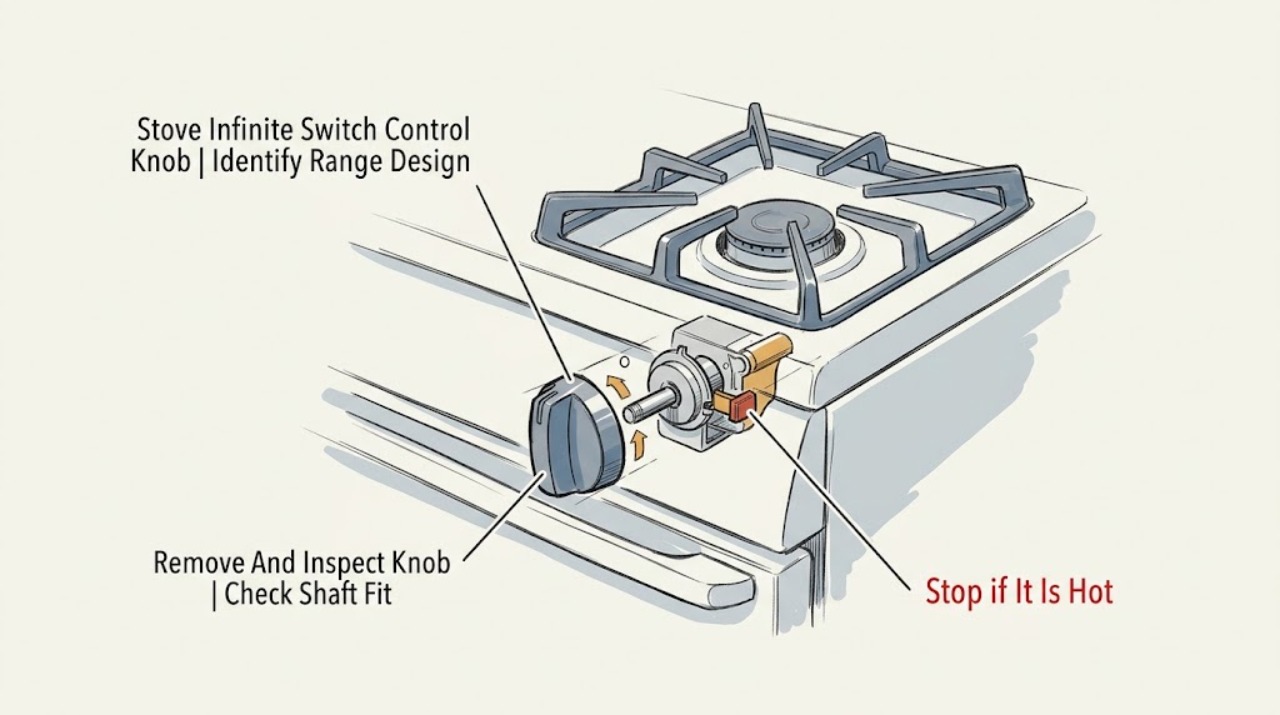
A loose Amana stove control knob does not by itself prove that the infinite switch has failed. With every control off and the cooktop cool, pull the knob straight off and compare its cutout with the visible switch shaft or valve stem. A knob that rocks, splits, or no longer grips a sound shaft points to the knob; a shaft that wobbles, sits behind a loose panel, turns roughly, or does not track the heat setting points toward the infinite switch or another control problem. This infinite-switch path is for electric surface-element controls; a gas knob operates a gas valve and needs the gas model's instructions. Do not open the control panel or test live wiring. If an element remains energized after its control is Off, the knob turns without changing heat, the breaker trips, there is smoke or a burning smell, or the shaft is loose, switch off the range safely and arrange qualified appliance service.
Work through in order
Diagnostic checks
Use only checks that match the exact appliance or system and its official guide.
-
Check 1
Record the Amana model number and determine whether the affected control operates an electric coil or smooth-top surface element or a gas burner; note which position is loose and whether the issue affects one control or several.
Expected result: The appliance is electric with a surface-element control, gas with a burner valve, or the fuel/design cannot be confirmed from the model information.
Next step: Use the exact Amana manual for the model and fuel type. If the design is uncertain, stop at the external knob check and arrange model-specific service.
Stop if: Do not remove a gas valve, disconnect a gas line, expose wiring, or continue if there is gas odor, a flame problem, smoke, or a hot surface that cannot be left undisturbed.
Why this matters
Why: An infinite switch is an electric-control diagnosis, while a gas knob is associated with a valve stem and gas ignition path. A generic knob procedure should not be used to open a gas control or assume parts cross between designs.
-
Check 2
With all controls in Off and the cooktop fully cool, pull the affected knob straight away from the control panel and inspect the knob's rear cutout for cracks, rounding, distortion, missing material, or debris.
Expected result: The knob cutout is visibly damaged or dirty, appears intact, or the knob will not pull straight off without force.
Next step: Clean only as Amana directs with a soft cloth and mild soap and water, allow the knob to dry, and keep it in Off for the fit check. Arrange service if the knob cannot be removed without force.
Stop if: Do not use a screwdriver or pliers to pry the knob, soak it, use abrasive cleaner, or remove seals beneath it.
Why this matters
Why: A damaged or contaminated cutout can make a sound shaft feel loose. An intact knob shifts attention toward alignment or the shaft. A knob that resists removal should not be pried because the panel or control stem can be damaged.
-
Check 3
From the front of the cool appliance, compare the knob cutout with the visible control shaft or valve stem and refit the knob only in the Off position, aligning the cutout without twisting or forcing it.
Expected result: The knob seats firmly and points correctly, rocks on a firm shaft, spins without engaging the shaft, or the shaft itself wobbles, tilts, or sits unusually far behind the panel.
Next step: If the knob is the only damaged part, record its markings and confirm the exact model before considering a replacement. If the shaft is loose or abnormal, leave the control Off and arrange appliance service.
Stop if: Do not bend the shaft, glue the knob on, add tape or shims, force a mismatched knob, or open the control panel.
Why this matters
Why: A firm shaft with a loose or misaligned knob supports a knob-fit problem. A wobbling or recessed shaft points toward the control shaft, mounting, or infinite switch or valve area and cannot be corrected by a new knob alone.
-
Check 4
Only if the knob is seated normally, the surface is cool before handling, and there is no gas or electrical warning, observe one normal low-to-high-to-Off control change from outside while keeping hands away from the element or burner.
Expected result: The heat follows the selected range and turns off, the element cycles normally, the knob turns without changing heat, the element remains energized after Off, or the indicator stays on while the surface cools.
Next step: Turn the control Off and let the surface cool. Arrange service for a control that does not track the setting or an element that stays energized; do not make another test to confirm it.
Stop if: If an element remains on after Off, smoke, scorching, arcing, a burning smell, or gas odor appears, de-energize the range from a safe location if possible and leave it unused until qualified service.
Why this matters
Why: Normal heat response with a loose knob favors a knob fit. A knob that does not change heat or an element that remains energized after Off points to a control or infinite-switch fault. Amana notes that an indicator may remain on while an electric surface is still hot, so that light alone is not proof of a switch failure.
-
Check 5
With the appliance cool and all controls Off, compare the affected knob and shaft with an adjacent matching control only by appearance and seating; do not swap knobs or operate an uncertain control as a repair test.
Expected result: Only one knob is loose, the affected shaft differs visibly from adjacent shafts, several knobs or controls are loose, or the panel appears loose or damaged.
Next step: Photograph the control, shaft, panel, and model label for service or exact-part identification. Keep the affected control Off and do not substitute another knob.
Stop if: Do not swap knobs, loosen panel fasteners, remove the control panel, or reach behind the panel to test the infinite switch.
Why this matters
Why: One damaged knob supports a local fit problem. A shaft or panel difference, several loose controls, or a loose control mounting suggests service beyond the removable knob. A comparison does not establish that a control switch is compatible with another position.
-
Check 6
Use the knob condition, shaft fit, control response, appliance design, and safety observations to decide whether the issue is limited to a removable knob or requires a qualified appliance diagnosis.
Expected result: The knob is damaged but the shaft is firm and heat tracks the setting, or the shaft, infinite switch, valve behavior, heat control, panel, or electrical safety is abnormal.
Next step: For the first pattern, verify the exact model and manufacturer fit information before replacing only the knob. For the second, leave the range Off and arrange qualified appliance service with the observations and photos.
Stop if: Do not purchase or install an infinite switch based only on looseness, open the panel, test live circuits, or operate the range with a control that does not reliably turn Off.
Why this matters
Why: A damaged knob can be a conditional user-replaceable item when the exact model confirms fit. Abnormal shaft movement or heat response means the control behind the knob may be involved; the symptom does not prove an infinite switch part is the correct repair.
Use your observations
Decision map
Find the observation that best matches what you see, then follow the next safe action.
-
PATH 01Next step
What you see
The cooktop is cool, the control shaft is firm and aligned, heat follows the setting normally, and the knob cutout is cracked, rounded, dirty, or no longer grips.
Do this next
Clean and refit the knob in Off if allowed by the manual, or confirm the exact model before considering a knob replacement. Do not glue, shim, or force it.
Why this path and its safety boundary
Why it matters: The removable knob is more likely than the infinite switch to be the failed item.
-
PATH 02Next step
What you see
The knob is intact or has been removed, but the shaft wobbles, sits recessed, turns roughly, or does not reliably change the surface heat setting.
Do this next
Keep the affected control Off and arrange qualified appliance service. Do not open the panel or choose a switch from appearance alone.
Why this path and its safety boundary
Why it matters: The shaft, switch mounting, infinite switch, or another control behind the panel is more likely than a loose knob alone.
-
PATH 03Next step
What you see
An electric element remains energized after its control is Off, heat continues unexpectedly, or smoke, scorching, or arcing appears; an indicator may also remain on while the surface cools.
Do this next
Leave the appliance unused and de-energize it from a safe location if possible without contact with a hot or damaged surface. Arrange qualified appliance service.
Why this path and its safety boundary
Why it matters: A stuck control or electrical fault is possible, while an indicator alone can reflect residual surface heat. The risk requires a stop decision before further diagnosis.
-
PATH 04Next step
What you see
The appliance is gas, the knob operates a burner valve rather than an electric infinite switch, or gas odor, delayed ignition, or abnormal flame is present.
Do this next
Turn controls Off, stop using the burner, and seek qualified gas-appliance service for any valve, ignition, odor, or flame concern. Do not remove the valve or disconnect the gas line.
Why this path and its safety boundary
Why it matters: The electric infinite-switch path does not apply; the gas valve and ignition system require the gas model's instructions and professional boundary.
-
PATH 05Next step
What you see
Several knobs are loose, the control panel or shaft support moves, or the fault began after cleaning, impact, installation, or a panel disturbance.
Do this next
Keep all affected controls Off, photograph the panel and model label, and arrange appliance service. Do not tighten hidden fasteners or expose the control assembly as a user repair.
Why this path and its safety boundary
Why it matters: A mounting, panel, or shared control issue is more likely than one worn knob.
Helpful context
Understand the symptom
The knob, stem, and infinite switch are different parts
A knob is the removable user interface. Its rear cutout grips a shaft or valve stem. On an electric range, the shaft is connected to a control such as an infinite switch behind the panel; on a gas range, the knob operates a gas valve instead. A knob can feel loose while the control remains sound, so do not order an infinite switch until the knob fit and shaft movement have been separated.
Inspect only from safe access
Amana's cleaning guidance says all controls should be off and the cooktop cool before knobs are removed. Pull a knob straight away, keep it dry, and inspect the visible cutout and shaft without prying or opening the panel. Do not use the knob as a reason to expose wiring or a hot element.
Heat behavior decides the service boundary
A smooth knob with a firm shaft may only need correct alignment, while a shaft that is loose or a control that no longer follows Off, low, medium, and high needs diagnosis behind the panel. Amana notes that electric surface elements can cycle on and off to maintain a setting and that an indicator can stay lit while a surface is still hot, so judge the element itself and the control position, not an indicator alone.
Safety boundary
Stop conditions
- Stop immediately for gas odor, delayed ignition, abnormal flame, smoke, scorching, burning smell, arcing, or an element that remains energized after its control is Off.
- Stop for a shaft that wobbles, a panel that moves, a knob that cannot be removed without force, or a control that does not reliably return to Off.
- Do not open the control panel, test live circuits, disconnect a gas line, bend a shaft, glue a knob, or use a mismatched control knob.
- Stop after the cool external fit and response checks if the fault remains or requires a switch, valve, wiring, or mounting diagnosis; arrange qualified appliance service.
Only after diagnosis
Potential parts
- surface-element control knob
Consider this only when the knob cutout is damaged or no longer grips, the shaft is firm and aligned, and the control reliably turns the element Off and follows the setting.
Confirm the exact Amana model and the manufacturer's fit information; knob shape and shaft interface can vary by range. - infinite switch
Consider this only after qualified diagnosis finds an electric control that does not track the setting or does not reliably turn the surface element Off; looseness alone is not proof of switch failure.
Confirm the exact model, element circuit, terminal arrangement, and electrical rating through the manufacturer's documentation or a qualified technician before any replacement.
When checks do not resolve it
Need a professional?
Arrange qualified Amana appliance service when the control shaft wobbles, the knob turns without changing heat, the element does not turn Off, the panel or switch mounting is loose, multiple controls are affected, the gas design is uncertain, or the knob problem remains after a safe fit check. Do not open the panel or test an infinite switch while energized.
Common questions
FAQ
Does a loose Amana stove knob mean the infinite switch is bad?
Not necessarily. First separate the removable knob from the shaft. A damaged knob with a firm shaft and normal heat response points to the knob; a wobbly shaft or heat that does not track the setting needs service for the control behind it.
How can I check an Amana control knob safely?
Turn every control Off, wait until the cooktop is cool, and pull the knob straight away without prying. Inspect the rear cutout and visible shaft, then refit only in Off if the exact instructions allow it. Do not open the panel.
Is an Amana gas knob the same as an electric infinite-switch knob?
No. A gas knob operates a gas valve and ignition path, while an electric surface-element control uses an electric control such as an infinite switch. Confirm the fuel type and exact model before selecting a part or procedure.
What if the element stays on after I turn the Amana knob Off?
Stop using that control. An indicator can remain lit while a surface cools, but an element that remains energized, smokes, scorches, arcs, or heats unexpectedly is a stop-and-service condition. De-energize the range safely if possible and arrange qualified appliance service.
Read the exact guide
Official sources
- Use & Care GuideAmana · Amana electric range Use and Care Guide for the identified model family; controls and features vary by model.
- Gas Burners are Clicking but Not Lighting - Product HelpAmana · Amana gas-cooktop guidance; gas controls, ignition, and model lockout features vary.
- Knob Won't Turn - Range - Product HelpAmana · Amana gas-range support page; its knob and stem comparison is useful for separating a removable knob from a control stem, while electric ranges require their exact manual.
- Caring for the Control Knobs and the Control Panel - Product HelpAmana · Amana cooktop care guidance; exact range and cooktop instructions control materials and seals.
- Nothing is Working - Electric - Product HelpAmana · Amana electric range support; electrical connections and control access are model- and installation-specific.
- Control Knobs or Control Panel - Range - Product HelpAmana · Amana range support; knob shape, seals, controls, and access differ by model.
Community feedback
Share a repair observation
Share a plain-text repair observation. Accepted observations are published automatically; this page may take a moment to update.