
On this page
Start here
Quick answer
A loose Frigidaire stove control knob does not by itself prove that the internal infinite switch has failed. First make the range safe and identify whether the knob is cracked or slipping on the control shaft, whether the shaft itself moves normally, or whether the surface element remains on, cycles normally, or cannot be turned to OFF. Frigidaire's electric-range guidance says the surface controls are pushed in and turned, the element-on light helps confirm that controls are OFF, and radiant elements may cycle on and off even on High. With the surface cool, inspect only the accessible knob and shaft as the exact model manual allows; do not open the control panel or test live wiring. If the knob cannot reliably select OFF, the element stays on with the control at OFF, the shaft is loose or damaged, the breaker trips, or heat, smoke, sparking, or a cracked cooktop is present, stop using the stove, disconnect power only from a safely identified circuit when appropriate, and arrange qualified appliance service.
Before you begin
Safety first
- This article supports cool-surface observation of the external knob and model identification only. A qualified technician must handle infinite-switch or shaft replacement, control-panel access, wiring, live electrical diagnosis, gas-valve work, induction electronics, cracked-glass repair, and any hazard that prevents safe access.
Work through in order
Diagnostic checks
Use only checks that match the exact appliance or system and its official guide.
-
Check 1
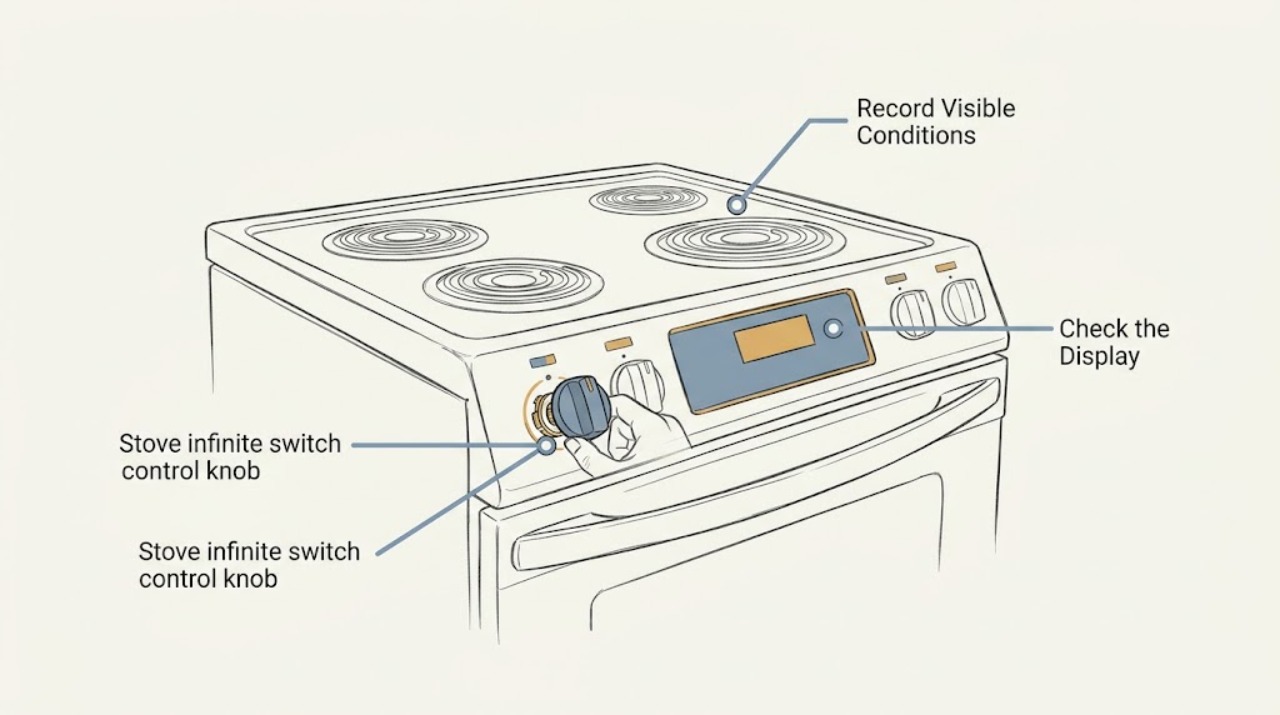
Stop cooking, move cookware only with appropriate heat protection, turn the affected surface control toward OFF using the normal control, and keep hands and combustibles away until the surface cools. Record the Frigidaire model, electric radiant versus induction or gas layout, affected burner, knob position, indicator lights, and whether heat continues when OFF is selected.
Expected result: The knob reaches OFF and the element-on light is off, or the knob cannot reach OFF, the element-on light remains on, the element glows or heats unexpectedly, a hot surface is present, or there is smoke, sparking, a burning smell, a cracked glass surface, or a gas odor.
Next step: For a hazard, stop using the range and leave the area for a gas odor or fire risk; use only a safely identified electrical disconnect when appropriate and arrange qualified service. If the control is OFF and the surface is safely cooling, continue with stopped, cool-surface checks.
Stop if: Stop for smoke, fire, sparking, burning odor, a cracked or shattered cooktop, a damaged cord, water near controls, a gas odor, or a surface element that remains on when its control is OFF.
Why this matters
Why: A hot-surface light can remain after normal heating, but an element-on indication or continued heating with the control at OFF is not a loose-knob-only symptom. Smoke, sparking, a cracked cooktop, uncontrolled heat, or a gas odor is an immediate stop-use hazard.
-
Check 2
Read the model and serial label from its normal accessible location and compare the control layout with the Frigidaire owner's manual. Identify whether the affected control is a push-and-turn radiant surface knob, a gas burner knob, an induction or touch control, or another electronic interface; do not assume every Frigidaire stove uses an infinite switch.
Expected result: The manual shows a matching electric radiant control knob, a different control technology, an unclear model identity, or a knob whose markings do not match the control panel.
Next step: Use the exact model manual for knob removal, control operation, and service instructions. If the model or technology cannot be confirmed, stop part selection and provide the model information to Frigidaire or a qualified appliance technician.
Stop if: Do not remove the range, open a control panel, or substitute a part based only on a similar-looking knob or a generic infinite-switch description.
Why this matters
Why: An infinite switch path is relevant only when the exact model uses that type of surface control. A gas valve, induction touch control, or electronic control can have different hazards and parts, so a generic switch diagnosis would be unsafe.
-
Check 3
When the cooking surface is fully cool and the model manual permits it, inspect the affected knob from ordinary access. Remove it only by the documented method, without prying against the cooktop, and look for a cracked hub, split socket, missing insert, distorted opening, or markings that no longer align; do not loosen the panel or pull the shaft from the range.
Expected result: The knob is visibly cracked or loose on the shaft, the knob is intact but the shaft is loose or does not track the OFF and setting marks, the shaft and knob fit normally, or the knob cannot be removed without force.
Next step: Photograph the knob, shaft end, markings, and model label. Replace a knob only after the exact model fit is confirmed; arrange service for a loose shaft, uncertain removal, damaged control panel, or any need to access wiring.
Stop if: Do not pry with a screwdriver, bend the shaft, spray cleaner into the opening, operate with exposed internal parts, or continue if the knob is stuck or the panel moves.
Why this matters
Why: A damaged knob can explain wobble or slipping while the shaft still works. A loose or nontracking shaft moves the diagnosis toward the control assembly or infinite switch. A normal fit or forced removal means the symptom cannot be safely assigned to the knob from external inspection.
-
Check 4
For a confirmed electric radiant model with an intact knob and a control that reliably returns to OFF, observe the affected element only during ordinary cooking with correctly sized cookware and from a safe position. Compare its glow or heat cycling with another similar radiant element at the same kind of setting; do not touch the glass or use the loose knob as a live test.
Expected result: The element cycles on and off while the control stays at a chosen setting and turns fully OFF, or it stays on continuously, heats with the control at OFF, ignores rotation, or behaves differently from the other element in a way the manual does not describe.
Next step: Treat normal cycling with reliable OFF control as an operating characteristic and continue monitoring the knob fit. For uncontrolled or unexplained heating, stop using that surface and arrange service; do not open the range to test the switch.
Stop if: Stop for uncontrolled heat, an element glowing at OFF, smoke, scorching, melted material, abnormal odor, sparking, or a cooktop surface that is cracked or damaged.
Why this matters
Why: Frigidaire identifies on/off cycling on radiant elements, even on High, as normal. Continuous heat at OFF, loss of control, or a repeatable abnormal response supports a control or infinite-switch fault rather than normal cycling.
-
Check 5
If the control cannot reliably turn the surface OFF or the element remains energized, stop operating the stove and, only if the electrical disconnect is clearly identified and can be reached without entering a hazard, switch off the range's circuit or unplug it as allowed by the installation. Do not remove covers, probe terminals, or perform live electrical measurements.
Expected result: The surface stops heating after the safely identified disconnect, or the disconnect is unknown, inaccessible, shared with other essential equipment, or the hazard remains such as smoke, burning, sparking, or heat from an unexpected source.
Next step: Leave the range out of service, label the affected control, and arrange qualified appliance service with the model and symptom record. Use the appropriate emergency response for fire, smoke, gas odor, or an electrical hazard.
Stop if: Do not repeatedly cycle a breaker, access energized wiring, remove the control panel, bypass a switch, or restore power to a surface that heats at OFF.
Why this matters
Why: Removing power can prevent continued heating while service is arranged, but it does not diagnose whether the knob, shaft, infinite switch, element, or wiring failed. An unknown disconnect or active hazard requires professional or emergency handling.
-
Check 6
Prepare a service handoff that distinguishes the external knob symptom from the internal control symptom: include the exact model, affected burner, knob and shaft fit, OFF behavior, element-on and hot-surface indications, whether cycling is normal or uncontrolled, installation history, and photos taken only with the range cool and de-energized when appropriate.
Expected result: The knob alone is damaged, the shaft or control response is abnormal, the element heats at OFF, the model uses a different control technology, or the symptom remains uncertain after safe external checks.
Next step: Have qualified appliance service diagnose and replace the component using the exact model documentation. Keep the old knob and any loose insert for identification, and do not resume use until the control can reliably select OFF and the technician confirms safe operation.
Stop if: Do not order an infinite switch from a generic listing, splice wires, bypass the control, or continue cooking while the burner cannot be turned off reliably.
Why this matters
Why: These patterns determine whether a compatible knob, shaft/control assembly, infinite switch, element, wiring, or a different model-specific component should be examined. None can be selected reliably from the phrase 'loose knob' alone.
Use your observations
Decision map
Find the observation that best matches what you see, then follow the next safe action.
-
PATH 01Next step
What you see
The exact model uses a push-and-turn radiant surface knob, the shaft moves normally and returns to OFF, the element-on indication follows the control, and the cool knob has a cracked, split, distorted, or loose socket.
Do this next
The visible knob is the leading suspect. Replace it only with a model-confirmed compatible knob and verify that it seats without force and that OFF remains reliable; arrange service if the shaft still wobbles or the element response is abnormal.
-
PATH 02Next step
What you see
The knob is intact or replaced but the control shaft is loose, rotates without matching the markings, will not stay at OFF, or does not transfer the selected setting consistently.
Do this next
Treat the shaft or attached control assembly, which may include the infinite switch, as a service diagnosis. Keep the range out of use and do not open the control panel or substitute a switch based on appearance.
-
PATH 03Next step
What you see
A confirmed radiant element cycles on and off at a selected setting, the control turns and returns fully to OFF, and the element-on indication clears while only the hot-surface indication remains during cool-down.
Do this next
This pattern is consistent with Frigidaire's described radiant-element cycling and residual heat. Continue only with a secure knob and normal controls; seek service if the knob cannot reliably select OFF or cycling changes into uncontrolled heating.
-
PATH 04Next step
What you see
The affected surface continues heating, the element-on indication remains, or the element ignores the knob when the control is at OFF, especially after a cool-surface check.
Do this next
Stop using the stove, disconnect power only from a safely identified source when appropriate, and arrange qualified service. Do not restart the element or attempt an infinite-switch or wiring repair.
-
PATH 05Next step
What you see
The model is gas, induction, touch-controlled, or otherwise does not match a push-and-turn electric radiant control, or the model identity cannot be confirmed.
Do this next
Do not apply the infinite-switch diagnosis. Follow the exact model manual's safety and control guidance and use qualified service for a loose shaft, valve, electronic control, or any uncontrolled heat.
Helpful context
Understand the symptom
The knob, shaft, and infinite switch are different failure points
The visible knob is the part a user grips. Behind it, a control shaft transfers the rotation to the range's surface-control mechanism; on compatible electric radiant models that mechanism may be called an infinite switch. A cracked knob socket can feel loose while the shaft and switch still follow the setting. A shaft that turns without a clear setting, a control that will not reach OFF, or an element that stays energized points to a control or electrical problem instead. The exact Frigidaire model and whether it uses radiant, induction, gas, or electronic controls determine which component path applies.
Do not mistake normal radiant cycling for a stuck infinite switch
Frigidaire says radiant elements on a smooth cooktop are designed to cycle on and off, even on High, to maintain heat and protect the cooktop. A healthy control can therefore produce an intermittent glow during a cooking setting. The safety distinction is whether the selected control can be returned to OFF and the element-on indication goes out; a hot-surface indicator can remain on while glass is still hot. If the element continues heating with the control at OFF, treat that as abnormal and stop use.
Limit checks to cool, accessible parts
A user can usually record the model, let the surface cool, and inspect the knob for a split, cracked, or distorted socket without opening the range. Some knobs are removable only by the method in the owner's manual; do not pry against the glass or force a knob that does not release. Infinite-switch replacement, shaft alignment, wiring, and control-panel access require a qualified technician, because a range can retain hazardous electrical energy and hot surfaces can burn even after a control is turned off.
Safety boundary
Stop conditions
- Stop using the stove if a surface element heats with its control at OFF, the knob cannot reliably select OFF, or the element-on indicator remains on unexpectedly.
- Stop for smoke, sparking, burning odor, melted material, a cracked or shattered cooktop, damaged cord, water near controls, or fire or gas odor; use the appropriate emergency response from a safe location.
- Do not touch a hot glass surface to test it, place combustibles near an element, or assume a hot-surface indicator means the control is still requesting heat.
- Do not open the control panel, test live terminals, splice wires, bypass an infinite switch or safety device, or reach behind the range as a routine knob check.
- Do not force, pry, bend, or spray into a knob or control shaft, and do not order a switch or shaft part without the exact model and a confirmed diagnosis.
Only after diagnosis
Potential parts
- surface control knob
Consider only when the exact model uses the same accessible knob and the cool knob is cracked, split, distorted, or no longer grips a confirmed-good shaft while OFF and heat control remain normal.
Confirm the complete Frigidaire model, shaft profile, markings, and control technology before ordering; similar-looking knobs are not proof of fit. - control shaft or knob insert
Consider only if qualified diagnosis finds a damaged or nontracking shaft or removable insert after the knob itself has been ruled out; a loose knob alone does not establish shaft failure.
Verify the exact model and the manufacturer's parts documentation; shaft geometry and control assemblies vary by range. - infinite switch or surface-element control
Consider only for a confirmed electric radiant model when service finds that the control will not regulate or disconnect the associated element, or the shaft is part of a failed control assembly.
An infinite switch is not interchangeable across models or control technologies; a technician must confirm the exact model, element circuit, terminals, and failed component before replacement. - surface-element or control wiring component
Consider only if service identifies a damaged element, connector, or wiring condition after uncontrolled heating or abnormal control response; the visible knob does not prove a wiring fault.
Electrical parts require exact model and qualified installation; do not improvise connectors, splice conductors, or select a part by appearance.
When checks do not resolve it
Need a professional?
Arrange qualified Frigidaire appliance service when the knob remains loose after a cool, model-approved external inspection; the control shaft is loose, slips, or does not track OFF; an element heats at OFF or the element-on light stays on; a breaker trips; the cooktop or wiring is damaged; the control technology is unclear; or the symptom requires panel, wiring, infinite-switch, or electrical diagnosis. Provide the exact model, affected burner, knob and shaft observations, control position, indicator behavior, cycling pattern, and any safe cool-surface photos.
Safety scope: This article supports cool-surface observation of the external knob and model identification only. A qualified technician must handle infinite-switch or shaft replacement, control-panel access, wiring, live electrical diagnosis, gas-valve work, induction electronics, cracked-glass repair, and any hazard that prevents safe access.
Common questions
FAQ
Is a loose Frigidaire stove knob always a bad infinite switch?
No. A cracked or worn knob socket can slip on a sound shaft. If the shaft is loose, the setting does not track, or the element heats at OFF, the control assembly or infinite switch becomes more likely and needs model-specific service diagnosis.
Why does my Frigidaire electric burner turn on and off on High?
Frigidaire says radiant elements are designed to cycle on and off, even on High, to maintain heat and protect the smooth cooktop. Cycling is different from an element that stays on with its control at OFF or cannot be regulated.
Can I pull the knob off to inspect it?
Only when the surface is fully cool and the exact model manual permits the removal method. Do not pry, bend the shaft, spray into the opening, loosen the panel, or continue if the knob will not release normally.
What if the burner stays on when the knob is at OFF?
Stop using that surface and do not keep testing it. If the range's electrical disconnect is safely identified and accessible, disconnect power as appropriate, then arrange qualified service; do not open the control panel or test live wiring.
Does the hot-surface light mean the infinite switch is stuck?
Not by itself. Frigidaire says the hot-surface light can remain on until the glass cools, while the element-on light indicates that a surface element is turned on. Compare the light and actual heat with the control position, without touching the hot glass.
Should I order a universal infinite switch for a loose Frigidaire knob?
No. The visible symptom does not identify the failed component, and control assemblies vary by model and technology. Confirm the exact model and have a qualified technician diagnose the knob, shaft, infinite switch, element, or wiring before ordering a part.
Read the exact guide
Official sources
- A23936502 Frig LUX-LO FCFS_A_en (Mdl 4 radiant SC Canada).indbFrigidaire · Official Frigidaire electric-range use-and-care manual for the listed radiant-control family; it is a representative manual, so the exact model manual controls a particular appliance.
- How do I use my display or controls?Frigidaire · Frigidaire ranges, cooktops, and ovens; the page directs users to the exact owner's manual because products vary by model.
- Ranges - No HeatingFrigidaire · Frigidaire electric range and cooktop guidance; reset and burner details vary by model and appliance type.
- Ranges - What do the indicator lights on my range mean?Frigidaire · Frigidaire ranges with these indicator-light designs; indicator location and behavior can vary by model.
- Ranges - Why does my surface element appear to go on and off on my ceramic glass cooktop?Frigidaire · Frigidaire smooth ceramic-glass ranges with radiant elements; exact model controls and cookware guidance may differ.
Community feedback
Share a repair observation
Share a plain-text repair observation. Accepted observations are published automatically; this page may take a moment to update.