
On this page
Start here
Quick answer
A loose stove control knob may be only a cracked or poorly seated knob cap, or it may indicate a damaged insert, worn infinite-switch shaft, loose control-panel mounting, or a switch that no longer follows the markings. Turn the burner control to Off and let the cooktop cool. If the model permits knob removal, pull it straight off, inspect the knob and shaft without opening the control panel, and reseat the knob in the Off position. Do not use the burner if the knob can turn without changing the switch, points to the wrong setting, falls off, or the burner heats when Off. A burner that stays continuously on, the control area becomes hot, or a breaker trips needs power disconnected if safe and qualified appliance service. Do not glue the knob to the shaft, force a loose shaft, spray cleaner into the control, or replace an infinite switch by appearance.
Before you begin
Safety first
- This article supports cool-cooktop observation, model-permitted straight-off knob removal, inspection of the accessible knob and shaft end, and correct Off-position reseating. A qualified appliance technician should handle the control panel, infinite switch, element, limiter, terminals, wiring, and live-circuit diagnosis.
Work through in order
Diagnostic checks
Use only checks that match the exact appliance or system and its official guide.
-
Check 1
With the affected control at Off and the cooktop cool, gently grasp the knob without twisting hard and observe whether only the knob cap rocks, the switch shaft moves with it, the panel flexes, or the knob slips without moving the control.
Expected result: The cap may have side-to-side play, the shaft may move in the panel, the knob may be cracked or split, the markings may no longer align, or the control may turn without a predictable burner response.
Next step: Continue only with a cool, Off cooktop and ordinary knob access when the shaft is stable; leave the burner unused and arrange service for shaft, panel, or burner-control movement.
Stop if: Stop immediately for a hot control area, burner heating at Off, smoke, burning odor, sparks, shock, cracked glass, or a knob that cannot reliably select Off.
Why this matters
Why: A loose cap or damaged insert is more likely when the shaft is stable and the control still tracks correctly. Shaft or panel movement, misalignment, or unpredictable heating makes an infinite-switch mounting or control fault more likely.
-
Check 2
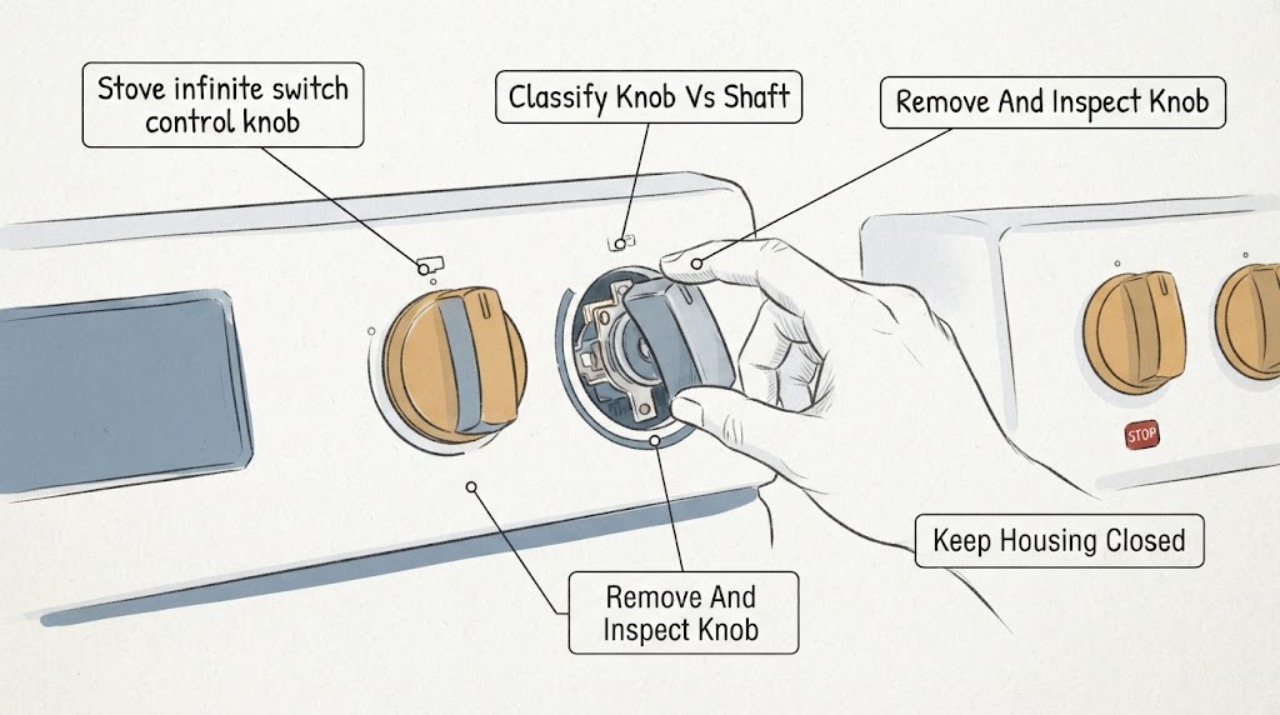
If the exact model manual permits removal, pull the knob straight away from the control panel with the control in Off; inspect the knob's hub, insert, and shaft end without removing the panel, seals, or switch mounting.
Expected result: The knob may have a split hub, worn insert, missing clip, debris, a normal shaft, a bent shaft, or a shaft that is loose in the panel; some models may have a seal that must remain in place.
Next step: Clean only as the model manual allows, keep any seal in place, and prepare to reseat an intact knob; arrange service for a loose shaft, damaged control assembly, or uncertain construction.
Stop if: Do not pry against the panel, pull a shaft, remove seals, spray cleaner into the stem opening, or continue if the knob will not release with ordinary straight pull.
Why this matters
Why: A damaged knob with a stable shaft can explain looseness without proving the infinite switch failed. A bent or loose shaft, disturbed seal, or panel movement shifts the problem to the switch or control assembly.
-
Check 3
Place an intact, model-correct knob back onto the shaft in the Off position and check that its pointer aligns with Off and turns the control smoothly through its normal range without force; keep cookware off the burner.
Expected result: The knob may seat firmly and align, remain loose, sit at the wrong angle, bind, rotate freely, or fail to change the burner response as the pointer moves.
Next step: Use the burner only if the control reaches Off and behaves predictably; otherwise leave it off and arrange qualified appliance repair for model-specific control diagnosis.
Stop if: Do not glue, tape, shim, force, or substitute a knob, and do not operate the burner if Off cannot be selected reliably.
Why this matters
Why: Firm alignment and predictable control support a loose cap or seating issue. A knob that will not seat, remains misaligned, binds, or does not track the burner points toward a damaged insert, shaft, switch, or control-panel mounting problem.
-
Check 4
From a safe distance and only after the knob is stable, observe one brief controlled heating cycle at a normal setting and then Off; do not touch the element or glass and do not use a pan as a test load.
Expected result: The burner may cycle on and off and stop responding to Off, remain fully energized at every setting, stay hot only from residual glass heat, or continue heating after Off.
Next step: Leave the burner unused and arrange service for an unresponsive or continuously heating control; do not continue cycling the knob to make the symptom disappear.
Stop if: Stop for heat at the control, smoke, odor, sparks, shock, cracked glass, or a burner that remains actively energized after Off.
Why this matters
Why: Setting-dependent cycling and stopping are consistent with normal electric-burner control. Continuous heat at lower settings or active heating after Off makes the infinite switch, element, limiter, or wiring suspect; residual glass warmth alone is not proof of live power.
-
Check 5
After one safe reseat and controlled observation, record whether the knob stays aligned and the burner responds normally, or whether looseness, misalignment, uncontrolled heating, or electrical warnings return; do not open the control panel.
Expected result: The cap may remain secure, loosen again quickly, rotate without changing heat, affect only one burner, or coincide with a hot surface indicator, smoke, odor, sparks, shock, or breaker trip.
Next step: Keep an unresolved burner off, disconnect power if it remains energized after Off and it is safe to do so, and give the technician the exact model, knob position, and observed burner response.
Stop if: Do not reset a tripping breaker, use another knob as a substitute, operate a control that cannot reach Off, or test exposed wiring.
Why this matters
Why: A lasting correction supports a knob or seating issue. Recurrence or a burner response that does not follow the knob makes the switch shaft, infinite switch, element, limiter, or wiring more likely; electrical warnings require an immediate stop-use boundary.
Use your observations
Decision map
Find the observation that best matches what you see, then follow the next safe action.
-
PATH 01Safety boundary
What you see
The knob cap is loose or cracked, the switch shaft and panel are stable, the pointer aligns in Off after reseating, and the burner follows its settings.
Do this next
Use only a model-confirmed replacement knob if needed and confirm that it reaches Off and tracks the control without binding.
Why this path and its safety boundary
Why it matters: A knob hub, insert, or seating issue is more likely than an infinite-switch failure.
Safety stop: Arrange service if the replacement remains loose, the shaft moves, or burner heat does not follow the pointer.
-
PATH 02Safety boundary
What you see
The knob is removed and the switch shaft moves in the panel, sits crooked, or the control panel flexes when the knob is turned.
Do this next
Leave the burner off and arrange qualified appliance repair; do not tighten or expose the assembly from behind the panel.
Why this path and its safety boundary
Why it matters: A switch mounting, control-panel, or control-assembly problem is more likely than a replaceable knob cap.
Safety stop: Do not operate the control if Off cannot be selected reliably or if the panel is hot or damaged.
-
PATH 03Safety boundary
What you see
The knob reseats at the wrong angle, slips on the shaft, binds, or rotates without producing the expected burner response.
Do this next
Stop using the burner and arrange model-specific service or part identification rather than gluing or shimming the knob.
Why this path and its safety boundary
Why it matters: A damaged insert, shaft, switch, or incorrect knob fit is more likely than normal looseness.
Safety stop: Do not force the knob, use a substitute knob, or leave the control in a position that might energize the burner unexpectedly.
-
PATH 04Safety boundary
What you see
The knob is stable and aligned, the burner cycles on and off at the selected setting, and it stops responding to Off.
Do this next
Use the exact range manual for setting and indicator behavior and monitor the knob for recurrence.
Why this path and its safety boundary
Why it matters: Normal thermal regulation is more likely than an infinite switch stuck on High.
Safety stop: Arrange service if the control later stays fully energized at lower settings, heats after Off, or the knob becomes unstable.
-
PATH 05Safety boundary
What you see
The knob is turned to Off but the element continues active heating, or it remains continuously on at lower settings while comparable burners regulate.
Do this next
Disconnect power at the breaker or approved disconnect if safe, keep the stove out of service, and arrange qualified appliance repair.
Why this path and its safety boundary
Why it matters: A stuck infinite switch or another local control, element, limiter, or wiring fault is possible; this is not a loose-knob adjustment.
Safety stop: Do not reset power to retest, touch the element, open the panel, or leave the burner unattended.
-
PATH 06Safety boundary
What you see
The loose-control symptom is accompanied by a hot control area, smoke, burning odor, arcing, sparking, shock, damaged insulation, cracked glass, or a breaker trip.
Do this next
Turn the range off, disconnect power if safe, keep people away, and obtain qualified appliance or electrical service.
Why this path and its safety boundary
Why it matters: An immediate appliance or electrical safety condition exists beyond a knob or switch adjustment.
Safety stop: Do not touch damaged glass or wiring, repeatedly reset the breaker, or test the control again until assessed.
Helpful context
Understand the symptom
First identify what is actually loose
A knob cap can wobble on the switch shaft while the shaft itself remains firmly mounted. A different failure is a shaft that moves in and out, a control panel that flexes, or a knob that rotates without changing the burner setting. Those latter patterns can leave an element unexpectedly on or off and should not be repaired with adhesive or extra force.
Remove and reseat only the user-accessible knob
Whirlpool and GE instructions describe pulling a removable knob straight away from the panel and aligning it in Off when replacing it; they also caution against soaking knobs or disturbing seals on some models. The exact model manual controls whether the knob is removable and whether an insert, spring, or seal is present. Keep the cooktop cool and the control Off before handling it.
A loose knob can mask an infinite-switch fault
If the knob is secure but the burner does not track the markings, remains on after Off, or stays fully energized at lower settings, the infinite switch, element, limiter, or wiring may be involved. GE notes that normal electric burners cycle on and off at all settings, so a brief glow is not enough to diagnose the switch; the control must also stop and regulate the burner as expected.
Do not open the panel to tighten the switch
The switch is part of the live appliance control circuit. A panel or shaft that is loose, a knob that will not stay aligned, or a burner that behaves unpredictably calls for qualified appliance repair. Do not reach behind the panel, test live terminals, or use a makeshift knob while the appliance is energized.
Safety boundary
Stop conditions
- Stop using the burner if the knob cannot reliably reach Off, slips without controlling the burner, the shaft or panel moves, or the burner remains active after Off.
- Work only with controls Off and the cooktop cool; do not touch an element or glass to test heat and do not use a pan as a diagnostic load.
- Do not glue, tape, shim, force, or substitute a knob, remove seals, spray cleaner into the stem, or pull on the switch shaft.
- Do not open the control panel, test live terminals, bypass the infinite switch, or replace a switch, element, limiter, or wiring by appearance alone.
- Disconnect power at the breaker or approved disconnect if safe for active heating after Off, smoke, odor, arcing, sparking, shock, damaged insulation, cracked glass, or a repeat breaker trip, then arrange qualified appliance repair.
Only after diagnosis
Potential parts
- exact-model stove control knob
Consider this only when the knob cap, hub, or insert is cracked or worn while the switch shaft is stable and burner control remains predictable.
Match the exact model, shaft shape, pointer position, temperature markings, and fit; do not glue or shim a knob that does not fit. - exact-model infinite switch
Consider this only when qualified testing identifies a switch that does not regulate or open the affected burner circuit.
Match the exact range model, terminal arrangement, shaft, ratings, and wiring diagram; a loose knob alone does not prove switch failure. - exact-model control panel or switch mounting hardware
Consider this only when service confirms a damaged panel, retainer, shaft support, or mounting component rather than a loose knob cap.
Confirm the model, panel geometry, switch support, and safety installation requirements; do not improvise fasteners or support.
When checks do not resolve it
Need a professional?
Arrange qualified appliance repair if the knob remains loose after correct reseating, the shaft or panel moves, the knob cannot align with Off, the burner does not follow the control, the element stays continuously energized or heats after Off, or there is heat, smoke, odor, arcing, sparking, shock, damaged insulation, cracked glass, or a breaker trip. Keep the range out of service for uncontrolled heating or electrical warnings.
Safety scope: This article supports cool-cooktop observation, model-permitted straight-off knob removal, inspection of the accessible knob and shaft end, and correct Off-position reseating. A qualified appliance technician should handle the control panel, infinite switch, element, limiter, terminals, wiring, and live-circuit diagnosis.
Common questions
FAQ
Why is my stove control knob loose?
The knob cap or insert may be worn or cracked, but a moving switch shaft, loose panel, misalignment, or burner that no longer follows the markings points to a control assembly problem. Inspect only the accessible knob with the cooktop cool and Off.
Can I pull a stove knob off to inspect it?
Only if the exact model manual permits it. Whirlpool and GE describe pulling a removable knob straight off and replacing it in Off; do not pry, remove seals, soak the knob, or spray into the stem opening.
Is a burner stuck on High if it glows red?
Not necessarily. Electric elements normally cycle on and off at every setting, including High and Low. A stronger warning is continuous heating at lower settings or active heating after Off.
Should I glue a loose infinite-switch knob?
No. Adhesive can prevent reliable Off selection or damage the shaft and panel. Use only an exact-model knob after confirming the shaft is stable; a moving shaft or unpredictable burner needs qualified repair.
When should I stop using a stove with a loose knob?
Stop if the knob cannot reach Off, slips without controlling the burner, the element remains on after Off, the control area is hot, or there is smoke, odor, arcing, sparking, shock, cracked glass, or a breaker trip. Disconnect power if safe and arrange appliance service.
Read the exact guide
Official sources
- Electric Range & Cooktop - Surface Burners Cycle On and OffGE Appliances · GE manufacturer support guidance for electric ranges and cooktops; exact appliance manual controls the particular burner and control behavior.
- 1.0GE Appliances · GE owner manual for specified older ranges; used for general knob-handling boundaries, while the particular model manual controls the installed control.
- Control Knobs or Control Panel - Range - Product HelpWhirlpool · Whirlpool manufacturer maintenance guidance; the exact range manual controls whether a particular knob or seal is removable.
- Electric Range - Hot Surface IndicatorGE Appliances · GE manufacturer support guidance; indicator timing varies by range model and the model manual controls interpretation.
- Service Manual - W11174814 - RangeWhirlpool · Whirlpool service manual for specified range families; used to distinguish related components and establish the professional testing boundary, not to identify parts for another model.
Community feedback
Share a repair observation
Share a plain-text repair observation. Accepted observations are published automatically; this page may take a moment to update.