
On this page
Start here
Quick answer
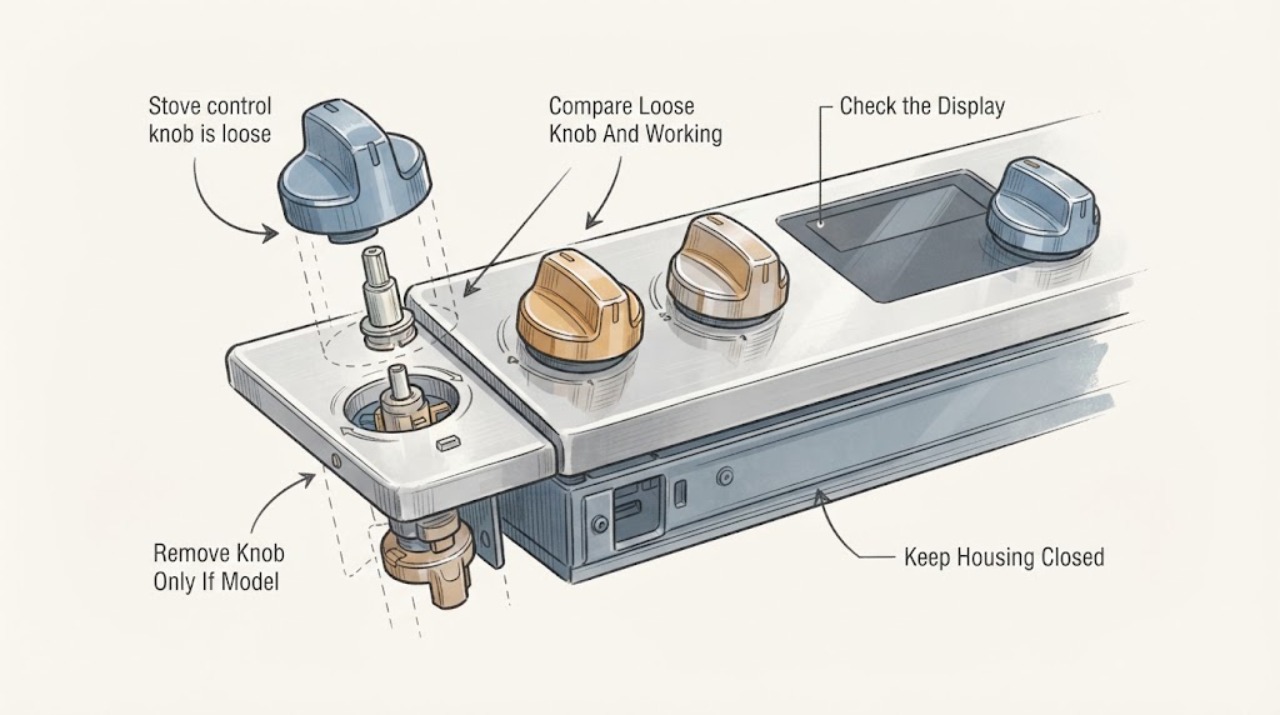
When one stove control knob is loose but the other controls work, the problem is often limited to a cracked or worn knob socket, a knob that is not seated, a misaligned knob, or damage at the control stem; the underlying gas valve or electrical switch can also be affected. Turn every control to Off and let the cooktop cool before any ordinary knob inspection. If the exact Owner's Manual allows removal, pull the knob straight off without tools, compare it with a working knob, and inspect the knob and visible stem for cracks, debris, distortion, or a stem that turns too easily. Refit only a sound, model-compatible knob in the Off position. Do not force the stem, spray cleaner into it, open the control panel, or use the stove if the knob can turn a burner on unintentionally, gas is smelled, a flame does not respond correctly, or a switch or valve feels damaged. CPSC says a front control that becomes too easy to turn should be replaced or addressed with the manufacturer; arrange qualified appliance service when the fault is not clearly limited to the removable knob.
Before you begin
Safety first
- This article permits only cool-surface, all-controls-Off, ordinary knob inspection when the exact model instructions allow it. A qualified technician must access the control panel, diagnose or replace a valve, switch, stem, wiring, ignition, or gas component, and verify safe shutoff.
Work through in order
Diagnostic checks
Use only checks that match the exact appliance or system and its official guide.
-
Check 1
Turn every stove and oven control to Off, let the cooktop cool, and from a safe position check for a flame, hot surface, gas odor, smoke, sparking, a damaged cord, liquid around controls, or a knob that can be bumped into an operating position.
Expected result: Record whether the loose knob is only physically wobbly or whether a burner or oven activates, fails to shut off, has an abnormal flame or heating response, or produces a gas or electrical warning.
Next step: Keep the affected control Off and stop using the stove for any activation, flame, gas, smoke, sparking, or electrical warning; arrange qualified appliance service and follow local emergency gas guidance if gas is smelled.
Stop if: Do not operate a burner or oven with a control that will not reliably return to Off, do not use an open flame to look for a leak, and do not touch hot or wet controls.
Why this matters
Why: A loose cosmetic knob can be inspected after cooling, but unintended activation or an abnormal burner, oven, gas, or electrical symptom makes the control unsafe to use. Other controls working does not clear the loose control's valve or switch.
-
Check 2
With the cooktop cool and all controls Off, compare the loose knob's height, fit, pointer alignment, cracks, socket shape, and side-to-side movement with a working knob; use only ordinary visual and fingertip inspection without forcing the control.
Expected result: Record a cracked or enlarged knob socket, missing insert, melted or distorted plastic, debris under the knob, a knob that sits higher or lower than its neighbor, or a control stem that is visibly bent or loose.
Next step: Photograph the knob and stem area and check the exact Owner's Manual before removing or ordering anything; leave the control unused if the stem or valve feels abnormal.
Stop if: Do not pry, twist hard, glue, tape, shim, file, or lubricate the knob, stem, valve, or switch.
Why this matters
Why: A difference confined to the removable knob supports a knob replacement or reseating path. A bent, loose, damaged, or unusually exposed stem shifts the problem to the control interface and needs model-specific service.
-
Check 3
Only if the exact model instructions permit removal and the control is Off and cool, pull the loose knob straight away from the control panel by hand; stop if it resists, uses a retaining screw or clip, or would require a tool or panel access.
Expected result: After permitted removal, record whether the knob comes off cleanly, the socket is cracked or stripped, a removable insert is missing, the stem is intact and aligned, or the knob cannot be removed without force.
Next step: Keep the removed knob with the stove, compare its markings and fit with the model documentation, and arrange service if any stem or panel condition is uncertain.
Stop if: Do not pry beneath the knob, remove seals, open the panel, rotate the exposed stem, or continue when the knob is stuck or the cooktop is not cool.
Why this matters
Why: A cleanly removable knob with a damaged socket supports a knob-only repair. Resistance, a retaining arrangement, or stem damage means the model's procedure or a technician is needed; forcing it can damage the control or accidentally rotate it.
-
Check 4
If the knob itself is sound and the model guide permits cleaning, wipe it with the approved mild method, keep liquid out of the stem opening, let it dry, and press it straight back onto the control in the Off position without force.
Expected result: Record whether the knob sits at the same height as a working control, aligns with Off, grips the stem without rocking, and turns only with normal resistance without activating the burner unexpectedly.
Next step: Use the control only if the model's normal operation and Off position are reliable. If the looseness returns or the response is abnormal, leave it Off and request service.
Stop if: Do not soak the knob, use abrasive or oven cleaner, inject cleaner into the stem, or glue the knob to the control.
Why this matters
Why: A stable, correctly aligned knob with normal control response supports a fit or debris issue. Continued looseness, free rotation, misalignment, delayed response, or unexpected activation indicates control or knob damage rather than a cleaning problem.
-
Check 5
After a sound knob is correctly seated and the model instructions allow a basic control check, observe the indicator, ignition, or heating response from a safe position without placing cookware over the burner or reaching across the cooktop; do not deliberately test a questionable control.
Expected result: Record a normal response, delayed or inconsistent response, a burner or oven that turns on too easily, a knob that turns without changing the setting, failure to return to Off, or a flame or heating output that does not follow the control.
Next step: Do not use the affected control if response is abnormal. Provide the model, knob photos, response pattern, and whether the stove is gas or electric to a qualified appliance technician or the manufacturer.
Stop if: Do not continue a burner or oven with delayed shutoff, abnormal flame, sparking, smoke, gas odor, overheating, or a control that activates when bumped.
Why this matters
Why: Normal response with other controls working supports a knob-only issue. An inconsistent or overly easy response can indicate control-stem, valve, switch, ignition, or panel damage; gas odor, abnormal flame, or electrical symptoms require immediate stop.
-
Check 6
Record the stove model and fuel type, affected control position, knob and stem photos, whether the knob was removable, whether the other controls work, the exact response to a permitted check, and any recent spill, cleaning, impact, or service.
Expected result: The issue is limited to a cracked removable knob, returns after reseating, includes a loose or bent stem, makes activation too easy, affects gas flow or electric heating, or cannot be assessed without panel access.
Next step: Keep the affected control Off and arrange manufacturer or qualified appliance service. Ask for the exact control and knob fitment to be confirmed before ordering or installing a part.
Stop if: Do not open the control panel, remove a valve or switch, adjust gas components, disconnect wiring, or keep using an unpredictable control.
Why this matters
Why: A part-only issue may be repairable with an exact model-compatible knob, while stem, valve, switch, ignition, or panel symptoms need qualified appliance service. A condition that cannot be verified safely should remain out of use.
Use your observations
Decision map
Find the observation that best matches what you see, then follow the next safe action.
-
PATH 01Safety boundary
What you see
The knob is cracked, enlarged, missing an insert, or sits loosely while the visible stem is straight, stable, and the affected control otherwise responds normally.
Do this next
Keep the control Off until a model-approved knob is obtained and seated in the Off position; confirm reliable alignment and response before normal use.
Why this path and its safety boundary
Why it matters: The removable knob or its fitment is more likely than the valve or switch, but only an exact model-compatible part should be used.
Safety stop: Do not glue, shim, file, tape, or use a generic knob that does not fit the exact control.
-
PATH 02Safety boundary
What you see
The knob is sound or replaced but the stem wobbles, turns freely, does not track the pointer, feels abnormal, or does not reliably return the burner or oven to Off.
Do this next
Stop using the affected control and arrange qualified appliance diagnosis of the stem, valve or switch, and panel.
Why this path and its safety boundary
Why it matters: The control stem, valve, switch, or panel interface may be damaged; other controls working does not make this control safe.
Safety stop: Do not remove the panel, lubricate the stem, adjust a gas valve, disconnect wiring, or operate the control to see if it improves.
-
PATH 03Safety boundary
What you see
The front control turns too easily, can be bumped into an operating position, ignites or heats without deliberate normal movement, or no longer clearly indicates Off.
Do this next
Keep the affected control and appliance out of use, keep children and pets away, and contact the manufacturer or qualified service. A suitable safety lock or cover may be considered only if the exact appliance manufacturer supports it.
Why this path and its safety boundary
Why it matters: Accidental activation creates a fire, burn, and possibly gas hazard even when the other controls operate normally.
Safety stop: Do not leave cookware, towels, or flammable items near the controls, tape the knob in place, or rely on a loose knob to prevent activation.
-
PATH 04Safety boundary
What you see
The loose control is accompanied by gas odor, an abnormal or delayed flame, smoke, sparking, electrical smell, overheating, or a burner or oven that will not shut off normally.
Do this next
Stop using the stove, leave the area and follow local emergency gas guidance when gas is suspected, and arrange urgent qualified appliance service; do not operate switches or flames near suspected gas.
Why this path and its safety boundary
Why it matters: This is an immediate gas, fire, burn, or electrical safety condition, not a knob-cleaning or replacement decision.
Safety stop: Do not relight, test with a flame, touch hot or energized components, or continue using the range until qualified service clears it.
-
PATH 05Safety boundary
What you see
The knob uses a retaining mechanism, will not pull off as documented, the stem or panel cannot be judged from ordinary access, or the model's procedure is unavailable.
Do this next
Leave the affected control Off, photograph the model and control, and ask the manufacturer or qualified technician for the exact inspection or replacement procedure.
Why this path and its safety boundary
Why it matters: The fault cannot be safely classified as a removable knob issue, and forcing access could damage the control or create an activation or electrical risk.
Safety stop: Do not pry, drill, remove a panel, use a tool on the control, or improvise a repair.
Helpful context
Understand the symptom
Separate a loose knob from a loose control
A knob that rocks, lifts, or no longer grips the stem may only need a model-compatible replacement. A stem that wobbles, turns without normal resistance, does not return to Off, or changes a burner unpredictably points to the control behind the knob. The fact that other controls work helps localize the symptom but does not make a damaged gas valve, electrical switch, or control panel safe to use.
Inspect only from a cool, Off, ordinary-access position
Manufacturer guidance for removable range knobs commonly requires all controls Off and the cooktop cool. If the model guide permits it, the knob can be pulled straight away for inspection; do not pry with a tool, force a stuck knob, soak it, or allow cleaner into the stem opening. Compare the loose knob with a working one and preserve the exact model information before considering a replacement.
Accidental activation changes the decision
A knob that has become unusually easy to turn can be bumped by a person, child, pet, towel, or cookware. CPSC recommends replacing a front-mounted control that becomes too easy to turn and contacting the manufacturer about a solution or remedy. If the control can activate a burner unintentionally, no longer indicates Off reliably, or the stove has gas or electrical symptoms, stop using it and arrange service rather than securing the knob with tape or an improvised spacer.
Safety boundary
Stop conditions
- Do not operate a burner or oven when a knob will not reliably return to Off, activates when bumped, turns too easily, or produces an abnormal flame, heat, or response.
- Do not open the control panel, remove a valve or switch, disconnect wiring, adjust gas components, or force a retaining knob or stem.
- Do not glue, tape, shim, file, lubricate, or substitute a generic knob to compensate for a damaged control stem or valve.
- Stop immediately for gas odor, hissing, delayed or abnormal flame, smoke, sparking, electrical smell, overheating, or a control that will not shut the appliance off; follow local emergency guidance and arrange qualified service.
- Keep the cooktop cool and all controls Off before any model-permitted knob inspection; if the model procedure or condition is uncertain, leave the appliance out of use and contact the manufacturer or a qualified technician.
Only after diagnosis
Potential parts
- stove control knob
Consider this category only if the exact model inspection shows that the removable knob socket, insert, pointer, or body is damaged while the control stem and valve or switch operate normally.
Confirm the exact stove model, control position, shaft shape, alignment, and manufacturer's fit information; do not use a knob that can turn the control unintentionally. - control knob insert or retainer
Consider this category only if the model uses a separate replaceable insert or retainer and inspection confirms that it is missing or damaged rather than the stem or control itself.
Confirm the model-specific assembly and installation method with the manufacturer or technician; do not add an improvised spacer, adhesive, or retainer. - stove control switch or gas valve
Consider this category only after qualified diagnosis confirms that the control stem, electrical switch, or gas valve is damaged and is causing abnormal response or unreliable shutoff.
Gas and electrical control components require exact model fitment and qualified installation; do not select one from looseness or other controls working alone.
When checks do not resolve it
Need a professional?
Arrange manufacturer or qualified appliance service when a loose stove knob is not clearly limited to a removable knob, the stem or control feels loose, the knob turns too easily, the control does not reliably indicate Off, the burner or oven response is abnormal, the knob cannot be removed as the model guide describes, or the issue returns after proper reseating. Treat gas odor, hissing, abnormal flame, smoke, sparking, electrical smell, overheating, or unintended activation as urgent safety conditions.
Safety scope: This article permits only cool-surface, all-controls-Off, ordinary knob inspection when the exact model instructions allow it. A qualified technician must access the control panel, diagnose or replace a valve, switch, stem, wiring, ignition, or gas component, and verify safe shutoff.
Common questions
FAQ
Can I fix a loose stove knob if the other controls work?
If the exact model permits it and the cooktop is cool with all controls Off, compare the loose knob with a working one and check for a cracked or enlarged socket. A sound knob that will not seat, a loose stem, or abnormal burner response needs qualified appliance service rather than glue or a generic replacement.
How do I remove a stove control knob safely?
Only follow the exact model guide. Whirlpool says controls should be Off and the cooktop cool before cleaning, and removable knobs are pulled straight away. Stop if the knob resists, has a retainer, or would require a tool or panel access.
Should I glue a loose range knob to the stem?
No. Glue, tape, shims, or lubricant can hide a damaged stem, interfere with reliable Off positioning, or make accidental activation more likely. Use only a model-compatible knob after the control itself is confirmed sound.
What if the loose knob turns the burner on too easily?
Stop using that control and keep children, pets, towels, and cookware away. CPSC says a front control that becomes too easy to turn should be replaced or addressed with the manufacturer; arrange qualified service if the control does not reliably remain Off.
Does a loose knob mean the gas valve or electrical switch is bad?
Not necessarily. A cracked knob socket or poor seating can be isolated to the removable knob, but a wobbly stem, free rotation, delayed response, abnormal flame or heating, or failure to return to Off needs diagnosis of the control behind it.
When should I stop using the stove and call service?
Stop for gas odor, hissing, abnormal or delayed flame, smoke, sparking, electrical smell, overheating, a control that will not shut off, or a knob that activates when bumped. Leave the appliance out of use and arrange qualified service; follow local emergency guidance for suspected gas.
Read the exact guide
Official sources
- 1.0GE Appliances · Supports comparing the knob and stem, keeping controls Off before removal, avoiding water in the stem opening, and stopping for gas odor or abnormal operation.
- Avoid Kitchen Fires: Keep Stovetops Clean and ClearU.S. Consumer Product Safety Commission · Supports stopping when a front control becomes too easy to turn, keeping children and pets away, checking Off status, and contacting the manufacturer about a remedy.
- Control Knobs or Control Panel - RangeWhirlpool Product Help · Supports the cool-cooktop and controls-Off boundary, model-permitted straight removal, gentle cleaning, keeping liquid out of the stem, and Off-position replacement alignment.
Community feedback
Share a repair observation
Share a plain-text repair observation. Accepted observations are published automatically; this page may take a moment to update.