
On this page
Start here
Quick answer
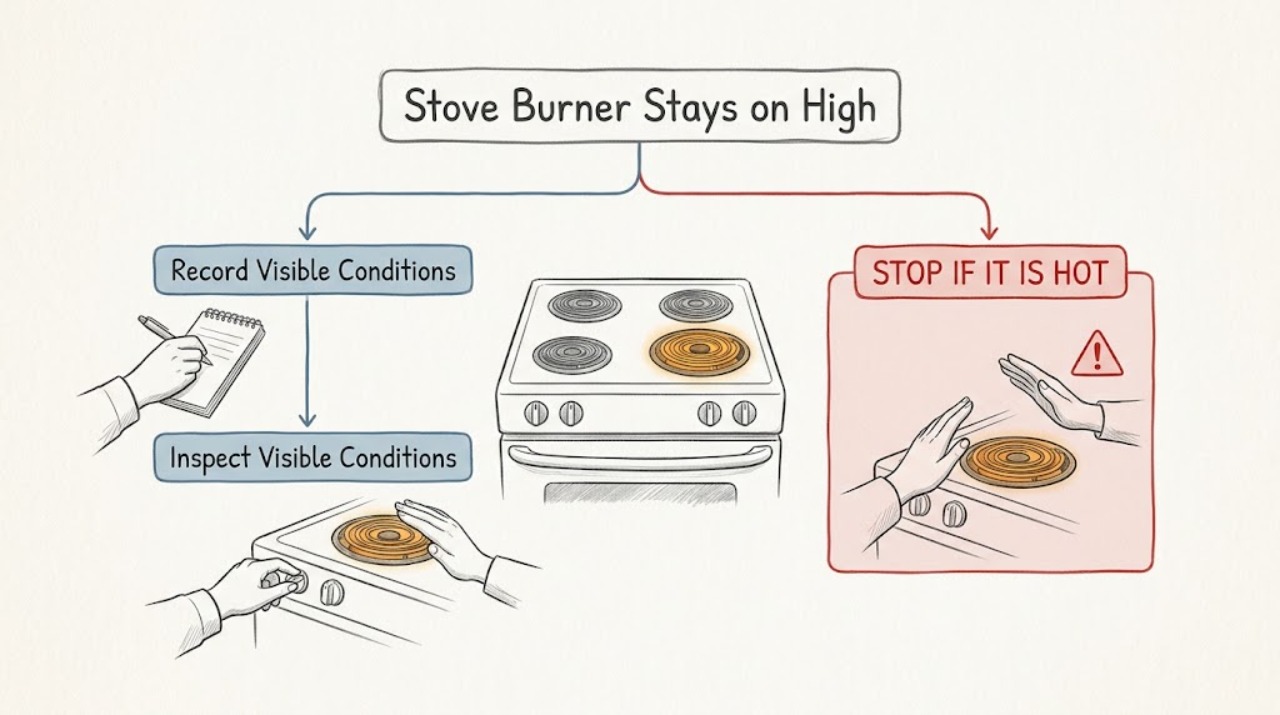
First identify whether the Frigidaire stove is gas, radiant electric, plug-in coil, or induction, then observe what remains high: the flame, the element, the pan heat, or only an indicator light. A smooth radiant element that cycles on and off even at High can be normal, and a hot-surface light can remain on while the glass cools. A gas flame that stays large after the knob is lowered or turned off, an electric element that continues heating after its control is Off, or an induction zone that ignores its control is not a normal cooking cycle. Turn the affected control off, move cookware only when safe, keep clear of a hot surface, and disconnect power from a safe dry location if an electric control will not release. For gas, close the appliance gas shutoff only if it is safe to reach. Stop using the stove and arrange qualified service for a flame or element that cannot be controlled, a persistent high-heat condition, a burning odor, smoke, arcing, a cracked glass surface, or a returning thermal fault.
Work through in order
Diagnostic checks
Use only checks that match the exact appliance or system and its official guide.
-
Check 1
Turn the affected control to Off, identify the technology from a visible flame and grate, exposed coil, smooth radiant glass, or induction markings, and record the Frigidaire model and burner position. From a safe distance, note whether the heat decreases, cycles, stays constant, or continues with the control off.
Expected result: The burner cycles, the flame or element stays at full output, only the hot-surface light remains, the element-on light remains, or the stove type is uncertain.
Next step: Do not touch the surface to test it. Follow the matching gas, radiant or coil, or induction branch below, and stop immediately for smoke, burning odor, arcing, gas odor, a cracked glass top, or a cord or outlet that is hot.
Why this matters
Why: Cycling on a smooth radiant top can be normal. A flame or element that ignores Off is an uncontrolled-heating fault. A hot-surface light can be normal while cooling, whereas an element-on light with all controls off warrants service or safe power isolation. An uncertain type requires the model manual.
-
Check 2
For a smooth radiant electric surface, compare the observed behavior with one normal cooking cycle using a suitable flat pan only if the affected zone responds to its control. Watch the element from a safe distance: it may glow and go dark, but it should respond when the setting changes and stop heating after Off.
Expected result: The element cycles and heat reduces when the setting changes, the element stays bright or hot after Off, the element-on light remains, or the glass or element is damaged.
Next step: Turn the control Off and stop using the zone for any failure to release. If the element-on light or heating remains active, disconnect power at the breaker only from a safe dry location and arrange service; do not remove the glass or control panel.
Why this matters
Why: Cycling even at High is normal for a radiant element. Failure to reduce or stop after Off indicates a stuck control, relay, sensor, or wiring fault rather than normal cycling. Visible cracking or a persistent indicator with an unresponsive control raises an electrical safety concern.
-
Check 3
For a plug-in coil, turn the control Off and wait for the element and pan to cool completely before looking for a visibly warped, cracked, or poorly seated coil. Disconnect power before touching or reseating a removable element, and do not swap elements unless the exact model manual permits a same-size comparison.
Expected result: The coil is damaged, the socket is loose or scorched, the coil was not fully seated, the coil responds normally after safe reseating, or the coil stays hot after Off.
Next step: If reseating does not restore predictable control, or if the coil stays hot with the knob Off, leave the range de-energized and arrange service. Consider a replacement element only after the exact Frigidaire model confirms the part; do not work on the socket or wiring.
Why this matters
Why: A loose or damaged coil can heat abnormally, but a coil that remains energized after Off points to the control or wiring. Scorching or a loose socket is not a cleaning issue and can create an electrical hazard.
-
Check 4
For a gas burner, observe the flame only from a normal standing position while turning the control down and then Off. Confirm that the knob corresponds to the affected burner; do not remove a hot grate or cap, and do not repeat ignition attempts when unburned gas is noticeable.
Expected result: The flame reduces and goes out, remains large after the knob is lowered, continues with the knob Off, is uneven or lifting, or gas odor remains after shutdown.
Next step: Turn the knob Off. If the flame will not go out or gas odor persists, do not disassemble the burner; leave the area, close the appliance gas shutoff only if safe to reach, avoid ignition sources, and arrange qualified gas-appliance service. For a cool burner with no odor, clean and dry only removable parts allowed by the model manual.
Why this matters
Why: A flame that follows the control can be normal operation. A flame that remains high or continues after Off points toward a knob, valve, regulator, or control fault. An uneven or lifting flame can involve cap seating, moisture, clogged ports, or gas-system service; persistent odor is an immediate hazard.
-
Check 5
For an induction zone, remove the pan only after the control is Off and it is safe to handle, then clear the control area and try one flat, suitable pan centered on the marked zone at a lower setting. Watch the display and allow the zone to cool if it has been used empty or has become very hot.
Expected result: The zone responds to a lower setting, turns off when the pan is removed, flashes or changes setting, ignores Off, or stays at high heat with a suitable centered pan.
Next step: Turn the zone and main control Off. If it does not release or a fault returns, disconnect power only from a safe dry location and arrange service; do not open the glass top or touch a hot pan or internal component.
Why this matters
Why: Induction heats the pan only when cookware is detected, and pan detection, control lock, or an overheated surface can alter output. A zone that ignores Off or keeps heating after the pan is removed is not a normal pan-detection cycle.
-
Check 6
After a normal-cycle or control correction, perform one supervised retest with the correct pan or flame, then confirm that the control is Off and the element-on indicator is off. Record whether the problem returns on the same zone, spreads to other zones, or appears after a power reset.
Expected result: Heat responds and stops normally, the burner still stays high, a control or thermal fault returns, or multiple burners become uncontrollable.
Next step: Stop testing after one failed retest or any unsafe symptom. Leave the stove off or safely de-energized and arrange service with the model, fuel type, affected zone, indicator behavior, and exact point at which the burner stopped responding.
Why this matters
Why: A stable response supports normal radiant cycling, a pan-detection condition, or a corrected gas cap or control selection. A returning high-output or multi-zone fault points toward shared control, power, wiring, or fuel hardware.
Use your observations
Decision map
Find the observation that best matches what you see, then follow the next safe action.
-
PATH 01Next step
What you see
Do this next
Use a suitable flat pan and the model manual's settings. Keep the pan and surrounding glass clear until the hot-surface light goes out; arrange service only if the element stops cycling, ignores the control, or remains on after Off.
-
PATH 02Next step
What you see
Do this next
Leave the area if gas odor is present, avoid ignition sources, close the appliance gas shutoff only if safe, and arrange qualified gas-appliance service. Do not keep trying to light or adjust the burner.
-
PATH 03Next step
What you see
Do this next
Keep clear of the hot surface, disconnect power from a safe dry location if possible, and arrange appliance service. Do not remove the panel, glass, element socket, or wiring.
-
PATH 04Next step
What you see
Do this next
Turn the zone Off, disconnect power only from a safe location, and arrange service. Do not touch the hot pan or open the glass top to inspect the induction hardware.
Helpful context
Understand the symptom
High setting does not mean constant heating on every Frigidaire stove
Radiant electric elements are designed to cycle on and off, including at High, to control heat and protect the glass. A hot-surface light can also remain on after a control is off while the glass cools. These are different from an element-on light that stays lit with all controls off, an element that keeps heating after the control is Off, or a gas flame that cannot be reduced.
The fuel system changes the safe diagnosis
A gas burner has a flame, cap, ports, and ignition system. A coil or radiant burner uses an electrical control and heating element. Induction heats compatible cookware only when the pan is detected in the zone. Use the exact model manual for lock, control, pan, and reset behavior; do not apply a gas check to a glass or induction model.
Treat an uncontrollable burner as an immediate stop condition
Do not continue cooking while a burner stays at full output after its control is lowered or turned off. Keep hands and cookware away from an unexpectedly hot area, and do not remove a hot coil or glass trim. Never open the control panel, probe live wiring, adjust a gas valve, or bypass a temperature sensor.
Safety boundary
Stop conditions
- Stop immediately for a gas odor, a flame that will not go out, delayed ignition, flame lifting or spreading, smoke, arcing, a burning smell, a hot cord or outlet, or a cracked glass surface.
- Stop using an electric or induction zone that stays hot after Off, cannot be controlled, shows a persistent thermal fault, or causes the breaker to trip again.
- Do not open the control panel, remove wiring, probe live circuits, adjust a gas valve, bypass a sensor or lockout, or remove a hot element or pan.
- Do not keep resetting power or relighting a burner to force a result; arrange qualified appliance service when the fault returns or affects multiple burners.
Only after diagnosis
Potential parts
- electric surface element or coil
Consider this only when the exact model and a safe inspection confirm a visibly damaged or failed replaceable element; an element that stays energized after Off may instead have a control fault.
Confirm the complete Frigidaire model and element design before selecting a part; do not substitute based only on appearance or burner size. - electric surface control or relay
Consider this only after service confirms that the element or zone remains energized after its control is Off and the control path is the cause.
Internal electrical work should follow the exact Frigidaire model documentation and qualified service procedures. - gas burner cap or burner head
Consider this only when a cool gas burner has a damaged, warped, missing, or mismatched removable cap or head after the correct cleaning and seating check.
Match the burner position and exact Frigidaire model; a similar-looking cap may not align with the head or ignition path. - induction control or heating module
Consider this only when a suitable centered pan is detected but one zone still ignores its control or returns a verified thermal or control fault.
Have qualified service identify the module for the exact Frigidaire model; do not infer fit from the zone's appearance.
When checks do not resolve it
Need a professional?
Arrange qualified appliance service when a gas flame or electric or induction element ignores its control, when the element-on indicator remains active with all controls off, when a burner remains at high after a safe model-specific check, when a thermal fault returns, or when smoke, odor, arcing, glass damage, or repeated breaker trips appear.
Common questions
FAQ
Is a Frigidaire radiant burner cycling on High normal?
Yes. Frigidaire says radiant elements on smooth cooktops are designed to cycle on and off even on High. It becomes a fault when the element ignores the control, remains energized after Off, or shows smoke, odor, arcing, or damage.
Why does the hot-surface light stay on after I turn a Frigidaire burner off?
The hot-surface light can remain on while the glass cools. Check that the element-on light is off and keep hands, cookware, and objects away until the surface is safe. If the element-on light or heating remains active with all controls off, disconnect power safely and arrange service.
What should I do if a Frigidaire gas flame will not reduce?
Turn the knob Off and stop using the burner. If the flame remains lit or gas odor persists, leave the area, avoid ignition sources, close the appliance gas shutoff only if safe, and arrange qualified gas-appliance service. Do not adjust a gas valve or keep relighting it.
Why can an induction burner seem to stay high?
Induction output can change with pan detection, pan placement, control lock, and cooling behavior. Try one flat suitable pan centered on the marked zone and use the model control sequence once. If the zone ignores Off or returns a fault, stop and arrange service.
Read the exact guide
Official sources
- How To Use Burners & Display On Your Induction CooktopFrigidaire · Frigidaire induction burner and display operation guidance
- Ranges Error Code F10 - Thermal RunawayFrigidaire · Frigidaire electric range thermal-runaway reset and service boundary
- Induction Ranges - What are the benefits of Induction?Frigidaire · Frigidaire induction pan detection, magnetic cookware, and cooler cooking-zone behavior
- Gas Range / Cooktops - Burners are not lightingFrigidaire · Frigidaire gas burner cap, port, knob, and service troubleshooting
- Ranges - What do the indicator lights on my range mean?Frigidaire · Frigidaire element-on and hot-surface indicator meaning
- Ranges - No HeatingFrigidaire · Frigidaire electric coil and glass-cooktop element seating, reset, cookware, and service guidance
- Ranges - Why does my surface element appear to go on and off on my ceramic glass cooktop?Frigidaire · Frigidaire radiant smooth-top element cycling, including cycling on High
- What should I do if my gas flames are uneven or too high?Frigidaire · Frigidaire gas flame height, cap seating, moisture, clogged port, and control checks
Community feedback
Share a repair observation
Share a plain-text repair observation. Accepted observations are published automatically; this page may take a moment to update.