
On this page
Start here
Quick answer
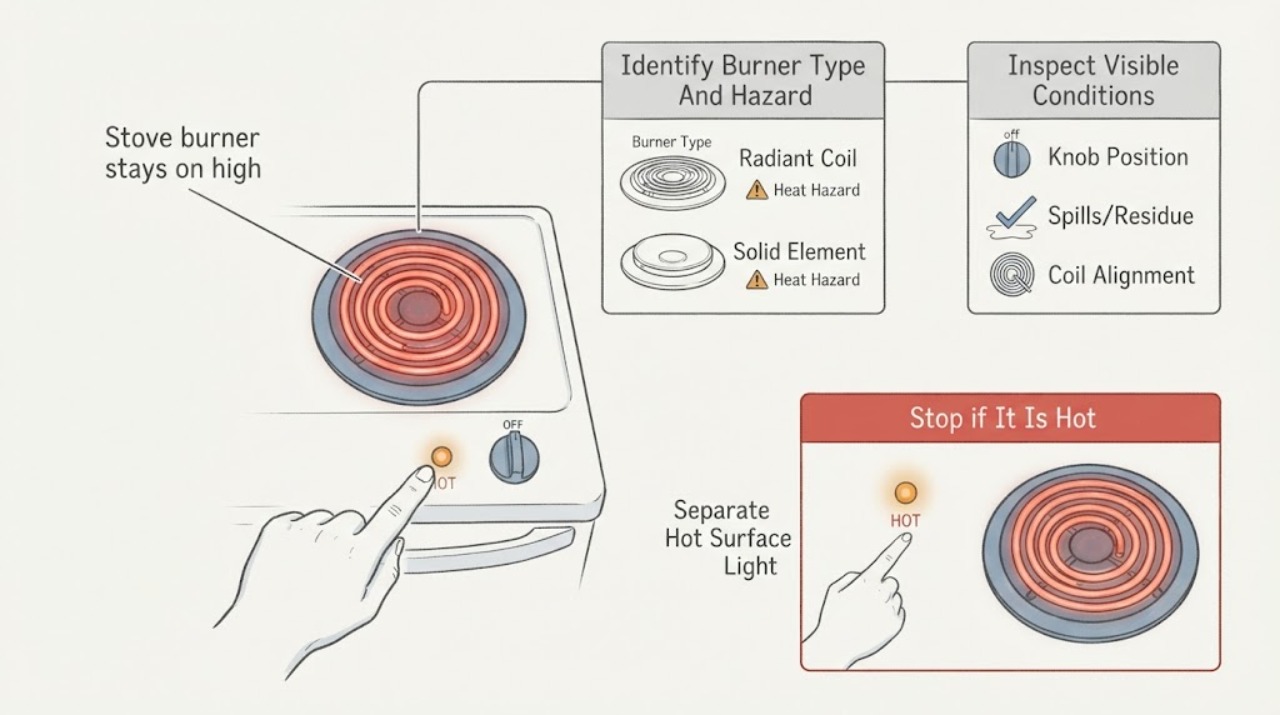
First distinguish a normal hot-surface light from a burner that is actually still heating. On radiant electric stoves, an element can cycle on and off even at High, and a hot-surface indicator can remain lit while the glass is still hot. Turn the burner control to OFF using its normal control and observe only from a safe distance; never touch the surface to test it. If the element continues glowing or a gas flame remains after OFF, if the knob is loose or misaligned, or if the indicator remains on after the surface is fully cool according to the model manual, stop using the stove and obtain qualified appliance service. Remove cookware and flammable materials only if this can be done without approaching a hot or malfunctioning burner.
Before you begin
Safety first
- Owner checks are limited to normal control selection, safe visual observation, keeping people and flammables away, reading visible model information, and documentation. A qualified professional must handle power or gas isolation when unsafe, panel access, electrical or gas testing, switch, relay, sensor, wiring, element, valve, and control replacement.
Work through in order
Diagnostic checks
Use only checks that match the exact appliance or system and its official guide.
-
Check 1
From a safe position, identify whether the affected surface is an electric radiant or coil element, an induction zone, or a gas burner. Look without touching for a visible flame, red glow, unusual smoke, sparking, burning odor, or cookware heating unexpectedly.
Expected result: A gas flame is present; an electric element glows; an induction pan remains hot; smoke, sparks, or odor is present; or no active heat is visible.
Next step: Keep clear and remove no cookware unless it can be done without reaching near the hazard. Leave for smoke, fire, or active arcing and contact emergency help; otherwise stop using the affected burner and continue only with safe visual checks.
Stop if: Stop immediately for smoke, flame that will not extinguish, sparks, burning odor, crackling, a pan overheating, exposed wiring, or any need to touch the hot surface or reach over it.
Why this matters
Why: The safe interpretation differs by burner type. A radiant element can cycle at High, but a flame or electric heating after OFF is a possible control fault. Smoke, sparks, and odor indicate an immediate fire or electrical hazard.
-
Check 2
Use the normal control knob or touch control to select OFF, keeping your hand away from the heating surface and flame. Observe from a safe distance whether the glow, heat output, or flame stops; do not touch the glass, pan, grate, burner cap, or knob repeatedly to verify.
Expected result: The element or flame stops; the electric element cycles while the control remains at High; the element stays on after OFF; the gas flame remains; or the control will not move normally to OFF.
Next step: If heat or flame continues after OFF, stop using the stove and request urgent qualified appliance service. Do not use another burner if the fault may affect shared controls or power, and do not attempt a repair at the knob or panel.
Stop if: Stop all testing if the burner stays active after OFF, the control is loose or jammed, the flame is abnormal, or the surface remains dangerously hot; keep clear and obtain service.
Why this matters
Why: Cycling at High while selected is expected on many radiant models. A burner that remains on after OFF, a persistent flame, or a control that cannot reach OFF is not explained by a normal hot-surface indicator and presents a burn or fire risk.
-
Check 3
After the control is OFF, allow the surface to cool naturally according to the exact model manual and observe whether the indicator eventually clears. Do not touch the glass to check temperature and do not place a wet cloth, ice, or cookware on the surface to cool it faster.
Expected result: The indicator clears as the surface cools; the indicator remains lit after the surface should be cool; the indicator flickers or shows a fault; or the surface is still visibly heating.
Next step: If the indicator remains on after the manual's expected cool condition or the surface continues heating, stop using the stove and arrange service. Do not reset the cooktop or remove power as a first response unless the exact manual or a qualified professional directs a safe isolation.
Stop if: Stop if checking temperature would require touch, if the glass is cracked, if the indicator shows an unexplained fault, or if any burner is still heating after OFF.
Why this matters
Why: A hot-surface light that remains during cooldown can be normal, but a light that stays on after the model's safe cool condition, or an indicator that disagrees with the actual burner state, suggests a sensor, switch, wiring, or control issue. Visible heating after OFF is the higher-risk symptom.
-
Check 4
From the outside, inspect whether the control knob or touch panel is aligned, loose, cracked, sticky, or displaying the selected setting correctly. Wipe only an accessible, cool control surface using the model manual's method; do not pull the knob, remove a bezel, spray cleaner, or reach beneath the cooktop.
Expected result: The knob is loose or misaligned; a touch control is unresponsive or shows a different setting; residue is visible; the control appears normal; or the fault started after cleaning or a spill.
Next step: Stop using the affected burner and document the control position. Arrange qualified service for a loose, damaged, sticky, unresponsive, or mismatched control; do not substitute a knob or switch by appearance.
Stop if: Stop if a spill entered the control area, the knob shaft is damaged, the panel is cracked, the control is hot, or correction requires removing a knob, bezel, panel, or wiring.
Why this matters
Why: A knob or control mismatch can prevent the burner from reaching OFF or can misreport its state. A spill can affect controls, but moisture or residue near electrical controls raises the need for service; the control surface appearing normal does not clear the hidden switch or wiring.
-
Check 5
Record the stove or cooktop model and serial information from a safely visible label or paperwork, the burner type, control position, indicator wording, and when the symptom began. Check the manufacturer's official support or recall information for that exact model; do not assume a recall or fix applies to another appliance.
Expected result: The model matches a published safety notice; the model or serial is unclear; the appliance had recent installation or service; or no model-specific notice is found.
Next step: Follow the official safety notice for a matching model and keep the stove unused until the remedy is arranged. Otherwise, provide the model and symptom record to qualified appliance service; do not open the appliance to find more data.
Stop if: Stop if the label is beneath a hot or energized cooktop, if identifying it requires moving the appliance or removing trim, or if a recall notice directs immediate non-use.
Why this matters
Why: A published recall can change the safe-use decision, but recall scope is exact to model and serial information. Recent work or an unknown identity makes an installation or control fault more likely and rules out guessing at parts.
-
Check 6
Prepare a service record with the model, burner type, control setting, whether the element or flame continued after OFF, indicator behavior during cooldown, visible damage, smoke or odor, recent cleaning or work, and photos taken from a safe distance. Keep the affected burner unused until a qualified technician confirms it is safe.
Expected result: The issue was a normal cycle or cooldown; the burner stayed on after OFF; the indicator stayed on after cool; the knob or touch control is faulty; or the cause remains uncertain.
Next step: Give the record to qualified appliance service and keep flammable materials away. Request urgent help for active heat, flame, smoke, odor, or visible damage; do not re-energize or retest the burner to reproduce it.
Stop if: End owner troubleshooting when diagnosis requires electrical isolation, control-panel access, switch or relay testing, burner disassembly, wiring, or component replacement.
Why this matters
Why: Normal cycling and a temporary hot-surface light need no repair by themselves, but active heating after OFF, a persistent indicator fault, or uncertain control behavior requires model-specific diagnosis. A technician may need to inspect the switch, sensor, relay, element, wiring, or control.
Use your observations
Decision map
Find the observation that best matches what you see, then follow the next safe action.
-
PATH 01Next step
What you see
The burner is electric radiant, the control remains at High, and the element cycles on and off without heat continuing after the control is turned OFF.
Do this next
Use cookware and settings from the exact manual and monitor normally. Request service if cycling changes, the element stays on after OFF, or the indicator behavior becomes inconsistent.
Why this path and its safety boundary
Why it matters: Limiter-controlled cycling at High is more likely normal operation than a stuck burner.
-
PATH 02Next step
What you see
The control is OFF, no burner is visibly heating, and the indicator remains on only while the surface is cooling according to the model's manual.
Do this next
Keep the surface clear and allow it to cool naturally. If the indicator remains on after the safe cool condition or the surface heats again, stop using the stove and arrange service.
Why this path and its safety boundary
Why it matters: Retained surface heat and a normal hot-surface indicator are more likely than a control failure.
-
PATH 03Next step
What you see
An electric element continues glowing or a gas flame remains after the control is set to OFF, or the control cannot reliably reach OFF.
Do this next
Stop using the stove, keep people and flammables away, and request urgent qualified appliance service. Leave and contact emergency help for smoke, fire, or active arcing; do not disassemble or reset the appliance.
Why this path and its safety boundary
Why it matters: A failed or misaligned knob, switch, relay, valve, sensor, or wiring condition is more likely and creates a burn or fire hazard.
-
PATH 04Next step
What you see
The knob is loose, damaged, or misaligned; the touch control disagrees with the burner; or the symptom follows a spill or cleaning event.
Do this next
Keep the affected burner unused and have a qualified technician inspect it. Do not pull the knob, spray cleaner, open the panel, or use a replacement control without model-specific diagnosis.
Why this path and its safety boundary
Why it matters: A control, switch, sensor, or moisture-related fault is more likely than normal cycling or cooldown.
-
PATH 05Next step
What you see
Smoke, burning odor, sparks, crackling, a cracked glass surface, abnormal flame, water near controls, visible damage, or unclear burner behavior is present.
Do this next
Leave fire or active arcing hazards and contact emergency help. Otherwise keep clear, avoid the stove, and request prompt qualified appliance or electrical service without reproducing the symptom.
Why this path and its safety boundary
Why it matters: The immediate priority is burn, fire, and electrical safety; the indicator cannot be used to prove that the appliance is safe.
Helpful context
Understand the symptom
The indicator may be showing retained heat, not a stuck burner
A hot-surface or burner-on light can stay lit after a radiant element is turned off because the glass remains hot. Some indicators are sensor- or time-based, and their behavior differs by model. Do not touch the glass to decide whether it is safe; use the owner's manual and allow the surface to cool naturally. If the burner is still visibly heating after the control is OFF, treat that as a control fault rather than normal indicator behavior.
High setting can legitimately cycle on electric radiant elements
Radiant electric elements use a limiter to cycle on and off, including at High, to regulate heat and protect the cooktop. A red glow that cycles while the control remains at High can therefore be normal. It is not normal for the element to remain on after the control is OFF, for a gas flame to persist after OFF, or for the control not to match the selected setting.
Do not test a suspected stuck burner by touch or repeated cycling
Keep hands, cookware handles, towels, paper, and flammable materials away from the cooking area. Do not remove the knob, lift the glass, open an electrical panel, probe a switch, or repeatedly turn power on and off to reproduce the condition. A qualified technician can determine whether the cause is a knob or shaft, infinite switch, relay, sensor, wiring, element, or control fault.
Safety boundary
Stop conditions
- Stop and leave the area for fire, smoke, active sparking, crackling, strong burning odor, an unextinguished gas flame, or a pan that is overheating; contact emergency help from a safe location.
- Do not touch the glass, coil, grate, burner cap, pan, or indicator area to test temperature. Keep towels, paper, plastic, and flammable materials away from a suspected active burner.
- Do not remove knobs, bezels, glass, panels, or wiring; do not probe switches, relays, elements, gas valves, or live circuits; and do not spray cleaner or pour liquid into controls.
- Do not repeatedly cycle power, reset, or re-energize a burner that stays on after OFF, has an abnormal indicator, or shows smoke, odor, noise, or damage. Do not install a larger fuse or bypass a control.
- Call qualified appliance service for a burner that continues heating after OFF, a gas flame that persists, an indicator that remains on after the model's cool condition, a damaged control, or any unknown or recall-related condition.
Only after diagnosis
Potential parts
- stove surface burner control switch or valve
Consider this only when a qualified technician confirms that the control switch or gas valve fails to regulate or shut off the affected burner.
Verify exact stove model, fuel type, burner position, control design, and safety requirements; do not choose or install a switch or valve from appearance. - stove burner indicator sensor or control component
Consider this only when the indicator remains on after the model's safe cool condition and a technician confirms a sensor, wiring, or control fault rather than retained heat.
Confirm exact model, indicator architecture, connectors, and manufacturer fit information; a persistent light can require diagnosis beyond the indicator itself. - stove radiant surface element
Consider this only when a technician confirms the element is damaged or remains energized because of a related control fault and the cooktop is otherwise serviceable.
Verify exact model, burner position, element dimensions, electrical rating, and glass-cooktop compatibility; do not replace an element to address a control symptom alone. - stove control knob or knob assembly
Consider this only when the exact model's knob is cracked, misaligned, or mechanically preventing OFF and a technician confirms that the underlying switch or valve is not damaged.
Confirm exact model, shaft shape, position markings, and safe OFF alignment; a cosmetic knob replacement cannot correct a failed switch or valve.
When checks do not resolve it
Need a professional?
Call a qualified appliance technician when a burner stays on after its control is OFF, a gas flame remains, an indicator stays lit after the surface has safely cooled, a knob or touch control is loose or mismatched, or the stove has visible damage, abnormal noise, or a recent spill or repair. Treat smoke, fire, active arcing, strong odor, or an unextinguished flame as an emergency. Do not open the appliance or attempt switch, relay, sensor, gas-valve, wiring, or element work.
Safety scope: Owner checks are limited to normal control selection, safe visual observation, keeping people and flammables away, reading visible model information, and documentation. A qualified professional must handle power or gas isolation when unsafe, panel access, electrical or gas testing, switch, relay, sensor, wiring, element, valve, and control replacement.
Common questions
FAQ
Why does my stove burner stay on High?
Electric radiant elements can cycle on and off at High normally. If the element stays on after OFF, a gas flame persists, or the control does not match the heat, stop using the stove and call qualified service.
Is it normal for a burner indicator to remain lit?
A hot-surface indicator can remain lit while a radiant surface cools. Check the exact manual and do not touch the glass. If the indicator remains on after the model's safe cool condition, arrange service.
Why does an electric burner cycle on and off on High?
Many radiant elements use a limiter to cycle at High and regulate heat. Cycling is different from continuous heating after the control is OFF, which is a fault condition.
What should I do if the burner stays on after I turn the knob off?
Keep away from the hot surface and stop using the stove. Do not remove the knob or panel, reset repeatedly, or touch the glass; request urgent qualified appliance service.
Can a loose or broken knob make a burner stay on?
A damaged or misaligned knob can prevent the control from reaching OFF, but the hidden switch or valve may also be damaged. Do not replace parts by appearance; keep the burner unused and call service.
What if the hot-surface light stays on after the cooktop is cool?
Indicator behavior varies by model, but a light that remains after the manual's safe cool condition needs service. Do not touch the glass to prove it is cool or open the control panel.
Can I unplug or turn off the breaker to a stuck electric burner?
Do not access a breaker or panel as a first response unless the exact manual or a qualified professional directs a safe isolation. A burner circuit can remain hazardous, and touching the cooktop or panel can cause burns or shock.
What if a gas flame remains after the knob is turned off?
Keep clear and treat it as an urgent gas and fire hazard. Do not disassemble the burner or valve. Leave and contact emergency or qualified gas appliance service from a safe location.
Could my stove be affected by a recall?
Some burner control failures have been covered by model- and serial-specific recalls. Record the exact model and serial from a safe label and check the official manufacturer or safety-agency notice; do not assume another model is included.
When should I call a technician for a burner indicator problem?
Call when the burner heats after OFF, a gas flame persists, the indicator stays on after the model's cool condition, the knob or touch control is damaged, or the symptom follows a spill, repair, or recall notice.
Read the exact guide
Official sources
- Electric Range & Cooktop - Surface Burners Cycle On and OffGE Appliances · GE Appliances official support guidance used to distinguish normal High-setting cycling from continuous heating after OFF; exact cookware and model behavior remain controlling.
- Ranges - What do the indicator lights on my range mean?Electrolux · Electrolux official support guidance used to explain that element-on and hot-surface indicators have different meanings; exact range manual instructions remain controlling.
- GE Appliances, a Haier Company, Recalls Electric Cooktops Due to Burn HazardU.S. Consumer Product Safety Commission · CPSC official recall notice used as a concrete example that a burner can remain on after OFF because of a model-specific control defect; it does not establish that an unspecified stove is recalled.
- Electric Range - Hot Surface IndicatorGE Appliances · GE Appliances official support guidance used for general hot-surface indicator distinctions; indicator timing and controls vary by model.
- Cooktop Element(s) Cycle Off and OnWhirlpool Corporation · Whirlpool official support guidance used for general radiant-element cycling and heat-retention behavior; model manuals govern exact operation.
- Displaying H or HOT - Electric CooktopWhirlpool Corporation · Whirlpool official support page used only for the distinction between a retained-heat display and a fault; exact model reset and service instructions govern.
Community feedback
Share a repair observation
Share a plain-text repair observation. Accepted observations are published automatically; this page may take a moment to update.