
On this page
Start here
Quick answer
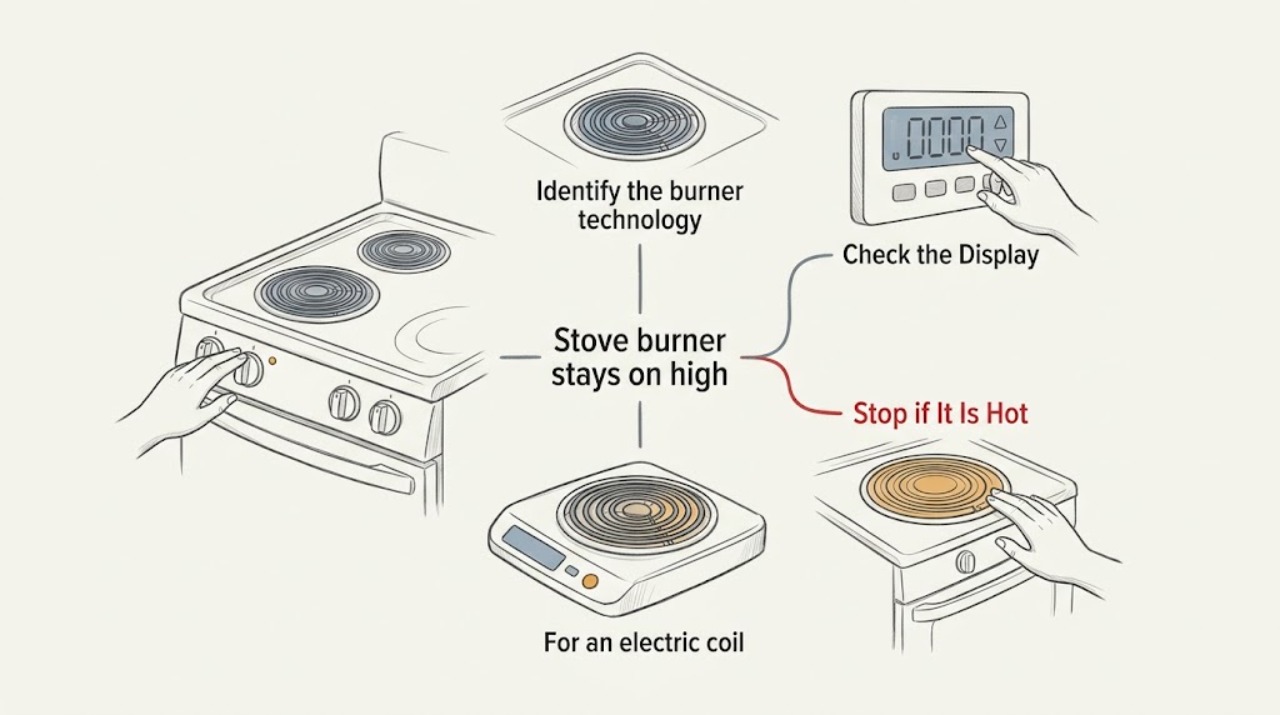
First determine whether the Amana stove is gas, electric coil or radiant, or induction. An electric radiant or coil element may glow and cycle at HIGH as its limiter regulates temperature, but it should respond when the control is turned OFF. A gas flame that remains tall or cannot be reduced can indicate a wrong fuel conversion, clogged or mis-seated burner parts, or a control fault. An induction zone may lower power or stop because of pan position, pan size, a hot control area, or overheat protection. Turn the affected control OFF and keep hands away from the hot surface. If the burner does not shut off, controls are unresponsive, there is a gas odor, yellow or unstable flame, smoke, arcing, damaged glass, or a repeated breaker trip, stop using the stove and arrange qualified service; do not open panels or gas components.
Work through in order
Diagnostic checks
Use only checks that match the exact appliance or system and its official guide.
-
Identify the burner technology and the actual OFF response
With hands away from the hot surface, identify whether the affected position has a gas cap and grate, an exposed coil, a smooth radiant element, or an induction zone with touch controls. Turn the affected control to OFF according to the Amana manual and observe only from a safe distance; record whether heat or flame decreases, cycles, or remains unchanged.
Expected result: The burner is gas, coil, radiant, or induction; and it responds to OFF, cycles at HIGH, remains visibly active, or has an unresponsive display or knob.
Next step: Select the gas, electric, or induction path below and record the full Amana model number before touching an accessible burner part.
Stop if: If a flame, element, or induction zone remains active after OFF, keep clear of the hot area and proceed to the service boundary; do not reach over it or remove a control panel.
Why this matters
Why: Technology determines whether cycling is expected and whether the heat source is a flame, resistive element, or electronically controlled zone. A true failure to respond to OFF is not normal temperature cycling.
-
Check controls, lockout, and shared power without opening the range
Verify the knob or touch setting from the model manual and check for a control lock, flashing display, or object or spill on a touch-control area. Determine whether other burners and the oven respond. If the model uses a household breaker, check it once from a safe standing position; do not remove covers or repeatedly reset a trip.
Expected result: Only one zone misbehaves; several zones or the whole cooktop are affected; the control lock or display is active; the breaker is open; or the burner control cannot be turned OFF.
Next step: Clear only a cool, accessible touch-control area as the manual permits. If the burner remains active, controls remain unresponsive, or a breaker trips again, leave the appliance off and arrange service.
Stop if: Do not repeatedly reset a tripping breaker, bridge a control, or touch a hot burner to confirm whether it is still heating.
Why this matters
Why: A single-zone symptom favors a local control, element, igniter, sensor, or burner assembly. Several dead or erratic zones favor shared power, control, or lockout. A control that cannot turn a live burner OFF is an immediate service condition.
-
For an electric coil or radiant element, distinguish normal limiting from runaway heat
With the element cool enough to approach safely, use the manual's setting and cookware guidance. Observe whether an electric coil or radiant area cycles on and off at HIGH, whether a suitable pan warms consistently, and whether the element stops or reduces when the control is OFF. Do not judge the condition solely by glow color.
Expected result: The element cycles and the pan warms; it glows continuously while the control is OFF; it never cycles down; or it stops heating but the hot-surface indicator remains on while the glass cools.
Next step: If cycling and OFF response are normal, use the manual's cookware and setting guidance. If heat continues after OFF or behaves erratically, turn the range circuit off only if safely accessible and arrange appliance service.
Stop if: Stop for smoke, scorching, arcing, cracked glass, melted control surfaces, exposed wiring, or a repeated breaker trip. Do not test voltage while energized.
Why this matters
Why: Cycling at HIGH and uneven glow can be normal temperature limiting. Heat continuing after OFF, a control that cannot reduce output, or a zone that does not cycle as designed points toward a control, sensor, element, or wiring fault.
-
For a gas burner, check flame reduction and cool cap seating
Only if the stove is gas, all controls are OFF, and the surface is cool, inspect the affected cap and base as the Amana manual permits. Confirm the cap is the correct one, centered, and flush; look for visible residue in ports and clean only by the documented method. Make one normal setting change while watching from the side, not over the flame.
Expected result: The flame reduces normally toward LOW and stops at OFF; the cap was displaced or dirty; the flame stays tall or yellow; the knob does not control it; or several burners show the same problem.
Next step: Correct only the accessible cap or residue issue described by the manual. If the flame remains too high or abnormal, turn the control OFF and arrange qualified service to verify installation, fuel configuration, ignition, and burner control.
Stop if: If you smell gas, hear hissing, see a yellow or unstable flame, or cannot turn the burner OFF, leave the area and contact the appropriate emergency or gas-service provider. Do not test a gas leak with a flame or open gas fittings.
Why this matters
Why: A cap or port issue can disturb flame shape on one burner. A flame that stays high, an incorrect fuel conversion after installation, a stuck control, or multiple abnormal burners requires gas or appliance diagnosis rather than more cleaning.
-
For induction, verify pan and touch-control conditions
If the Amana cooktop is induction, remove any object from the touch-control area and wipe only a cool, accessible surface. Use a flat, appropriate-size electromagnetic pan centered on the marked zone and follow the model manual for selecting and turning OFF the zone. Do not use an empty pan to provoke a test.
Expected result: The zone changes power and turns OFF normally; a no-pan or flashing indication clears with a suitable centered pan; the control area remains active; the zone reduces output after overheating; or the zone will not turn OFF.
Next step: Use only the manual's cookware and reset instructions. If the correct pan is recognized but the zone will not reduce or turn OFF, stop using the cooktop and arrange service.
Stop if: Do not bypass pan detection, open the induction surface, place metal objects on the controls, or continue using a cracked glass surface.
Why this matters
Why: Pan recognition, centering, control-area interference, or protective power reduction can look like a stuck or high setting. A zone that remains energized or has a persistent abnormal display after the documented control action points toward a control, sensor, or power fault.
-
Document the pattern and arrange service when the heat is not controllable
Record the complete Amana model number, fuel or surface type, affected zone, control position, whether other zones work, whether the heat cycles, and any display, flame, smell, smoke, or breaker symptoms. Photograph only cool, accessible areas and do not remove covers to expose a part number.
Expected result: The symptom clears after a safe setting or cap/pan correction; it returns; the burner remains active after OFF; or the fault requires access beneath the glass, behind a panel, or at a gas component.
Next step: Keep the affected zone off and provide the model and symptom record to qualified appliance service. For a suspected gas leak, leave the area and contact the appropriate emergency or gas-service provider.
Stop if: Do not resume cooking on a burner that cannot be controlled, or on a stove with gas odor, abnormal flame, smoke, arcing, damaged glass, exposed wiring, or a recurring breaker trip.
Why this matters
Why: A repeatable OFF failure or recurring high heat is more consistent with a control, element, igniter, sensor, valve, wiring, or power-module fault than with normal cycling. The correct diagnosis and parts depend on the model and technology.
Use your observations
Decision map
Find the observation that best matches what you see, then follow the next safe action.
-
PATH 01Next step
What you see
The Amana surface is electric coil or radiant, the control responds to OFF, a suitable pan warms, and the element periodically reduces or stops at HIGH.
Do this next
Continue only within the model manual's cookware and setting guidance, and treat the surface as hot during and after cycling. Arrange service if output remains excessive, never cycles, or does not stop at OFF.
Why this path and its safety boundary
Why it matters: Temperature limiting and cycling are more likely than a stuck-high fault; an element need not glow continuously to regulate heat.
-
PATH 02Safety boundary
What you see
An electric zone keeps heating or glowing after OFF, cannot be reduced, several controls act erratically, or a breaker trips again.
Do this next
Stop using the range. If safely accessible, isolate power at the range breaker without opening the appliance, then arrange qualified appliance service.
Why this path and its safety boundary
Why it matters: A failed control, limiter, sensor, element, wiring, or power module is more likely than normal cycling.
Safety stop: Do not test energized wiring, bypass a limiter, remove the glass, or repeatedly reset the breaker.
-
PATH 03Safety boundary
What you see
A gas burner remains tall at a lower setting, is yellow or unstable, does not turn OFF, or multiple burners show the same high-flame pattern.
Do this next
Turn controls OFF and use only the cool cap or port check documented by the manual. If the flame remains abnormal or the control cannot stop it, leave the appliance off and arrange qualified gas or appliance service.
Why this path and its safety boundary
Why it matters: Fuel conversion or installation, burner cap or port condition, gas pressure or supply, or a burner control fault is more likely than electric temperature cycling.
Safety stop: For gas odor, hissing, or an uncontrolled flame, leave the area and contact the appropriate emergency or gas-service provider. Do not open gas fittings or test with a flame.
-
PATH 04Next step
What you see
An induction zone changes power, flashes, or refuses to maintain the selected setting, but behavior changes when a correctly sized pan is centered or when a hot object is removed from the controls.
Do this next
Follow the exact Amana manual for cookware, control lock, and reset behavior. Stop using the zone if a suitable pan is recognized but the zone cannot be turned OFF or the display remains abnormal.
Why this path and its safety boundary
Why it matters: Pan recognition, control-area interference, or protective heat management is more likely than a stuck heating element.
-
PATH 05Safety boundary
What you see
Any technology shows a burner that cannot be turned OFF, smoke, arcing, damaged glass, exposed wiring, water on controls, a repeated electrical trip, or a suspected gas leak.
Do this next
Stop using the stove. Turn the control OFF only if it is safe, leave the area for a suspected gas leak, and arrange qualified appliance service or the appropriate emergency response.
Why this path and its safety boundary
Why it matters: The appliance may have an uncontrolled energy source or damage requiring qualified diagnosis; continued operation can create fire, shock, burn, or gas hazards.
Safety stop: Do not remove panels, open gas components, touch a hot surface to test it, bypass safety controls, or resume cooking before the fault is assessed.
Helpful context
Understand the symptom
A glowing element is not automatically stuck on HIGH
On an Amana electric cooktop, radiant and temperature-limited coil elements can cycle on and off at the HIGH setting. Parts of a smooth-top element may not glow red, and a surface can retain heat after the element cycles off. The useful distinction is whether the burner eventually regulates and responds to OFF, not whether it glows continuously.
Gas flames need a different check
A gas burner should reduce when its knob is moved from HIGH toward LOW and should stop when the control is OFF. An unusually tall or yellow flame can follow installation, fuel-conversion, port, or cap problems. Only inspect a gas cap or visible port with every control OFF and the cooktop cool; never open a valve or enlarge a port.
Induction power changes can be protective or a fault
An induction zone does not behave like a glowing coil. Amana's guidance ties pan detection and power changes to the cookware's material, size, position, the touch-control area, and overheating. Follow the exact model manual; if the zone will not turn off or the display remains abnormal after a safe control reset, stop using it and arrange service.
Use the model number before replacing anything
Amana manuals cover different range and cooktop layouts, and not every model has the same burner technology or control behavior. Record the complete model number and use the matching manual before attempting a reset or accessible cleaning. A part that fits one Amana surface may not fit another, so diagnosis must come before ordering.
Persistent HIGH heat is a service boundary
If a burner keeps heating after its control is OFF, the control panel will not respond, a gas flame is abnormal, or the appliance shows smoke, arcing, damaged glass, or a recurring electrical trip, turn the affected control OFF if it is safe to do so and stop using the stove. Do not remove the cooktop, test live wiring, bypass a limiter, or work on gas fittings.
Safety boundary
Stop conditions
- If a burner or zone remains active after its control is OFF, stop using the stove; isolate power at the breaker only if it is safely accessible and arrange qualified service rather than opening the appliance.
- For gas odor, hissing, a yellow or unstable flame, or a gas burner that cannot be shut off, leave the area and contact the appropriate emergency or gas-service provider. Do not ignite, test, or disassemble gas components.
- Stop for smoke, arcing, exposed wiring, melted controls, water on the control area, cracked glass, or a breaker that trips again. Do not bypass a limiter, sensor, lockout, or induction pan detection.
- A cool, accessible gas-cap, visible-port, touch-control, or cookware check is the homeowner boundary. Internal controls, elements, wiring, valves, fuel conversion, glass surfaces, and induction power modules require qualified diagnosis.
Only after diagnosis
Potential parts
- electric surface-element control, limiter, or heating element
Consider this category only when an electric zone fails the OFF-response or cycling check and qualified diagnosis identifies the element, limiter, switch, sensor, or related control as the cause.
Confirm the complete Amana model, surface type, element size, and diagnosed component before ordering; coil and smooth-top parts are not interchangeable by appearance. - gas surface burner cap, igniter, or burner-control component
Consider this category only when a gas burner has a correctly seated clean cap but a qualified diagnosis confirms a local ignition, flame-control, valve, or related burner fault.
Verify the full Amana model, fuel type, burner position, and diagnosed part before selecting a component; do not change fuel-conversion parts as a homeowner. - induction zone sensor or power-control assembly
Consider this category only when a suitable centered pan and documented control reset do not restore normal power or OFF response and qualified diagnosis identifies a sensor or power-control fault.
Induction assemblies vary by Amana model and zone; confirm the complete model and technician diagnosis before ordering, and do not attempt homeowner replacement.
When checks do not resolve it
Need a professional?
Arrange qualified appliance service when an Amana burner remains on HIGH after the control is OFF, an electric element never cycles or will not stop, a gas flame remains too high or abnormal, an induction zone will not turn off with compatible cookware, multiple zones fail, a breaker trips again, or the suspected cause is behind a panel, beneath the glass, in wiring, or in a gas component. For gas odor or hissing, leave the area and contact the appropriate emergency or gas-service provider. Provide the complete model number, technology, affected zone, control response, cycling pattern, flame or display observations, and the safe checks already performed.
Have this ready
- Provide the complete Amana model number, gas/electric/induction type, affected position, control setting and OFF response, whether other zones work, cycling or flame pattern, display messages, cookware used on induction, recent installation or spill history, breaker behavior, photographs of cool accessible areas, and the safety checks completed.
Common questions
FAQ
Is an Amana electric burner staying on HIGH always a fault?
Not always. Amana says radiant and temperature-limited coil elements may cycle on and off even at HIGH, and parts of an element may not glow red. It is concerning when heat continues after the control is OFF, the element never cycles, the control is unresponsive, or the stove shows smoke, arcing, damage, or a repeated breaker trip.
What should I do if an Amana gas burner flame is too high?
Turn the burner control OFF and, only when the surface is cool, check the correct cap's seating and visible port condition as the model manual describes. A high or yellow flame after installation can involve fuel conversion or installation. If the flame remains abnormal, the knob cannot shut it off, or you smell gas, stop and arrange qualified gas or appliance service; do not open gas fittings.
Why does my Amana induction burner change power or seem stuck on high?
Induction power can change when the pan is not the right material, size, or position, when something hot or wet is on the touch controls, or when protective heat management acts. Use the exact model manual and a suitable centered pan. If the zone will not turn OFF or its display remains abnormal, stop using it and arrange service.
When should I cut power to an Amana stove?
If an electric or induction zone continues heating after OFF or the controls are unresponsive, stop using the stove and isolate its breaker only if it is safely accessible; do not open the appliance. A breaker that trips again, smoke, arcing, damaged glass, exposed wiring, or any suspected gas leak requires qualified service or the appropriate emergency response.
Read the exact guide
Official sources
- Cooktop Not Working - Electric CooktopAmana Product Help · Amana electric radiant-cooktop cycling, HIGH-setting limiter behavior, power checks, and service guidance
- Manuals and Guides | AmanaAmana · Amana model-number lookup for model-specific owner manuals and operating instructions
- Coil Element not Operating CorrectlyAmana Product Help · Amana electric coil temperature-limiting behavior and normal cycling
- Owner's ManualAmana · Amana gas-range burner controls, burner-cap and port care, model variation, and safety boundaries
- C82 - Electric and Induction CooktopAmana Product Help · Amana induction and electric cookware size, material, positioning, overheat protection, and reset guidance
- Burner Flames Too High - Natural GasAmana Product Help · Amana natural-gas burner flame-height, fuel-conversion, port-cleaning, cap-seating, and service guidance
- Indicator or Display Flashing - Electric and Induction CooktopAmana Product Help · Amana induction pan recognition, control-area interference, protective power changes, and reset/service guidance
Community feedback
Share a repair observation
Share a plain-text repair observation. Accepted observations are published automatically; this page may take a moment to update.