
On this page
Start here
Quick answer
A burner that remains on high after you lower the control knob is a heat and fire hazard, not a setting to work around. First turn the control to OFF if it responds normally, keep hands and cookware away, and stop using the affected burner. For an electric stove, isolate power at the accessible breaker once the surface is safe; for a gas stove, do not reach across a flame, and treat a flame that will not reduce or shut off as an appliance-service issue. From the outside, identify whether the knob is loose or slipping, whether the flame or element actually responds, and whether the problem started after cleaning. Do not remove the control panel, adjust a gas valve, test live wiring, or replace an infinite switch based on the symptom alone.
Before you begin
Safety first
- This article supports ordinary-access observation only. Do not operate an uncontrolled burner, open panels, adjust gas controls, bridge wiring, test live circuits, or replace an infinite switch, gas valve, element, or other internal component yourself.
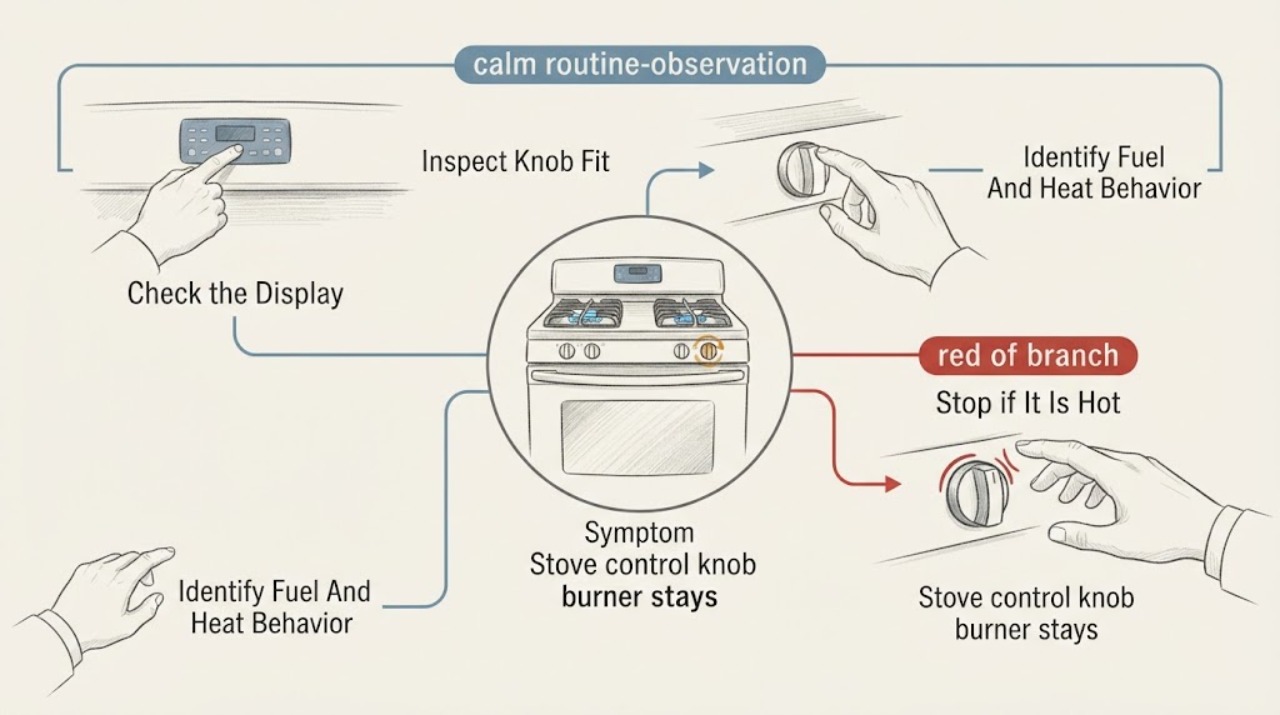
Work through in order
Diagnostic checks
Use only checks that match the exact appliance or system and its official guide.
-
Check 1
Identify whether the stove uses gas, electric radiant elements, or another design, and observe the affected burner from a safe distance without touching the surface or reaching over cookware.
Expected result: Record whether you see a flame, a glowing element, a hot-surface indicator, or only residual heat; note whether the burner is continuously high, cycles, or simply stays hot after being turned off.
Next step: Continue with the appropriate knob-response check, keep people and combustibles away, and stop using the burner until the response is understood.
Stop if: Stop immediately for an uncontrolled flame, smoke, arcing, burning odor, damaged glass, or heat affecting nearby materials; isolate the appliance only through a safe accessible control or breaker and arrange service.
Why this matters
Why: A cycling electric element can be normal infinite-control behavior, while continuous full output at a low setting or an unresponsive gas flame suggests a control fault. Residual heat alone does not prove that power remains on.
-
Check 2
With no hand over the burner and no cookware blocking access, move the affected control knob once toward LOW and then OFF using its normal range; do not force it or repeat the test.
Expected result: Record whether the gas flame reduces and extinguishes, the electric element stops energizing after its normal cool-down, the knob binds, or the knob reaches OFF while heat output remains high.
Next step: Leave the burner off. For an electric stove, turn off the appliance breaker when safe and keep it out of use; for gas, do not reach over the flame and arrange urgent appliance service, using the appliance shutoff only if it is known, accessible, and safe.
Stop if: Do not keep operating the burner, hold the knob in place, bypass a control, or attempt to extinguish an inaccessible flame with water.
Why this matters
Why: A knob that cannot shut off or a flame that remains high is an unsafe control response. An electric surface may stay hot after de-energizing, but continued full output or a hot-surface indicator that does not behave as the manual describes needs service.
-
Check 3
After the burner and surface are completely cool and the appliance is isolated, compare the affected knob's seating, pointer alignment, cracks, and rotational feel with another matching knob from ordinary access; do not expose the shaft or control panel.
Expected result: Record whether the knob is loose, cracked, misaligned, slipping on the shaft, difficult to turn, or indistinguishable from the other controls while the burner still stays high.
Next step: Photograph the knob and exact model information. Replace a knob only when the model manual or manufacturer confirms the exact fit; arrange service when the shaft, control, or output does not track the knob.
Stop if: Do not pull the knob to expose adjustment screws, bend the shaft, lubricate the control, or operate the burner with a loose or missing knob.
Why this matters
Why: A damaged or slipping knob can misrepresent the control position. A normal-feeling knob with unchanged heat output makes an internal infinite switch, gas valve, wiring, element, or control fault more likely.
-
Check 4
For a gas burner only, with the gas and appliance safely off and completely cool, inspect whether the removable burner cap is seated flat, ports are visibly obstructed, or moisture remains after cleaning; do not probe ports or adjust the valve.
Expected result: Classify the cap as seated or displaced, the ports as visibly clear or obstructed, and the surface as dry or wet; note whether the flame was uneven as well as high.
Next step: Correct only a clearly displaced cap or clean and dry the burner according to the model manual; if the flame remains high or the control remains unresponsive, leave the burner off and call service.
Stop if: Do not drill or enlarge ports, adjust a gas valve, use an open flame to dry moisture, or continue using the burner when flame behavior is abnormal.
Why this matters
Why: A displaced cap, moisture, or blocked port can produce an uneven or abnormal flame, but it does not explain a control that cannot reduce or shut off gas. A uniformly high flame with a normal cap and clear ports points more strongly to the control or gas valve.
-
Check 5
For an electric radiant burner only, after the surface is cool and power is safely isolated, document whether the symptom is continuous energizing at LOW/OFF or normal cycling at a selected level; do not remove the cooktop or work on energized circuitry.
Expected result: Record whether the element cycles on and off, stays visibly energized continuously, the hot-surface indicator remains on, or another burner has the same behavior.
Next step: Keep the breaker off and arrange appliance service for continuous or unresponsive output; provide the model, burner location, knob position, cycle observation, and indicator behavior.
Stop if: Do not remove the console, access the infinite switch, bridge wires, or restore power to test a suspected stuck control.
Why this matters
Why: GE says traditional knob controls can cycle elements as heat is maintained, so pulsing is not automatically a defect. Continuous high output at a low setting, output that ignores OFF, or one burner behaving differently makes an infinite-switch, wiring, element, or control fault more likely.
-
Check 6
Prepare a service record with the stove brand, model, fuel type, affected burner, knob position, flame or element behavior, hot-surface or control indicators, knob condition, recent cleaning, and any smoke, odor, arcing, or breaker activity.
Expected result: Confirm whether the burner can be set to OFF, whether it cycles or stays continuously high, whether the symptom affects one burner or several, and whether the appliance has been isolated.
Next step: Keep the stove out of use and give the record and photographs to a qualified appliance technician; request diagnosis of the knob, shaft, infinite switch or gas valve, element, burner, and wiring as applicable.
Stop if: Do not restore power or gas merely to reproduce the symptom, and do not use another burner if the appliance has a burning smell, arcing, gas odor, or other unsafe condition.
Why this matters
Why: One burner with a normal knob but unresponsive output points toward that burner’s control path; multiple burners or shared electrical/gas symptoms raise a broader appliance or supply concern. Either pattern needs service if output cannot be controlled safely.
Use your observations
Decision map
Find the observation that best matches what you see, then follow the next safe action.
-
PATH 01Safety boundary
What you see
A gas flame remains large or will not extinguish when the control knob is moved normally toward LOW or OFF.
Do this next
Stop using that burner, keep clear of the flame, and arrange urgent qualified appliance service; close a known accessible appliance gas shutoff only if it can be done safely without reaching over the flame.
Why this path and its safety boundary
Why it matters: The control knob, valve shaft, gas burner control, or another gas-control fault is more likely than a simple cap or port issue, and the appliance cannot be safely controlled.
Safety stop: Do not adjust the gas valve, remove the knob to reach a screw, probe the burner, or keep cooking while waiting.
-
PATH 02Safety boundary
What you see
The flame changes with the knob, but is uneven or unusually high and the burner cap is displaced, ports are visibly obstructed, or moisture remains after cleaning.
Do this next
With the unit cool and off, restore the cap or clean and dry the burner only as the model manual allows; call service if the flame remains abnormal or the knob response is not reliable.
Why this path and its safety boundary
Why it matters: A cap, port, or moisture condition is plausible, but it does not justify gas-control adjustment or explain a flame that cannot be shut off.
Safety stop: Do not enlarge ports, use an open flame to dry the burner, or operate with an unseated cap or persistent abnormal flame.
-
PATH 03Safety boundary
What you see
An electric radiant element cycles on and off at a selected setting and eventually de-energizes when turned OFF, although the glass remains hot for a while.
Do this next
Follow the model's use-and-care guidance, keep hands away until the hot-surface indication clears, and seek service only if the element ignores LOW/OFF, behaves differently from the manual, or becomes continuously energized.
Why this path and its safety boundary
Why it matters: This is consistent with the normal cycling behavior of an electric infinite control and residual surface heat, not necessarily a stuck-high fault.
Safety stop: Do not touch or clean the surface while hot, and do not assume a glowing cycle means the control is stuck.
-
PATH 04Safety boundary
What you see
An electric element remains continuously energized or at full output when the knob is at LOW or OFF, while other burners respond normally.
Do this next
Keep the appliance breaker off once safe, do not use the stove, and arrange qualified appliance diagnosis with the exact model and affected burner.
Why this path and its safety boundary
Why it matters: A stuck infinite switch, control shaft, wiring, or element-control fault is more likely than normal heat cycling.
Safety stop: Do not remove the control panel, bridge wires, work on energized circuitry, or restore power to verify the suspected switch.
-
PATH 05Safety boundary
What you see
The control knob is cracked, loose, misaligned, slips on the shaft, binds, or does not track the control position while the burner output changes unexpectedly.
Do this next
Leave the burner off, photograph the knob and model information, and use only a model-confirmed replacement knob; have a technician inspect the shaft and control if output remains uncontrolled.
Why this path and its safety boundary
Why it matters: A knob or shaft interface may be misrepresenting the setting, but an internal control fault cannot be excluded without service inspection.
Safety stop: Do not operate with a missing knob, expose adjustment hardware, or force the shaft.
-
PATH 06Safety boundary
What you see
There is a gas odor, smoke, arcing, burning smell, damaged cord or glass, repeated breaker trip, or heat damage around the stove.
Do this next
Leave the area if gas odor or smoke is present, avoid electrical switches or flames, and contact the appropriate emergency gas or electrical service; otherwise isolate the appliance safely and arrange qualified repair.
Why this path and its safety boundary
Why it matters: The immediate issue is an unsafe appliance or fuel/electrical condition, regardless of whether the original complaint began with the control knob.
Safety stop: Do not relight, reset repeatedly, inspect behind panels, or continue using any burner.
Helpful context
Understand the symptom
Separate normal cycling from a control that is stuck high
Electric radiant elements controlled by a traditional knob may cycle on and off to hold a selected heat level, and the element can remain hot after power is removed. A burner is more concerning when the control is at LOW or OFF but the element continues to energize continuously, or when a gas flame remains large and does not respond to the knob. Gas and electric stoves use different controls, so identify the fuel type before interpreting the symptom.
The knob response is the important observation
A loose, cracked, or slipping knob can make the pointer show LOW or OFF while the control shaft remains at a higher setting. A knob that turns normally but does not change the flame or element output points farther into the control or burner circuit. Compare the affected knob's feel and pointer alignment with an unused burner, but do not remove the console or use a screwdriver on a gas control's adjustment screw.
Gas flame problems need a different check than electric heat
For a gas surface burner, an uneven or unusually high flame can also follow a burner cap that is not seated, moisture left after cleaning, blocked burner ports, or a knob set too high. These are visible, ordinary-access observations only. If the flame stays high when the knob is moved normally toward LOW or OFF, stop using that burner and arrange service for the burner control or gas valve rather than trying to adjust it yourself.
Treat internal control replacement as appliance service
An electric infinite switch or a gas burner valve sits behind the user control and is connected to hazardous power or fuel. Whirlpool's service documentation requires power disconnection and panel replacement before operating after infinite-switch work. A technician must identify whether the fault is the knob, shaft, infinite switch, burner element, wiring, gas valve, burner head, or another control before selecting a part.
Safety boundary
Stop conditions
- Turn the burner OFF if it responds normally, isolate an electric stove at its accessible breaker when safe, and stop use whenever a burner remains high or cannot be controlled.
- For a gas odor, smoke, arcing, or suspected fuel leak, leave the area, avoid flames and electrical switches, and contact the appropriate emergency gas or electrical service.
- Do not remove the control panel or cooktop, expose or adjust a gas valve, pull wiring, bridge a switch, or test live electrical parts.
- Do not keep operating an uncontrolled burner, use water on an inaccessible flame, probe or enlarge gas ports, or restore power or gas merely to reproduce the symptom.
- Do not treat normal electric cycling or residual hot glass as proof of a stuck-high control, but arrange service for continuous output at LOW/OFF, an unresponsive gas flame, or any abnormal safety symptom.
Only after diagnosis
Potential parts
- stove infinite switch
Consider this class only after model-specific diagnosis confirms that an electric burner-control switch is stuck or not regulating output and the knob and wiring are not the cause.
Match the exact stove model, switch ratings, terminals, shaft orientation, and manufacturer fit; replacement requires power isolation, panel access, and qualified service. - stove surface element
Consider this class only if diagnosis confirms the electric surface element itself is damaged or shorted and the control switch and wiring have been assessed.
Confirm exact model, element geometry, wattage, connectors, limiter arrangement, and manufacturer compatibility; do not infer element failure from continuous heat alone. - stove control knob
Consider this class only if the external knob is cracked, loose, slipping, or missing and the exact replacement restores the model's intended shaft fit without masking an internal control fault.
Match exact model, shaft shape, pointer position, temperature markings, and retaining fit; do not use a knob replacement to bypass a control that cannot shut off.
When checks do not resolve it
Need a professional?
Arrange urgent qualified appliance service when a gas flame will not reduce or shut off, an electric element stays continuously energized at LOW/OFF, the knob or shaft slips or binds, the burner has abnormal flame behavior after an approved cap or port check, or any diagnosis would require panel access, gas-valve adjustment, electrical testing, or control replacement. Stop using the appliance and isolate it safely for smoke, arcing, gas odor, burning smell, damaged cord or glass, repeated breaker trips, or heat damage.
Safety scope: This article supports ordinary-access observation only. Do not operate an uncontrolled burner, open panels, adjust gas controls, bridge wiring, test live circuits, or replace an infinite switch, gas valve, element, or other internal component yourself.
Common questions
FAQ
Why does my stove burner stay on high when I turn the knob down?
For an electric radiant burner, normal infinite-control cycling can look like pulsing, but continuous full output at LOW or OFF is not normal. For gas, a flame that does not reduce or shut off can indicate a knob, shaft, or gas-control problem. Stop using the burner and arrange service rather than adjusting internal controls.
Is it normal for an electric burner to stay hot after I turn it off?
Yes, the surface can retain heat after the element is de-energized, and a traditional electric control may cycle the element while maintaining a selected setting. Do not touch the surface until the model's hot-surface indication clears. Continuous energizing at LOW or OFF is a different symptom and needs service.
What should I check if a gas burner flame is too high?
With the appliance cool and off, check only that the burner cap is seated, ports are visibly clear, moisture is absent after cleaning, and the knob is not set too high, following the model manual. If the flame remains high or will not shut off, stop using the burner and call qualified service.
Can I replace the infinite switch behind the stove knob myself?
Do not. The switch is behind the control panel and connected to hazardous electrical circuits. A qualified technician should confirm that the switch, rather than the knob, shaft, element, wiring, or another control, is defective before replacing it with a model-compatible part.
Should I keep cooking on another burner if one burner is stuck on high?
Do not use the affected burner. If there is a gas odor, smoke, arcing, burning smell, damaged cord or glass, repeated breaker activity, or another unsafe symptom, stop using the entire appliance and isolate it safely. Otherwise have the appliance assessed before relying on it again, especially if the controls or power supply are shared.
Read the exact guide
Official sources
- USING YOUR COOKTOPGE Appliances · GE cooktop manual for a particular product family; exact model manual controls the appliance's knob travel and ignition design.
- Service Manual - W11174814 - RangeWhirlpool Corporation · Whirlpool service manual for specified range families; used to establish that internal switch access is service work, not a user adjustment.
- Range - Infinite Heat ControlsGE Appliances · GE support guidance; control travel and flame or heat behavior vary by model.
- Relectric Range and Cooktop - Infinite vs Electroinc "No Pulse" BurnersGE Appliances · GE support guidance describing traditional electric knob-controlled elements; exact stove model instructions control behavior and service.
- What should I do if my gas flames are uneven or too high?Frigidaire · Frigidaire gas-range and gas-cooktop support guidance; exact model manual controls cleaning and service procedure.
Community feedback
Share a repair observation
Share a plain-text repair observation. Accepted observations are published automatically; this page may take a moment to update.