
On this page
Start here
Quick answer
First identify whether this is a gas flame, an electric radiant/coil element, or an induction zone, because the normal response is different. On a gas stove, the flame should respond to the control; if it remains high when the knob is lowered or turned off, turn the control to OFF, keep the stove out of use, and arrange service rather than adjusting the valve yourself. On an electric radiant or coil stove, a hot pan and glass or coil can stay hot after a lower setting, and normal cycling can look like constant heat; however, an element that stays energized at OFF or never changes its cycling pattern is not a user adjustment. Do not remove the control panel, pull a knob stem apart, open a gas valve, or work around a hot surface. Stop for gas odor, yellow or lifting flames, smoke, sparking, damaged controls, or heat that continues with the control OFF.
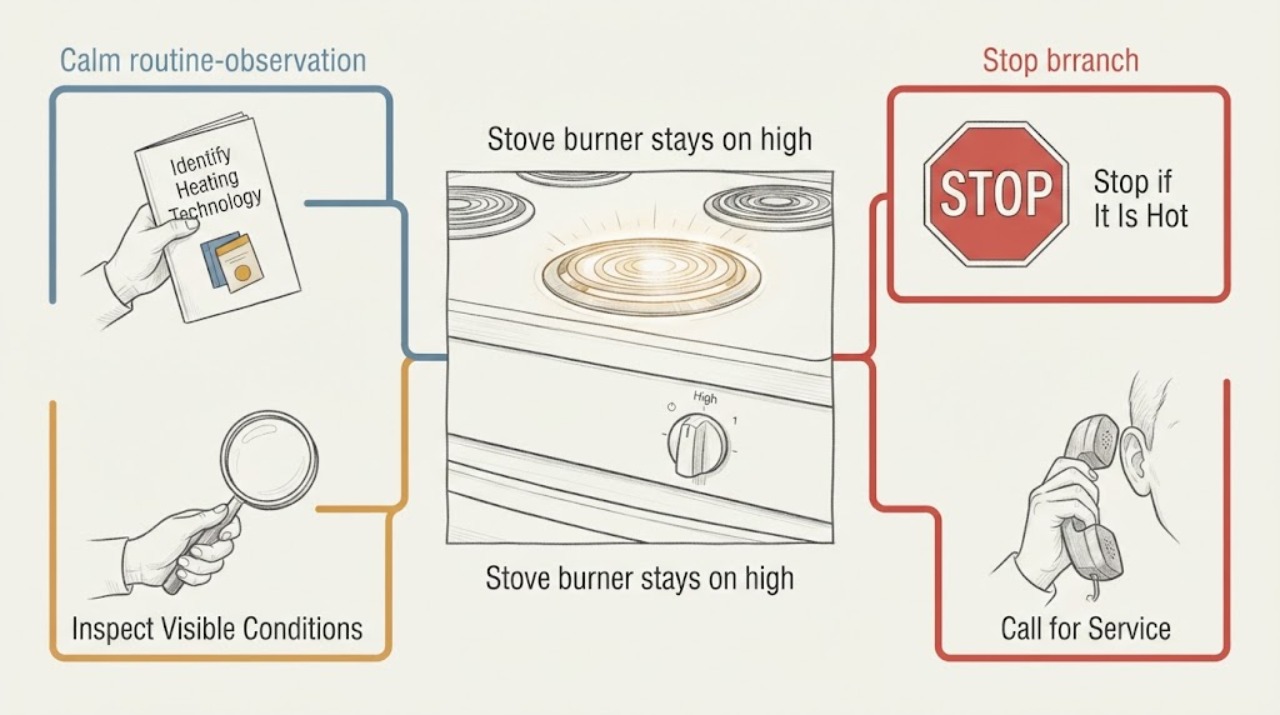
Work through in order
Diagnostic checks
Use only checks that match the exact appliance or system and its official guide.
-
Check 1
With every control turned OFF and the surface cool enough to approach safely, identify whether the affected burner is a visible gas flame, a plug-in electric coil, a radiant element under glass, or an induction zone; note the control type and the affected position.
Expected result: Record whether you see a flame, a glowing coil or glass zone, or no visible heat source, and whether the control is a knob or electronic touch control.
Next step: Follow the branch for the identified technology; if the technology or control is unclear, stop experimenting and use the owner's manual or arrange service.
Stop if: Do not touch the burner, pan, glass, coil, or control wiring to identify the technology.
Why this matters
Why: Gas flame height should track the control position. Electric coil and radiant elements may cycle fully on and off and may remain hot after the control is lowered. Induction behavior and controls are model-specific, so do not apply gas or radiant assumptions to it.
-
Check 2
For a gas burner only, while standing clear of the flame and using the normal control, observe whether the flame changes as the knob moves from a high position toward a lower position and then to OFF; do not remove the knob or reach toward the valve stem.
Expected result: Separate a flame that decreases and shuts off normally, a flame that remains high at a lower setting, a flame that goes out or becomes unstable, and a flame that continues after the control is OFF.
Next step: If the flame does not respond correctly or does not shut off, turn the control OFF if it can be done normally, stop using that burner, and arrange qualified appliance or gas service. Never adjust the valve yourself.
Stop if: Stop for gas odor, a flame that continues at OFF, yellow or lifting flame, smoke, scorching, or any need to remove a control or expose the valve.
Why this matters
Why: A flame that remains high or continues at OFF indicates a control or gas-flow fault and is not corrected by cooking longer. An unstable, yellow, lifting, or uneven flame can also indicate cap, port, moisture, fuel-conversion, or service issues; the visible flame alone does not identify the failed part.
-
Check 3
For an electric coil or radiant burner, turn the control to a lower setting with no hand or utensil near the hot surface and observe the element over a normal heating cycle; do not judge the setting by touching the pan or glass.
Expected result: Note whether the element eventually cycles between energized and dark at the lower setting, whether the pan simply remains hot from stored heat, or whether the element remains visibly energized with the control at OFF.
Next step: If the element remains on at OFF or the response is clearly abnormal, stop using that zone and arrange service; leave the surface undisturbed until it is fully cool.
Stop if: Stop for smoke, a glowing area where the control is OFF, cracked glass, melted controls, sparking, or any need to open the cooktop.
Why this matters
Why: On/off cycling can be normal on electric coil and radiant burners, even at high, and a hot pan or glass can delay the felt temperature change. A zone that remains energized at OFF, or whose cycling does not change across settings after the appliance has had time to respond, makes a control or element fault more likely.
-
Check 4
Only after a gas burner is completely cool and the gas control is OFF, compare the removable burner cap and base with the owner's manual: check that the cap is the correct one, centered, seated flat, and free of visible moisture or residue; do not probe ports or alter the valve.
Expected result: Record a cap that rocks, sits off-center, is wet, is on the wrong burner, or has visible residue, versus a cap and base that are correctly matched and seated.
Next step: Use only the cleaning and reassembly method in the model manual; if the flame remains high or abnormal after the safe external check, stop using the burner and arrange service.
Stop if: Do not scrape, drill, enlarge, or probe openings, and do not continue if the burner is hot, the area smells of gas, or the cap/base is damaged.
Why this matters
Why: A misplaced cap, moisture, or blocked port can create an uneven or abnormal flame, but it does not prove that the control itself is stuck high. A correctly seated, dry, clean-looking burner with unchanged flame response makes a control or gas-flow diagnosis more likely.
-
Check 5
For an electric or electronic-control stove, observe the burner-on or hot-surface indicator with all controls OFF and the appliance allowed to cool; consult the exact owner's manual rather than assuming the light is a live-heating indication.
Expected result: Record whether the indicator follows an active control, remains on only while the surface is still hot, or remains on after every burner is OFF and cool.
Next step: Do not disassemble the console. Keep the affected zone out of use and contact service when the indicator behavior does not match the manual or the burner actually remains energized.
Stop if: Stop if the glass is cracked, an indicator is accompanied by smoke or odor, or power would need to be tested at exposed terminals.
Why this matters
Why: A hot-surface light can remain on because the glass is retaining heat or the indicator is sensor- or time-based. If the indicator and the element both behave as though a burner is energized while every control is OFF, a control or sensing fault needs service.
-
Check 6
Write down the burner technology, affected position, control setting, visible flame or element behavior, cap condition if gas, indicator behavior if electric, and whether the heat continues at OFF; do not attempt an internal adjustment.
Expected result: The record should show a normal delayed cool-down/cycling pattern, a repeatable gas flame-control failure, or a zone/control that remains energized at OFF.
Next step: Arrange qualified appliance service for any abnormal response. If gas odor or an active electrical hazard is present, leave the area and use the appropriate emergency or gas-safety channel rather than operating the stove.
Stop if: There is no safe user path through a removed control panel, exposed gas valve, live electrical test, bypassed thermostat/control, or forced burner operation.
Why this matters
Why: Normal cycling or retained heat supports continued use only within the manual's normal operation. A gas flame that ignores the knob, an electric zone that remains on at OFF, or an unexplained response indicates an appliance control, valve, element, or wiring issue requiring diagnosis.
Use your observations
Decision map
Find the observation that best matches what you see, then follow the next safe action.
-
PATH 01Next step
What you see
The stove is gas and the flame decreases with the knob, then shuts off normally, but the food or pan remains hot after lowering the setting.
Do this next
Use the cookware and heat guidance in the model manual, and stop using the burner if the flame later stops responding or does not shut off.
-
PATH 02Next step
What you see
A gas flame stays large at a lower position, is unstable or abnormal, or continues when the control is OFF.
Do this next
Turn the control OFF if possible without reaching into a hazard, stop using the stove, and arrange qualified appliance or gas service. Do not adjust the valve or retry repeatedly.
-
PATH 03Next step
What you see
An electric coil or radiant element cycles between on and off at the lower setting, while the pan or glass remains hot for a while.
Do this next
Use the cookware and setting guidance in the exact manual, keep hands away until cool, and seek service only if the cycle never changes as expected or the zone stays energized at OFF.
-
PATH 04Next step
What you see
An electric element remains visibly energized at OFF, or the burner-on indication and heating behavior remain active after every control is OFF and the surface is cool.
Do this next
Stop using the affected zone and arrange qualified appliance service. Do not open the cooktop, remove the control, or perform live tests.
-
PATH 05Next step
What you see
There is gas odor, smoke, sparking, scorching, melted control material, a cracked glass surface, or a flame that cannot be shut off normally.
Do this next
Do not operate switches or create flames if gas is suspected. Leave the area when necessary, contact the appropriate emergency or gas-safety service, and keep the appliance out of use until inspected.
Helpful context
Understand the symptom
Separate a slow-to-cool burner from a control fault
The phrase “stays on high” can describe two different experiences. Gas flame height normally changes promptly with the knob, so a flame that remains large at a lower position is a control or gas-appliance concern. Electric radiant and coil elements use timed cycling, and the pan, glass, or coil retains heat after the setting is lowered; you may not feel an immediate change. A useful observation is whether the element eventually changes its on/off pattern at the lower setting, not whether the surface becomes cool immediately.
Keep checks external and model-specific
With the controls OFF and the appliance cool, an owner can identify the heating technology, confirm that a removable gas cap is the correct cap and seated flat, and note visible moisture or blocked burner openings using the owner's manual. Do not pry off a stubborn knob, turn a valve-stem adjustment screw, remove a control panel, or clean a hot burner. Manufacturer pages describe gas valve adjustment as a technician task and direct owners to model-specific instructions.
What to tell service
Record whether the stove is gas, electric coil, radiant glass, or induction; which burner is affected; whether the heat changes at all; whether a gas flame changes height; whether an electric element cycles; and whether the problem occurs at OFF or only at lower settings. A photo of the control label and a cool, unpowered exterior view can help identify the correct manual. This information narrows the likely control or element path without asking you to test energized parts.
Safety boundary
Stop conditions
- Stop using the stove for gas odor, a flame that continues at OFF, yellow or lifting flames, smoke, sparking, scorching, melted controls, a cracked glass surface, or heat that remains energized with the control OFF.
- Do not remove the control panel, pry apart a knob stem, adjust a gas valve, probe or enlarge burner ports, bypass a thermostat or control, or perform live electrical tests.
- Do not touch a pan, glass surface, coil, burner cap, or grate to judge temperature; retained heat can cause burns even after a control is lowered or turned OFF.
Only after diagnosis
Potential parts
- gas burner control valve
Only consider this if a qualified diagnosis finds that one gas control does not regulate or shut off while the cap, base, and fuel setup are correct.
Confirm the exact stove model, gas type, burner position, and manufacturer-approved fit before ordering; do not adjust a valve based on a symptom alone. - electric surface burner control
Only consider this if an electric coil or radiant zone remains energized at OFF or its control does not change the documented cycling behavior after professional testing.
Confirm the exact model, control type, terminal arrangement, and manufacturer fit; do not substitute a control by appearance. - surface heating element
Only consider an element after diagnosis shows the element itself is damaged or abnormal; a hot pan or normal cycling does not establish an element failure.
Match the exact stove model and element style, size, and connection requirements using manufacturer information. - gas burner cap and base
Only consider this when the cap is missing, damaged, mismatched, or cannot seat correctly and the resulting flame problem is confirmed to be at that burner.
Confirm the burner position and exact model; a visually similar cap may not be the correct part.
When checks do not resolve it
Need a professional?
Arrange qualified appliance service when a gas flame ignores the knob, a burner will not shut off, an electric element remains energized at OFF, the cycling pattern is abnormal, the control indicator disagrees with the manual, or the safe external checks do not explain the symptom. Use emergency or gas-safety assistance for active smoke, fire, gas odor, or immediate danger. Do not open the appliance or make a gas or electrical adjustment yourself.
Common questions
FAQ
Is an electric burner staying hot after I lower the setting always a failure?
No. Electric coil and radiant burners can cycle on and off at every setting, and the pan or glass can retain heat after the setting is lowered. Concern rises when the element remains energized at OFF or its documented cycling never changes across settings.
What should I do if a gas flame stays high when I turn the knob down?
Turn the control to OFF if it responds normally, stop using that burner, and arrange qualified service. Do not remove the knob to adjust the valve or continue cooking while the flame ignores the control.
Can I adjust the screw under a gas burner knob?
Do not do that as a homeowner repair. GE identifies model-specific valve adjustment as work for a qualified gas technician; the correct setting depends on the appliance and fuel configuration.
Why is a gas flame too high or uneven even though the knob moves?
A wrong or poorly seated cap, moisture, blocked burner openings, or an improper gas conversion can affect the visible flame. Inspect only the cool, removable external parts described by the manual; arrange service if the flame remains abnormal.
What if the electric element or hot-surface light stays on when every control is OFF?
Keep the zone out of use and arrange appliance service. The indicator may legitimately remain on while the surface is hot, but an element that is actually energized at OFF or behavior that conflicts with the model manual is not a cooking adjustment to make yourself.
Read the exact guide
Official sources
- Gas Range & Cooktop - Degree Rotation and Adjustment of Gas Burner ControlsGE Appliances · Gas range and cooktop burner-control operation and technician-only valve adjustment guidance
- Gas Range & Cooktop - Burner or Oven Flame Too High or UnevenGE Appliances · Gas burner flame appearance, cap seating, burner ports, and fuel-conversion troubleshooting
- What should I do if my gas flames are uneven or too high?Frigidaire · Gas range and cooktop checks for high or uneven flames
- Electric Range - Hot Surface IndicatorGE Appliances · Electric range burner-on and hot-surface indicator behavior and service boundary
- Electric Range & Cooktop - Surface Burners Cycle On and OffGE Appliances · Electric coil and radiant surface burner cycling behavior
- Electric Range & Cooktop - Radiant Burner Too Hot After Setting to Lower TemperatureGE Appliances · Radiant electric burner cool-down and retained heat behavior
Community feedback
Share a repair observation
Share a plain-text repair observation. Accepted observations are published automatically; this page may take a moment to update.