
On this page
Start here
Quick answer
Turn the affected control to OFF immediately. If an electric burner remains visibly energized or continues heating, and the breaker is safely reachable, switch off the range circuit at the breaker and stop using the appliance. Do not keep testing, remove the knob, open the control panel, disconnect wiring, or measure live voltage. On an electric range, an element cycling on and off while set to a selected heat level can be normal, but a burner that remains on after OFF is not a user repair. On a gas range, a flame that remains after the control is OFF is also a stop-use condition. Note whether the problem affects one burner or several, whether the knob reaches OFF normally, and whether a hot-surface indicator remains lit; then arrange a qualified appliance technician.
Before you begin
Safety first
- Do not continue cooking, remove knobs or panels, access a switch or element, disconnect wiring, measure live voltage, or work on a gas valve. For an electric stove, use the breaker only if it is safely accessible; do not rely on a control that has failed to shut off the burner.
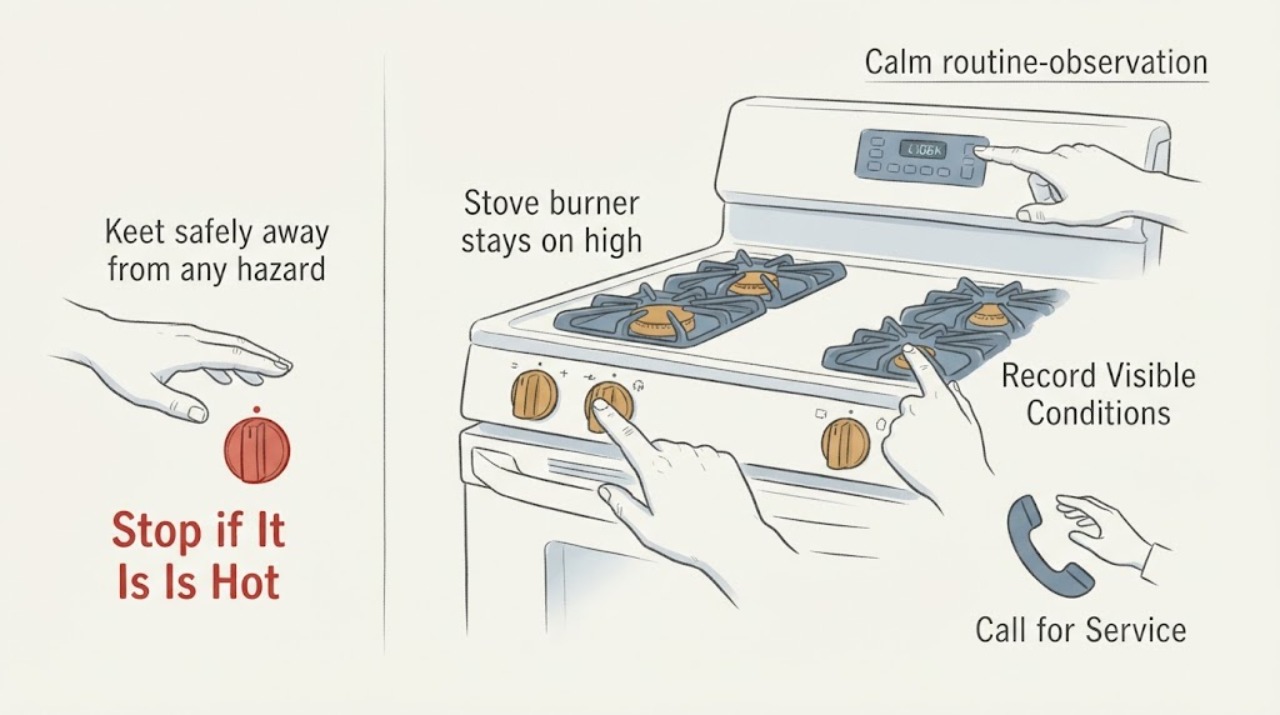
Work through in order
Diagnostic checks
Use only checks that match the exact appliance or system and its official guide.
-
Check 1
Turn the affected burner control to OFF once and step back, observing from a safe position whether an electric element stops visibly energizing or a gas flame goes out; do not touch the hot surface or repeat the test.
Expected result: The burner may stop normally, continue glowing or heating after OFF, or a gas flame may remain after the knob reaches OFF.
Next step: If heat or flame continues, stop using the stove; for an electric range, switch off the range breaker if safely accessible and arrange appliance service.
Stop if: Stop immediately for continued heat at OFF, a remaining flame, smoke, sparks, burning odor, gas odor, or an appliance that behaves unpredictably.
Why this matters
Why: Normal shutoff supports a possible setting or cycling misunderstanding. Continued heat or flame at OFF is a control or appliance fault until a technician determines otherwise.
-
Check 2
From the floor or a safe standing position, record whether the burner is electric coil, radiant glass, or gas and whether the heat behavior is steady or cycles while the control remains at a selected setting; do not lift grates, touch the element, or disturb cookware.
Expected result: An electric burner may cycle on and off during normal operation, while a burner that remains active after OFF is a different result; a gas flame should not be treated as an electric cycling symptom.
Next step: Write down the fuel type, burner position, control setting, and whether the activity stopped at OFF, then keep the appliance out of use if the result is abnormal.
Stop if: Stop if the surface is unexpectedly hot, the flame continues, there is gas odor, smoke, sparking, or any need to touch or open the appliance.
Why this matters
Why: Cycling at a selected setting can be normal for electric ranges, but failure to stop at OFF requires service. Fuel type changes the safe shutdown and diagnostic path.
-
Check 3
With the appliance not being operated, look only at the affected knob and control markings and note whether the knob appears aligned with OFF, loose, cracked, or unable to reach its normal stop; do not pull it off or open the control panel.
Expected result: The knob may appear correctly aligned, be visibly damaged or loose, or stop short of the OFF marking while the burner remains active.
Next step: Photograph the control face and record the burner location and model marking for the technician; do not try to correct the knob or control position yourself.
Stop if: Stop if the knob is hot, the panel is damaged, the control cannot be moved normally, or the appliance remains energized after OFF.
Why this matters
Why: A damaged or misaligned knob can make the displayed setting unreliable, while a correctly positioned OFF control with continued heat points toward an internal control or valve fault.
-
Check 4
Without touching the cooktop, note any hot-surface, burner-on, or control-panel indicator after all controls are set to OFF and the appliance has had time to cool; do not use the indicator alone to justify continued operation.
Expected result: The indicator may remain on briefly after use, go out as the surface cools, or remain on while all burners are off and cool.
Next step: Record the indicator label and the relationship between the indicator and actual burner heat, then keep the stove out of use if the behavior is abnormal.
Stop if: Stop if the surface is still heating, the indicator conflicts with an active burner, there is smoke, odor, sparking, or a breaker event.
Why this matters
Why: Some indicators are time- or sensor-based and can remain on after normal use. An indicator that remains on with all burners off and cool, or a burner that will not turn off, supports a service call.
-
Check 5
Decide whether the stove can remain safely out of service until a qualified appliance technician evaluates it; do not remove a switch, element, knob, wiring, or panel and do not measure live voltage.
Expected result: The burner may have shut off normally, or it may have remained active at OFF, produced an abnormal flame, or caused heat, odor, smoke, sparks, or repeated breaker trips.
Next step: Provide the technician with model information, fuel type, burner position, control behavior, indicator behavior, and any safety event; keep children and cookware away from the appliance.
Stop if: For continued heat or flame at OFF, smoke, burning or gas odor, sparks, or repeated trips, stop using the stove, use the electric breaker only if safely accessible, leave the area if necessary, and obtain professional or emergency help.
Why this matters
Why: A burner that stays on high or remains active at OFF is not resolved by continued use. Red flags increase urgency and require safe de-energizing and professional assessment.
Use your observations
Decision map
Find the observation that best matches what you see, then follow the next safe action.
-
PATH 01Next step
What you see
An electric burner cycles while set to a selected heat level but stops when its control is turned OFF.
Do this next
Treat the cycling as potentially normal for that electric range and consult the model manual for expected operation; arrange service if cooking control remains abnormal.
-
PATH 02Next step
What you see
An electric burner remains hot or visibly energized after OFF, or a gas flame remains after OFF.
Do this next
Keep the stove out of use. For an electric range, switch off the identified breaker if safely reachable; for a gas flame or gas odor, move away and use qualified or emergency help as appropriate.
-
PATH 03Next step
What you see
The knob is visibly damaged, loose, or does not align with OFF.
Do this next
Tell the technician exactly how the knob moves and provide a model photograph; do not pull it off or replace it as a guess.
-
PATH 04Next step
What you see
Smoke, burning odor, gas odor, sparks, visible damage, or repeated breaker trips occur.
Do this next
Stop using the stove, de-energize only from a safe accessible control or breaker when applicable, leave the area if needed, and obtain professional or emergency assistance.
Helpful context
Understand the symptom
First make the appliance safe
Move the affected control to OFF and keep hands, cookware, and combustible items away from the hot surface. If an electric element continues heating, use the range breaker only if it is clearly identified and safely reachable. Do not lean over the cooktop, touch the element or flame, or continue a test to see whether it eventually stops.
Do not confuse cycling with a stuck control
Electric coil and radiant elements can cycle on and off to regulate heat even when a selected setting is high. The important distinction is whether the burner actually de-energizes when its control is OFF. A burner that remains active at OFF, or an indicator that remains on after the surface is cool, needs model-specific service rather than a new setting or repeated test.
Use observations to separate the likely paths
From a safe position, note whether the issue is limited to one control, whether the knob reaches its OFF marking, whether a light or display reports a hot surface, and whether the appliance is electric or gas. These observations can point a technician toward a control, element, indicator, or gas-valve evaluation, but they cannot safely identify a failed part by themselves.
Leave internal work to service
An infinite switch, surface element, control knob, wiring, or gas valve may look like a possible cause depending on the model. Do not remove panels or controls to inspect them. Provide the technician with the model information, the burner location, the control position when heat continued, and any odor, smoke, sparking, or breaker event.
Only after diagnosis
Potential parts
- stove infinite switch
This part is relevant only if a technician confirms that the electric surface control is failing to regulate or shut off the burner.
Match the exact range model, control type, terminal arrangement, and electrical specifications; do not select a switch from the symptom alone. - stove surface element
A surface element may apply only when the technician confirms the element is damaged or incompatible rather than the control that feeds it.
Confirm range model, element style, size, connector, and manufacturer fit information before selecting a part. - stove control knob
A knob is relevant only when the visible knob is cracked, loose, or no longer indexes the control correctly and the underlying control is sound.
Match the exact model, shaft interface, markings, and knob geometry; a similar-looking knob may misrepresent the OFF position.
When checks do not resolve it
Need a professional?
Arrange a qualified appliance technician when a burner stays active at OFF, the knob does not align or control normally, the hot-surface indication conflicts with the burner state, or any internal control, element, wiring, or valve fault is suspected. Obtain urgent or emergency help for smoke, fire, gas odor, sparks, or dangerous heat.
Safety scope: Do not continue cooking, remove knobs or panels, access a switch or element, disconnect wiring, measure live voltage, or work on a gas valve. For an electric stove, use the breaker only if it is safely accessible; do not rely on a control that has failed to shut off the burner.
Have this ready
- Provide the stove model and fuel type, affected burner position, control setting and OFF behavior, whether heat cycles or stays steady, knob alignment, indicator behavior, and any odor, smoke, spark, or breaker event. Keep the appliance out of use until assessed.
Common questions
FAQ
Is it normal for an electric burner to cycle while set on high?
Electric coil and radiant burners can cycle on and off during normal temperature control, including at a high setting. The important distinction is whether the burner stops when its control is OFF; continued heat at OFF needs service.
What should I do if the burner stays on after I turn the knob to OFF?
Stop using the stove. For an electric range, switch off the range breaker if it is safely accessible and arrange a qualified appliance technician. Do not remove the control or continue testing. A gas flame that remains after OFF is also a stop-use condition.
Could the control knob be the problem?
A cracked, loose, or misaligned knob can make the displayed setting unreliable, but it does not prove the underlying control is sound. Photograph it in place and let a technician determine whether the knob, switch, element, or valve needs attention.
Why is the hot-surface light still on after the burner is off?
Some indicators are time- or sensor-based and can remain on while the surface cools. If every burner is off and cool but the indicator remains on, or the burner itself continues heating, keep the appliance out of use and request service.
Read the exact guide
Official sources
- Electric Range & Cooktop - Radiant Top Surface Burner Turns On and OffGE Appliances · Applies to radiant glass cooktops as a general operating explanation; it does not authorize opening or testing a range.
- Electric Range & Cooktop - Surface Burners Cycle On and OffGE Appliances · Supports distinguishing cycling at a selected heat setting from a burner that remains active at OFF; exact behavior depends on the model.
- Electric Range - Hot Surface IndicatorGE Appliances · Supports interpreting a hot-surface indicator and escalating when a burner will not turn off; model-specific manual information controls.
Community feedback
Share a repair observation
Share a plain-text repair observation. Accepted observations are published automatically; this page may take a moment to update.