
On this page
Start here
Quick answer
First identify whether the Frigidaire stove has a gas, electric coil, radiant glass, or induction surface and whether one burner or all burners are affected. A gas burner must produce a stable flame; an electric coil should heat after its center safety switch and socket are seated; a radiant glass element can require a reset; an induction zone heats only when compatible cookware is correctly placed. For gas, check the knob, cap, burner ports, moisture, and ignition area with the appliance off and cool. For an electric coil, compare the suspect coil with a known-good burner by swapping positions only when the coils are cool. For glass or induction, use the exact model instructions and avoid opening the cooktop. Stop for a gas odor, damaged glass, exposed wiring, tripped power, sparking, or a burner that remains unsafe after the external checks.
Before you begin
Safety first
- A qualified technician should diagnose gas valves and ignition, live electrical circuits, coil receptacles, radiant elements, induction controls or sensors, cracked glass, and any internal disassembly.
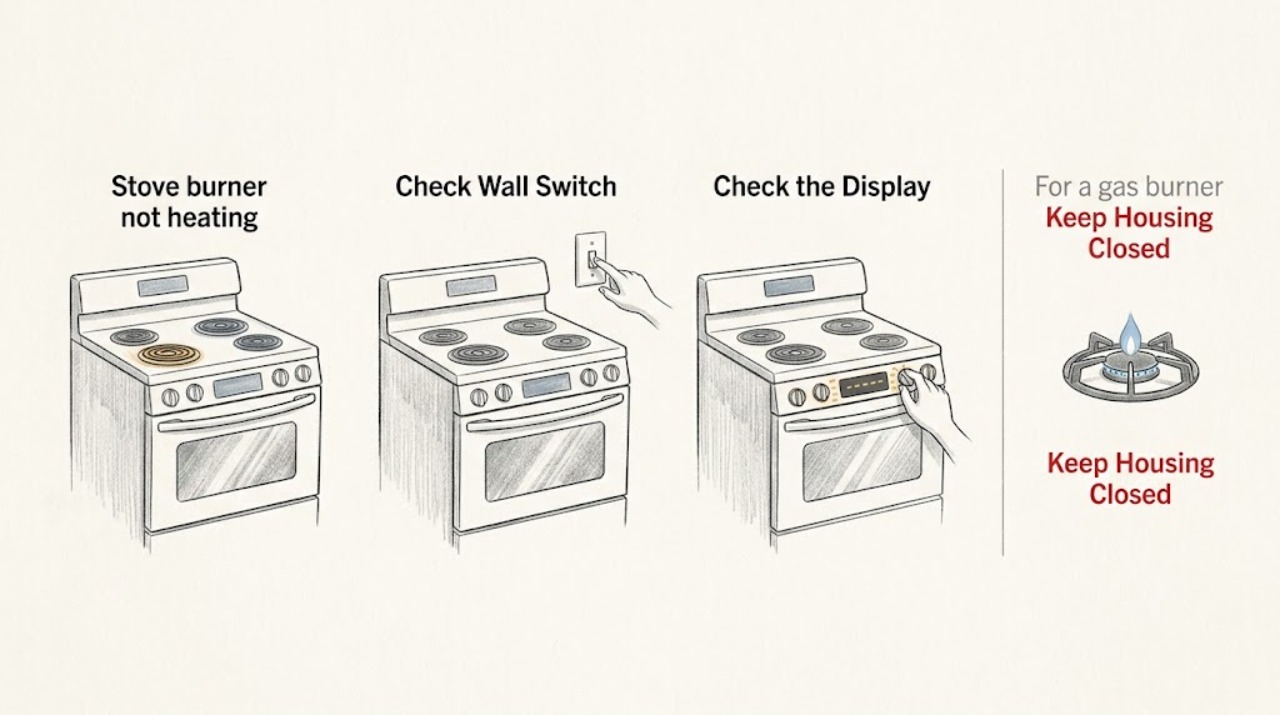
Work through in order
Diagnostic checks
Use only checks that match the exact appliance or system and its official guide.
-
Check 1
Turn all surface controls off, let the burner and cookware cool, keep combustible items away, and if gas is smelled, sparking continues, glass is cracked, or wiring is exposed, leave the appliance off and ventilate without operating switches.
Expected result: There is a gas odor, visible flame outside the burner pattern, repeated clicking or sparking, cracked glass, smoke, exposed wiring, or only a cold burner with no visible hazard.
Next step: For gas odor or an unsafe electrical or glass condition, leave the appliance off, use the home gas or electrical emergency procedure as appropriate, and arrange qualified service. Otherwise continue with the fuel-type check.
Why this matters
Why: Gas, electrical arcing, and damaged ceramic surfaces can create fire, shock, or cut hazards that an external burner check cannot safely resolve.
-
Check 2
Identify the surface as gas, electric coil, radiant glass, or induction and test whether one burner or all burners are affected; note whether any display, igniter, coil, element indicator, or induction control responds.
Expected result: Only one burner is cold, all burners are cold, a gas igniter clicks without flame, an electric coil stays dark, a glass control responds but does not heat, or an induction control shows no pan detection.
Next step: Follow the gas, coil, glass, or induction branch below. Do not remove panels or test live voltage as a household diagnostic.
Why this matters
Why: One failed burner supports a local cap, coil, element, socket, valve, or sensor branch. All burners being cold raises a supply, control, installation, or lockout concern. The response pattern determines which technology-specific check is safe.
-
Check 3
For a gas burner, with the cooktop off and cool, confirm the knob reaches the model's Lite position, the cap is level and seated on the burner head, and visible ports or slots are not blocked by residue or moisture.
Expected result: The cap is mis-seated, ports are dirty or wet, the power cord is disconnected, the burner lights with a stable flame after cleaning, or the burner still will not ignite or heat.
Next step: Clean and dry only the accessible burner head and slots using the exact manual and a non-abrasive method, then reseat the cap. If gas is released without ignition, the flame is abnormal, or the burner remains cold, turn it off and arrange service.
Why this matters
Why: Frigidaire identifies cap placement, clear ports, and power connection as basic gas-burner conditions. A stable flame after reseating supports a placement or blockage issue; persistent failure may involve ignition, gas delivery, or a valve.
-
Check 4
For an electric coil range, when the coil is fully cool, press and release the center safety switch, inspect the coil for visible damage, reseat it, and swap it with a known-good coil position only if the manual and connector design allow that comparison.
Expected result: The switch does not spring back, the coil is visibly damaged, the suspect coil works in another socket, the known-good coil fails in the suspect socket, or both coils work normally after reseating.
Next step: Stop using a damaged coil or failed socket. Arrange service for the switch, receptacle, control, wiring, or supply; do not remove the rear panel or probe the receptacle while energized.
Why this matters
Why: A damaged or non-seated coil points to the coil or safety-switch branch. A coil that follows the socket points toward the coil; a known-good coil failing in one position points toward the receptacle, control, or circuit.
-
Check 5
For a radiant glass cooktop, perform the model-approved 30-second power reset and then test a flat-bottomed, medium- to heavy-weight pan; do not cook on or press a cracked surface.
Expected result: The controls recover after reset, one element remains cold, all elements remain cold, the pan heats unevenly, or the surface is cracked or shows a hot spot.
Next step: Use the exact model manual for element or control diagnosis. If a new installation has no heat, have the installation voltage and wiring checked by a qualified professional; stop immediately for cracked glass or abnormal heat.
Why this matters
Why: A reset can clear a control state, while unsuitable cookware can make heating appear poor. One or all cold elements after reset suggests an element, control, wiring, or installation issue rather than pan choice.
-
Check 6
For an induction zone, center the model-approved magnetic cookware on the marked zone, select the zone and a heat level according to the manual, and observe whether the pan is detected and begins heating.
Expected result: The pan is not detected, a smaller or non-magnetic pan fails while an approved pan heats, the control responds but the approved pan remains cold, or every zone fails.
Next step: Try only the approved cookware and placement. If an approved pan is not detected, one zone remains cold, or all zones fail, stop using the surface and arrange model-specific appliance service.
Why this matters
Why: Induction heating depends on cookware detection and pan placement. A pan-specific failure is different from a zone, control, or power failure affecting multiple zones.
Use your observations
Decision map
Find the observation that best matches what you see, then follow the next safe action.
-
PATH 01Next step
What you see
A gas burner releases gas without a stable flame, smells of gas, lights outside the cap, or continues clicking after the control is off.
Do this next
Turn the control off, do not relight or disassemble the burner, ventilate as appropriate without operating electrical switches, and arrange qualified gas-appliance service.
Why this path and its safety boundary
Why it matters: The problem may involve ignition, gas flow, a wet or blocked burner, or a valve/control fault, and repeated ignition attempts can accumulate gas.
-
PATH 02Next step
What you see
A gas cap is mis-seated or ports are dirty or wet, and the burner produces a normal stable flame after the accessible clean-and-reseat check.
Do this next
Let the burner remain dry and use it normally. If the flame becomes uneven, high, yellow, or fails again, stop and use the model-specific service procedure.
Why this path and its safety boundary
Why it matters: Cap placement, moisture, or residue was more likely than a failed gas valve or igniter.
-
PATH 03Next step
What you see
An electric coil fails in one position but works in another, or a known-good coil fails in the suspect position.
Do this next
Stop using the failed position and arrange appliance service for the component indicated by the swap; do not open the range to test it yourself.
Why this path and its safety boundary
Why it matters: The result separates a coil fault from a socket, switch, control, wiring, or supply fault without live electrical testing.
-
PATH 04Next step
What you see
A glass cooktop resumes heating after the 30-second reset, or a suitable flat-bottomed pan heats while another pan performs poorly.
Do this next
Continue with the approved cookware and settings. If the same element stays cold, all elements remain cold, or abnormal hot spots appear, arrange service and check installation through a professional.
Why this path and its safety boundary
Why it matters: A temporary control state or cookware mismatch is more likely than a failed element, provided the surface is intact and heat is normal.
-
PATH 05Next step
What you see
An induction zone does not detect an approved pan, or multiple zones remain cold after correct placement and controls.
Do this next
Stop repeated tests, keep the surface off, and arrange model-specific appliance service. Do not remove the glass or test internal voltage.
Why this path and its safety boundary
Why it matters: A pan-detection, zone sensor, control, or power issue is more likely than ordinary cookware performance.
Helpful context
Understand the symptom
Identify the surface technology before testing
A gas flame, red-hot electric element, and induction zone fail in different ways. Check the owner's manual or model label if the surface is not obvious. Note whether one burner is cold or every burner is cold, and whether the control display, igniter, coil, or pan detector responds. Do not use a metal pan or a flame test to diagnose an unknown surface.
Gas: flame, cap, ports, and ignition
With the cooktop off and cool, verify the knob reaches Lite when the burner is intentionally started, the cap is level on the burner head, and visible ports are not blocked by food residue or moisture. Frigidaire's cleaning guide permits hot soapy water and a soft brush for the head and slots, with a small non-sharp ignition-port tool where appropriate. Dry and reseat the cap before trying again. Never keep releasing gas when a burner does not ignite.
Electric coil: use a swap as a diagnosis
On a cool coil range, inspect the center safety switch and visible coil damage, then reseat the coil. If the coil still does not heat, Frigidaire recommends swapping it with another burner to distinguish a failed coil from the receptacle or control serving that position. A coil that works in one socket but not another points away from the coil itself and toward the range circuit or receptacle.
Glass radiant: reset and cookware check
Frigidaire's no-heating guidance suggests a 30-second power reset for a glass cooktop. If the surface was recently installed and no burners heat, voltage or wiring may need attention. A suitable pan matters for cooking performance: use a flat-bottomed, medium- to heavy-weight pan and do not mistake uneven cookware for a dead element. A cracked glass surface is not a DIY electrical repair.
Induction: the pan is part of the circuit
An induction zone can appear not to heat while the pan is not detected. Frigidaire says induction begins when cookware is properly placed and uses magnetic and pan-size detection. Center a compatible pan on the marked zone and follow the exact model's control and cookware instructions. The surface can remain relatively cooler than the pan, so judge heating by the cookware and food, not by expecting a radiant element to glow red.
Safety boundary
Stop conditions
- Stop immediately for a gas odor, flame outside the burner pattern, repeated unignited gas, smoke, sparking, or a control that will not turn off; follow the home's gas or electrical emergency procedure and arrange qualified service.
- Do not open the range, probe a live receptacle, bypass a coil safety switch, or test wiring unless you are qualified and following the exact service manual.
- Do not cook on cracked glass, use abrasive or oven-cleaner products around a gas burner, or force a cap, coil, knob, pan, or induction surface into place.
- Stop if every burner is cold after the model-approved reset or a recently installed unit has a suspected voltage, wiring, or gas-supply problem; installation and supply diagnosis require a professional.
- Arrange service when a correct gas cap and port cleaning, coil swap, glass reset, or approved induction-pan check does not restore heat, or when the failure returns.
Only after diagnosis
Potential parts
- gas burner cap or burner head
Consider this only when the exact gas model has a damaged or missing cap or burner head after confirming that the cap is correctly seated and ports are clear.
Match the exact Frigidaire model and burner position; a similar-looking cap can alter flame alignment and safe ignition. - electric surface coil or coil receptacle
Consider a coil only when the cool-coil swap shows the coil itself fails in another position; a failed socket position points toward the receptacle, switch, control, or wiring instead.
Match the exact model, coil wattage and connector, receptacle design, and service instructions; do not assume a universal coil is safe. - radiant or induction surface element assembly
Consider this only after a model-approved reset and cookware check leave one surface zone cold and service diagnosis identifies the element or zone assembly.
Confirm the exact model, radiant versus induction technology, connector, mounting, and glass compatibility before any replacement.
When checks do not resolve it
Need a professional?
Use appliance service for an internal igniter, gas valve, element, coil receptacle, control, sensor, wiring, induction zone, cracked glass, or unresolved all-burner failure; use a qualified installer or electrician for a suspected installation-supply problem and a gas professional for gas-flow concerns.
Safety scope: A qualified technician should diagnose gas valves and ignition, live electrical circuits, coil receptacles, radiant elements, induction controls or sensors, cracked glass, and any internal disassembly.
Common questions
FAQ
Why is one Frigidaire stove burner not heating?
The likely checks depend on the surface. Gas burners need a correctly seated cap and clear, dry ports; an electric coil can be compared by swapping it with a known-good coil; glass and induction zones need model-specific reset, cookware, and control checks.
How do I tell whether a Frigidaire gas burner is blocked?
With the burner off and cool, inspect the cap, burner head, slots, and ignition port for food residue or moisture. Frigidaire recommends non-abrasive cleaning and proper cap seating; never keep releasing gas when the burner will not ignite.
Can I swap electric coil burners to find the fault?
For applicable Frigidaire coil ranges, a cool-coil swap can show whether the problem follows the coil or stays with the receptacle position. A damaged coil or failed position should not be used or electrically probed at home.
Why does my Frigidaire induction burner stay cool?
Induction heats the cookware rather than simply glowing like a radiant element. Center compatible cookware on the zone and follow the exact model controls; a pan that is not detected can make the zone appear cold.
When should I stop troubleshooting a Frigidaire burner?
Stop for gas odor, uncontrolled flame, sparking, cracked glass, exposed wiring, suspected supply or installation faults, or a burner that stays cold after the technology-specific external checks. Leave it off and arrange qualified appliance service.
Read the exact guide
Official sources
- What should I do if some or all of my burners are not lighting?Frigidaire · Frigidaire gas range and cooktop models; cap placement and cleaning details vary by owner's manual
- Ranges - No HeatingFrigidaire · Frigidaire electric ranges with coil burners or glass cooktops; exact controls and installation vary by model
- Gas Cooktop Ignition Port Cleaning GuideFrigidaire · Frigidaire gas cooktops and ranges with the described burner-head and ignition-port arrangement
- Induction Ranges - What are the benefits of Induction?Frigidaire · Frigidaire induction ranges; exact pan and control requirements vary by model
Community feedback
Share a repair observation
Share a plain-text repair observation. Accepted observations are published automatically; this page may take a moment to update.