
On this page
Start here
Quick answer
When an Amana stove burner is not heating, first identify whether it is a gas burner, a plug-in electric coil, a smooth-top radiant element, or an induction cooking zone. For gas, turn the control off, let the surface cool, then check only the model-approved cap, base, and ports; any gas odor is an immediate stop condition. For electric or induction, check the correct control, control lock, visible power status, element seating or pan placement as applicable, and the household breaker without opening the appliance. A radiant element can cycle off or look less red while still heating. If one burner remains cold after these model-safe checks, if all burners lost power, a breaker trips again, an induction display reports a fault, or a gas burner smells of gas or will not control its flame, stop using the stove and arrange qualified appliance or electrical service.
Before you begin
Safety first
- This article covers normal controls, cool-surface visual checks, cap or coil seating, model-approved cookware and cooldown observations, and one accessible power reset. Qualified service must handle gas supply or ignition components, live electrical diagnosis, internal wiring, induction electronics, control boards, sensors, and glass or panel removal.
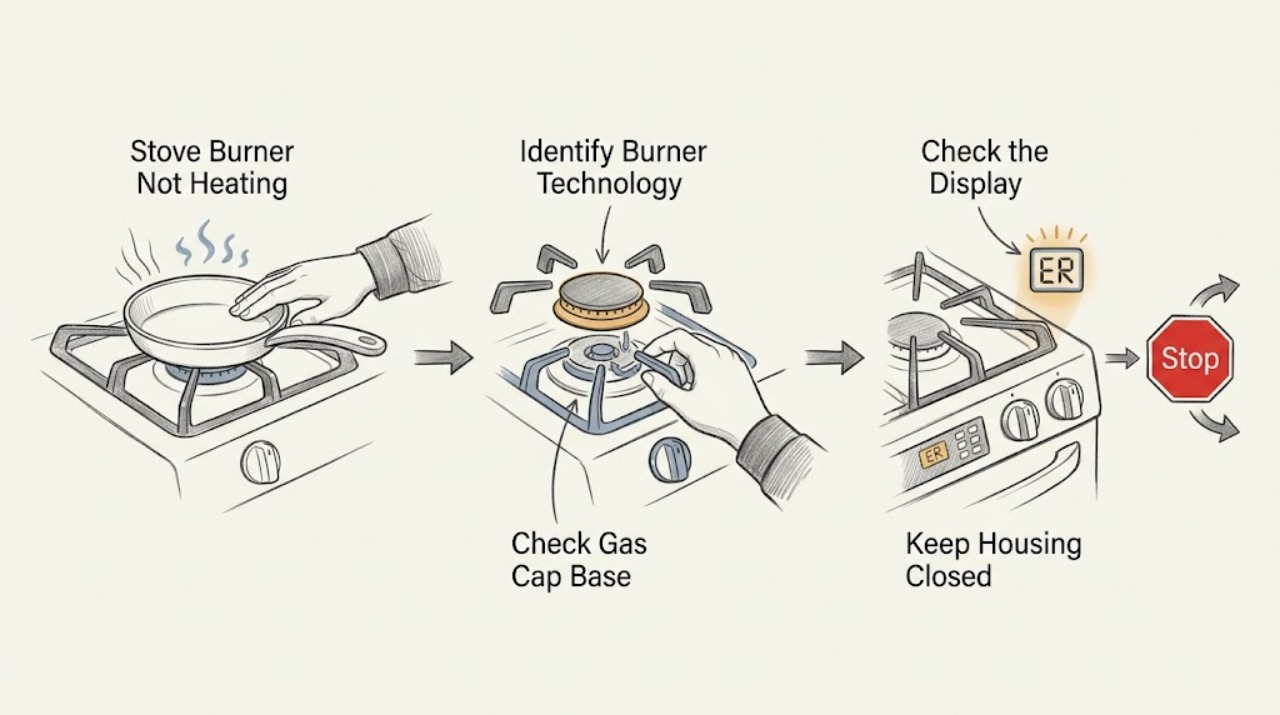
Work through in order
Diagnostic checks
Use only checks that match the exact appliance or system and its official guide.
-
Check 1
With all controls off and the cooking surface cool, identify whether the affected Amana burner is gas, a removable electric coil, a smooth-top radiant element, or an induction zone; locate the exact model instructions before removing or repositioning anything.
Expected result: A flame and cap are present, a plug-in coil is visible, a smooth glass zone is controlled by a knob or touch panel, or the zone uses induction controls and cookware detection.
Next step: Follow the matching gas, electric, smooth-top, or induction branch below. If the model or technology cannot be identified, stop at visual checks and use the owner's manual or qualified service.
Stop if: Do not lift the cooktop, remove panels, touch a hot surface, or test wiring to identify the burner type.
Why this matters
Why: The energy source determines what counts as normal heating and which user checks are safe. A gas burner cannot be diagnosed by looking for a red glow, and a radiant or induction zone may not show a flame.
-
Check 2
For a gas burner, turn every control off and wait until the cooktop is cool; remove only the accessible cap and base as the model instructions allow, and inspect for spill residue, clogged ports, a mismatched cap, or a cap that is not centered and flush.
Expected result: The port is obstructed, the cap or base is wet or misaligned, the correct cap is seated but there is no ignition, or there is a gas odor or an uncontrolled flame.
Next step: Clean and reseat only as the Amana model guidance permits, then try one normal ignition. If it still will not light, the flame is unstable, or gas is smelled, turn the control off, ventilate without operating switches, leave the area if needed, and obtain qualified gas or appliance service.
Stop if: Do not enlarge ports, use oven cleaner or bleach, use an improvised ignition source, work on a gas line, or continue testing when gas is smelled.
Why this matters
Why: Amana identifies clogged ports and incorrect cap or base seating as common gas-burner causes. A correctly seated, clean burner with no ignition or a gas odor shifts the problem toward ignition, gas supply, or a control fault.
-
Check 3
For a removable electric coil, confirm the control is set for the affected burner and that the cool coil is fully inserted into its receptacle; check the household breaker or fuse status from the electrical panel without opening the range.
Expected result: The coil was not seated, the knob or touch control was wrong or locked, one burner is cold while others heat, or several burners are cold and the breaker is open.
Next step: Reseat the cool coil and restore a tripped breaker only once if it operates normally, then try the burner using the model control. If the breaker trips again, the receptacle is damaged, or the coil remains cold, stop and arrange electrical or appliance service.
Stop if: Do not handle a hot coil, remove the receptacle, open the control area, replace an unknown fuse, or repeatedly reset a tripping breaker.
Why this matters
Why: Amana lists control settings, coil insertion, and the household power path as separate checks. One cold burner suggests a local element or control path; several cold burners suggest shared power, control, or wiring rather than a single coil.
-
Check 4
For a smooth-top radiant burner, use the correct model control and observe the cooking zone from a safe distance with a suitable pan; note whether it heats while the glow cycles off, whether only a warming or simmer zone is selected, or whether the pan never warms.
Expected result: The zone heats while the red glow cycles, the selected setting is warming or simmer, the zone does not cycle back on, or the pan remains cold throughout the test.
Next step: Remove the pan and let the cooktop cool if the element stopped during use, then try the documented setting once more. If the zone remains cold, shows a fault, or the glass is cracked, keep it off and arrange qualified service.
Stop if: Do not touch the glass or element to check heat, place an empty pan on it, scrape the surface while hot, or remove the glass top.
Why this matters
Why: Amana says radiant elements can cycle off even at high settings and that some zones or settings may not glow red. A zone that never reheats or never warms after the normal control and cooldown behavior is more likely to have a local element or control fault.
-
Check 5
For an induction zone, clear the touch panel, confirm the correct zone and power setting, make sure control lock is off, and place cookware as the exact Amana manual requires; watch the display for a no-pan, overheat, or other status message rather than expecting a visible flame or coil glow.
Expected result: The control was locked, the pan was not centered or recognized, a status message clears after moving the pan or allowing a cooldown, or the zone stays inactive with correct settings and cookware.
Next step: Follow the exact model manual for cookware and display messages, then retry once after the documented cooldown or reset. If the message returns or the zone remains cold, stop using that zone and arrange appliance service.
Stop if: Do not place metal tools on the zone, defeat a control lock, open the cooktop, or diagnose the induction module or sensors yourself.
Why this matters
Why: Induction and electronic cooktops can withhold heat for a control, cookware-detection, or protection condition. A persistent inactive zone with correct settings and no warning is more consistent with a control, sensor, or power fault than a normal glow cycle.
-
Check 6
If multiple electric or induction burners stopped together and there is no smoke, heat damage, or active fault, use the home's accessible electrical panel to turn the range circuit off and back on once, following Amana's model guidance; do not remove the range cover.
Expected result: All affected burners recover, only one burner remains cold, the breaker will not stay on, or a fault display returns after the reset.
Next step: Stop after one reset. Use an electrician for a recurring breaker or supply issue and qualified appliance service for a local element, control, sensor, or display fault.
Stop if: Do not repeatedly cycle the breaker, reset around smoke or burning odor, or probe the range's wiring or terminal block.
Why this matters
Why: Recovery after a normal power reset points toward a temporary control state. A single persistent cold burner points toward a local element or control, while a recurring breaker trip or fault display indicates an electrical or electronic problem.
-
Check 7
Compare the affected burner with a neighboring burner of the same technology using the normal controls only; record whether the issue is one burner, one element ring, all burners, ignition only, slow heating, or a displayed message, along with the exact model number.
Expected result: Only one burner fails, one ring of a dual or triple element fails, every burner fails, gas ignition is absent but gas is present, or the symptom changes with cookware or control setting.
Next step: Keep the affected burner off if it is abnormal and provide the model, technology, symptom pattern, breaker behavior, and any display message to qualified appliance or electrical service.
Stop if: Do not swap live parts, bypass an igniter or sensor, test concealed gas flow, or continue using a burner with a damaged surface or uncontrolled flame.
Why this matters
Why: The pattern helps a technician separate a local element, switch, igniter, burner cap, or sensor from shared power, control, gas-supply, or installation problems. It does not identify a replacement part by itself.
Use your observations
Decision map
Find the observation that best matches what you see, then follow the next safe action.
-
PATH 01Safety boundary
What you see
The stove is gas, the affected burner has a wet, clogged, mismatched, or misaligned cap or base, and other burners operate normally.
Do this next
With controls off and the surface cool, clean and reseat only the model-approved cap and base, then try one normal ignition. Arrange service for persistent no-ignition, an unstable flame, or any gas odor.
Why this path and its safety boundary
Why it matters: A local gas-flow or ignition-path issue is more likely than a shared electrical failure.
Safety stop: Do not enlarge ports, use chemicals, improvise ignition, or work on the gas supply.
-
PATH 02Safety boundary
What you see
One removable coil remains cold after the correct control and full insertion are confirmed, while neighboring electric burners heat.
Do this next
Leave the burner off and have a qualified technician identify the model-compatible element, receptacle, control, or wiring fault.
Why this path and its safety boundary
Why it matters: The local coil, receptacle, switch, or wiring path is more likely than the range's shared power supply.
Safety stop: Do not open the range, handle a hot coil, or swap parts as a live diagnostic.
-
PATH 03Safety boundary
What you see
Several electric or induction burners stopped together, a breaker is open or trips again, or a power reset does not restore operation.
Do this next
Stop resetting. Use an electrician for the household circuit and qualified appliance service for the range control, terminal, or internal wiring.
Why this path and its safety boundary
Why it matters: A shared supply, control, wiring, or electronic fault is more likely than multiple independent burner failures.
Safety stop: Do not repeatedly reset a breaker or remove electrical covers.
-
PATH 04Safety boundary
What you see
A smooth-top radiant zone heats the pan but its visible glow cycles off, or a warming or simmer setting does not glow red.
Do this next
Judge the zone by cooking performance and the model setting. If the pan never warms, the zone fails to cycle back on after the documented cooldown, or the glass is damaged, stop using it and arrange service.
Why this path and its safety boundary
Why it matters: The observed behavior is consistent with Amana's temperature-limiting or low-setting operation rather than a dead burner.
Safety stop: Do not touch the surface to confirm heat or leave an empty pan on the zone.
-
PATH 05Safety boundary
What you see
An induction zone remains inactive with the correct control, unlocked panel, model-approved cookware, and no temporary status or cooldown condition, or a fault returns after the documented reset.
Do this next
Keep that zone off, record the model and display message, and arrange qualified appliance service. Use an electrician if the household circuit itself trips or will not stay energized.
Why this path and its safety boundary
Why it matters: Cookware detection, a sensor, control, power module, or other electronic fault is more likely; the symptom cannot identify the failed component.
Safety stop: Do not defeat the control lock, open the cooktop, or probe induction electronics.
Helpful context
Understand the symptom
Identify the heating technology before troubleshooting
A gas burner should produce a controlled flame, a coil or radiant electric element uses resistance heat, and an induction zone is controlled electronically and may not glow red. Amana's support paths are different for each design. Use the model label and owner's manual to identify the appliance before removing a cap, lifting a coil, or changing a touch-control setting.
A dark electric element is not automatically a failed element
Amana says radiant elements can cycle on and off to limit surface temperature, and some settings or warming zones may not glow red. Judge performance by whether the pan heats in the selected mode, not by a momentary absence of red light. A coil that never heats, is not seated, or is isolated to one control needs a different branch.
Gas cap and port alignment change the flame path
On an Amana gas surface burner, a wet or obstructed port, the wrong cap, or a cap that is not centered can prevent ignition or produce an uneven flame. Clean only with all controls off and the surface cool, and reinstall the correct cap flush with its base. A gas smell, uncontrolled flame, or suspected supply issue is not a cleaning experiment.
Power and controls are shared clues for electric and induction models
If several electric or induction zones stop together, check the normal controls, control lock, and household power path. Amana recommends a model-specific power reset before service, but the reset does not authorize opening the cooktop or measuring live circuits. A recurring breaker trip or persistent display fault belongs with an electrician or qualified appliance technician.
Safety boundary
Stop conditions
- For a gas burner, turn the control off and stop using the stove for a gas odor, uncontrolled flame, damaged gas component, repeated ignition failure with gas present, or any suspected supply leak.
- For electric or induction burners, stop for smoke, burning odor, sparking, a cracked glass surface, exposed wiring, a hot or damaged receptacle, or a breaker that trips again.
- Do not touch hot elements, remove electrical covers, probe wiring, bypass sensors or control locks, or work on gas piping as a user check.
- Do not enlarge gas ports, use oven cleaner or bleach on gas components, use an improvised ignition source, or place an empty pan on a heating zone.
- Do not repeatedly reset the breaker or appliance. After one model-approved reset and the basic control, seating, cap, cookware, or cooldown checks, arrange qualified service for a persistent fault.
- Use the exact Amana owner's manual for model-specific settings, dual or triple element behavior, induction cookware requirements, and any error message before ordering a part.
Only after diagnosis
Potential parts
- Amana gas burner cap or burner base
Consider only when the affected gas burner has a damaged or model-mismatched cap or base after cleaning and alignment are confirmed.
Cap shape, base, alignment features, and burner position vary by model; confirm the exact Amana documentation before replacement. - gas burner igniter or electrode
Consider only after a correctly seated, clean burner still fails to ignite and qualified diagnosis identifies the local ignition path.
Igniter style, position, connector, and gas-control system are model-specific; do not diagnose or replace it from the symptom alone. - electric coil or radiant surface element
Consider only when one electric burner remains cold after correct control, insertion, power, and normal cycling checks and a technician confirms the element path.
Element size, connector, limiter, wattage, and mounting vary by model; confirm fitment with the exact Amana model. - surface burner switch or control
Consider only when a qualified diagnosis shows that the correct control is not delivering the expected operation to one burner or element.
Switch type, control interface, connector, and burner circuit are model-specific; internal electrical work is not a user check. - induction cooking-zone sensor or power module
Consider only after correct cookware, unlocked controls, power, cooldown, and model-approved reset checks fail and a technician confirms an electronic fault.
Induction modules and sensors require exact model and revision confirmation; do not open or electrically test the cooktop.
When checks do not resolve it
Need a professional?
Arrange qualified appliance service when one Amana burner remains cold after the correct control, cap or coil seating, cookware or cooldown, and model-approved reset checks; when an induction message returns; when a radiant zone never reheats; or when the burner requires panel access, wiring diagnosis, sensor work, or a part replacement. Use a qualified electrician for a recurring breaker, damaged outlet, or uncertain household supply. For a gas odor or suspected gas leak, turn controls off, avoid ignition and electrical switches, leave the area if necessary, and use the appropriate gas emergency or professional service pathway.
Safety scope: This article covers normal controls, cool-surface visual checks, cap or coil seating, model-approved cookware and cooldown observations, and one accessible power reset. Qualified service must handle gas supply or ignition components, live electrical diagnosis, internal wiring, induction electronics, control boards, sensors, and glass or panel removal.
Common questions
FAQ
Why is only one Amana stove burner not heating?
One failed burner points toward a local cap, port, igniter, coil, element, switch, sensor, or connection rather than a total power loss. Identify the fuel technology, perform the cool-surface and control checks for that design, and arrange service if the burner remains cold.
Why does my Amana electric burner stop glowing red?
Amana says radiant elements cycle on and off to limit surface temperature, and warming or simmer settings may not glow red. If the pan still heats, the cycling can be normal; if it never reheats or the pan stays cold, stop using that zone and arrange service.
What should I check when an Amana gas burner will not heat?
With controls off and the surface cool, check the correct cap and base, alignment, cleanliness, and visible port blockage as the Amana guide allows. If it will not ignite, gas is smelled, or the flame is uncontrolled, turn it off and obtain qualified gas or appliance service.
Why is my Amana induction burner not heating the pan?
Check the exact model's cookware and control instructions, control lock, pan placement, and any no-pan or fault message. If correct cookware and settings still leave the zone inactive after the documented reset or cooldown, the sensor, control, or power module needs qualified service.
Can I reset an Amana stove when a burner will not heat?
If the problem affects electric or induction controls and there is no smoke, burning odor, or active fault, Amana documents a model-approved power reset. Use it once from the accessible breaker panel; do not repeatedly reset a breaker that trips again or open the appliance.
When should I call for Amana stove burner service?
Call when one burner remains cold after the correct control and model-safe seating or cookware checks, when several burners fail or the breaker trips, when an induction message returns, or when a gas burner has an odor, unstable flame, or ignition fault. Internal electrical, gas, sensor, and control work belongs with qualified service.
Read the exact guide
Official sources
- Not Powering On - Electric and Induction CooktopAmana · Official Amana guidance for electric and induction cooktops that do not power on; follow the exact model manual for cookware detection and display messages.
- Cooktop Not Working - Electric CooktopAmana · Official Amana guidance for smooth-top electric cooktops; exact settings and element behavior vary by model.
- Coil Element Not WorkingAmana · Official Amana guidance for electric coil elements on cooktops and freestanding ranges; model-specific controls and service procedures are in the owner's manual.
- None of the Burners are Lighting - Product HelpAmana · Official Amana troubleshooting for gas range or cooktop burners that do not light; exact controls and supply arrangement remain model-specific.
- Burner Not Lighting - Gas CooktopAmana · Official Amana Product Help guidance for gas cooktop surface burners; use the exact range or cooktop manual for the installed model.
- Burners Not Glowing - Glass CooktopAmana · Official Amana Product Help for glass cooktop burners that do not glow; glow is not the only indicator of heating and controls vary by model.
- Manuals and GuidesAmana · Official Amana owner resource for locating manuals and documents by model number; use the model document for exact burner technology and procedures.
Community feedback
Share a repair observation
Share a plain-text repair observation. Accepted observations are published automatically; this page may take a moment to update.