
On this page
Start here
Quick answer
For an electric stove, first determine whether one surface burner is cold or all burners are cold, and whether it is a plug-in coil, a radiant element beneath glass, or an induction element. From a cool, dry range, confirm the correct control is selected and check the external breaker or fuse without opening the appliance. A plug-in coil that remains cold in a known-good same-size socket points toward the coil; a socket that fails with a known-good coil, all burners that fail, a recent installation, or a range whose clock works while the top burners do not points toward the receptacle, wiring, controls, or supply. A cracked element, sparks, burning-plastic odor, damaged cord, wet connection, or any burner that will not turn off is a stop condition. Do not open the range, move hard-wired elements, test live terminals, or continue using a damaged unit; arrange qualified appliance or electrical service.
Before you begin
Safety first
- This article supports identifying the element type, confirming the marked control, checking an external supply from a dry safe position, checking accessible external damage, and comparing removable plug-in coils only when the model instructions and power-disconnected condition permit. A qualified professional should handle hard-wired or tilt-lock elements, glass or induction disassembly, live electrical tests, supply wiring, receptacles, controls, and internal repairs.
Work through in order
Diagnostic checks
Use only checks that match the exact appliance or system and its official guide.
-
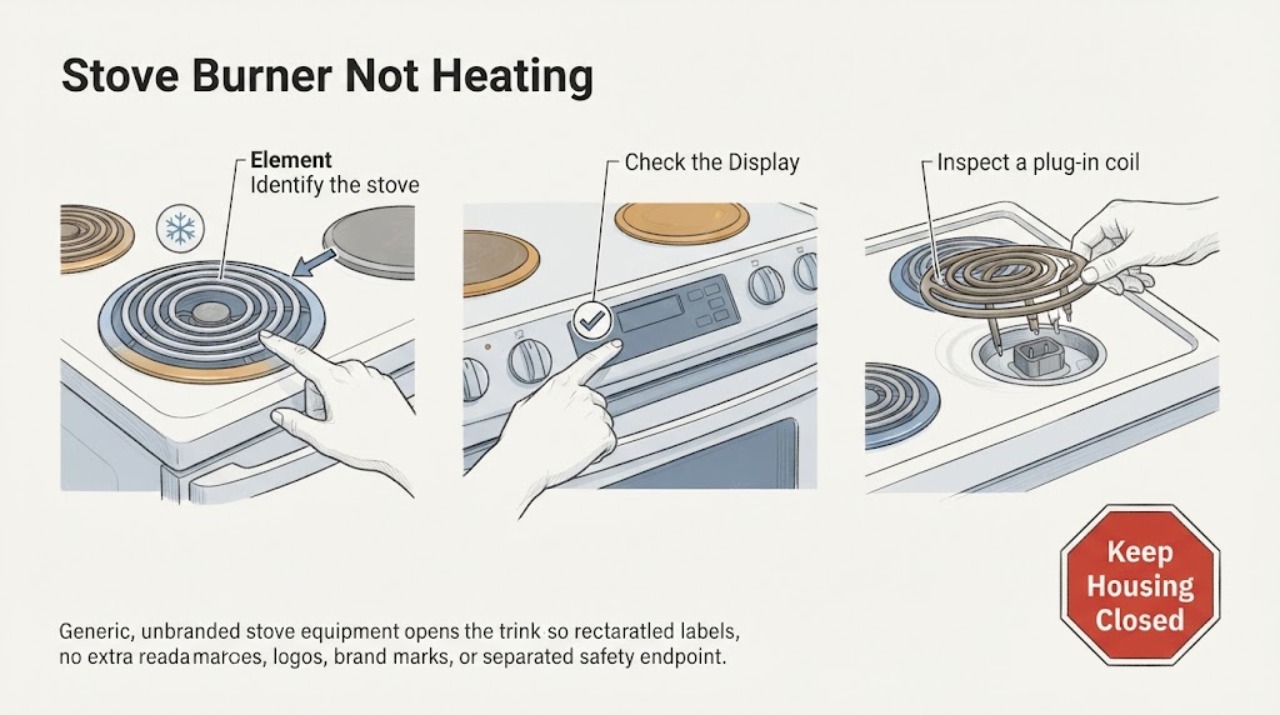
Identify the stove and the scope of the cold element
Let the cooktop cool completely, then record whether the stove is electric coil, smooth radiant, or induction, whether one burner or all surface burners stay cold, and whether the clock, oven, or other controls still work. Match each knob or touch control to its marked burner before trying any test.
Expected result: One element is cold; several or all elements are cold; the clock works while the top burners do not; the wrong control was selected; or the cooktop is induction and cookware is not detected.
Next step: Use the applicable branch below. If the range is hard-wired, recently installed, or has any damaged cord or connection, stop at identification and arrange qualified service.
Stop if: Do not lift a glass cooktop, expose wiring, or continue if there is smoke, arcing, heat damage, water, or a burning odor.
Why this matters
Why: One cold element points toward that element, socket, control, or branch connection. All cold elements or a clock-versus-burner mismatch points toward range supply or installation. A control mismatch or induction cookware-detection state can imitate a failed element.
-
Check the external power and control state
From a dry, safe position, confirm the range's external breaker or fuse is on and that no control lockout or timer state is preventing heating. Look at the power cord and accessible wall connection only if they can be seen without moving the range or opening a panel; do not remove a fuse, pull a hard-wired range, or touch exposed terminals.
Expected result: The breaker or fuse is off; it trips again; the cord or receptacle is loose or damaged; the range was recently installed; or the external supply looks normal while the burner remains cold.
Next step: If the supply device is clearly off and there is no hazard, follow the model instructions for one safe restoration attempt. If it trips again or the connection is damaged, leave the range off and call qualified electrical service.
Stop if: Do not repeatedly reset the breaker, substitute a larger fuse or breaker, open the range, or repair a cord or receptacle as a homeowner test.
Why this matters
Why: A supply, installation, or cord problem can affect surface burners even when some controls still operate. A repeated trip or damaged connection is an electrical fault, not a reason to increase the fuse or breaker rating. Normal external power shifts attention toward the burner, control, or internal connection.
-
Inspect a plug-in coil and its seating only when the model allows it
For a cool electric coil model identified by its manual as having removable plug-in elements, turn every surface control off and disconnect range power before looking at the coil terminals and receptacle from the exterior. Check for a loose fit, bent terminal, scorch mark, crack, or contamination; reseat the coil only according to the model instructions and only if there is no damage. Do not remove a tilt-lock or hard-wired burner.
Expected result: The coil is loose; the terminals or receptacle are visibly damaged; the coil is cracked or ruptured; the element is seated normally; or the burner type is not a removable plug-in coil.
Next step: If there is no damage and the manual permits reseating, restore power only after the coil is cool and correctly seated. If it stays cold or any damage is visible, stop using that burner and arrange service.
Stop if: Do not immerse a coil, force terminals, remove a hard-wired element, touch it while hot, or expose the range's internal wiring.
Why this matters
Why: A loose plug-in coil can lose contact, but a damaged element or socket needs service. A tilt-lock, radiant, or hard-wired element cannot be safely diagnosed by pulling it out. A normal fit does not rule out an open element or failed control.
-
Use a same-size coil comparison when the manual permits it
Only on a fully cool, power-disconnected stove with removable plug-in coils, move the cold coil to another receptacle of the same size as described by the model instructions, and place the known-good coil in the original receptacle. Do not perform this comparison on radiant glass, induction, tilt-lock, or hard-wired elements.
Expected result: The cold coil remains cold in the known-good receptacle; the known-good coil stays cold in the original receptacle; or both coils work after the exchange.
Next step: Leave a failed coil or suspect receptacle out of use and arrange qualified range service. Use only the model-approved element type; do not order a replacement from appearance alone.
Stop if: Stop if terminals are damaged, the receptacle is scorched, the element is not designed to be removed, or any spark, odor, or heat damage appears.
Why this matters
Why: A cold coil that stays cold in another same-size receptacle makes the coil itself more likely to be open or failed. A known-good coil that stays cold in the original socket makes the socket, switch, limiter, or wiring more likely. Working after reseating makes a poor connection more likely but does not prove the socket is sound.
-
Check cookware and cycling on glass or induction surfaces
For a radiant or induction surface, use the exact control for the marked zone and a clean, flat-bottom pan that the model manual identifies as suitable. Watch whether the zone heats or cycles normally rather than judging only by an indicator light; for induction, confirm the cookware is centered and recognized. Do not run an element with questionable glass, damage, or an empty pan merely to make it glow.
Expected result: The correct cookware heats; the element cycles but eventually warms; induction reports missing or unsuitable cookware; or the zone remains cold with suitable cookware and the correct control.
Next step: Use the model manual for cookware and indicator behavior. If the correct setup remains cold, stop using that zone and arrange qualified service; do not lift the glass top or test beneath it.
Stop if: Do not use cracked glass, place cookware across zones, bypass induction detection, or open a radiant or induction cooktop.
Why this matters
Why: Flat cookware and induction detection can explain poor heating without an element failure. A zone that remains cold with suitable cookware points toward the control, sensor, element beneath the glass, or supply.
-
Compare one cold element with the other surface functions
After the range is cool and no hazard is present, note whether other surface elements heat normally, whether the oven operates, and whether a burner-on or hot-surface indicator behaves as the manual describes. Do not use another element as a substitute if the controls, glass, cord, or supply show damage.
Expected result: Only one element is cold; several elements are cold; the oven works while all top burners are cold; the indicator shows a fault or stays on unexpectedly; or an element will not turn off.
Next step: Provide the technician with the model, element type, affected zones, control and oven behavior, and any indicator result. Arrange appliance service for local burner faults and electrical service when the supply, cord, receptacle, or wiring is suspect.
Stop if: Do not continue cooking on a burner that will not turn off, sparks, smells of burning plastic, or heats unpredictably.
Why this matters
Why: One cold element is more consistent with a local element, receptacle, switch, limiter, or control fault. Several cold elements with a working oven can indicate supply or wiring trouble. An indicator that stays on unexpectedly or an element that will not turn off is a safety condition requiring service.
Use your observations
Decision map
Find the observation that best matches what you see, then follow the next safe action.
-
PATH 01Next step
What you see
One removable coil stays cold after a same-size comparison, while the alternate receptacle heats a known-good coil.
Do this next
Leave that coil unused and obtain qualified appliance service or a model-confirmed replacement; do not assume another coil will fit by appearance alone.
Why this path and its safety boundary
Why it matters: The coil itself is more likely to be open or failed than the range supply.
-
PATH 02Next step
What you see
A known-good same-size coil stays cold in the original receptacle, while the original cold coil works in another suitable receptacle.
Do this next
Stop using that burner and arrange qualified range service; the socket and internal controls require diagnosis without exposing the appliance wiring.
Why this path and its safety boundary
Why it matters: The original receptacle, switch, limiter, or associated wiring is more likely than the coil.
-
PATH 03Next step
What you see
All surface burners remain cold, especially when the oven or clock still has power or the range was recently installed.
Do this next
Do not rewire or slide the range to inspect a connection. Have the installer or qualified appliance/electrical professional verify the supply, cord connection, controls, and model requirements.
Why this path and its safety boundary
Why it matters: A supply, cord, installation, or internal control issue is more likely than several unrelated element failures.
-
PATH 04Next step
What you see
A radiant or induction zone remains cold with the correct control and model-suitable flat cookware, while other zones operate.
Do this next
Stop using the affected zone and arrange qualified service. Do not lift the glass or attempt an internal sensor or element repair.
Why this path and its safety boundary
Why it matters: The cookware-detection path, sensor, control, or element beneath the surface is more likely than a pan-shape issue.
-
PATH 05Safety boundary
What you see
The element is cracked, ruptured, scorched, sparking, accompanied by a burning-plastic odor, or the burner heats unpredictably or will not turn off.
Do this next
Turn the control off, keep the range out of use, and arrange qualified appliance service. If there is smoke, active arcing, or a developing fire, leave the area and contact emergency services from a safe location.
Why this path and its safety boundary
Why it matters: The element or control may have a short, damaged sheath, or unsafe switching fault; this is not a normal cold-element diagnosis.
Safety stop: Do not touch the damaged element, continue a heat test, open the appliance, or attempt to bypass the control.
Helpful context
Understand the symptom
Start by separating one cold burner from a whole-range power problem
A single cold surface element usually narrows the search to the element, its socket or connection, its control, or the associated wiring. If every top burner is cold, look first at the range supply and installation history, especially if the oven or clock behaves differently. GE notes that top burners can fail while the clock still works when the power-cord connection is wired improperly, and recommends installer or service assistance rather than improvised wiring changes.
Element type changes what ‘cold’ means
A plug-in coil should become visibly hot when its matching control is operating normally, while a radiant element is beneath the glass and may cycle rather than glow continuously. An induction element does not heat the unused surface by itself; it depends on suitable cookware and the model's cookware-detection behavior. Check the model manual before applying coil checks to a glass or induction top.
A visible fault is a service boundary, not a repair clue
Do not keep testing an element that has a crack, rupture, scorch mark, sparking, or burning-plastic odor. GE describes a damaged surface unit as capable of opening the circuit or shorting against its sheath, and directs owners to service. Let the range cool, keep it out of use, and have the appropriate appliance or electrical professional diagnose the fault.
Safety boundary
Stop conditions
- Stop using the range for a cracked, ruptured, scorched, sparking, wet, or burning-smelling element, damaged cord, damaged receptacle, smoke, active arcing, or a burner that will not turn off.
- Do not open the range, lift a glass cooktop, remove a hard-wired or tilt-lock element, test live terminals, repair a cord, move wiring, or open a junction box as a homeowner test.
- Do not repeatedly reset a breaker, substitute a larger fuse or breaker, defeat an induction safety function, or continue heating an element after a trip or visible fault.
- Only compare removable plug-in coils when the range is fully cool, power is disconnected, and the model instructions permit that comparison; do not force or immerse the coil.
- Arrange qualified appliance service for a failed element, socket, switch, limiter, sensor, control, or internal wiring; arrange qualified electrical service for supply, cord, receptacle, breaker, or installation concerns.
Only after diagnosis
Potential parts
- plug-in coil surface element
Consider this category only when a model-approved same-size comparison shows that the cold removable coil remains cold in a known-good receptacle or qualified diagnosis identifies an open element.
Confirm the complete stove model, element type, terminal arrangement, and any temperature-limiting design before ordering. - burner receptacle or surface switch
Consider this category only when a known-good compatible coil remains cold in the original socket or qualified diagnosis identifies a failed receptacle, switch, limiter, or connection.
Confirm the stove model and have qualified service verify the part and wiring; do not replace a receptacle or switch as a trial. - radiant or induction surface element and sensor
Consider this category only when suitable cookware and the correct control are confirmed and qualified diagnosis finds a failed element or sensor beneath the glass.
Confirm the complete model and cooktop technology; glass and induction components require model-specific professional service.
When checks do not resolve it
Need a professional?
Arrange qualified appliance service when one element stays cold after the model-approved seating or same-size comparison, when a radiant or induction zone stays cold with suitable cookware, when several surface burners fail, or when a control, limiter, sensor, or internal connection may be involved. Arrange qualified electrical or installer service for a tripped or incorrectly connected supply, loose or damaged cord or receptacle, recent installation, or any wiring concern. Stop immediately for sparks, smoke, burning odor, damaged glass, water near the range, or a burner that will not turn off.
Safety scope: This article supports identifying the element type, confirming the marked control, checking an external supply from a dry safe position, checking accessible external damage, and comparing removable plug-in coils only when the model instructions and power-disconnected condition permit. A qualified professional should handle hard-wired or tilt-lock elements, glass or induction disassembly, live electrical tests, supply wiring, receptacles, controls, and internal repairs.
Common questions
FAQ
Why is one stove burner not heating while the others work?
A single cold burner points first toward its element, socket, switch, limiter, sensor, or local wiring. On a removable coil model, a model-approved same-size comparison can show whether the fault follows the coil or stays with the receptacle. Radiant and induction zones need their model-specific cookware and control checks instead.
What if my electric stove element stays cold but the clock works?
If all top burners are cold while the clock works, GE says the power-cord connection may be wired improperly and recommends installer or service assistance. Do not slide the range, open a panel, or change wiring as a test.
Can I swap a stove coil burner to find the fault?
Only if the element is a removable plug-in coil, the range is fully cool and disconnected from power, and the model instructions permit a same-size comparison. If the cold coil stays cold in another suitable socket, the coil is more suspect; if a known-good coil stays cold in the original socket, the socket or control is more suspect. Do not remove tilt-lock, hard-wired, radiant, or induction elements.
Why does my glass cooktop burner stay cold?
A radiant element is beneath the glass, so it does not look like an exposed coil; an induction zone also needs model-suitable cookware to be detected. Confirm the marked control and suitable flat cookware. If the correct setup remains cold while other zones work, stop using that zone and arrange qualified service.
Is a cracked or sparking stove element safe to keep testing?
No. GE explains that a surface unit can short against its sheath, produce sparks, trip the breaker, or create a burning-plastic odor. Turn the control off, keep the range out of use, and arrange qualified appliance service; leave the area and seek emergency help for active smoke, arcing, or fire.
When should I call service for a stove burner that will not heat?
Call when a model-approved coil comparison indicates a failed coil or socket, a radiant or induction zone remains cold with suitable cookware, all surface burners fail, the range was recently installed, the breaker trips, or internal controls or wiring may be involved. Stop immediately for sparks, smoke, burning odor, damaged glass, water, or a burner that will not turn off.
Read the exact guide
Official sources
- Electric Range - Removing Plug-In or Tilt-Lock Coil BurnersGE Appliances · Official GE Appliances guidance distinguishing removable plug-in coils from hard-wired tilt-lock burners; used to prevent applying plug-in checks to hard-wired elements.
- Electric Range & Cooktop - Induction Cooktop FAQsGE Appliances · Official GE Appliances induction FAQ used only for cookware-detection and induction-versus-radiant distinctions; exact model manual controls cookware requirements.
- Electric Range & Cooktop - Replacing Plug-In Surface BurnerGE Appliances · Official GE Appliances support guidance for cool plug-in coil installation and the requirement for technician service on hard-wired burners.
- Range and Oven SafetyU.S. Consumer Product Safety Commission · Official CPSC range-safety page used for the stop boundary around unsafe range operation and professional or emergency help.
- Electric Range - Surface Burners Not Heating or WorkingGE Appliances · Official GE Appliances support guidance used for general electric-range diagnostic patterns; exact stove model instructions control element removal, supply checks, and repair.
- Electric Range - Hot Surface IndicatorGE Appliances · Official GE Appliances guidance for electric radiant-range surface indicators; used for observing indicator behavior and stopping when a burner will not turn off.
- Electric Range & Cooktop - Surface Burners Not Heating WellGE Appliances · Official GE Appliances guidance for electric surface burners that heat poorly or not normally; used for plug-in coil seating and flat cookware behavior.
- Range Surface Unit FailureGE Appliances · Official GE Appliances explanation of how an electric range surface unit can fail and why visible rupture, sparks, odor, or a trip requires service.
- Electric Range & Cooktop - Improving Cooking Performance on Radiant Surface BurnersGE Appliances · Official GE Appliances guidance for smooth ceramic-glass radiant cooktops; used to distinguish beneath-glass elements from exposed coils and to explain cookware effects.
Community feedback
Share a repair observation
Share a plain-text repair observation. Accepted observations are published automatically; this page may take a moment to update.