
On this page
Start here
Quick answer
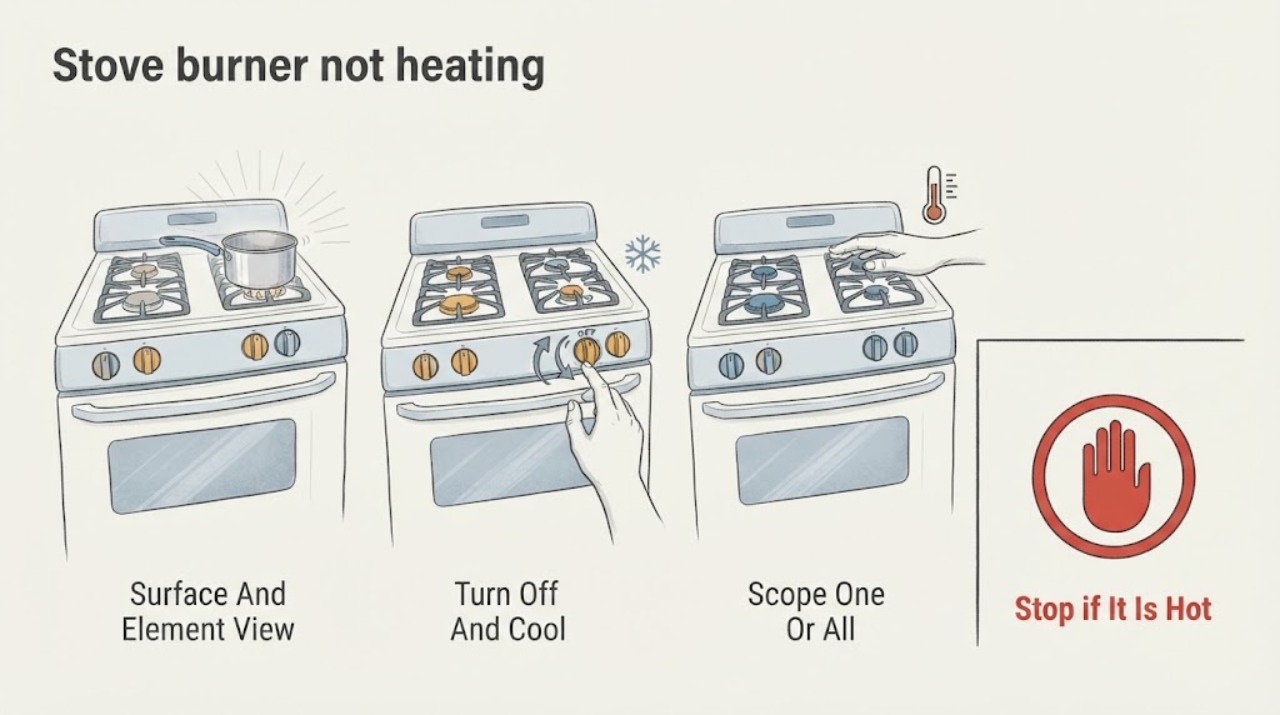
Turn the affected burner off and let the cooktop cool completely. Then identify whether the symptom affects one burner or the whole stove, and record any visible crack, scorching, loose coil seating, breaker trip, spark, smoke, or burning odor without opening the appliance or performing a live electrical test. If the issue persists, the breaker trips, or there is any arc, smoke, gas odor, or damaged wiring, stop using the stove and arrange professional appliance repair. Disconnect power before any permitted external cleaning or contact with a removable coil, and do not open internal switches or the terminal block.
Work through in order
Diagnostic checks
Use only checks that match the exact appliance or system and its official guide.
-
Check 1
Turn the affected burner control to Off, move cookware away only if it can be done without contacting a hot surface, and wait until the surface is cool; note whether a hot-surface indicator remains lit.
Expected result: The indicator may remain on while a radiant surface is still hot, or the burner may be cool with no heat response; either state should be recorded without touching the heating area.
Next step: Keep the burner off while you identify the stove type and compare the scope of the problem. Do not place plastic, towels, or other heat-sensitive items on the surface while it cools.
Stop if: Stop immediately for smoke, sparks, arcing, a burning-plastic odor, a gas odor, uncontrolled heat, or a surface crack; leave the area safe and arrange professional help.
Why this matters
Why: A lingering indicator can represent retained heat rather than a failed burner, while a cool burner after a normal heat request indicates a fault that needs more information.
-
Check 2
From the controls and the front of the appliance, record whether the problem is limited to one burner or whether several surface burners are cold; do not repeat a heating cycle solely to test it.
Expected result: One cold zone with otherwise normal operation differs from several cold zones, a dead display, or an oven that is also not working.
Next step: Use the scope, burner position, and any already-observed display or control response in the service request. Leave the appliance off if more than one zone is affected.
Stop if: Stop using the appliance if operation causes a breaker or fuse to trip, visible electrical damage, a hot cord or plug, or any abnormal odor.
Why this matters
Why: An isolated symptom points the technician toward that burner, its control, or its connection; a whole-appliance symptom raises concern about the supply, installation, or range-level control and should not be diagnosed with live testing.
-
Check 3
After the burner and surrounding surface are fully cool, visually inspect from above for a cracked glass surface, a visibly blistered or split coil, scorching, a loose-looking removable coil, or residue around the burner; do not lift, pull, bend, or probe the element.
Expected result: A visible crack, split sheath, scorching, or abnormal connection area is different from a clean, intact-looking burner; a normal appearance does not rule out an internal fault.
Next step: Keep the stove out of service when damage is visible. If the manufacturer manual specifically permits handling a removable coil, power must be disconnected and the surface cool before any contact; otherwise leave it for a technician.
Stop if: Do not remove a coil, open a cooktop, touch terminals, or continue if the surface is hot, cracked, wet, or damaged.
Why this matters
Why: Visible damage can create shock, fire, or burn risk and requires professional assessment. A clean appearance means only that no external clue was seen.
-
Check 4
Without opening a panel or moving the range, observe the accessible control/display state and whether the household range breaker or fuse has tripped; do not reset it repeatedly or perform a voltage test.
Expected result: A dead display, a single changed breaker, or a breaker that trips again after a safe authorized reset is different from a normal display with one cold burner.
Next step: Record the state and call a qualified appliance technician or electrician as appropriate. If a breaker has tripped, leave the appliance off when the cause is unclear rather than repeatedly restoring power.
Stop if: Stop at the breaker or fuse if it trips again, there is heat or odor at the plug, or any panel would need to be opened; do not bypass, upsize, or bridge a protective device.
Why this matters
Why: The result helps distinguish a supply or range-level symptom from an isolated surface symptom, but it cannot confirm safe wiring or identify a failed internal switch.
-
Check 5
Record the last normal use and any event that preceded the failure, such as a spill, boil-over, cleaning, power interruption, audible pop, spark, smoke, or unusual control behavior; inspect only from a dry, safe position.
Expected result: A recent spill or outage, a repeatable control symptom, or an electrical odor gives the technician useful context even when no damage is visible.
Next step: Keep the affected burner off, photograph visible damage only after cooling, and provide the timeline and stove model information to professional service.
Stop if: For smoke, flame, arcing, gas odor, or a rapidly worsening condition, leave the area if needed, use local emergency procedures, and do not re-energize the appliance.
Why this matters
Why: The history can point toward moisture or contamination around the surface, a supply event, or an element/control fault without asking the homeowner to prove the diagnosis.
Use your observations
Decision map
Find the observation that best matches what you see, then follow the next safe action.
-
PATH 01Next step
What you see
The burner or cooktop shows a crack, split or blistered coil, scorch mark, melted material, spark, smoke, or burning odor.
Do this next
Stop using the stove, keep people away, and arrange professional appliance repair. Do not touch the damaged area or open the appliance.
-
PATH 02Next step
What you see
Several surface burners are cold, or the display and oven are also without power.
Do this next
Treat it as a range-level or supply concern. Leave the appliance off, record the external breaker/display state, and have a qualified technician evaluate it.
-
PATH 03Next step
What you see
Only one burner is affected and no external damage is visible.
Do this next
Do not assume the burner is safe to keep cycling. Preserve the burner position and request diagnosis of the surface element, control, and accessible connections.
-
PATH 04Next step
What you see
The range breaker or fuse trips, or trips again after an authorized safe reset.
Do this next
Leave the appliance off and do not bypass, upsize, or repeatedly reset the protective device. Call a qualified appliance technician or electrician.
-
PATH 05Next step
What you see
No visible cause is found after the appliance is cool and the external status is recorded.
Do this next
A hidden element, control, terminal, or supply fault remains possible. Stop troubleshooting at the user level and provide the scope, history, and model information to professional service.
Helpful context
Understand the symptom
Start with the burner type and the safety boundary
A cold burner can be an isolated surface-element fault, a control problem, a power-supply issue, or a normal difference between electric radiant, coil, and induction designs. The first useful distinction is whether one heating zone is affected or the entire stove. Keep cookware and flammable items away while the surface cools, and do not use a burner that shows damage or abnormal heat behavior.
What a technician needs to know
Record the stove type, the affected burner position, whether other burners and the oven work, whether a breaker or fuse changed state, and any spark, smoke, odor, noise, or visible damage. If a model label is readable without moving the appliance, include it in the service request. Do not slide the range out or remove panels to find a label.
Safety boundary
Stop conditions
- Turn the affected burner off and stop using the stove for smoke, flame, arcing, gas odor, burning-plastic odor, a cracked cooktop, or visible electrical damage.
- Do not perform live voltage tests, open internal switches or a terminal block, or reach into wiring or other internal components.
- Do not keep cycling a burner that remains cold, do not repeatedly reset a tripped breaker, and do not bypass or upsize a protective device.
- Disconnect power before any permitted cleaning or contact with a removable coil, and only follow the exact owner manual boundary; otherwise leave the work to a qualified professional.
Only after diagnosis
Potential parts
- stove surface element
Consider only if a technician confirms the affected surface element is open, damaged, or otherwise the cause after power is safely isolated.
Confirm the exact stove model, element style, dimensions, connector arrangement, and manufacturer fit before selection; appearance alone is not enough. - stove infinite switch
Consider only if professional diagnosis identifies the burner control switch as the failed component rather than the element or supply.
Switch ratings, terminals, control type, and model fit must be confirmed by a qualified technician or the manufacturer documentation. - stove terminal block
Consider only if a technician finds heat damage or a failed connection at the range terminal block and confirms replacement is appropriate.
Terminal arrangement, rating, wiring configuration, and model compatibility require professional confirmation; do not open or handle this component.
When checks do not resolve it
Need a professional?
Arrange professional appliance repair when one burner remains cold after the safe external observations, when several burners are affected, or whenever a breaker trips, damage is visible, or the cause is not clear. Provide the burner position, stove type and model if safely readable, scope of the failure, breaker/display state, and any odor, spark, smoke, spill, or outage history.
Common questions
FAQ
Why is one stove burner cold while the others work?
An isolated cold burner can involve the surface element, its control, or a connection, but a visual check cannot prove which one. Keep it off, record its position and any visible damage, and arrange professional diagnosis.
Should I keep turning the burner knob to see whether it heats?
No. Do not repeatedly cycle a burner that stays cold or behaves abnormally. Turn it off, let the surface cool, and record what already happened for the technician.
Is a cracked glass cooktop or split coil safe to use?
No. Stop using the affected area and arrange professional appliance repair. Do not touch the damage, open the cooktop, or continue heating it.
What if the stove breaker trips when a burner is used?
Leave the stove off and do not repeatedly reset, bypass, or upsize the protective device. Report the trip and any odor, spark, or heat to a qualified appliance technician or electrician.
Read the exact guide
Official sources
- Watch What You HeatElectrical Safety First · General safe behavior around active hobs and cooking-appliance fire hazards
- Electric Range - Surface Burners Not Heating or WorkingGE Appliances · General external checks for electric ranges; model-specific instructions take precedence
- Range Surface Unit FailureGE Appliances · Electric surface elements and their possible visible failure symptoms
Community feedback
Share a repair observation
Share a plain-text repair observation. Accepted observations are published automatically; this page may take a moment to update.