
On this page
Start here
Quick answer
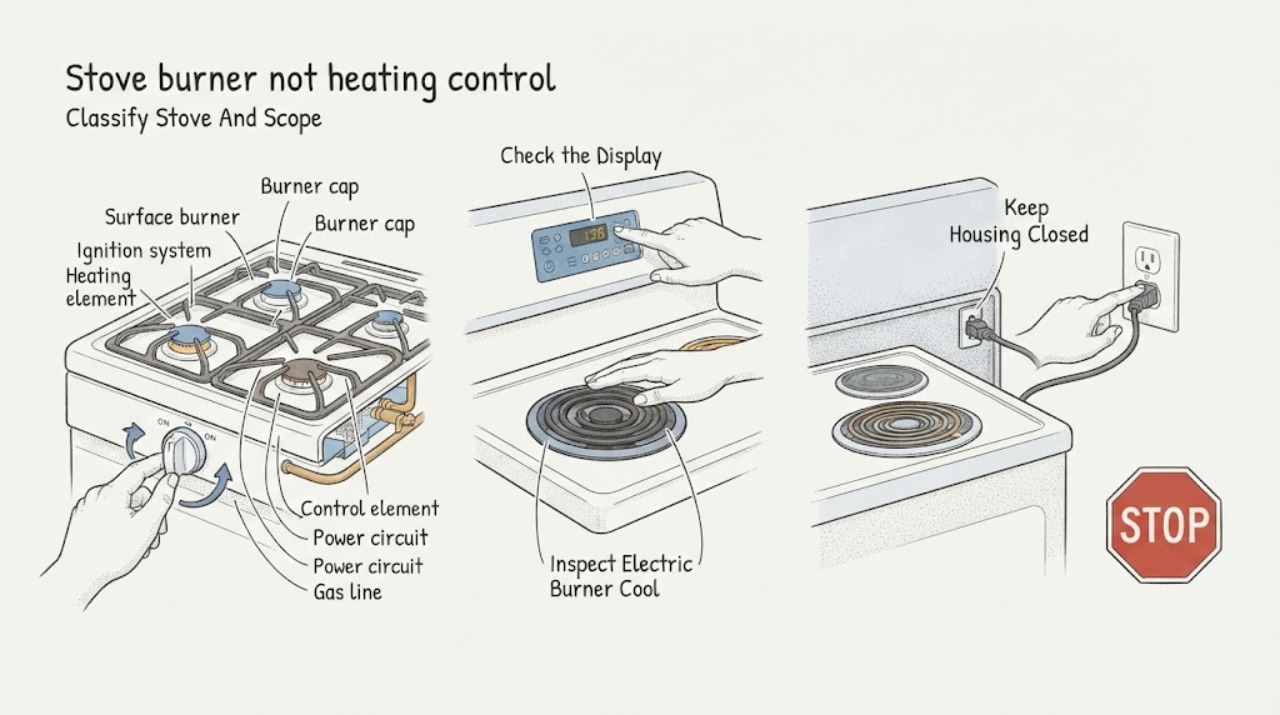
If a stove burner is not heating while its control is on, first identify whether the stove is gas or electric and whether one burner or all burners are affected. For an electric stove, confirm the affected control is the correct one, check the power supply and breaker from a safe position, and after the surface is fully cool inspect only for an obviously displaced removable coil or visible damage; do not open the appliance. For a gas stove, turn the control off, let the burner cool, and check that the cap and head are level, clean, and dry without opening gas fittings. If other burners work but this one does not, an element, socket, switch, igniter, burner head, or local wiring fault is possible. If all burners fail, suspect the shared power, gas supply, or ignition system. Stop using the stove for gas odor, uncontrolled flame, smoke, sparking, a cracked surface, repeated breaker trips, exposed wiring, or a control that will not turn off, and arrange qualified appliance service.
Before you begin
Safety first
- This article supports classification, ordinary control and breaker observation, and cool visible inspection only. Do not open the appliance, work on live electrical parts, disassemble gas fittings, adjust gas pressure, bypass a control, or continue testing an unsafe burner.
Work through in order
Diagnostic checks
Use only checks that match the exact appliance or system and its official guide.
-
Check 1
Without touching a hot surface, identify whether the stove uses gas, electric coils or radiant elements, or induction, and compare the affected burner with the other burners using their normal controls.
Expected result: Record whether only one burner is cold, several but not all are cold, or no burner heats; for gas, note whether there is a click, spark, flame, or gas odor; for electric, note whether other elements and the display operate.
Next step: Use the electric or gas branch below, and do not keep trying to ignite or heat the stove if there is a gas odor, abnormal flame, smoke, sparking, or visible damage.
Stop if: Stop immediately for gas odor, an uncontrolled flame, smoke, sparking, a cracked cooking surface, exposed wiring, or a control that will not turn off.
Why this matters
Why: A single failed burner points toward a local element, switch, cap, head, igniter, or connection. Failure across burners points toward shared power, gas supply, ignition, or control circuitry instead of one burner alone.
-
Check 2
If the stove is electric, confirm from a safe position that the intended control is set to a heat position and that the unit is connected to power; check the appliance breaker for an obvious tripped position without removing a panel or touching wiring.
Expected result: Other elements work and the breaker appears normal, the whole stove has no power, or the breaker trips again when the stove is used.
Next step: If the whole unit is without power, use only the reset procedure stated in the model manual and stop if it trips again. If power is present but this burner stays cold, leave internal electrical diagnosis to qualified service.
Stop if: Do not remove covers, probe a live receptacle, handle exposed wiring, or repeatedly reset a breaker that trips.
Why this matters
Why: Normal power with one cold element makes a local element, receptacle, or control issue more likely. No power suggests a supply or breaker issue; a repeated trip indicates a fault that should not be tested repeatedly.
-
Check 3
After the electric cooking surface is fully cool and power is safely off when the model instructions require it, inspect the affected removable coil or visible element area for a displaced coil, poor seating, burn mark, crack, or other damage; do not disassemble the stove.
Expected result: The coil is visibly out of position, the element or glass is damaged, the surface looks normal but stays cold, or the burner warms only intermittently.
Next step: Restore only an obviously displaced removable coil as described by the exact manual, then make one controlled test. If it remains cold, is damaged, or works intermittently, stop use of that burner and request appliance service.
Stop if: Do not test with a cracked glass surface, scorch damage, exposed conductors, loose wiring, or a component that requires opening the appliance.
Why this matters
Why: A displaced coil may prevent proper contact on models designed for user removal, while visible damage or an intermittently cold burner can indicate an element, receptacle, control, or wiring fault. A normal appearance does not rule out an internal electrical failure.
-
Check 4
If the stove is gas, turn the affected control off, wait for the burner to cool, and inspect the visible burner cap, burner head, ignition area, and openings for a level fit, moisture, or ordinary food debris; do not open a gas fitting or force a part.
Expected result: The cap or head is tilted or not fully seated, moisture or debris is visible, the burner clicks and sparks without a flame, there is no spark, or a gas odor is present.
Next step: Only after the control is off and the parts are cool, dry and clean visible surfaces using the exact model instructions and restore the cap or head level. If there is gas odor, abnormal flame, no ignition after a permitted inspection, or uncertainty about the gas path, leave the stove off and call qualified gas or appliance service.
Stop if: Do not operate the burner with a gas odor, do not disassemble gas components, and do not use a flame or improvised tool to locate a leak.
Why this matters
Why: A displaced cap or head, or moisture or debris at visible ignition parts, can prevent one burner from lighting. Spark without ignition can involve gas supply or a blocked path; no spark can involve power or ignition components. Gas odor is a stop condition, not a cleaning result.
-
Check 5
After a permitted cool inspection or documented control and power check, make one brief normal-use test while watching from a safe position; turn the control back off and compare the result with a working burner.
Expected result: The burner heats or ignites normally, remains cold, heats unevenly, the flame is weak or unstable, the control stays active after being turned off, or the original symptom returns.
Next step: Stop using the affected burner and arrange qualified appliance service for any persistent or abnormal result; provide the stove type, affected burner, scope, power or spark behavior, and what was observed after cooling.
Stop if: Do not continue cycling a failed burner, bypass a control or safety device, or use the stove if a burner remains on when commanded off.
Why this matters
Why: A stable normal result supports a seating, moisture, debris, or control-selection issue. A persistent cold burner, uneven flame, repeated failure, heat with the control off, or abnormal electrical behavior needs diagnosis beyond ordinary checks.
Use your observations
Decision map
Find the observation that best matches what you see, then follow the next safe action.
-
PATH 01Safety boundary
What you see
One electric burner remains cold while the other elements and the stove display operate normally.
Do this next
After the surface is cool, verify only the correct control and any model-permitted coil seating. If the burner is still cold or intermittent, stop using it and arrange appliance service.
Why this path and its safety boundary
Why it matters: The fault is more likely local to the element or coil, receptacle, burner control, or wiring than to the home's general supply.
Safety stop: Do not open the appliance, probe live parts, or use a damaged element or cracked glass surface.
-
PATH 02Safety boundary
What you see
All electric elements are cold or the stove has no display or power.
Do this next
Check the breaker position and appliance connection only from safe access, follow the exact manual's single reset procedure if provided, and request service if power is absent or the breaker trips again.
Why this path and its safety boundary
Why it matters: A shared power, breaker, connection, or control problem is more likely than a single failed heating element.
Safety stop: Do not repeatedly reset a tripping breaker or touch wiring, terminals, or an opened appliance.
-
PATH 03Safety boundary
What you see
One gas burner does not ignite, while other burners ignite normally.
Do this next
With the control off and the burner cool, perform only the model-permitted visible cleaning and seating check. If there is still no ignition, leave it off and arrange qualified service.
Why this path and its safety boundary
Why it matters: A cap or head that is not level, moisture or debris at visible ignition parts, or a local igniter or burner-path issue is more likely than a whole-house gas outage.
Safety stop: Stop for gas odor, an abnormal flame, a damaged burner, or any need to open a gas fitting.
-
PATH 04Safety boundary
What you see
No gas burner ignites; either none spark or they spark without producing a flame.
Do this next
Confirm only that the appliance has power and the breaker is not obviously tripped. Leave gas troubleshooting to the gas provider or qualified installer when burners spark without ignition, and request appliance service for persistent no-spark behavior.
Why this path and its safety boundary
Why it matters: No spark makes appliance power or the shared ignition system more likely; spark without ignition makes gas supply or connection more likely.
Safety stop: Do not keep clicking or attempting ignition when gas may be accumulating, and leave the area for a gas odor or immediate hazard.
-
PATH 05Safety boundary
What you see
A gas burner lights but is weak, uneven, flickering, delayed, or will not stay lit.
Do this next
Turn the burner off, let it cool, and check only visible cap or head fit according to the model instructions. If the flame remains abnormal, leave the stove off and contact qualified gas or appliance service.
Why this path and its safety boundary
Why it matters: The cap or head may be dirty or incorrectly seated, but persistent instability can indicate gas pressure or supply trouble that a user should not adjust.
Safety stop: Do not adjust a regulator, enlarge burner openings, or operate an unstable or lifting flame.
-
PATH 06Safety boundary
What you see
The burner heats with its control off, the control will not turn off, the surface is cracked, a breaker repeatedly trips, wiring is exposed, or there is smoke, sparking, or gas odor.
Do this next
Stop using the stove, keep people away, and arrange qualified appliance or gas service; for an immediate fire or gas emergency, follow local emergency guidance from a safe location.
Why this path and its safety boundary
Why it matters: This is an active electrical, heat, fire, or gas hazard rather than a routine burner-cleaning issue.
Safety stop: Do not continue tests, use another burner if it could worsen the hazard, bypass a control, or attempt internal repair.
Helpful context
Understand the symptom
Start with the stove type and the scope of the failure
A control that is turned on does not prove that heat is reaching the burner. A gas burner needs gas flow and ignition, while an electric burner needs the correct control, power path, and heating element. Note whether one burner is cold while the others work or whether every burner is affected; that distinction changes the likely fault and the safe next step.
What a single failed burner can mean
On an electric stove, one cold burner with otherwise normal operation makes the local element, receptacle, control switch, or wiring more likely than a house-wide power problem. On a gas stove, a single burner that will not light or heat can have a cap or head that is not seated level, moisture or debris around the ignition area, or a localized ignition or gas-flow fault. Inspection should stay at ordinary, cool, visible access.
When to stop testing
Do not continue testing a stove with a gas odor, an uncontrolled or abnormal flame, smoke, sparking, a cracked surface, exposed wiring, repeated breaker trips, or a control that cannot be switched off. These symptoms can involve gas supply, electrical parts, or heat-damaged components outside ordinary user checks. Leave the appliance out of service and arrange qualified help; if there is an immediate fire or gas emergency, follow local emergency guidance from a safe location.
Safety boundary
Stop conditions
- Stop using the stove for a gas odor, uncontrolled or abnormal flame, smoke, sparking, a cracked cooking surface, exposed wiring, or a control that will not turn off.
- Do not open the appliance, touch wiring or terminals, probe live parts, adjust a gas regulator, or open gas fittings as an ordinary troubleshooting step.
- Do not repeatedly reset a breaker that trips, repeatedly attempt ignition when gas may be accumulating, or keep cycling a burner that remains cold or behaves abnormally.
- Do not use a burner with a damaged or cracked element, glass surface, loose wiring, or a flame that is weak, lifting, flickering, or unstable.
- Leave persistent one-burner or all-burner failures to qualified appliance service after the documented, ordinary-access checks are exhausted.
Only after diagnosis
Potential parts
- electric surface heating element or coil
Consider this part class only when one electric burner remains cold with correct control and power, and diagnosis identifies the element or coil as failed or damaged.
Confirm the exact stove model, element shape, wattage, connector, and manufacturer fit information before ordering; do not assume a visually similar element fits. - gas burner cap or burner head
Consider this part class only when a gas burner remains abnormal after the cap or head is correctly seated and clean, and the exact model diagnosis identifies damage or a missing component.
Confirm the exact stove model and burner position with the manufacturer or qualified technician; a cap or head from another burner or model may not be compatible. - stove burner igniter or spark electrode
Consider this part class only when a single gas burner has no spark or repeatedly fails to ignite after safe cap, head, moisture, and debris checks, and service diagnosis supports an ignition fault.
Confirm the exact model, burner location, electrode connection, and manufacturer fit information; gas and electrical access should be handled by qualified service. - stove burner control switch
Consider this part class only when an electric burner remains cold or heats abnormally and diagnosis identifies the control switch as the failed component.
Confirm the exact model, switch type, terminal arrangement, and manufacturer fit information; do not replace or test internal controls as a live-user procedure.
When checks do not resolve it
Need a professional?
Arrange qualified appliance service when one burner stays cold after the correct control, power, and model-permitted visible checks; when all burners fail; when a gas burner has no spark or will not ignite; when an element, switch, igniter, wiring, or control may be faulty; or when the burner is intermittent. Contact the gas provider or a qualified gas professional for spark without ignition, persistent weak or unstable flames, or suspected gas-supply trouble. Treat gas odor, smoke, sparking, uncontrolled flame, cracked glass, exposed wiring, repeated breaker trips, or a control that will not turn off as stop-use conditions.
Safety scope: This article supports classification, ordinary control and breaker observation, and cool visible inspection only. Do not open the appliance, work on live electrical parts, disassemble gas fittings, adjust gas pressure, bypass a control, or continue testing an unsafe burner.
Common questions
FAQ
Why is one stove burner not heating when the control is on?
On an electric stove, a single cold burner can involve the element or coil, receptacle, burner control, or wiring. On a gas stove, a cap or head that is not seated level, moisture, debris, ignition, or local gas-flow trouble can prevent heating. Identify the stove type, let it cool, and use only ordinary visible checks before service.
What if none of the stove burners heat?
For an electric stove, check from safe access whether the appliance has power and whether the breaker is obviously tripped; a repeated trip needs service. For a gas stove, distinguish no spark from spark without ignition: the former can involve appliance power or ignition, while the latter can involve gas supply. Do not keep attempting ignition if gas may be accumulating.
Can I clean a gas burner that will not light?
After turning the control off and allowing the burner to cool, you can inspect and clean visible cap, head, and ignition surfaces only as the exact model instructions allow, then restore the cap or head level. Do not open gas fittings, use a flame to test for leaks, or continue if there is a gas odor or abnormal flame.
When should I stop using a stove burner?
Stop for gas odor, smoke, sparking, an uncontrolled or unstable flame, a cracked surface, exposed wiring, repeated breaker trips, a burner that heats with its control off, or a control that will not turn off. Leave the stove out of service and arrange qualified appliance or gas help; follow local emergency guidance for an immediate hazard.
Read the exact guide
Official sources
- LG Range - Why Won't My Burner LightLG USA Support · Official LG gas-range guidance used for the gas branch; the page notes that images and content can differ by model, so the installed manual controls.
- What can you do when the burner of your Samsung gas cooktop does not ignite or has other ignition issuesSamsung Canada · Official Samsung gas-cooktop guidance used as a cross-manufacturer symptom reference; it notes the information is for cooktops sold in Canada, so the installed manual and local gas authority govern.
- LG Range – Why is My Electric Cooktop Not Heating?LG USA Support · Official LG electric-cooktop guidance used for one-element versus all-element branching; the assigned stove is unbranded, so the exact model manual and qualified service govern.
- LG Gas and Electric Ranges: Cook Top Burners or Eyes Not WorkingLG USA Support · Official LG overview used to distinguish electric not-heating from gas burner ignition and uneven-flame checks; the assigned stove has no brand or model, so model-specific instructions take precedence.
Community feedback
Share a repair observation
Share a plain-text repair observation. Accepted observations are published automatically; this page may take a moment to update.