
On this page
Start here
Quick answer
If one electric stove burner stays cold, first confirm that the correct knob is controlling that location, then turn the stove off and let it cool before checking a removable coil for a loose fit or visible damage. Traditional knob controls use an infinite switch that cycles power on and off, so an element going dark briefly can be normal; a burner that never heats, while another burner works, is not explained by normal cycling. On a plug-in coil model, a same-size coil can be moved to another receptacle only after power is disconnected as the manual directs: if the coil fails there too, the coil is suspect; if it works there, the original receptacle, wiring, or control path—including the infinite switch—needs qualified service. Do not open the control panel, probe live terminals, or replace a switch from the symptom alone.
Before you begin
Safety first
- This article supports ordinary-access observation and, only for a removable coil design, a manual-permitted comparison after the appliance is cool and disconnected from power. It does not authorize live electrical testing, panel removal, wiring changes, safety bypass, glass removal, or switch replacement.
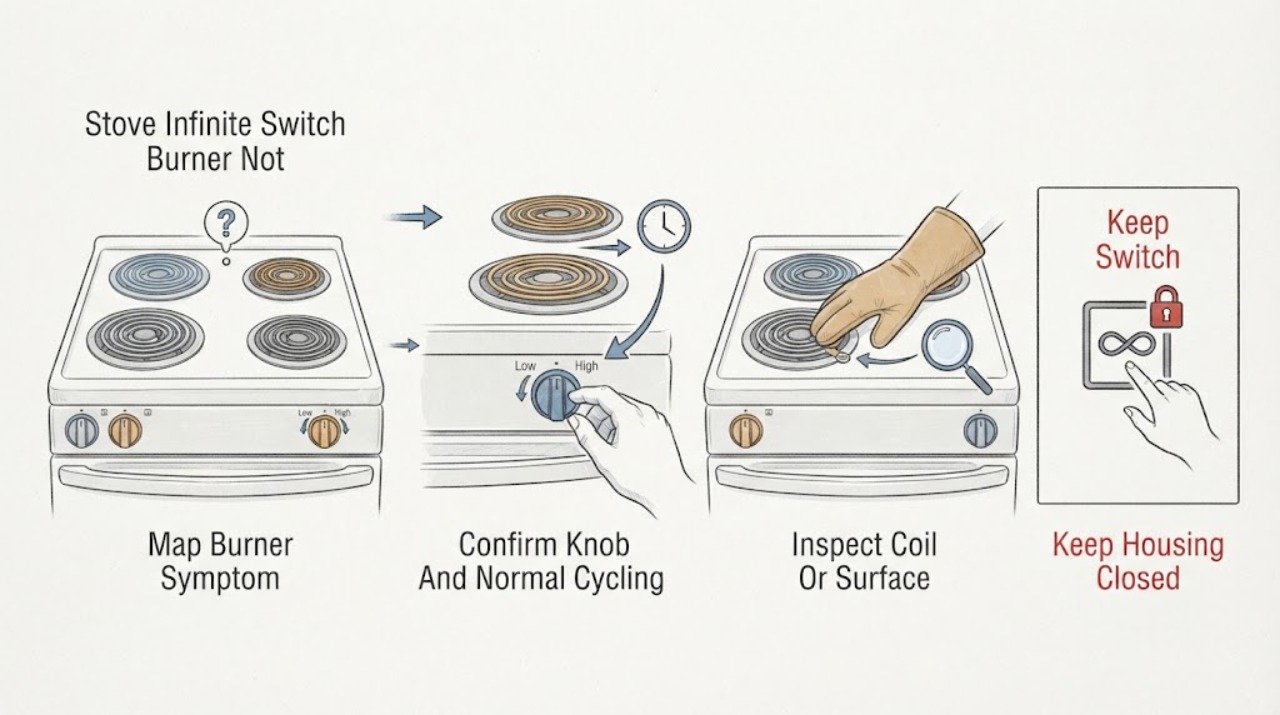
Work through in order
Diagnostic checks
Use only checks that match the exact appliance or system and its official guide.
-
Check 1
With the stove controls off and the cooking surface cool enough to approach safely, identify the affected burner and compare it with one known-working burner using the normal knobs; do not remove panels or touch wiring.
Expected result: Record whether only one burner is cold, several burners are cold, the oven and clock still operate, the affected knob turns normally, and the surface-element indicator responds when that knob is selected.
Next step: Keep the symptom map with the exact model information and continue only with the safe, design-appropriate check for the stove type.
Stop if: Stop using the stove for smoke, burning odor, arcing, exposed wiring, a control that will not turn off, a hot surface that cannot be explained, or a breaker or fuse event that repeats.
Why this matters
Why: A single cold burner with otherwise normal stove operation focuses the check on that element, receptacle, wiring, or infinite control. Several dead burners or a stove-wide loss of heat points first toward supply, installation, or a common control problem. An indicator light confirms a control request, not that the element is receiving usable heat.
-
Check 2
From the normal user position, verify that the knob marking matches the affected burner and select a normal heat setting once; observe the burner without treating continuous glowing as a requirement.
Expected result: Classify the result as no response, an element that heats and later cycles dark, heat that returns after cycling, or an element that remains cold throughout the observation.
Next step: If the element never heats, turn the knob OFF and proceed to the cool-surface inspection; if it heats and cycles normally, use the correct flat cookware and monitor without opening the stove.
Stop if: Do not keep turning a control that sticks, sparks, smells hot, or will not return to OFF; arrange qualified appliance service for those symptoms.
Why this matters
Why: GE explains that traditional knob-controlled electric ranges use infinite controls that cycle the element on and off. Heat that returns after a dark interval can therefore be normal. No heat at all, a wrong-burner response, or a control that does not match the other locations requires further diagnosis rather than a higher setting or repeated cycling.
-
Check 3
After turning the stove off and following the exact owner manual's power-safety instructions, inspect only the cool, user-accessible burner area: check a removable coil for a loose fit, bent or damaged terminals, contamination, or a failed center safety button, and check a glass surface for visible damage and a flat pan without lifting the glass.
Expected result: Record whether the coil is seated correctly and intact, the coil safety button moves as the manufacturer describes, the receptacle looks damaged, the glass is cracked, or the surface and cookware are normal but the burner remains cold.
Next step: Photograph the condition and retain any loose or damaged part for service; use the cross-location comparison only if this is a removable coil design and the manual permits it.
Stop if: Do not touch energized parts, bend terminals, pry a coil from a hot surface, remove glass, or use the stove with a cracked glass top, damaged receptacle, loose connection, or exposed conductor.
Why this matters
Why: GE and Frigidaire identify a loose or damaged coil, its receptacle, and cookware or surface conditions as separate possibilities. A cracked glass surface, damaged receptacle, or uncertain safety button is not a cleaning issue or a reason to force the part. A normal visual inspection with no heat narrows the problem toward the electrical control path or a concealed element fault.
-
Check 4
Only for a removable plug-in coil and only after the stove is cool and disconnected from power as directed by the owner manual, place the suspected coil in another receptacle of the same size; do not perform this comparison on a radiant glass element or if access requires moving the range or handling wiring.
Expected result: Observe whether the same coil heats in the known-good receptacle, whether a known-good same-size coil heats in the original receptacle, or whether neither comparison is safe or possible.
Next step: Restore the coils only as the manual specifies, turn controls OFF, and give the exact comparison to a qualified appliance technician instead of opening the control area.
Stop if: Stop if the coil, receptacle, plug, or surrounding surface is damaged, wet, loose, unusually hot, or difficult to remove; never bridge contacts or continue after a breaker trips.
Why this matters
Why: GE uses this comparison to distinguish a failed coil from a receptacle or range-side fault. If the suspected coil fails in both locations, the coil is more likely defective. If it works elsewhere but another coil will not work in the original location, the original receptacle, wiring, or control path—including the infinite switch—becomes more likely. The comparison does not prove which internal part failed.
-
Check 5
If multiple burners are affected, check the range circuit's breaker or fuse from ordinary access and confirm the plug is not visibly loose without sliding, tilting, or disassembling the stove; do not repeatedly reset a protective device.
Expected result: Record a normal breaker or fuse state, a trip that returns, an inaccessible or uncertain connection, a recently installed range, or a stove whose clock works while the top burners do not.
Next step: Stop troubleshooting and provide the model, burner map, knob and indicator behavior, visual findings, and any permitted coil comparison to qualified appliance service; use an electrician or installer when the supply or installation is uncertain.
Stop if: Do not increase fuse or breaker capacity, open the range, probe terminals, move the appliance to reach a cord, or reset a breaker that trips again.
Why this matters
Why: GE notes that the range can have a supply or wiring issue even when some appliance functions still operate. A returning trip, a questionable connection, or a recent installation needs qualified electrical or appliance assessment. If supply checks are normal and one burner remains cold, an element, receptacle, harness, or infinite switch can still require service.
Use your observations
Decision map
Find the observation that best matches what you see, then follow the next safe action.
-
PATH 01Safety boundary
What you see
The suspected removable coil remains cold in the original location and in another same-size receptacle, while the alternate receptacle works with another compatible coil.
Do this next
Keep the coil out of service and give the exact model and comparison result to qualified appliance service for a compatible element decision.
Why this path and its safety boundary
Why it matters: The failure follows the coil, making the coil or its integral safety feature more likely than the infinite switch. The comparison still does not authorize a generic replacement without model fitment confirmation.
Safety stop: Do not bend terminals, bypass a safety button, or continue using a damaged or intermittently arcing coil.
-
PATH 02Safety boundary
What you see
A known-good same-size coil heats in another location, but the suspected coil works elsewhere and the original receptacle does not heat a known-good coil.
Do this next
Leave that burner unused and arrange qualified appliance service for de-energized, model-specific diagnosis of the receptacle and control path.
Why this path and its safety boundary
Why it matters: The coil is less likely to be the cause. The original receptacle, harness, infinite switch, or another range-side control fault is more likely and cannot be safely selected from appearance alone.
Safety stop: Do not open the console, exchange switch wires, probe live terminals, or install a switch without exact model and service guidance.
-
PATH 03Safety boundary
What you see
The element heats, periodically goes dark, and returns to heat while the knob and surface remain otherwise normal.
Do this next
Use the correct burner and a flat pan, allow the control to regulate heat, and request service only if heat never returns, cooking performance is abnormal, or the control behaves differently from the manual.
Why this path and its safety boundary
Why it matters: Cycling is consistent with the designed operation of an infinite control or temperature-limiting element. A dark interval alone does not establish a failed switch.
Safety stop: Stop for uncontrolled heating, a knob that will not turn OFF, smoke, odor, arcing, or a surface that is damaged.
-
PATH 04Safety boundary
What you see
Several burners are cold, the clock or display behaves abnormally, a breaker trips, or the range was recently installed or moved.
Do this next
Keep the stove out of use when the connection or supply is uncertain and contact qualified appliance or electrical service, or the installer for a recent installation issue.
Why this path and its safety boundary
Why it matters: A supply, plug, installation, or common control problem is more plausible than a single infinite switch, and a user cannot confirm wiring safety from a visual check.
Safety stop: Do not repeatedly reset the breaker, slide or tilt the range, open the wiring compartment, or use an improvised cord or fuse.
-
PATH 05Safety boundary
What you see
The stove has a radiant element beneath glass, the surface is cracked, or the next check would require removing glass or accessing hidden wiring.
Do this next
Stop the burner test, keep a cracked or damaged surface out of use, and provide the model and photos to qualified appliance service.
Why this path and its safety boundary
Why it matters: The removable-coil comparison is not applicable. A radiant limiter, element, receptacle, control, or damaged glass surface needs model-specific professional assessment.
Safety stop: Do not lift the glass, use cookware to heat-test a cracked area, or open the control panel.
Helpful context
Understand the symptom
A dark element is not automatically a failed infinite switch
An electric stove with a traditional knob may use an infinite control to regulate heat by cycling the element. The coil or radiant area can therefore go dark during normal operation and return later. The useful distinction is whether the burner ever produces heat and whether the same element behaves differently in another compatible location, not whether it glows continuously. A burner that stays cold from the first start, or a control that behaves differently from the other burners, needs a more focused diagnosis.
Separate the element from the control path
A plug-in coil gives a limited, low-risk comparison when the exact range design and owner instructions allow it: after the stove is cool and de-energized, a same-size coil can be tried in another receptacle. A failure that follows the coil points toward the coil; a coil that works elsewhere leaves the original receptacle, wiring, or control path as the service question. This comparison does not apply to a radiant element beneath glass, and it does not authorize opening the range or testing energized terminals.
Use the model identity before ordering a part
An infinite switch is one possible part in a knob-controlled electric stove, but the same symptom can come from a coil, receptacle, harness, supply, or control design. Record the stove model, burner location, knob behavior, indicator-light behavior, and any safe comparison result. A technician can then identify the correct control or element and verify fitment without relying on a visual match or a generic part listing.
Safety boundary
Stop conditions
- Stop using the stove for smoke, burning odor, arcing, exposed wiring, uncontrolled heating, a control that will not turn OFF, or a breaker or fuse that trips again.
- Do not open the control panel, probe live terminals, exchange switch wires, bridge contacts, or bypass a coil safety feature.
- Do not move or tilt the stove to reach wiring or a cord; have an electrician or qualified appliance technician handle uncertain supply and installation conditions.
- Do not use a cracked glass surface, damaged receptacle, loose coil, wet burner connection, or visibly damaged element.
- Do not choose an infinite switch or heating element from the symptom alone; confirm the exact model and have fitment and de-energized diagnosis handled by qualified service.
Only after diagnosis
Potential parts
- model-specific infinite switch
Consider this category only when a qualified diagnosis finds that the original location's control path fails while a compatible element and other receptacle are known to work.
Confirm the complete stove model, control type, burner position, electrical rating, terminal arrangement, and manufacturer fit information before ordering or installing. - model-specific coil or radiant surface element
Consider this category only when the element itself is isolated as the failure, such as a removable coil that stays cold in a known-good same-size receptacle or a technician-confirmed radiant element fault.
Verify the exact model, element style, burner position, and manufacturer-approved fit; do not substitute by appearance or bypass a temperature-limiting feature. - surface element receptacle or wiring assembly
Consider this category only when a known-good compatible coil fails in the original location or service diagnosis identifies a damaged receptacle or harness.
This is an internal electrical repair requiring model-specific parts and qualified installation; do not alter terminals or wiring based on a visual match.
When checks do not resolve it
Need a professional?
Arrange qualified appliance service when one burner stays cold after the correct control, cool visual inspection, and any permitted coil comparison; when the suspected coil works elsewhere but the original location does not; when the infinite switch or receptacle is suspected; or when a radiant surface, hidden wiring, or model-specific control must be accessed. Use qualified electrical or installation service for a tripping breaker, uncertain supply, loose connection, or recent installation problem. Treat smoke, burning odor, arcing, uncontrolled heating, exposed wiring, a cracked glass surface, or repeat breaker operation as urgent stop conditions.
Safety scope: This article supports ordinary-access observation and, only for a removable coil design, a manual-permitted comparison after the appliance is cool and disconnected from power. It does not authorize live electrical testing, panel removal, wiring changes, safety bypass, glass removal, or switch replacement.
Common questions
FAQ
Does an infinite switch make the burner glow continuously?
No. Traditional knob-controlled electric burners use an infinite control that cycles the element on and off to regulate heat. A dark interval can be normal when heat returns, but a burner that never heats is a different symptom.
How can I tell whether the coil or the stove control is at fault?
On a removable plug-in coil design, a same-size coil comparison after the stove is cool and disconnected as directed can show whether the failure follows the coil or stays with the receptacle. It does not identify the internal switch by itself.
Can I swap a burner on a glass-top stove to test it?
No. A radiant element beneath glass is not a plug-in coil. Do not lift the glass or open the control area; record the model and arrange qualified service for a cold radiant burner or damaged surface.
What if the burner indicator light turns on but the burner stays cold?
The indicator shows that the control is requesting heat, not that the element is heating. If the element remains cold, the element, receptacle, wiring, or infinite-control path needs model-specific diagnosis.
When should I stop using the stove immediately?
Stop for smoke, burning odor, arcing, exposed wiring, uncontrolled heating, a knob that will not turn off, a cracked glass surface, a damaged receptacle, or a breaker that trips again. Arrange qualified appliance or electrical service.
Read the exact guide
Official sources
- Coil Element Not Glowing Like BeforeWhirlpool · Official Whirlpool support for coil elements that cycle and may not glow continuously during normal use.
- Electric Range & Cooktop - Surface Burners Not Heating WellGE Appliances · Official GE support for electric range and cooktop burners that are partially heating or not working properly.
- Ranges - No HeatingFrigidaire · Official Frigidaire range support for coil safety-button inspection, coil swapping, glass-cooktop reset, and service escalation.
- Relectric Range and Cooktop - Infinite vs Electroinc "No Pulse" BurnersGE Appliances · Official GE support explaining that traditional knob-controlled elements cycle on and off, while electronic touch controls use a different control method.
- Electric Range - Surface Burners Not Heating or WorkingGE Appliances · Official GE support for electric range surface burners; exact model instructions control any maintenance.
Community feedback
Share a repair observation
Share a plain-text repair observation. Accepted observations are published automatically; this page may take a moment to update.