
On this page
Start here
Quick answer
Because the other burners work, start by separating the stove type and the failed burner's symptom. On a gas stove, a cap that is wet, misplaced, or not seated can stop one burner from lighting, while no clicking points toward ignition power or control and clicking without flame points toward the burner, ports, or gas path. On an electric coil stove, a cool removable element can be tested only after power is safely disconnected and the exact manual permits a same-size comparison; if the failure follows the element, the element is suspect, and if it stays at the receptacle, the receptacle or control needs service. A glass or induction zone may cycle normally or require compatible, flat cookware. Do not open the appliance, probe energized parts, change gas settings, or keep trying when there is gas odor, a yellow or unstable flame, smoke, arcing, a hot cord, a cracked cooktop, or a tripped breaker. Stop, keep clear, and arrange qualified service for those hazards or for a burner that remains dead after the model-specific visible checks.
Before you begin
Safety first
- Keep the failed burner off until service for gas odor, abnormal flame, smoke, arcing, hot wiring, water near electrics, cracked glass, repeated trips, or a control that will not turn off. Do not open the appliance, perform energized checks, change gas or circuit settings, or bypass safety devices.
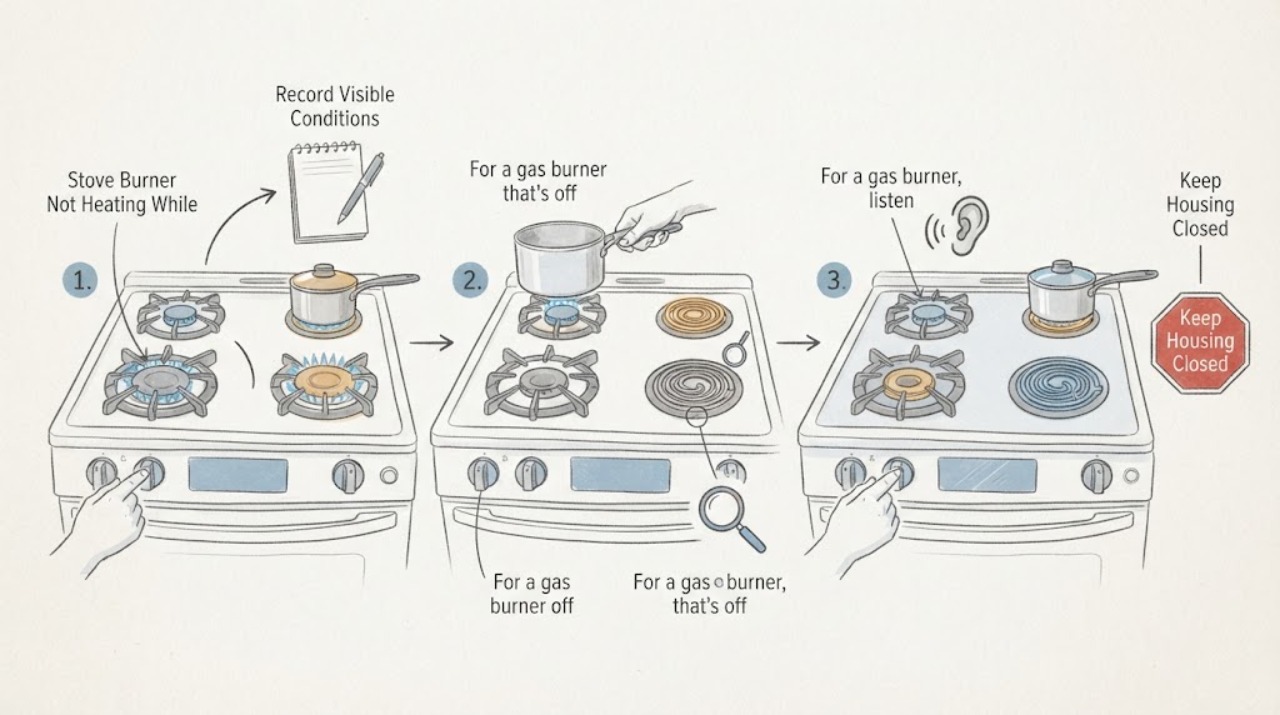
Work through in order
Diagnostic checks
Use only checks that match the exact appliance or system and its official guide.
-
Check 1
Turn the failed burner control fully off and let every nearby surface cool. From a safe position, identify whether the appliance is gas, electric coil, smooth glass, or induction and record whether the failed area has a flame, clicking, glow, indicator light, or no response. Do not touch a hot surface or start a test when a hazard is present.
Expected result: There is gas odor, smoke, arcing, an unstable or yellow flame, a hot cord, a cracked cooktop, a control that will not turn off, or a tripped breaker; or the appliance is cool and the symptom is limited to one area.
Next step: For gas odor, leave immediately and contact the gas utility or emergency services from outside. For smoke, arcing, hot wiring, a crack, or a repeated trip, keep clear and arrange emergency or qualified service. Otherwise continue only with the matching cool-appliance branch.
Why this matters
Why: The first group indicates a fire, combustion, shock, burn, or equipment hazard. A cool isolated failure supports a technology-specific visible check.
-
Check 2
For a gas burner that has no flame, inspect only the cool, removable burner cap and head for moisture, spill residue, a cap sitting crooked, or a cap placed on the wrong burner. Wipe visible moisture with a dry cloth and reseat only parts the exact manual identifies as removable; do not enlarge ports or disassemble the gas system.
Expected result: The cap is wet, mismatched, or not flat; the ports are visibly obstructed; or the cap and visible burner parts are correctly seated and clean but the burner still will not light.
Next step: After the burner is cool and correctly reassembled, make one normal ignition attempt only if there is no gas odor. If it still fails, turn it off and arrange service; do not poke deeply, adjust the orifice, or continue releasing gas.
Why this matters
Why: RANGE guidance identifies cap placement, burner-port condition, and clean burner parts as separate causes of a single gas burner not lighting. A correctly assembled burner with persistent failure points toward ignition, gas delivery, or control service.
-
Check 3
For a gas burner, listen and look only during a brief normal start attempt: note whether the igniter clicks or sparks, whether gas reaches a flame, and whether the flame is even and stable. Do not hold the knob open, use a match, or keep trying after a failed ignition or odor.
Expected result: There is no click or spark, clicking occurs but no flame appears, the flame is weak, yellow, noisy, or uneven, or the burner lights and heats normally after the cap check.
Next step: Turn the control off. Arrange qualified appliance service for no spark, persistent no flame, or abnormal flame. Leave for gas odor or suspected combustion trouble and contact emergency help from outside; do not adjust gas pressure or burner settings.
Why this matters
Why: No click can indicate a power, igniter, or control issue; clicking without flame can indicate burner assembly or gas-path service; an abnormal flame can indicate adjustment, contamination, ventilation, or combustion trouble. Normal flame after reseating points to a correctable assembly issue.
-
Check 4
For an electric coil burner, disconnect power from a safe dry location and wait until the element is completely cool. Only if the exact manual permits removal, compare the failed coil with a same-size working coil in the matching receptacle; do not pull wiring, open the control area, or perform energized tests.
Expected result: The failed coil works in the known-good same-size receptacle, the known-good coil also fails in the original receptacle, or the comparison is not permitted or cannot be done safely.
Next step: Restore only the documented, cool, safe configuration and arrange appliance service for a failed coil, receptacle, wiring, or control. Do not bypass a safety switch or replace a part without the exact model diagnosis.
Why this matters
Why: If the failure follows the coil, the element is suspect; if the failure stays with the receptacle, the receptacle, wiring, switch, or control is suspect. An unsafe or unavailable comparison requires service rather than guesswork.
-
Check 5
For a smooth glass or induction cooktop, use the exact manual to check that the zone is unlocked, the control is set to a heat setting, and the pan is compatible, centered, and flat. Observe the indicator and normal cycling without touching the glass or deliberately overheating an empty zone.
Expected result: The indicator responds but the pan stays cool, the zone cycles on and off, the pan is warped or incompatible, the control is locked, or the zone gives no response while other zones work.
Next step: Use suitable cookware and one supervised normal attempt only when there is no hazard. If the zone remains cool, a lockout returns, the glass is cracked, or the control behaves abnormally, stop using it and arrange service.
Why this matters
Why: Radiant zones can cycle as designed, cookware can change heat transfer, and induction zones can require compatible cookware. No response from one zone after the model-specific setup points toward its control, sensor, element, or power path.
-
Check 6
Record the exact model, fuel or cooktop type, failed burner position, control setting, visible flame or element behavior, recent spill or cleaning, recent installation, breaker status, and any odor or noise. Do not remove panels or slide a range to inspect a cord unless the manual and a qualified person make that safe.
Expected result: The fault repeats on one position with correct assembly and cookware, or it occurred after a spill, installation, movement, wiring change, or control problem.
Next step: Leave the failed burner off and provide the record to qualified appliance service. Do not continue tests, change circuit protection, adjust gas parts, or open the cabinet.
Why this matters
Why: A repeatable position-specific failure points toward the local burner, element, receptacle, sensor, switch, or gas path; a recent installation or spill adds wiring, moisture, or contamination questions that need model-specific service.
Use your observations
Decision map
Find the observation that best matches what you see, then follow the next safe action.
-
PATH 01Next step
What you see
A gas burner has a correctly seated dry cap and visible clean ports but produces no click or spark while other burners work.
Do this next
Keep the control off and arrange qualified appliance service. Do not use a match, open the control area, or continue releasing gas to test it.
Why this path and its safety boundary
Why it matters: The individual igniter, electrode, switch, wiring, or appliance power path is more likely than a whole-house gas outage.
-
PATH 02Next step
What you see
A gas burner clicks but does not light, or lights with a weak, yellow, noisy, or uneven flame after the cap and visible ports are correctly assembled.
Do this next
Turn the control off and arrange qualified service. For gas odor, suspected combustion trouble, or an unstable flame, leave the area and obtain gas or emergency help from outside.
Why this path and its safety boundary
Why it matters: A burner-path, ignition, gas-delivery, contamination, adjustment, or ventilation problem may be present; the other working burners do not clear this local hazard.
-
PATH 03Next step
What you see
An electric coil element works in a same-size working receptacle, or a known-good coil fails in the original receptacle after safe power isolation.
Do this next
Stop comparing parts and arrange model-specific appliance service. Do not open the range or bypass the receptacle safety connection.
Why this path and its safety boundary
Why it matters: The failure follows the coil in the first pattern; it stays with the receptacle, wiring, switch, or control in the second pattern.
-
PATH 04Next step
What you see
A glass or induction zone responds or cycles, but heat transfer is poor with a warped, unsuitable, off-center, or too-small pan; or the zone is locked by the control.
Do this next
Use the exact manual's compatible cookware and control procedure for one supervised attempt. If the zone remains cold with correct cookware or the glass is damaged, stop and arrange service.
Why this path and its safety boundary
Why it matters: Cookware or normal control behavior may explain the complaint rather than a failed heating component.
-
PATH 05Next step
What you see
The burner remains dead after its technology-specific visible check, or there is a cracked surface, smoke, arcing, hot cord, repeated breaker trip, gas odor, or a control that will not turn off.
Do this next
Stop using the stove and arrange qualified appliance service. Leave for gas odor and call the gas utility or emergency services from outside; call emergency services for smoke or fire.
Why this path and its safety boundary
Why it matters: A component, wiring, gas, combustion, or structural safety fault may be present and cannot be confirmed by further homeowner testing.
Helpful context
Understand the symptom
First identify the burner technology
A gas burner makes a flame, an electric coil becomes hot, and a glass or induction zone transfers heat through the cooktop and pan. The same symptom—one cooking area stays cool while others work—therefore has different safe checks. Record whether the failed area has a flame, clicking, a glowing element, a hot-surface indicator, or no response at all. Use the exact appliance manual for controls, lockout behavior, and removable parts.
The other working burners narrow the fault, but do not make testing risk-free
If one gas burner fails while its neighbors light, a whole-house gas outage is less likely, but the individual cap, ports, igniter, control, or burner path can still be at fault. If one electric coil fails, comparing the cool element and its same-size receptacle can separate an element problem from a receptacle or control problem when the appliance is safely disconnected. Do not infer that the wiring or gas system is safe simply because other burners work.
When a weak flame or unusual smell changes the decision
CPSC guidance warns that an improperly adjusted gas stove can emit more carbon monoxide and recommends proper burner adjustment and outdoor-vented exhaust. A persistent yellow-tipped or unstable flame, gas odor, soot, hissing, or a burner that will not shut off is not a cleaning experiment. Turn the control off if it is safe to do so, leave the area for gas odor or suspected combustion trouble, and obtain qualified help.
Safety boundary
Stop conditions
- For gas odor, hissing, smoke, a persistent yellow or unstable flame, or suspected combustion trouble, turn the control off only if safe, leave immediately, avoid flames and switches, and contact the gas utility or emergency services from outside.
- Stop for arcing, a hot cord or plug, melted wiring, a repeated breaker trip, a cracked glass surface, a control that will not turn off, or water near electrical parts. Keep clear and obtain qualified or emergency help.
- Do not open the range, adjust gas pressure or burner orifices, probe energized parts, bypass a coil safety switch, change circuit protection, use a match to light a failed igniter, or keep releasing gas after an ignition failure.
- Use only the exact manual for a removable coil, glass or induction lockout, burner cap, or control procedure. If a single burner remains cool after the safe visible check, leave it off and arrange service.
Only after diagnosis
Potential parts
- gas burner cap or burner head
Consider this only when the exact manual and qualified diagnosis confirm a damaged, missing, mismatched, or unserviceable cap or head after correct seating and cleaning.
Cap size, head design, ports, and burner position vary by model. Do not swap parts by appearance or enlarge ports. - gas igniter or electrode assembly
Consider this only when a qualified diagnosis confirms no spark or a failed local ignition component after the control and power path are evaluated.
Igniter shape, electrode location, wiring, and insulation are model-specific and require safe installation. - electric surface element or receptacle
Consider this only when a safe, manual-permitted comparison or professional test distinguishes a failed coil from the receptacle, switch, or wiring.
Element size, terminal layout, receptacle, wattage, and safety switch requirements must match the exact range model. - surface burner control or infinite switch
Consider this only after qualified diagnosis confirms the burner, element, receptacle, wiring, and control input are otherwise correct.
Controls vary by fuel type, zone position, rating, and model; replacement is not a homeowner energized test or bypass.
When checks do not resolve it
Need a professional?
Request service for a persistent single-burner failure, no spark, clicking without flame, abnormal gas flame, failed coil or receptacle comparison, unresponsive glass or induction zone, repeated trips, or any damaged control, cord, wiring, burner surface, or cooktop.
Safety scope: Keep the failed burner off until service for gas odor, abnormal flame, smoke, arcing, hot wiring, water near electrics, cracked glass, repeated trips, or a control that will not turn off. Do not open the appliance, perform energized checks, change gas or circuit settings, or bypass safety devices.
Common questions
FAQ
Why does one stove burner not heat when the other burners work?
The likely branch depends on the technology. A gas burner may have a wet or misplaced cap, blocked visible ports, no spark, or a gas-path fault. An electric coil may have a failed element or receptacle. A glass or induction zone may be cycling normally or need compatible cookware. Use the exact model manual and stop for hazards.
What should I check when a gas stove burner clicks but will not light?
With the burner cool and the control off, check only that the correct cap and head are clean, dry, and seated as the exact manual shows. Make one normal attempt only when there is no gas odor. If clicking continues without flame, turn it off and arrange service; do not use a match or keep releasing gas.
How can I tell if an electric coil or the receptacle is bad?
Only after safe power disconnection and if the exact manual permits it, compare the cool failed coil with a same-size working coil. If the failure follows the coil, the element is suspect; if it stays at the receptacle, the receptacle, switch, wiring, or control needs service. Do not open the range or perform energized checks.
Is it normal for a glass-cooktop burner to cycle on and off?
Radiant glass-cooktop elements can cycle to regulate heat, including at a high setting. Pan size and a flat bottom affect heat transfer. If one zone stays cold with suitable cookware and correct controls, or the glass is cracked, stop using it and arrange service.
When is a stove burner problem an emergency?
Treat gas odor, hissing, a persistent yellow or unstable flame, smoke, arcing, a hot cord, a repeated breaker trip, a cracked cooktop, or a control that will not turn off as urgent. Leave for gas odor, call emergency help from outside, and do not restart or keep testing the stove.
Read the exact guide
Official sources
- Ranges - Why does my surface element appear to go on and off on my ceramic glass cooktop?Frigidaire · Frigidaire ceramic glass cooktop support page; cycling behavior and indicators vary by model.
- Ranges - No HeatingFrigidaire · Frigidaire range support page; use the exact manual for a different brand or model.
- Gas Range & Cooktop - Burners Won't LightGE Appliances · GE gas range and cooktop support page; burner design and controls vary by model.
- The Inside Story: A Guide to Indoor Air QualityU.S. Consumer Product Safety Commission · CPSC/EPA household safety guide; follow the appliance manual and qualified gas service for a specific range.
- Electric Range - Surface Burners Not Heating or WorkingGE Appliances · GE electric range support page; exact model instructions and safe power isolation govern a specific appliance.
Community feedback
Share a repair observation
Share a plain-text repair observation. Accepted observations are published automatically; this page may take a moment to update.