
On this page
Start here
Quick answer
Treat a gas smell from or near a Hotpoint gas dryer as a safety incident, not as a normal dryer odor. Stop using the dryer, do not relight or restart it, and avoid flames, switches, plugs, phones, or other possible ignition sources in the affected area. From a safe location, ventilate only if that can be done without creating a spark, leave the property if the odor is strong or anyone feels unwell, and contact the local gas emergency service. If you can safely reach the meter control valve, follow the emergency service or safety authority’s instructions about shutting off the supply. Do not use the dryer again until a qualified gas engineer has checked it and declared it safe.
Work through in order
Diagnostic checks
Use only checks that match the exact appliance or system and its official guide.
-
Check 1
If gas odor is present now, stop the dryer and move people and pets away from the appliance. Do not press controls, unplug it, light a flame, smoke, operate electrical switches, or use a phone in the affected area.
Expected result: The odor lessens after leaving and ventilating from a safe position, or it remains strong, spreads, or is accompanied by hissing, a carbon monoxide alarm, smoke, or symptoms such as headache or dizziness.
Next step: Leave the property if the odor is strong or anyone feels unwell, contact the local gas emergency service from outside, and follow its instructions. Seek urgent medical help for possible carbon monoxide exposure.
Why this matters
Why: Any suspected gas escape or combustion-safety concern is an emergency boundary, not a normal appliance diagnosis. Carbon monoxide can be present without a smell, so absence of odor after ventilation does not prove the appliance is safe.
-
Check 2
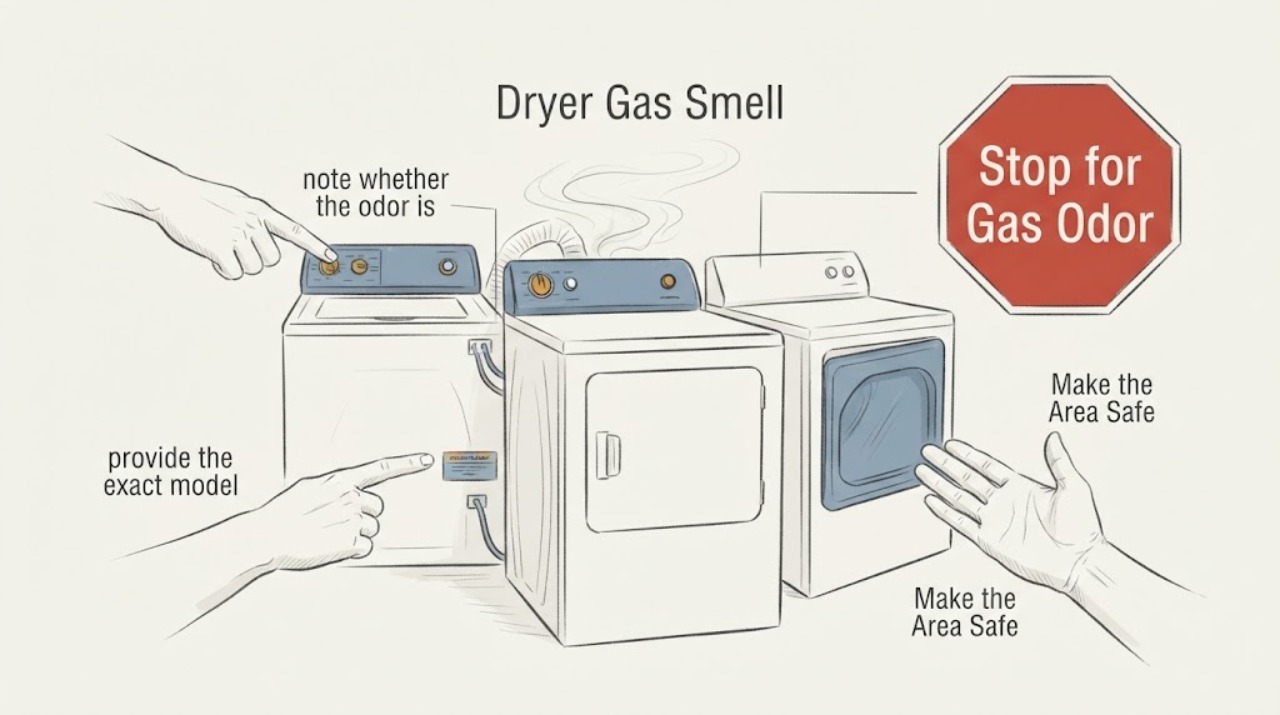
From a safe location and only if it can be reached without entering a gas-filled area or creating a spark, note whether the odor is strongest at the dryer, at the gas meter, or elsewhere. Do not move the dryer, disconnect the gas connector, or open its cabinet.
Expected result: The smell is localized near the dryer, is present throughout the room or property, or returns after the appliance has been isolated by the emergency service.
Next step: Report the location and when it was noticed to the emergency service or qualified engineer. Keep the dryer off and do not attempt a leak test, burner inspection, relight, or repair yourself.
Why this matters
Why: A location observation can help the emergency operator or engineer triage the incident, but it cannot prove that an internal dryer valve, connector, flue, or combustion path is safe. A whole-room or recurring odor requires the same stop-use response.
-
Check 3
After the gas emergency service has made the area safe and a qualified engineer has cleared the gas appliance, provide the exact Hotpoint model, installation type, when the smell occurs, whether the dryer was heating or tumbling, and any visible staining, unusual flame report, or error indication.
Expected result: The odor occurred only during ignition or heating, appeared while the dryer was off, followed a recent installation or gas-line change, or was accompanied by abnormal combustion signs or a carbon monoxide alarm.
Next step: Keep the appliance out of service until the engineer completes the required gas-safety checks and explicitly says it may be used. If the source is not the dryer, keep the dryer isolated until the responsible gas professional confirms the surrounding installation is safe.
Why this matters
Why: Timing and context help the engineer distinguish an appliance fault from a connector, installation, flue, ventilation, or wider gas-supply issue. They do not justify another test cycle by the consumer.
-
Check 4
Once the appliance is formally cleared, review the Hotpoint manual and carry out only routine, user-accessible maintenance: clean the fluff filter, empty a water container if fitted, and inspect the model-appropriate exhaust or condenser path for lint or obstruction with the appliance disconnected as directed.
Expected result: The dryer subsequently performs normally without any gas odor, or it develops an odor, overheating, poor drying, or a fault indication again.
Next step: Stop immediately and arrange another qualified gas-safety inspection if any odor returns. If only drying performance remains abnormal and there is no gas concern, use the manual’s model-specific maintenance and service guidance rather than opening the appliance.
Why this matters
Why: Routine airflow and moisture-path maintenance can address drying performance, but it cannot validate a gas valve, burner, connector, flue, or combustion system. A returning odor is a renewed safety stop regardless of whether the clothes dry.
Use your observations
Decision map
Find the observation that best matches what you see, then follow the next safe action.
-
PATH 01Next step
What you see
Gas odor is strong, persistent, spreading, or accompanied by hissing, a carbon monoxide alarm, smoke, or illness.
Do this next
Leave the property as appropriate, avoid ignition sources and electrical switching, contact the local gas emergency service from outside, and seek medical help for possible exposure. Do not re-enter or restart the dryer until cleared.
Why this path and its safety boundary
Why it matters: Treat the situation as an emergency gas or combustion incident.
-
PATH 02Next step
What you see
The odor is faint or disappears after the dryer is stopped, but its source has not been professionally identified.
Do this next
Keep the dryer out of service and arrange qualified gas inspection; do not run a short cycle to see whether the smell returns.
Why this path and its safety boundary
Why it matters: The absence of a current smell does not prove the appliance or gas installation is safe.
-
PATH 03Next step
What you see
A qualified engineer clears the gas appliance, but the dryer later produces the odor again.
Do this next
Stop using the dryer and contact the gas emergency service or qualified engineer again. Do not attempt to adjust a burner, gas valve, connector, or flue.
Why this path and its safety boundary
Why it matters: This is a repeat safety stop, not a filter or timer problem.
-
PATH 04Next step
What you see
No gas odor returns after formal clearance, but the dryer still dries poorly or runs unusually long.
Do this next
Use the exact Hotpoint manual for routine filter, condenser, water-container, and vent checks. Escalate persistent drying faults without disturbing gas components.
Why this path and its safety boundary
Why it matters: A separate lint, condenser, water-container, load, airflow, heating, or control issue may remain.
Helpful context
Understand the symptom
A gas smell changes the troubleshooting order
Do not test a gas-smelling dryer by starting another cycle, checking the burner, sniffing around the cabinet, or removing a panel. The smell may come from the appliance, its connector or pipework, another gas appliance, or the wider supply. You do not need to identify the exact source before stopping use and getting emergency advice.
Gas odor and carbon monoxide are different hazards
Carbon monoxide cannot be seen, tasted, or smelled. Headache, dizziness, nausea, unusual tiredness, confusion, or breathlessness around a fuel-burning appliance warrants fresh air and urgent medical or emergency advice. Do not rely on your sense of smell or a carbon monoxide alarm as permission to keep using a dryer that has produced a gas odor.
Only return to ordinary maintenance after clearance
After a qualified engineer and the relevant gas emergency service have cleared the appliance, follow the exact Hotpoint manual for routine filter, condenser, water-container, and vent maintenance. Those maintenance checks can improve drying, but they are not a safe substitute for a gas-safety inspection while an odor remains unexplained.
Safety boundary
Stop conditions
- Stop immediately for any gas odor, hissing, a carbon monoxide alarm, smoke, abnormal flame report, or symptoms of possible exposure.
- Do not restart, relight, unplug, move, or open a gas-smelling dryer in the affected area if doing so could create a spark.
- Do not test for leaks with a flame, disconnect the gas connector, adjust a gas valve, inspect a burner, or work on a flue or live electrical component.
- Do not use the dryer again until a qualified gas engineer has checked the appliance and surrounding installation.
Only after diagnosis
Potential parts
- gas valve or burner assembly
Only consider this category if a qualified gas engineer identifies a confirmed appliance-side gas or combustion fault after making the installation safe.
Gas components are model-specific and safety-critical; do not order or install one from an odor symptom alone. - gas connector or sealing component
Only consider this category if a qualified professional confirms a connector or seal issue and specifies the compliant replacement for the installation.
Confirm the appliance model, fuel type, local requirements, and professional fitment before any replacement. - carbon monoxide alarm
A suitable alarm may add warning protection after the gas installation is made safe, but it is not a diagnostic tool or a substitute for inspection and servicing.
Follow local safety guidance and the alarm manufacturer’s placement and certification requirements.
When checks do not resolve it
Need a professional?
Call the local gas emergency service immediately for a suspected gas leak or strong gas odor. Arrange a qualified gas engineer before using the dryer again, even if the smell has stopped. Seek urgent medical help for possible carbon monoxide exposure or symptoms such as headache, dizziness, nausea, confusion, breathlessness, or unusual tiredness.
Common questions
FAQ
Can I run my Hotpoint dryer once the gas smell disappears?
No. A smell that fades does not prove the dryer or gas installation is safe. Keep it off until the relevant gas emergency service or a qualified gas engineer has checked it and cleared it for use.
What should I do first if my gas dryer smells of gas?
Stop using it, avoid flames and electrical switching in the affected area, move to safety, ventilate only when it can be done safely, and contact the local gas emergency service from outside if a leak is suspected.
Can a carbon monoxide alarm detect a gas smell?
No. Carbon monoxide has no smell, and a carbon monoxide alarm does not make a gas-smelling appliance safe. Treat the odor as a gas-safety incident and obtain professional help.
Should I clean the lint filter to fix the smell?
Only after the gas appliance and installation have been professionally cleared. Filter, condenser, and vent maintenance can address drying performance, but it is not a safe response to an unexplained gas odor.
Read the exact guide
Official sources
- Hotpoint Service Tumble Dryer Repair - HotpointHotpoint · Hotpoint tumble dryer safety, filter, water-container, fault and service guidance
- Why Is My Hotpoint Tumble Dryer Not Working? Troubleshooting GuideHotpoint · Hotpoint tumble dryer maintenance and professional-help guidance
- Domestic gas: frequently asked questionsHealth and Safety Executive · UK domestic gas appliance emergency and qualified-engineer safety guidance
- Gas safety - Carbon monoxide awareness frequently asked questionsHealth and Safety Executive · Carbon monoxide hazard, symptoms, and response around fuel-burning appliances
Community feedback
Share a repair observation
Share a plain-text repair observation. Accepted observations are published automatically; this page may take a moment to update.