
On this page
Start here
Quick answer
First confirm that the Hotpoint refrigerator actually has a water dispenser and identify its model before using any model-specific control instruction. With the refrigerator operating normally, check that the household shut-off valve is fully open, the supply tubing is not kinked, and the dispenser is not locked. If the model uses a water filter, use only the matching filter procedure or supplied bypass plug: improved flow with the bypass plug points to a restricted filter, while no improvement points back toward the supply path or service. After a new installation or filter change, purge air using the manufacturer guidance. Do not remove panels or assume an inlet valve, dispenser switch, or control board has failed from the symptom alone; active leaking or persistent no-flow needs qualified service.
Before you begin
Safety first
- Do not remove panels, disconnect water tubing, reach into wet electrical areas, perform live electrical tests, force a filter or bypass plug, or replace an inlet valve or control component based only on the symptom.
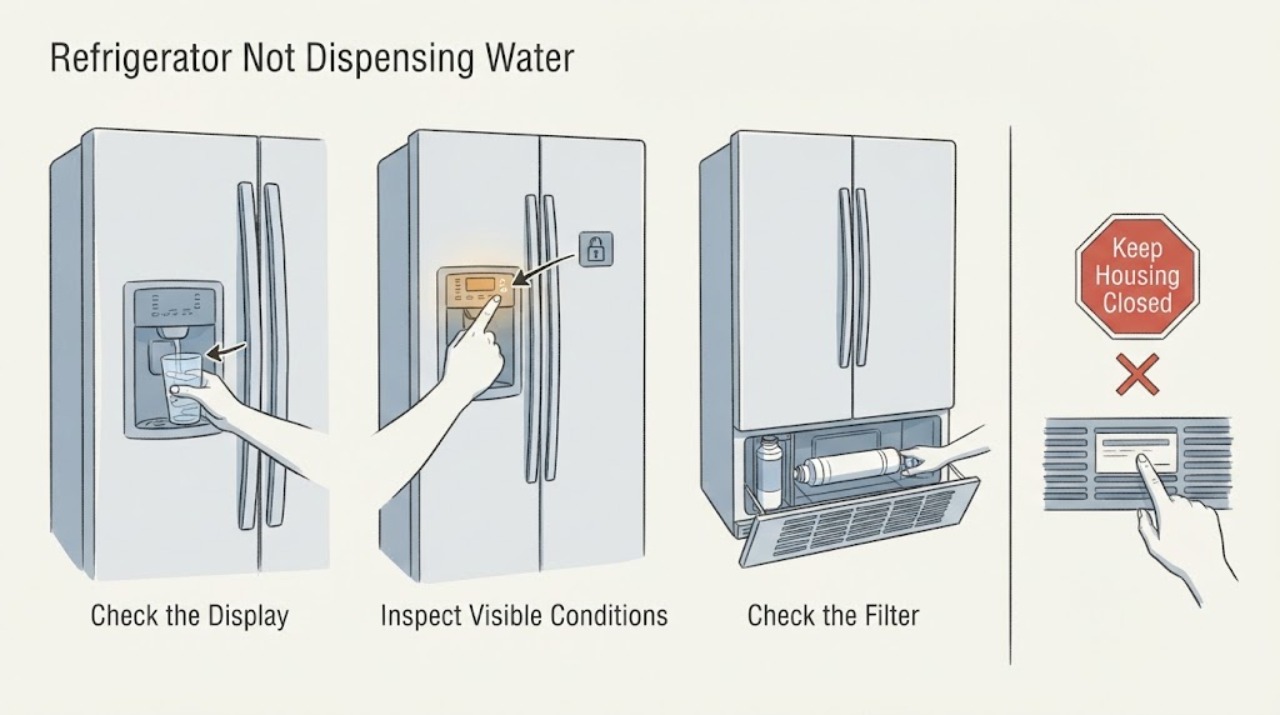
Work through in order
Diagnostic checks
Use only checks that match the exact appliance or system and its official guide.
-
Check 1
Read the complete model number and confirm that the refrigerator has a built-in water dispenser. With the appliance dry and powered normally, check the visible dispenser controls for a lock or child-lock state and use only the model manual for any unlock instruction.
Expected result: The model is a dispenser-equipped Hotpoint refrigerator and the control responds, the control is visibly locked, or the model has no built-in dispenser.
Next step: For a locked control, follow the matching owner manual. If the model has no dispenser, stop this path. If the control remains non-responsive, use the control-panel branch and do not open the panel.
Why this matters
Why: A no-dispenser model cannot be diagnosed as a failed water dispenser. A locked or non-responsive control can prevent dispensing without proving a water-valve failure.
-
Check 2
Without moving the refrigerator or disconnecting tubing, confirm that the household shut-off valve feeding the refrigerator is open and look at accessible tubing for a sharp kink. If the refrigerator was newly installed or its doors were removed, check the installation instructions for the door harness and dispenser fill procedure.
Expected result: The valve is closed, the accessible tubing is kinked, the refrigerator was recently installed or reassembled, or the external supply looks normal.
Next step: Correct only the accessible valve position or tubing routing, then allow the model's documented fill/purge procedure to complete. If the supply is normal and there is still no water, continue to the filter and flow branch.
Why this matters
Why: A closed valve, kink, disconnected door harness, or air after installation can prevent flow. A normal visible supply does not identify an internal component.
-
Check 3
If the model has a water filter, verify that it is the model-matched cartridge and is seated according to the owner manual. If the refrigerator supplied a bypass plug, remove the filter and install that plug only as the documented comparison test; after a filter change or new installation, purge the line using the manufacturer's dispenser guidance.
Expected result: Flow improves with the supplied bypass plug, flow remains poor with the bypass plug, or air was present after a recent filter change or installation.
Next step: Replace the filter only with one confirmed for the exact model if the bypass comparison supports it, or complete the documented purge. If the bypass test does not improve flow, do not infer a failed inlet valve; proceed to external flow/service assessment.
Why this matters
Why: Improvement with the bypass plug supports a restricted filter path. No improvement points toward supply pressure, tubing, or another unresolved cause. Air after installation or filter replacement can temporarily prevent normal flow.
-
Check 4
If water is present but slow, use the official general flow comparison: collect dispenser water in a measuring cup for 20 seconds and note whether the amount is below or at least 8 ounces. Keep the test external and stop if water leaks or the area becomes wet.
Expected result: The 20-second amount is below 8 ounces, at least 8 ounces, or no water comes out at all.
Next step: For low flow, compare the result with the bypass plug and accessible supply conditions. For no flow, use the no-water branch. If the flow result is normal but the user experience remains abnormal, record the model and arrange service rather than changing internal parts.
Why this matters
Why: GE Appliances treats less than 8 ounces in this general test as probably inadequate and 8 ounces or more as likely normal for that test. Complete no-flow is a different result and should not be treated as a slow-filter problem without checking the supply and model documentation.
-
Check 5
If the model has a chilled-water reservoir and the ice maker still receives water but the dispenser does not, inspect only visible fresh-food-floor areas for water and review the refrigerator temperature setting. Do not remove bins, tubing, or panels to reach an unseen tank.
Expected result: There is water on the fresh-food floor, the refrigerator is set unusually cold, the model is a top-freezer without a reservoir, or no visible leak is present.
Next step: If water is present or the reservoir may be cracked, stop using the dispenser and arrange service. If the manual supports a warmer setting, make only that user adjustment and allow the documented wait period; do not transfer a reservoir procedure to a model without one.
Why this matters
Why: GE Appliances notes that a frozen or cracked reservoir can stop dispenser flow and may leak onto the fresh-food floor; it also notes that top-freezer models may not have a reservoir. An unusually cold setting can contribute to reservoir freezing on applicable designs.
Use your observations
Decision map
Find the observation that best matches what you see, then follow the next safe action.
-
PATH 01Next step
What you see
The refrigerator has no built-in water dispenser, or the assigned model cannot be identified as a dispenser-equipped Hotpoint model.
Do this next
Stop and use the full model number to locate the correct owner manual; do not apply dispenser, filter, or valve instructions from another Hotpoint configuration.
Why this path and its safety boundary
Why it matters: The no-dispensing symptom is an identity mismatch or a different water-delivery feature, so dispenser troubleshooting would be misleading.
-
PATH 02Next step
What you see
The valve is open, accessible tubing is not kinked, and flow improves when the supplied filter bypass plug is installed.
Do this next
Keep the bypass comparison within the exact model instructions and obtain a model-confirmed replacement filter. If there is no supplied bypass plug, do not improvise one or remove internal tubing; use service or the manufacturer support path.
Why this path and its safety boundary
Why it matters: The filter path is restricting flow strongly enough to change the dispenser result; this does not prove a particular filter cartridge fits.
-
PATH 03Next step
What you see
The bypass comparison does not improve flow, the 20-second flow is below the official general comparison, or the accessible supply valve/tubing is abnormal.
Do this next
Correct only a safely accessible supply condition. If it persists, arrange appliance service or a qualified plumbing assessment and provide the model, flow result, filter status, and supply observations.
Why this path and its safety boundary
Why it matters: The issue remains in the external supply, pressure, tubing, or an unresolved model-specific water path; the official evidence does not identify an internal valve from this result alone.
-
PATH 04Next step
What you see
Water is visible on the fresh-food floor, around an accessible connection, or in a wet electrical area, or the dispenser continues to fail after the model-specific external checks.
Do this next
Stop using the dispenser, keep clear of wet electrical areas, and arrange qualified service. Use only a known, safely accessible household shut-off if water must be stopped; do not remove covers or test live components.
Why this path and its safety boundary
Why it matters: This is a leak or unresolved appliance fault that should not be narrowed by repeated dispensing tests or panel removal.
Helpful context
Understand the symptom
Start with the appliance identity and symptom
Hotpoint refrigerators are sold in different configurations. A Hotpoint side-by-side owner center page identifies a model with a water dispenser, while a Hotpoint top-freezer owner center page identifies a model without one. Read the full model number from the appliance label and confirm that the complaint concerns a built-in dispenser, not a pitcher or an ice-maker fill. Then separate complete no-flow from a weak stream; the two results point to different external checks.
Use the filter test only when the refrigerator has that filter system
GE Appliances says a clogged or partially clogged filter can stop or slow dispenser flow and describes a supplied bypass plug as a diagnostic comparison. A bypass result is evidence about the filter path, not proof that every Hotpoint refrigerator accepts the same filter or bypass part. Match the procedure to the model manual and do not order a filter by appearance alone.
Know when external checks have reached their limit
A visible leak, a frozen reservoir, or a dispenser that remains dead after the documented external checks needs a model-specific service assessment. Keep wet areas and electrical connections dry, and do not remove the door liner, tubing, valve, or control housing to test an internal component.
When checks do not resolve it
Need a professional?
Arrange qualified appliance service when the dispenser remains dry after the documented supply, lock, filter/bypass and purge checks; when water is leaking or a reservoir may be cracked; when the control panel remains non-responsive; or when the exact Hotpoint model and dispenser configuration cannot be matched to instructions.
Safety scope: Do not remove panels, disconnect water tubing, reach into wet electrical areas, perform live electrical tests, force a filter or bypass plug, or replace an inlet valve or control component based only on the symptom.
Have this ready
- Provide the full model and serial information, refrigerator configuration, whether the dispenser is completely dry or slow, whether the ice maker receives water, filter and bypass-test results, recent installation or filter work, and any visible leak location.
Common questions
FAQ
Do all Hotpoint refrigerators have a water dispenser?
No. GE Appliances' Hotpoint owner center identifies some models as side-by-side refrigerators with a dispenser, while other Hotpoint refrigerator configurations do not have one. Confirm the full model number and visible feature before following dispenser instructions.
Can a clogged filter stop a Hotpoint refrigerator from dispensing water?
On models with a water filter, GE Appliances says a clogged or partly clogged filter can cause no water or slow flow. Use the supplied bypass plug only when the model instructions provide one; improved flow supports a restricted filter path, but it does not identify a universal filter fit.
What should I do after replacing the refrigerator filter?
Air can remain in the water system after a filter change. Follow the exact model guidance to purge the line, and stop if water leaks or the area becomes wet. If flow does not improve, compare the result with the official bypass and supply checks rather than ordering an internal part.
Is a slow stream the same as no water at all?
No. GE Appliances provides a general 20-second comparison for slow flow, while complete no-flow requires checking the valve, installation air, filter path, lock and model configuration. A normal flow comparison does not prove that every dispenser is operating correctly.
Should I replace the water inlet valve if the dispenser is dry?
Not from this symptom alone. First complete the safe, model-matched external checks and record the results. Persistent no-flow, active leaking, or a non-responsive control should be handed to qualified service rather than diagnosed by opening the refrigerator or changing an internal component.
Read the exact guide
Official sources
- User Manual & Care for HSH25GFBBBGE Appliances · Opened GE Appliances Owner Center page identifies the exact product as a Hotpoint side-by-side refrigerator with dispenser and links its owner manual and support resources.
- User Manual & Care for HTR15BBRLWWGE Appliances · Opened GE Appliances Owner Center page identifies a different Hotpoint top-freezer configuration, used only to show why dispenser presence and model scope must be confirmed.
- Refrigerator - Dispenser Control Panel Not WorkingGE Appliances · Opened manufacturer support article for a non-responsive dispenser control; used for lock, model-specific manual, brief power reset and service boundary without inferring an internal control failure.
- Refrigerator - No Water from DispenserGE Appliances · Opened manufacturer support article for no or slow dispenser water; used for supply valve, installation purge, door harness, filter/bypass, trapped air, frozen reservoir and service boundary.
- Refrigerator - Dispenser Water Flow TestGE Appliances · Opened manufacturer support article for slow dispenser flow; used only for the general 20-second/8-ounce comparison, bypass comparison and visible supply/pressure escalation.
- Refrigerator - Not Getting Water from the DispenserGE Appliances · Opened manufacturer support article for no water from a dispenser; used for new-installation fill, filter/bypass comparison, air purge, frozen reservoir and service boundary.
Community feedback
Share a repair observation
Share a plain-text repair observation. Accepted observations are published automatically; this page may take a moment to update.