
On this page
Start here
Quick answer
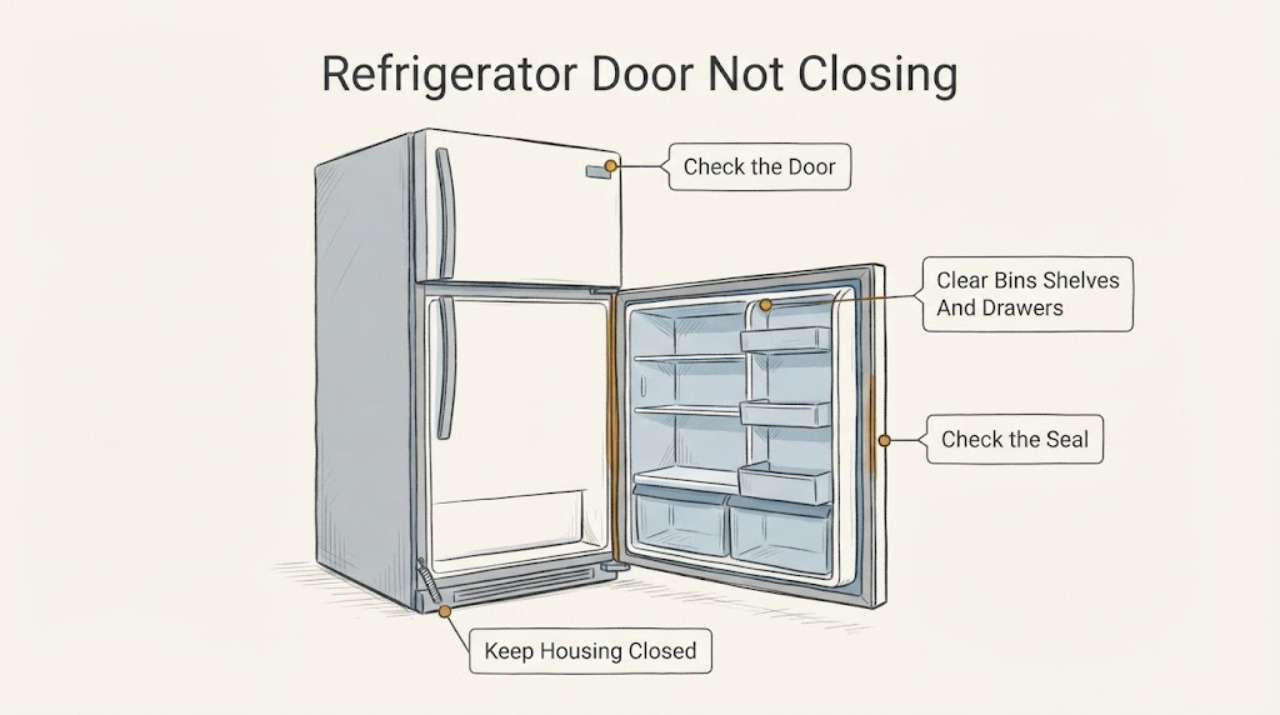
Start with the exact Hotpoint model and determine whether the door is physically blocked, no longer seals, has dropped on one side, or is being held by an integrated decor panel. Remove or reposition only an item that visibly prevents closure, check that shelves, bins, and drawers are fully home, and inspect the gasket for dirt, folds, tears, or a section pulled out of its channel. Hotpoint's official integrated-fridge-freezer guidance says that a dropped door can result from poor leveling and recommends correcting the foot on the hinged side, while its guidance for a built-in appliance says an incorrectly fitted outer decor door can keep the inner door from closing fully and keep the light on. Hotpoint's official parts information also links a door that does not close properly with a damaged or worn seal and says its hinge parts are suitable only for selected models. Do not force the door or loosen hinge fasteners on a heavy door. If the cabinet is not level, the door is sagging, the gasket is damaged, the hinge or closure is loose, the door has a water or electrical line, or internal access is needed, stop and arrange qualified Hotpoint service. Keep the door closed as far as safely possible to protect food, and move perishables if the seal cannot be restored promptly.
Before you begin
Safety first
- The user may identify the model, clear a visible item, clean and inspect the accessible gasket, and observe an accessible decor-panel or leveling symptom without moving an unstable appliance. Qualified service must handle heavy-door support, hinge and closure adjustment, cabinet movement, hidden water or electrical lines, door wiring, internal access, and live testing.
Work through in order
Diagnostic checks
Use only checks that match the exact appliance or system and its official guide.
-
Check 1
Record the complete Hotpoint model and identify the affected door or drawer. Determine whether the appliance is freestanding, integrated with an outer decor panel, a fridge freezer, or another configuration, and note whether the door stops against something, springs open, sits low, or leaves a gap.
Expected result: The door is blocked by an item, the appliance is integrated and the outer panel is misaligned, one corner is low, the gasket does not contact the frame, or the construction cannot be identified.
Next step: Follow only the branch matching the exact installation and symptom. If the model or door construction is unknown, obtain the manual before moving the appliance, adjusting feet, or ordering a part.
Stop if: Do not pull out a built-in refrigerator, support or remove a heavy door, or loosen hinge fasteners during identification.
Why this matters
Why: The safe first check changes with architecture. Hotpoint's dropped-door and decor-panel guidance applies to integrated fridge freezers, while the seal and hinge pages cover selected refrigerator or fridge-freezer parts rather than every model.
-
Check 2
Open the door only as far as it moves safely and inspect door bins, shelves, drawers, food packages, ice containers, and the cabinet edge for a visible interference. Push drawers and shelves fully home and remove or reposition only the item that clearly prevents the door from reaching the frame.
Expected result: A bin, shelf, drawer, package, ice buildup, or outer decor panel blocks the door; the door closes after the item is moved; or nothing visible interferes.
Next step: Restore safe clearance and make one gentle closure test. For ice that prevents closure, use the exact model defrost procedure; do not chip ice near the gasket or liner.
Stop if: Do not force the door, overfill a bin, cut a frozen drawer free, or use a sharp tool against the gasket or cabinet liner.
Why this matters
Why: A physical obstruction is more likely than a failed hinge or gasket when the door closes after clearance is restored. If nothing visible changes the gap, continue to seal, level, and alignment checks rather than forcing it.
-
Check 3
Clean and dry the accessible gasket and the frame it contacts, then inspect the gasket all the way around for folds, a section pulled out, tears, hardening, or a gap when the door is gently closed. Do not remove the gasket from its channel unless the exact manual explicitly permits it.
Expected result: The gasket is dirty, folded, displaced, torn, hardened, or fails to touch the frame; or it is clean, continuous, and evenly compressed.
Next step: Correct only surface dirt or a gentle, model-permitted seating issue. If the gasket is torn, permanently deformed, or remains loose, record the model and arrange service or a verified model-specific seal.
Stop if: Do not glue, stretch, heat aggressively, or substitute a universal gasket, and do not keep the door propped open with food inside.
Why this matters
Why: A displaced or damaged seal can keep the door from closing and can allow cold air to escape. Hotpoint's official seal information links improper closure with a possible seal replacement, but its listed seal fits selected models only.
-
Check 4
For an integrated Hotpoint fridge freezer, look without moving the cabinet for an outer decor panel that is visibly loose, shifted, or colliding with the appliance door. Check whether the cabinet rocks or the door sits lower on the hinge side. Adjust feet only when the exact manual allows it and the appliance is stable; do not lift the cabinet yourself.
Expected result: The decor panel restricts closure, the appliance is visibly out of level, the door has dropped on the hinge side, or the installation looks stable and aligned.
Next step: Secure only a clearly accessible decor-panel issue permitted by the installation instructions. For leveling, cabinet movement, or a dropped heavy door, arrange qualified service rather than lifting or tilting the appliance.
Stop if: Do not pull out or tilt a built-in unit, remove cabinet fixings, or adjust feet while the appliance is unstable or unsupported.
Why this matters
Why: Hotpoint says a badly fitted decor door can prevent full closure and that poor leveling can make a door appear dropped on an integrated model. A stable, level installation shifts suspicion to the gasket, hinge, closure, or door body.
-
Check 5
With the door supported by its normal position and the appliance undisturbed, observe the hinge side for a loose-looking fastener, sag, rubbing mark, uneven gap, or closure that changes when the door is lifted very slightly by its handle without force. Do not remove covers or hinge hardware.
Expected result: The door is visibly sagging, the hinge is loose or worn, the gap is uneven, the door has a rubbing mark, or the hinge area looks intact.
Next step: Keep the door closed as far as possible and arrange qualified service for hinge, closure, spacer, or alignment work. Use only a model-verified seal or hinge after diagnosis.
Stop if: Do not loosen hinge screws, remove the door, insert shims, or test a heavy door without proper support.
Why this matters
Why: Hotpoint's hinge information links a loose or worn hinge with improper closure. A sagging or heavy door can place stored loads and hinge geometry under tension; the observation does not identify which hinge, cam, spacer, or fastener is correct.
-
Check 6
After a gentle closure, check from outside whether the interior light goes out if the model has an accessible light indication, and note frost, condensation, warm food, or a compressor that runs unusually long. Do not hold the switch down or leave the door open to test it.
Expected result: The light remains on, a visible gap or condensation remains, food is warming, or the door seals and the appliance returns to normal operation.
Next step: Move perishable food to another cold appliance if closure is not promptly restored. Arrange service for a persistent light, temperature consequence, or closure gap.
Stop if: Do not bypass the light switch, adjust a thermostat to mask a warm compartment, or keep operating with a wide gap or leaking gasket.
Why this matters
Why: Hotpoint says an outer decor-door fit problem can keep the inner light on in a built-in model. A persistent gap can also increase cooling load and frost or condensation, but these effects do not identify the door part by themselves.
-
Check 7
Stop owner troubleshooting when visible clearance, gasket, and model-permitted installation checks do not restore closure, or when the hinge, closure cam, door liner, wiring, cabinet alignment, or built-in mounting would need access.
Expected result: The door remains sagging or open, a verified seal does not restore contact, the hinge is loose or worn, the door contains hidden lines, the cabinet is unstable, or the appliance shows water or electrical damage.
Next step: Keep the appliance stable and the door closed as far as possible, protect perishable food, and arrange qualified Hotpoint appliance service. Provide the model, installation type, gap location, seal and leveling observations, and any temperature or light symptom.
Stop if: No door removal, hinge disassembly, cabinet movement, wiring access, live testing, or operation with a damaged cord, water near electrical parts, broken glass, or an unstable unit.
Why this matters
Why: A hinge, closure, door body, gasket channel, cabinet mount, door wiring, or other internal condition may be involved. The appearance cannot safely determine the part or adjustment sequence.
Use your observations
Decision map
Find the observation that best matches what you see, then follow the next safe action.
-
PATH 01Safety boundary
What you see
A bin, shelf, drawer, package, ice buildup, or decor panel visibly stops the door before it reaches the frame.
Do this next
Restore only the visible clearance and make one gentle test; use the exact model's defrost procedure for ice.
Why this path and its safety boundary
Why it matters: Clearance is more likely than a failed hinge or gasket, especially if closure returns after the item is moved.
Safety stop: Do not force the door, cut frozen parts, or use sharp tools against the liner or seal.
-
PATH 02Safety boundary
What you see
The door reaches the frame but the gasket is folded, displaced, torn, hardened, or leaves a continuous gap after cleaning and correct loading.
Do this next
Seat only a model-permitted displaced section; otherwise obtain qualified service or a model-verified seal and keep food protected.
Why this path and its safety boundary
Why it matters: A seal problem is more likely. Hotpoint says a door that does not close properly may need a seal, but its listed parts are suitable only for selected models.
Safety stop: Do not glue, stretch, heat aggressively, or install a universal gasket.
-
PATH 03Safety boundary
What you see
An integrated appliance's decor panel restricts the inner door, or the cabinet is out of level and the door appears dropped on the hinge side.
Do this next
Secure only an accessible decor-panel issue permitted by the manual; arrange service for cabinet leveling, mounting, or a dropped heavy door.
Why this path and its safety boundary
Why it matters: Hotpoint's integrated guidance makes decor-panel fit and leveling more likely than a random seal replacement for this pattern.
Safety stop: Do not pull out, tilt, lift, or unfasten a built-in refrigerator alone.
-
PATH 04Safety boundary
What you see
The door is sagging, has an uneven gap or rubbing mark, or a hinge looks loose or worn after loading and gasket checks are clear.
Do this next
Stop adjustment attempts, support the appliance, and arrange qualified service with the exact model; do not select a hinge from appearance alone.
Why this path and its safety boundary
Why it matters: A hinge, closure cam, spacer, door mount, or alignment issue is more likely than a simple obstruction. Hotpoint links loose or worn hinges with improper closure.
Safety stop: Do not loosen fasteners, remove the door, or insert shims without the exact procedure and proper support.
-
PATH 05Safety boundary
What you see
The supported door still will not close after accessible checks, the light or temperature consequence persists, or water, broken glass, instability, cord damage, or electrical exposure is present.
Do this next
Keep the unit stable and off if electrically unsafe, protect food, and arrange qualified Hotpoint appliance or electrical service.
Why this path and its safety boundary
Why it matters: An internal door, cabinet, closure, wiring, or installation fault may remain; the safety symptom takes priority over further adjustment.
Safety stop: No repeated force, cabinet movement, door removal, live testing, or operation while unstable or wet near electrical parts.
Helpful context
Understand the symptom
Find the physical interference first
A door that stops at one point usually has an item, drawer, shelf, or decor panel in the way; a door that reaches the frame but springs back is more likely to have a gasket, alignment, or hinge problem. Empty only the obstructing area and check that bins and drawers are fully seated. Do not force the door against a container, because the resulting pressure can bend a shelf, damage the gasket, or worsen alignment.
Integrated and freestanding doors need different checks
Hotpoint's opened support page is specifically for integrated fridge freezers and says poor leveling can make a door appear dropped; it also identifies a badly fitted outer decor door as a cause of incomplete closure. A freestanding door may instead depend on its own hinges, closure cam, and gasket. Use the exact model manual before adjusting feet, cabinet fixings, or hinge hardware.
A gasket or hinge part is never universal
Hotpoint's official parts pages describe door seals and hinges as suitable for selected models and require a model-number fit check. A torn seal may be a conditional part after a close visual inspection, but a sagging door or loose hinge can require controlled support of the door and alignment of the cabinet. Those adjustments, especially on a tall or built-in appliance, should be left to qualified service.
Protect food and stop at unsafe access
If the door remains open, cold air escapes and food temperature can rise. Transfer vulnerable food to another cold appliance if closure cannot be restored promptly. Do not remove a door with hidden water or electrical lines, work around a heavy door without support, or loosen a hinge to see what happens. A damaged cord, water near electrical parts, broken glass, or an unstable cabinet is an immediate stop condition.
Safety boundary
Stop conditions
- Identify the exact Hotpoint model and installation type before adjusting feet, decor panels, hinges, closure hardware, or ordering a gasket.
- Do not force a door, remove a heavy built-in door, pull out or tilt an integrated appliance, or loosen hinge fasteners without proper support and the exact procedure.
- Move perishable food if the door cannot be closed promptly. Stop for broken glass, an unstable cabinet, water near electrical parts, a hot or damaged cord, smoke, or electrical exposure.
- Do not bypass a light or door switch, access hidden water or electrical lines, perform live tests, or operate with a torn seal or persistent wide gap.
Only after diagnosis
Potential parts
- refrigerator door gasket or seal
Consider this category only when the exact model's gasket is torn, permanently deformed, or missing after visible clearance and cleaning checks, and the gap follows the seal.
Hotpoint lists door seals for selected models only. Confirm the complete model and fit information before ordering or removing a seal. - refrigerator door hinge or closure hardware
Consider this category only when qualified diagnosis confirms a loose, worn, bent, or damaged hinge or closure after the door is visibly sagging or misaligned.
Hinge sides, closure parts, fasteners, and door weights vary by model. Do not remove or adjust a heavy door without qualified support. - integrated decor-door mounting or leveling hardware
Consider this category only when an exact integrated model's outer decor panel or mounting and leveling system is visibly preventing the appliance door from closing.
Built-in cabinet mounting and foot adjustments are installation-specific. Qualified service should handle unstable or heavy integrated units. - door liner, closure cam, wiring, or cabinet alignment service
Consider these service categories only after accessible loading, gasket, and model-permitted alignment checks fail and qualified diagnosis identifies an internal door or cabinet fault.
Hidden lines, door wiring, closure geometry, and cabinet mounts are model-specific. Do not select internal parts from the symptom alone.
When checks do not resolve it
Need a professional?
Arrange qualified Hotpoint refrigerator service when visible clearance, gasket, and model-permitted decor or leveling checks do not restore closure, or when a hinge, closure cam, door liner, cabinet mount, hidden water line, or door wiring needs access. Protect perishable food. Stop immediately for an unstable built-in unit, broken glass, water near electrical parts, smoke, abnormal heat, or a hot or damaged cord.
Safety scope: The user may identify the model, clear a visible item, clean and inspect the accessible gasket, and observe an accessible decor-panel or leveling symptom without moving an unstable appliance. Qualified service must handle heavy-door support, hinge and closure adjustment, cabinet movement, hidden water or electrical lines, door wiring, internal access, and live testing.
Common questions
FAQ
Why is my Hotpoint refrigerator door not closing?
Check visible food, bins, shelves, drawers, and ice first, then inspect the gasket for folds, displacement, or damage. If the appliance is integrated, also check for a shifted decor panel or a dropped door from poor leveling. Hotpoint links door-closure problems with seals and hinges on selected models. Persistent sagging or a wide gap needs qualified service.
Can a Hotpoint refrigerator gasket keep the door from closing?
Yes. A folded, displaced, torn, or hardened gasket can prevent contact with the frame. Clean and inspect it with the door supported, but use only a model-verified seal if replacement is needed; Hotpoint states its listed seals fit selected models rather than every refrigerator.
Why does my integrated Hotpoint refrigerator door look dropped?
Hotpoint's integrated-fridge-freezer guidance says poor leveling can make a door appear to droop and recommends a hinged-side foot adjustment for that model family. It also says a badly fitted outer decor door can prevent full closure. Do not pull out or tilt a built-in unit; arrange service for unstable or heavy installations.
When does a Hotpoint refrigerator door hinge need service?
A visible sag, uneven gap, rubbing mark, or loose-looking hinge after clearance and gasket checks makes hinge or closure wear possible. Hotpoint links loose or worn hinges with improper closure, but the correct hinge is model-specific. Do not loosen fasteners or remove a heavy door yourself.
What should I do if my Hotpoint refrigerator door stays open?
Keep the door closed as far as safely possible and move vulnerable food to another cold appliance if the gap cannot be corrected promptly. Stop for an unstable cabinet, broken glass, water near electrical parts, smoke, heat, or cord damage. If visible loading, gasket, and exact-model installation checks fail, arrange qualified service.
Read the exact guide
Official sources
- Fridge Freezer Door Seal J00118212Hotpoint · Official Hotpoint UK parts page for one listed seal and selected models only; used to support conditional seal diagnosis, not universal part compatibility.
- Fridge & Freezer Upper Right/lower Left Door Hinge J00118281Hotpoint · Official Hotpoint UK parts page for one hinge and selected models only; used to establish the hinge symptom and model-fit boundary, not universal compatibility.
- Integrated Fridge Freezer Troubleshooting & FAQHotpoint · Official Hotpoint UK troubleshooting page for integrated fridge freezers; leveling and decor-door guidance is model- and installation-specific and must not be generalized to every refrigerator.
Community feedback
Share a repair observation
Share a plain-text repair observation. Accepted observations are published automatically; this page may take a moment to update.