
On this page
Start here
Quick answer
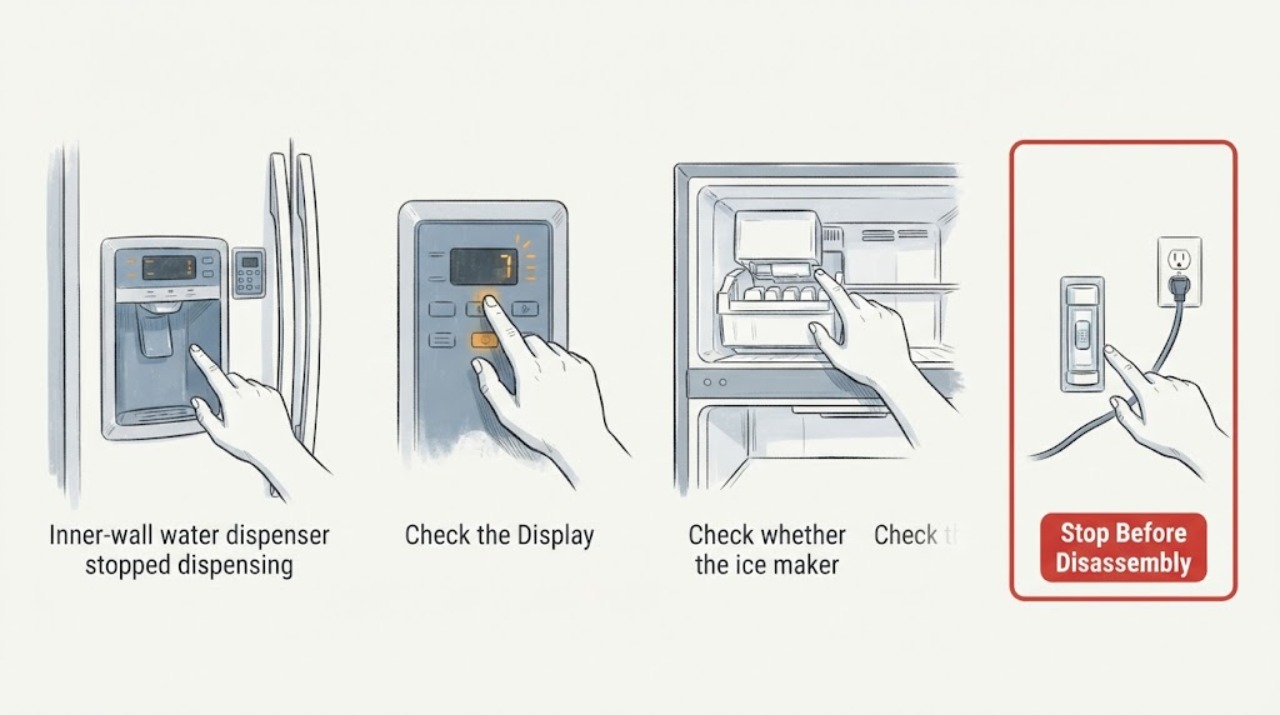
For the KitchenAid KRFC300ESS09, first determine whether the inner-wall dispenser is disabled or whether water flow is missing. Check the dispenser or control lock and select the water function exactly as the model manual shows, then compare water dispensing with ice production and the refrigerator's normal cooling. If both ice and water are affected, inspect the filter seating and service life, filter flushing after a recent change, the fully open cold-water shutoff, and visible supply-line kinks. A filter that is not seated, a clogged filter, air after filter replacement, or restricted supply can reduce or stop flow; these observations do not prove a failed valve or control board. If the lock is off, the filter and visible supply are normal, and the inner dispenser still produces no water, stop disassembly and arrange qualified service.
Work through in order
Diagnostic checks
Use only checks that match the exact appliance or system and its official guide.
-
Check 1
With the refrigerator doors closed as required by the exact manual, select the water function and check whether a control-lock or dispenser-lock indicator is active; then engage the inner dispenser pad or lever exactly as the model instructions show.
Expected result: The lock indicator is active, the water function was not selected, the pad or lever is not being engaged, or the controls are unlocked and the dispenser still gives no water.
Next step: Use only the model-documented lock release or selection procedure. If the controls are already unlocked and correctly engaged, compare the result with ice production before naming any internal cause.
Why this matters
Why: A lock, selection or engagement issue can disable the dispenser without proving a water-valve or control-board fault. An unlocked, correctly selected dispenser needs the shared water-path checks below.
-
Check 2
Check whether the ice maker is still producing ice and whether the refrigerator is otherwise cooling normally; make this observation without removing panels or trying to force a harvest cycle.
Expected result: Ice production and cooling are normal, ice production is also reduced or absent, or cooling is abnormal as well.
Next step: For a dispenser-only pattern, continue with the control and filter checks. For ice-and-water or cooling problems together, record the pattern and continue only with the visible filter and supply checks; do not diagnose a valve from this comparison.
Why this matters
Why: Normal ice production with a dead inner dispenser makes a dispenser control or local dispensing path more plausible. Reduced ice and water together make a shared supply or filter restriction more plausible, while abnormal cooling is a separate service concern rather than proof of a dispenser-part failure.
-
Check 3
If the filter was recently installed or changed, follow the exact KRFC300ESS09 manual to remove and reinstall it so it is fully seated, and confirm the filter is not visibly damaged; do not force the housing or substitute an unverified filter.
Expected result: The filter is not seated, was recently changed without the model-required flush, is visibly damaged, or is correctly seated and the system was flushed.
Next step: Correct the seating or perform only the model- and filter-specific flush, then retest once. If the filter is correctly installed and water still does not flow, continue to the supply-line check rather than ordering a part.
Why this matters
Why: KitchenAid says an incorrectly seated filter can cause water not to dispense, and air after filter replacement can make dispensing slow. A normal filter installation does not rule out a supply restriction or an internal fault.
-
Check 4
From a dry, accessible position, confirm the refrigerator's cold-water supply is turned on and inspect the visible supply line for a kink or pinch; do not pull the refrigerator, disconnect pressurized tubing or force a shutoff valve.
Expected result: The shutoff is closed or not fully open, the visible line is kinked or pinched, or the supply appears normal.
Next step: Open a normally operating accessible shutoff or straighten only a clearly visible kink without moving the appliance, then retest once. If the supply is normal and dispensing remains absent, use the service branch.
Why this matters
Why: A closed supply or kink can reduce water pressure and affect the dispenser and ice maker together. A normal visible supply leaves filter seating, dispenser controls, a concealed tube or an internal water component unresolved.
-
Check 5
After the lock, filter and visible supply checks, perform one brief normal dispense into a clean container and observe whether there is no flow, weak flow, or a short flow followed by air; stop if water appears inside the cabinet, near wiring, or on the floor.
Expected result: Water resumes normally, flow is weak or sputtering after filter service, or no water appears despite normal controls, filter and supply.
Next step: Follow the exact manual's flush or use instructions for air, then stop repeated testing. Arrange qualified service when no flow persists or a concealed tube, valve, control or door component would need access.
Why this matters
Why: Normal flow after a documented filter or supply correction supports that external condition. Weak or sputtering flow can be consistent with air after filter service, while no flow after all accessible checks does not identify a valve, tube or control board.
Use your observations
Decision map
Find the observation that best matches what you see, then follow the next safe action.
-
PATH 01Next step
What you see
The lock indicator is active or the water function/pad was not engaged, while ice production and refrigerator cooling remain normal.
Do this next
Use the exact KRFC300ESS09 manual to release the lock or select water and retry. If the controls are unlocked and the dispenser still fails, continue with filter and supply checks.
Why this path and its safety boundary
Why it matters: The evidence favors a dispenser-control state rather than a refrigerator-wide water or cooling failure.
-
PATH 02Next step
What you see
Water and ice both stop or become weak, especially after a filter change, while the refrigerator still cools normally.
Do this next
Verify filter seating and the required flush, then check the fully open cold-water shutoff and visible line for kinks. Stop if the next step requires tubing or panel access.
Why this path and its safety boundary
Why it matters: A shared filter, air-after-filter-service or household supply restriction is more plausible than a dispenser-only interface problem; the observation still does not identify a valve.
-
PATH 03Next step
What you see
The dispenser is unlocked and correctly engaged, the filter is seated and flushed, the visible supply is open and unkinked, and ice production is normal, but the inner dispenser remains completely dry.
Do this next
Arrange qualified KitchenAid or appliance service with the complete model suffix and the ice/filter/supply observations. Do not remove the door liner, tubing or control panels.
Why this path and its safety boundary
Why it matters: This is now a dispenser-local or concealed water-path fault, but the public checks do not safely distinguish a tube, valve, switch or control problem.
-
PATH 04Next step
What you see
The refrigerator is not cooling normally, ice production is also failing, water appears near electrical parts, or a leak develops while testing.
Do this next
Stop using the dispenser and ice maker, protect food and flooring, and arrange qualified service. Do not move the refrigerator alone or work near wet wiring.
Why this path and its safety boundary
Why it matters: The dispenser symptom is no longer isolated, and food, water or electrical safety takes priority over further dispensing checks.
Helpful context
Understand the symptom
KitchenAid's French-door refrigerator guidance starts with the dispenser control lock, the filter, the water supply and visible line kinks, and flushing after filter installation. The guide notes that a control lock simply deactivates the dispenser controls, while a clogged or improperly seated filter can reduce flow to both the dispenser and ice maker. That makes the ice-maker result a useful branch: it helps separate a dispenser-only control problem from a shared water-path problem.
The opened KitchenAid Owner's Center page for this task's KRFC300ESS09 URL resolves to the KRFC300ESS product record and identifies a 20 cu. ft. counter-depth French-door refrigerator with interior dispense. The page displays the base model KRFC300ESS rather than the 09 suffix, so use the rating label and exact manual for any suffix-specific control-lock, filter or dispensing procedure. Do not infer a valve or control-board failure from a silent dispenser alone.
When checks do not resolve it
Need a professional?
Call qualified appliance service when the inner dispenser remains dry after the exact model's lock, filter, flush and visible supply checks, when ice and cooling are abnormal together, when a concealed tube, valve, switch, door liner or control would need access, or when water reaches electrical parts or flooring. Stop immediately for smoke, sparking, a hot cord or a leak that cannot be isolated safely.
Have this ready
- The complete KRFC300ESS09 rating-label identity, whether the lock indicator was active, whether ice production and cooling were normal, filter age and recent replacement/flush history, supply-line observations, and whether flow was absent, weak or sputtering.
Common questions
FAQ
If the ice maker still works, does that rule out a water-system problem?
No. It makes a dispenser-only control or local path more plausible, but it does not prove that a valve, tube or control component is healthy. First verify the dispenser lock, water selection, filter seating and the exact manual procedure.
Can a recently changed filter stop the inner dispenser?
Yes. KitchenAid says a filter that is not seated properly can prevent dispensing, and air after filter replacement can make water dispense slowly. Reinstall and flush only as the exact model and filter instructions direct.
Should I replace the water valve when the dispenser is silent?
Not from the symptom alone. A control lock, selection issue, filter, air, supply shutoff or kink can produce the same user symptom. If those accessible checks are normal, service should identify the concealed cause.
Read the exact guide
Official sources
- KRFC300ESS | KitchenAidKitchenAid · The opened KitchenAid Owner's Center page identifies the KRFC300ESS 20 cu. ft. 36-inch counter-depth French-door refrigerator with interior dispense. It is used here for platform identity only, not to infer suffix-specific component compatibility.
- Not Dispensing Ice or Water - RefrigeratorKitchenAid Product Help · The opened KitchenAid article covers control lock, recent filter replacement and seating, cold-water supply, visible supply-line kinks, and flushing after filter installation; it explains that these conditions can affect dispenser and ice production.
Community feedback
Share a repair observation
Share a plain-text repair observation. Accepted observations are published automatically; this page may take a moment to update.