
On this page
Start here
Quick answer
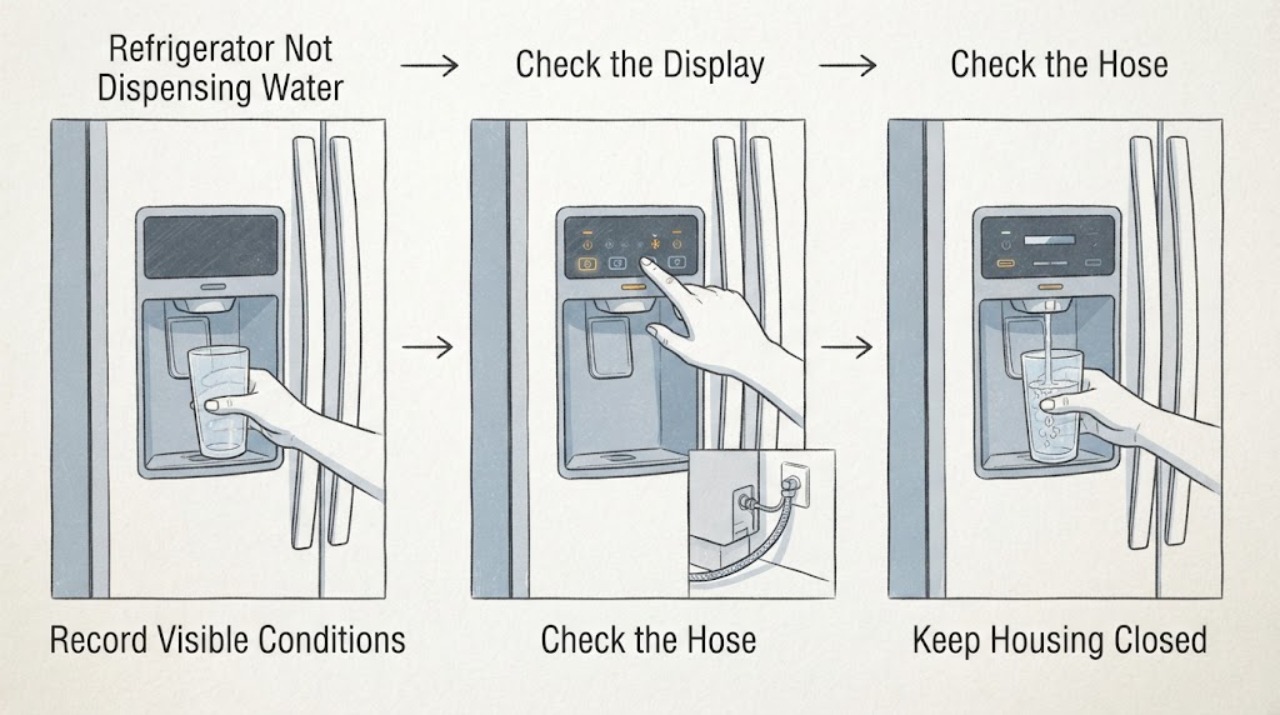
First confirm that this Bosch refrigerator is a plumbed model with a water dispenser, then use its exact E-Nr/model manual to check the dispenser lock, household water supply, hose and filter. Bosch manuals for dispenser-equipped families list an open supply valve, an unblocked water hose, sufficient pressure and a correctly fitted filter as user-level checks; some models also stop dispensing after prolonged or repeated use and require a short wait. Do not assume every Bosch refrigerator has the same dispenser, filter location or lock control, and do not diagnose a valve or replace a part from a generic description. If the supply and model-specific checks do not restore flow, or there is a leak, have Bosch or a qualified appliance professional assess it.
Work through in order
Diagnostic checks
Use only checks that match the exact appliance or system and its official guide.
-
Check 1
Confirm that the refrigerator has a plumbed water dispenser, then record the complete Bosch E-Nr/model and region from the rating label or paperwork. Compare the dispenser symbols, filter location and control-lock wording with the matching Bosch manual; do not apply a sequence from a different Bosch family.
Expected result: The appliance has a water dispenser and the exact model manual is available, or the appliance/model/region remains uncertain.
Next step: If the model is uncertain, provide the E-Nr/model and a photo of the control/dispenser area to Bosch support before ordering a filter or part. If the manual confirms a dispenser, continue with the model-matched checks.
Why this matters
Why: The safe checks and filter fit are model-dependent. A refrigerator without a plumbed dispenser cannot be repaired by changing a dispenser filter, and an unknown model does not establish which lock or filter arrangement is present.
-
Check 2
With no water being dispensed, check only the accessible dispenser controls: make sure the water option is selected, the glass/button is being operated as the manual shows, and a control or automatic water lock is not active. If water had been dispensed continuously or several times in a row, wait the interval stated by the exact manual before judging the symptom.
Expected result: The dispenser is locked or the wrong selection/operation is used; the model manual documents a short pause after repeated dispensing; or the control behaves correctly and there is still no flow.
Next step: Unlock or select water only through the model’s documented control, wait as directed, and try once. If there is still no flow, do not repeat the test continuously; check the supply and filter instead.
Why this matters
Why: A lock, selection or temporary dispenser pause can prevent output without proving a failed water component. Correct controls with persistent no-flow move the check to the water path.
-
Check 3
Make a cool, external visual check that the refrigerator water connection is supplied, the accessible shutoff valve is open, and the hose is not kinked or visibly damaged. Do not pull out a built-in refrigerator or disconnect a pressurized hose; if water is leaking, close the shutoff only if it is safely accessible.
Expected result: The valve is closed/no water supply is present, the hose is kinked or damaged, the supply appears normal, or a leak is visible.
Next step: Restore the supply only after a closed valve is intentionally corrected and there is no leak. For a kinked or damaged hose, shut off the supply and use an installer or qualified professional rather than forcing the hose. For a visible leak, keep the water off and arrange service.
Why this matters
Why: Bosch manuals associate no supply, a closed valve and a kinked hose with a non-functioning dispenser; a leak is a stop-and-contain condition, not a reason to keep testing.
-
Check 4
Check the filter indicator and filter housing only as the exact Bosch manual permits. Confirm the installed filter is the approved type for this E-Nr, seated/locked, and not overdue or blocked; do not force a cartridge, substitute a guessed universal filter, or remove a filter under pressure without following the manual.
Expected result: The filter indicator is active, the filter is overdue/blocked or not seated, or the filter is correctly fitted and output remains absent.
Next step: Use the model-specific filter procedure, flush or reset only as that manual specifies, and check for drips afterward. If the filter is correct and flow remains absent, stop replacing parts and arrange model-specific service.
Why this matters
Why: Bosch guidance links reduced water output or no dispenser operation with low pressure or a blocked filter, but a filter symptom does not prove a failed valve or dispenser module.
-
Check 5
If the model-matched lock, supply, hose and filter checks do not restore dispensing, record whether the dispenser is silent, clicks, leaks or shows a display message, along with the E-Nr/FD/Z-Nr and region. Do not open the door liner, access a valve, or make an energized measurement.
Expected result: The no-flow symptom persists after documented external checks, or the appliance displays a fault or has a leak.
Next step: Contact Bosch support or an authorized/qualified appliance professional with the identifiers and history. Keep the water supply off for a leak and do not operate the dispenser until the service boundary is clear.
Why this matters
Why: The remaining cause is not established by the public user checks and could involve model-specific water-path or control service; a part diagnosis would be speculative.
Use your observations
Decision map
Find the observation that best matches what you see, then follow the next safe action.
-
PATH 01Next step
What you see
The refrigerator has no plumbed water dispenser, or the E-Nr/model and region cannot be confirmed.
Do this next
Use the rating label and Bosch support to identify the appliance; do not order a dispenser part or transfer steps from another Bosch refrigerator.
Why this path and its safety boundary
Why it matters: A filter, dispenser lock or water-valve procedure cannot be selected safely from the Bosch brand name alone.
-
PATH 02Next step
What you see
The exact manual shows an active dispenser lock, wrong water selection, or a temporary stop after continuous/repeated dispensing.
Do this next
Use the model-specific unlock/selection instruction or wait the documented short interval, then make one controlled check.
Why this path and its safety boundary
Why it matters: The observed no-flow can be an operating condition documented for that family rather than proof of an internal failure.
-
PATH 03Next step
What you see
The valve is closed, water is not supplied, the hose is kinked/damaged, pressure is low, or a filter is blocked/not seated.
Do this next
Correct only the documented external condition. Shut off water for a leak or hose work and use an installer/professional when the connection is not safely accessible.
Why this path and its safety boundary
Why it matters: The external water path can account for the no-flow symptom; it does not identify a failed valve or pump.
-
PATH 04Next step
What you see
Supply, hose, filter and model-specific controls are correct, but no water dispenses, or there is a leak/display fault.
Do this next
Keep the water off for a leak and contact Bosch or qualified service with E-Nr/FD/Z-Nr, region, filter history and observed dispenser behavior.
Why this path and its safety boundary
Why it matters: The remaining fault is outside the supported external checks and needs model-specific diagnosis; it is not safe to name a valve or other part from the symptom alone.
Helpful context
Understand the symptom
Start by confirming the refrigerator can dispense water
“Bosch refrigerator” is not one dispenser design. Some Bosch refrigerators have an ice-and-water dispenser, while others do not; the task has no E-Nr/model or region. Find the complete model number and check the matching Bosch product page or manual before assuming a filter, dispenser lock or control sequence. Bosch’s support center and filter finder use the model number to select the applicable documentation and filter.
Use only the model-supported dispenser and lock controls
On the opened Bosch B36.D.. manual, the water control starts dispensing and the water-dispenser keylock can prevent operation. The same manual says a dispenser may stop after continuous or repeated dispensing and then resume after a short wait. Those controls and timings are family-specific examples, not a universal Bosch button sequence; if the display or symbols differ, follow the exact manual instead of repeatedly pressing controls.
Separate water supply and filter symptoms from an internal fault
Bosch manuals direct owners to check that water is supplied, the shutoff valve is open, the hose is not kinked, pressure is sufficient and the filter is not blocked. Bosch’s official filter guide also says to use a filter approved for the refrigerator model and consult the owner manual for the replacement procedure. These observations can narrow the safe next step; they do not prove that a water valve, pump or control board has failed.
Stop for leaks or unresolved no-flow after the documented checks
If a connection or hose is leaking, stop the water supply if it can be reached safely and do not continue dispensing. If the model-specific supply, lock and filter checks do not restore water, stop changing parts or opening panels. Bosch routes repairs to qualified technicians or authorized service providers and requires the model/E-Nr and other product identifiers for support.
When checks do not resolve it
Need a professional?
Contact an installer or qualified appliance professional for a closed/inaccessible water connection, a kinked or damaged hose, or any water leak., Contact Bosch or authorized service when model-matched controls, supply, hose and filter checks do not restore dispensing, or when a display fault remains., Do not open the refrigerator liner, access a valve or make energized measurements to diagnose no flow.
Have this ready
- complete Bosch E-Nr/model, FD and Z-Nr if available
- country/region
- whether the refrigerator has a plumbed water dispenser
- filter type, installation date and indicator state
- whether the valve is open, hose is kinked, a leak is present, or a display message appears
Common questions
FAQ
Could a Bosch refrigerator stop dispensing because the filter is blocked?
Yes, Bosch manuals for dispenser-equipped families list a blocked filter among causes of reduced output or no dispenser operation. Confirm the exact E-Nr/model and use only the matching manual and filter instructions; a blocked filter does not prove that a valve has failed.
Should I change the filter without knowing the Bosch model?
No. Bosch’s official filter guidance says to use the refrigerator model number to identify the approved filter and to follow the owner manual. Do not guess from appearance or use a generic cartridge.
What if the Bosch dispenser worked and then stopped after several glasses?
The opened Bosch B36.D.. manual says dispensing can stop after continuous or repeated dispensing and to wait a short period before dispensing again. Use that only if your exact model manual documents the same behavior; persistent no-flow needs the supply/filter checks and service decision.
Is a water valve the likely cause if no water comes out?
The symptom alone does not identify a valve. Check the model-specific lock, supply valve, hose, pressure and filter first; if those are correct and flow remains absent, arrange model-specific service rather than replacing an unverified part.
Read the exact guide
Official sources
- B36CL80SNS French Door Bottom Mount Refrigerator | BOSCH USBosch Home Appliances · Opened official Bosch US product page for one dispenser-equipped family as an identity example only. The task has no model, so this source is not used to claim that every Bosch refrigerator has the same feature.
- How to Replace Your Refrigerator Water Filter: Step-by-Step GuideBosch Home Appliances · Opened official Bosch US filter guide. It instructs owners to use the refrigerator model number to identify the correct filter, consult the owner manual and check the housing/seating/leaks; it is not used to infer a valve or part for the unspecified task.
- Getting Started with your Bosch Refrigerator | Refrigerator FAQsBosch Home Appliances · Opened official Bosch refrigerator FAQ. It states the filter recommendation for refrigerators equipped with a filter and the post-installation flush/reset reminder; model-specific instructions still control.
- Get Support - Refrigeration | Bosch Home AppliancesBosch Home Appliances · Opened official Bosch US refrigeration support page. It links model lookup, manuals, filter resources, troubleshooting and service; it does not define a universal dispenser repair or part.
- Use and Care Manual B30BB130SS, B30IB100SPBosch Home Appliances · Opened the official Bosch manual PDF and verified the listed B30BB130SS/B30IB100SP models. It supports the common external checks only within that documented family; no model-specific part diagnosis is generalized.
- Use and Care Manual B36.D..Bosch Home Appliances · Opened the official Bosch manual PDF and verified its B36.D.. family heading. It is used only for the explicitly covered dispenser-equipped family and presented as a conditional example, not a universal instruction for every Bosch refrigerator.
Community feedback
Share a repair observation
Share a plain-text repair observation. Accepted observations are published automatically; this page may take a moment to update.