
On this page
Start here
Quick answer
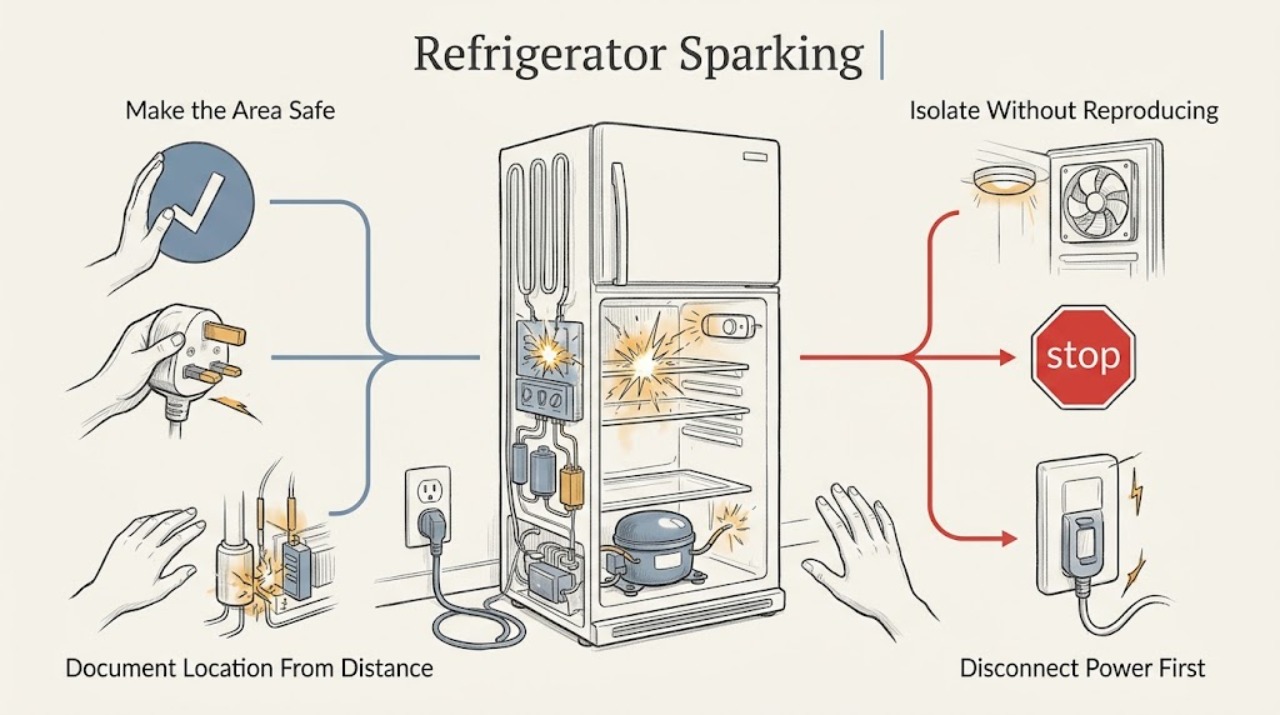
Treat any spark, flash, arc, or electrical crackle from a Hotpoint refrigerator as an active electrical hazard, not as a symptom to reproduce. Move people away, keep flames and other ignition sources away, and do not touch the appliance, plug, socket, wet floor, or cord if doing so could expose you to shock. If it is safe to do so from a dry position without reaching through smoke, water, or flame, switch off the supply at the socket or consumer unit; otherwise leave it alone and call emergency or qualified electrical help. Do not plug it back in, press controls, open the cabinet, remove a cover, test the outlet, or reset a breaker merely to see whether the spark returns. Once the area is safe, record where the flash appeared, whether it happened at the plug/socket, inside the cabinet, near a light or control, during compressor or defrost operation, and whether there was smoke, heat, odor, water, or a tripped protective device. Hotpoint's official guidance provides model-specific manuals and repair support, says to disconnect mains before replacing a part, and directs safety-notice checks by model; a spark does not identify a safe replacement part. Leave the refrigerator out of service until a qualified appliance technician or electrician has assessed the complete supply and appliance, and protect perishable food using a safe alternative.
Before you begin
Safety first
- The owner may keep people away, isolate power only when safe, record the event from a safe distance, and provide model information without dismantling. A qualified electrician must assess the fixed supply and socket when implicated; authorized appliance personnel must assess the cord, controls, lighting, fans, compressor circuit, defrost system, wiring, and cabinet.
Work through in order
Diagnostic checks
Use only checks that match the exact appliance or system and its official guide.
-
Check 1
Stop using the Hotpoint refrigerator immediately. Keep people, pets, flames, and water away; do not touch the appliance, plug, socket, or cord if smoke, flame, wetness, heat, or exposed damage is present. If there is an active fire or escalating smoke, leave and contact emergency help.
Expected result: There is smoke, flame, a burning odor, heat, visible arcing, water near electrics, or an immediately dangerous outlet; or the event has stopped and the area is dry and stable.
Next step: For an emergency, evacuate and obtain emergency help. If there is no immediate danger, remain at a safe distance and isolate power only if reachable from a dry position without handling damaged equipment.
Stop if: Do not approach, touch, move, unplug, or photograph closely when flame, smoke, water, heat, exposed conductors, or ongoing arcing makes the area unsafe.
Why this matters
Why: An active fire, heat, water, or electrical condition takes priority over identifying the refrigerator fault. A quiet, dry area is safer for remote isolation but does not make the appliance safe to use.
-
Check 2
If the area is dry and safe, switch off the refrigerator's supply at the socket or appropriate consumer-unit circuit from a safe position. Do not pull a plug from a scorched or wet socket, use an extension lead, press refrigerator controls, or repeatedly reset a breaker or residual-current device.
Expected result: The supply can be switched off without contact with damage; a protective device has tripped; the socket or plug is hot/scorched; or the supply cannot be safely reached.
Next step: Leave the appliance disconnected and arrange qualified electrical and appliance service. If power cannot be isolated safely, keep clear and obtain urgent qualified help rather than attempting a second method.
Stop if: Never restore power to reproduce the spark, bridge protection, remove a socket faceplate, or handle a wet/damaged plug or cord.
Why this matters
Why: Safe isolation prevents another energization event. A hot, damaged, wet, or inaccessible connection needs electrical assessment and must not be treated as a normal outlet check.
-
Check 3
After isolation and only from a safe distance, record where the flash or sound occurred: plug/socket, visible cord, behind or beneath the cabinet, interior light/control region, or unknown. Note the appliance state immediately before it happened and whether a breaker, RCD, alarm, smoke, odor, heat, or water was present.
Expected result: The event was clearly at the supply connection; visibly behind or inside the refrigerator; associated with water, odor, heat, or protection tripping; or its location is uncertain.
Next step: Give the notes, model information, and any safe-distance photographs to a qualified professional. Keep the refrigerator out of service regardless of whether the event has repeated.
Stop if: Do not open doors repeatedly, remove covers, pull out an integrated appliance, use an extension lead, or re-energize it to identify the location.
Why this matters
Why: The location helps separate a possible supply-side assessment from an appliance-side assessment, but no location proves a failed part and an unknown location is not a reason to inspect internally.
-
Check 4
Without moving or dismantling the refrigerator, record the exact Hotpoint model and product information from an accessible rating label, manual, purchase record, or existing photograph. Use Hotpoint's model-specific support and safety-notice lookup only after the appliance is isolated.
Expected result: The exact model is available; only a family name is known; the label requires moving or removing trim; or the product may be covered by a safety notice.
Next step: Provide the exact model and event record to authorized Hotpoint service and, where the spark was at the supply connection, a qualified electrician. Do not move an integrated unit or access a concealed label yourself.
Stop if: Stop if identification requires reaching behind the unit, removing panels/trim, touching the cord or socket, or entering a wet or damaged area.
Why this matters
Why: Model information allows the professional to retrieve the correct manual and check safety notices. A family name cannot determine wiring, controls, or an affected-product action.
-
Check 5
Leave the refrigerator disconnected and arrange qualified inspection of both the electrical supply and the appliance. Tell the professional that a spark occurred and provide the location, model, timing, protective-device result, and any heat, odor, smoke, or water observations. Do not replace a part or perform a live test.
Expected result: The event was a single flash with no visible damage; it recurred; protection tripped; the plug/socket is damaged; or an internal source is suspected.
Next step: Keep the appliance out of service until the professional declares the supply and refrigerator safe. Use a safe alternative for food storage and follow applicable food-safety guidance for any warmed perishables.
Stop if: Do not reset protection repeatedly, reconnect for a final test, bypass a fuse or interlock, open the cabinet, or attempt compressor, light, fan, control, or cord repair.
Why this matters
Why: Even a single unexplained arc may have damaged a connection. Recurrence, protection operation, visible damage, or an internal source increases the urgency, but none selects a replacement component remotely.
Use your observations
Decision map
Find the observation that best matches what you see, then follow the next safe action.
-
PATH 01Safety boundary
What you see
The spark is accompanied by flame, continuing smoke, burning odor, heat, water near electrical parts, or ongoing arcing.
Do this next
Leave the area and obtain emergency or qualified help as appropriate. Do not approach to unplug or inspect; isolate power only if it can be done remotely and safely.
Why this path and its safety boundary
Why it matters: This is an immediate fire or shock hazard, not a refrigerator troubleshooting branch.
Safety stop: Do not touch the refrigerator, cord, socket, water, or nearby metalwork, and do not return to reset power until the hazard is controlled.
-
PATH 02Safety boundary
What you see
The flash was clearly at the wall socket, plug, or visible cord, especially with scorch marks, looseness, heat, smell, or a tripped protective device.
Do this next
Leave the circuit and appliance isolated and arrange qualified electrical assessment, with appliance service if the refrigerator or cord may also be damaged.
Why this path and its safety boundary
Why it matters: The supply connection is a primary safety concern; the refrigerator cannot be cleared by substituting another socket or resetting protection.
Safety stop: Do not pull a plug from a damaged socket, replace a fuse as an experiment, use an extension lead, remove the socket faceplate, or reconnect the refrigerator.
-
PATH 03Safety boundary
What you see
The flash appeared behind/inside the cabinet, near a lamp or control, during an operating transition, or its location cannot be established safely.
Do this next
Keep the appliance de-energized and arrange authorized Hotpoint appliance diagnosis. Supply the model, timing, operating state, photographs from a safe distance, and protective-device result.
Why this path and its safety boundary
Why it matters: An internal appliance circuit or concealed connection may be involved, but the symptom cannot identify a lamp, fan, compressor, board, defrost component, or wiring fault.
Safety stop: Do not remove liners or panels, enter service mode, test live voltage, bypass a safety device, or run another cycle to reproduce the event.
-
PATH 04Safety boundary
What you see
There was one brief spark, no visible heat, smoke, water, or damage is present, and the supply has been safely isolated.
Do this next
Keep the refrigerator out of service, document the event, identify the model without dismantling, and obtain professional assessment before reconnecting.
Why this path and its safety boundary
Why it matters: The absence of visible damage does not prove that a connection or component is safe; a quiet reset is not a diagnostic clearance.
Safety stop: Do not perform a confirmation test, move the refrigerator to another outlet, or repeatedly reset a breaker or RCD.
-
PATH 05Safety boundary
What you see
The model is unknown, the appliance may match a Hotpoint safety notice, or the product information cannot be retrieved without moving or opening the unit.
Do this next
Keep the appliance unplugged and have an authorized professional identify it and check the applicable Hotpoint safety information; do not access a concealed label yourself.
Why this path and its safety boundary
Why it matters: A model-specific safety action cannot be confirmed remotely, and identity uncertainty increases the risk of applying the wrong repair instruction.
Safety stop: Do not infer safety from a similar model, combine error-code tables, or reconnect while the model and event remain unresolved.
Helpful context
Understand the symptom
A spark changes the job from diagnosis to isolation
A visible flash, arc, snapping sound with light, or spark at a refrigerator is a stop signal. Do not run another cycle, toggle the thermostat, open and close the door to reproduce it, or reset protection to see if the unit works. Keep children, pets, water, and ignition sources away. If smoke, flame, a hot outlet, or a burning odor is present, leave the area and contact emergency help as appropriate. If there is no immediate emergency, isolate the circuit only from a dry, safe position and leave the appliance disconnected until it is inspected.
Record the location without touching the fault
After the refrigerator is safely de-energized, write down whether the event came from the plug or wall socket, the visible cord, beneath or behind the cabinet, a lamp or control area, or an unknown internal location. Note whether the floor or appliance was wet, whether the compressor or fan had just started, whether a defrost or light event was occurring, and whether a breaker or residual-current device opened. Do not use a camera or flashlight close to smoke, flame, exposed conductors, or a wet electrical area. This evidence helps a technician choose the safe inspection path; it is not permission to inspect inside.
Separate the supply-side and appliance-side possibilities
A spark at the socket or plug can involve the supply connection, plug, cord, or receptacle; a flash from behind the cabinet or an internal lamp/control area can involve the appliance. From a safe distance, note the location and any visible scorch, melted plastic, heat, or damage, but do not pull the plug through a damaged socket or touch a cord lying in water. Do not substitute another outlet or extension lead as an experiment. A qualified electrician may need to assess the fixed supply, while an appliance technician assesses the refrigerator; either way, the event should not be re-energized for a comparison test.
Use model information only for safe service routing
Once the area is safe and without dismantling the refrigerator, record the model and product information from an accessible rating label or existing paperwork. Hotpoint's support area separates refrigerator and fridge-freezer guidance, and its safety notice uses the model number to check whether a product is affected. Do not interpret a generic E-code or assume that a model with the same appearance uses the same electrical arrangement. Supply the model, event location, photographs taken from a safe distance, and any protective-device or odor information to the professional.
Do not return it to service after a quiet reset
A breaker reset or a period with no further noise does not prove that the fault is gone. Hotpoint publishes model-specific fault guidance and tells owners to disconnect mains before part replacement; it does not make a generic spark safe to test. Keep the refrigerator out of service until the supply, plug, socket, cord, and appliance have been assessed. Move food to a safe, temperature-controlled alternative and follow local food-safety guidance if the refrigerator has warmed.
Safety boundary
Stop conditions
- Treat any spark, flash, arc, electrical crackle with light, smoke, flame, burning odor, heat, or damaged insulation as a stop-use condition; do not reproduce it.
- Do not touch or unplug from a wet, hot, scorched, loose, smoking, or arcing socket; isolate power only from a dry safe position or obtain qualified help.
- Do not repeatedly reset a breaker or RCD, use another outlet or extension lead as a test, press undocumented controls, or reconnect to confirm the fault.
- Do not open the cabinet, remove covers or liners, pull out an integrated refrigerator, test live wiring, bypass a fuse/interlock, or replace any electrical or refrigeration part.
- Keep the refrigerator out of service until a qualified electrician and/or authorized appliance technician has assessed the supply and appliance; check Hotpoint safety notices by exact model when safe.
When checks do not resolve it
Need a professional?
Call emergency help for fire, escalating smoke, or an immediate danger to people. Otherwise, leave the Hotpoint refrigerator disconnected and arrange qualified electrical assessment when the spark was at the plug, socket, cord, or supply, and authorized Hotpoint appliance service when it was behind or inside the cabinet or its source is unknown. Service is required even after a single unexplained flash; a quiet reset does not prove safety. Provide the model, event location and timing, operating state, protective-device result, and any heat, odor, smoke, water, or visible damage observed from a safe distance. Do not reconnect, use an extension lead, reset protection repeatedly, open panels, test live circuits, or replace a cord, lamp, fan, compressor component, control, or other part yourself.
Safety scope: The owner may keep people away, isolate power only when safe, record the event from a safe distance, and provide model information without dismantling. A qualified electrician must assess the fixed supply and socket when implicated; authorized appliance personnel must assess the cord, controls, lighting, fans, compressor circuit, defrost system, wiring, and cabinet.
Common questions
FAQ
What should I do if my Hotpoint refrigerator sparks?
Stop using it and do not reproduce the spark. Keep people, water, and flames away. If safe from a dry position, isolate the supply without touching a damaged or wet plug/socket; otherwise leave the area and get qualified help. Keep the appliance disconnected until the supply and refrigerator are assessed.
Can I plug my Hotpoint refrigerator into another outlet to see if it sparks again?
No. A different outlet or extension lead is not a safe diagnostic test after an arc. Leave the appliance isolated. If the original socket, plug, or cord was involved, arrange qualified electrical assessment; if the event was internal or unknown, arrange authorized appliance service as well.
Should I reset the breaker after a Hotpoint refrigerator sparks?
Do not repeatedly reset it or reconnect the refrigerator to reproduce the event. If the circuit can be isolated safely, leave it isolated and have the supply and appliance assessed. Smoke, flame, heat, water near electrics, or continued arcing requires immediate safety action.
Does a Hotpoint refrigerator spark identify a bad compressor or control board?
No. The symptom cannot distinguish a socket, plug, cord, lamp, control, fan, compressor circuit, defrost component, or wiring issue. Do not choose a part from the spark alone; Hotpoint's guidance is model-specific and internal work requires qualified service.
Can I check a Hotpoint refrigerator safety notice after it sparks?
Yes, but only after the area is safe and the appliance is isolated without dismantling. Hotpoint's safety-notice process uses the exact model number and instructs owners to unplug and refrain from using an affected appliance. If finding the label requires moving or opening the unit, let a professional identify it.
When does a Hotpoint refrigerator spark require a technician?
Every unexplained spark warrants professional assessment before reconnection. Use a qualified electrician when the plug, socket, cord, or supply may be involved, and authorized Hotpoint appliance service when the event came from inside/behind the refrigerator or its location is unknown. Emergency help is appropriate for fire, escalating smoke, or immediate danger.
Read the exact guide
Official sources
- Hotpoint Fridge Freezer RepairHotpoint UK · Opened official Hotpoint refrigerator service page; used for exact manual lookup, trained-engineer escalation, and the boundary against owner internal electrical or component work.
- Hotpoint Fridge Error CodesHotpoint UK · Opened official Hotpoint fridge error-code page; used only to establish that code meanings and next steps are model-specific and that mains must be disconnected before replacing a part.
- Hotpoint Appliances Safety NoticesHotpoint UK · Opened official Hotpoint safety-notice page; used for the model-based safety check and its instruction to unplug and refrain from using an appliance when a safety action requires it. It does not identify the cause of an unspecified spark.
- Hotpoint Service Help and AdviceHotpoint UK · Opened official Hotpoint help page; used to direct owners to refrigerator/fridge-freezer model support and certified service rather than infer a fault from a spark.
Community feedback
Share a repair observation
Share a plain-text repair observation. Accepted observations are published automatically; this page may take a moment to update.