
On this page
Start here
Quick answer
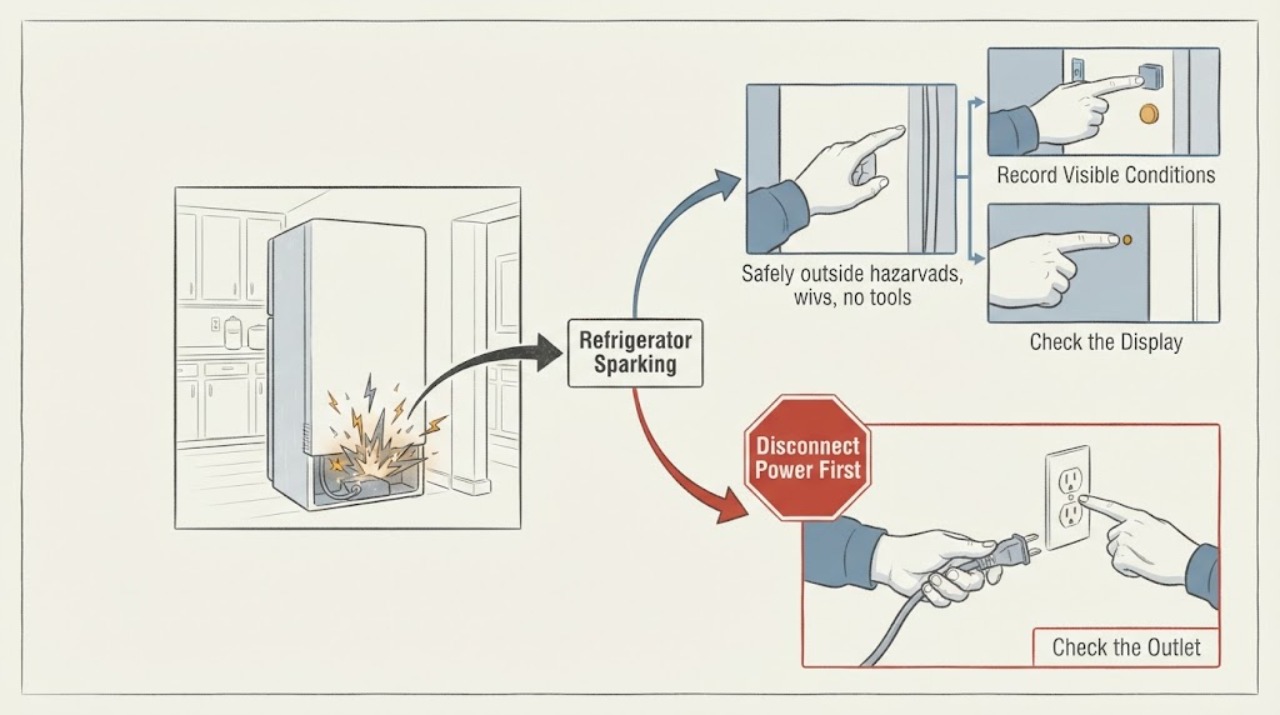
Stop using a Whirlpool refrigerator that produces visible sparks, arcing, smoke, or a burning smell. If it is safe to reach the plug without touching damaged parts, disconnect it, keep clear of the outlet, and do not repeatedly reset power. Check only the accessible cord, plug, outlet, and visible interior area; internal voltage testing and panel removal require an authorized technician.
Work through in order
Diagnostic checks
Use only checks that match the exact appliance or system and its official guide.
-
Check 1
From a safe position, note exactly where the flash occurs: the wall outlet or plug, the refrigerator cord, an accessible light or control area, or behind a cover. Record whether there was smoke, crackling, odor, heat, or a breaker trip; do not touch the sparking area.
Expected result: A spark at the outlet or plug points to a supply-connection hazard; a flash inside the cabinet or behind a cover points to an appliance fault. A single flash with no location is still unresolved.
Next step: If there is active arcing, smoke, heat, or a burning odor, step away and use the electrical disconnect only if it can be reached safely; otherwise call qualified electrical help. Do not remove a panel to locate it.
Why this matters
Why: This observation narrows the likely cause but does not identify an internal part by itself.
-
Check 2
Inspect only the unplugged refrigerator cord, plug, and the visible face of the outlet for scorch marks, melted plastic, looseness, moisture, or a damaged ground pin. Do not use an extension cord, adapter, power strip, or live meter test.
Expected result: Damage or heat at the connection raises a supply hazard and can damage the receptacle; an intact exterior does not clear an internal fault.
Next step: Leave the refrigerator disconnected and have the receptacle and appliance connection checked by qualified electrical or appliance service when damage, looseness, or heat is present.
Why this matters
Why: This observation narrows the likely cause but does not identify an internal part by itself.
-
Check 3
If no immediate hazard prevents it, disconnect the refrigerator at the plug and verify from outside that the display and lights go dark. Do not restore power just to see whether the spark repeats.
Expected result: A normal shutdown only confirms that power was removed; it does not prove the cause is gone. A repeat spark after restoration would confirm an unresolved electrical defect.
Next step: Keep it disconnected after any recurrence, protection trip, or unexplained flash, and provide the technician the timing, location, odor, and power-event details.
Why this matters
Why: This observation narrows the likely cause but does not identify an internal part by itself.
-
Check 4
With power isolated, look through the accessible cabinet area for spilled liquid, ice, or a foreign conductive object near a light, control, or connector, without reaching into wiring or removing guards.
Expected result: A visible spill or object may explain a localized event, but moisture can remain inside and the observation cannot rule out damaged insulation.
Next step: Dry and clean only surfaces the owner manual permits, then seek service if the spark occurred inside the appliance or any doubt remains; never energize an appliance with wet or damaged electrical parts.
Why this matters
Why: This observation narrows the likely cause but does not identify an internal part by itself.
-
Check 5
Write down the model and serial information, whether the refrigerator was cooling, the exact spark location, and any breaker or outlet behavior before arranging service.
Expected result: This information helps the authorized technician choose the correct safety procedure without exposing you to live diagnostics.
Next step: Arrange authorized Whirlpool appliance service, and qualified electrical service for a hot, scorched, loose, or damaged receptacle. Do not guess at a replacement control or wiring part.
Why this matters
Why: This observation narrows the likely cause but does not identify an internal part by itself.
Use your observations
Decision map
Find the observation that best matches what you see, then follow the next safe action.
-
PATH 01Next step
What you see
The flash is at the wall outlet or plug, especially with heat, scorch marks, looseness, or a tripped breaker.
Do this next
Keep the refrigerator unplugged and have qualified electrical service assess the receptacle and appliance cord; do not reuse that outlet.
Why this path and its safety boundary
Why it matters: The supply connection is unsafe until assessed; the refrigerator symptom does not distinguish a receptacle fault from cord damage.
-
PATH 02Next step
What you see
The outlet and cord look normal but a flash, crackle, odor, or smoke comes from inside the refrigerator or behind a cover.
Do this next
Stop testing, isolate power safely, and arrange authorized Whirlpool service with the location and timing recorded.
Why this path and its safety boundary
Why it matters: An internal appliance electrical fault is more likely, and Whirlpool reserves energized diagnosis for authorized technicians.
-
PATH 03Next step
What you see
Sparking happens only after a spill or visible moisture near an accessible light or control area, with no damage at the plug.
Do this next
Leave power off, clean only owner-accessible surfaces as directed, and obtain service if the event recurs or the area cannot be confirmed dry.
Why this path and its safety boundary
Why it matters: Moisture may be contributing, but it does not establish that internal insulation is safe or undamaged.
-
PATH 04Next step
What you see
The refrigerator repeatedly trips electrical protection, has smoke or a burning smell, or cannot be safely disconnected.
Do this next
Move away, avoid water and metal contact, and call qualified electrical or emergency help as appropriate for active smoke or fire.
Why this path and its safety boundary
Why it matters: This is an urgent electrical safety boundary rather than a symptom suitable for home diagnosis.
Helpful context
Understand the symptom
Sparking may come from a damaged supply connection, a wet or contaminated accessible area, or an internal electrical fault. The spark location and whether protection trips are more useful than guessing at a component; the symptom alone does not identify a relay, board, harness, or compressor part.
Keep food-safety needs separate from electrical diagnosis. Move perishable food only if it is safe to do so, and do not reach behind the appliance or remove covers while power may be present. Whirlpool installation guidance also requires an undamaged, properly grounded connection.
When checks do not resolve it
Need a professional?
Arrange authorized Whirlpool appliance service for any spark inside the refrigerator, recurrence after isolation, unexplained crackling, or loss of cooling after the event. Use qualified electrical service for a hot, loose, scorched, wet, or damaged receptacle, plug, or cord. Never open the cabinet or perform live voltage tests.
Common questions
FAQ
Can I keep using a Whirlpool refrigerator after one small spark?
No. One spark does not identify a harmless cause. Isolate power when safe, record where it occurred, and arrange service before normal use resumes.
Can I remove the rear cover to find the spark?
No. Whirlpool service guidance reserves electrical measurements and internal servicing for authorized technicians with power disconnected. Keep covers in place.
What details should I give the technician?
Give the model and serial information, spark location, whether it crackled or smoked, any odor or heat, the cooling state, and whether a breaker or outlet tripped.
Read the exact guide
Official sources
- Service Manual W11296289Whirlpool · Whirlpool refrigerator service safety; voltage diagnostics are for authorized technicians and power must be disconnected before servicing.
- Owner’s ManualWhirlpool · Whirlpool refrigerator electrical grounding, cord and outlet safety; the manual warns against damaged cords, extension devices, and use when the appliance is not working properly.
- Installation Instructions W11807247Whirlpool · Whirlpool refrigerator supply connection, grounding, cord routing, ventilation, and fire/electric-shock warnings.
Community feedback
Share a repair observation
Share a plain-text repair observation. Accepted observations are published automatically; this page may take a moment to update.