
On this page
Start here
Quick answer
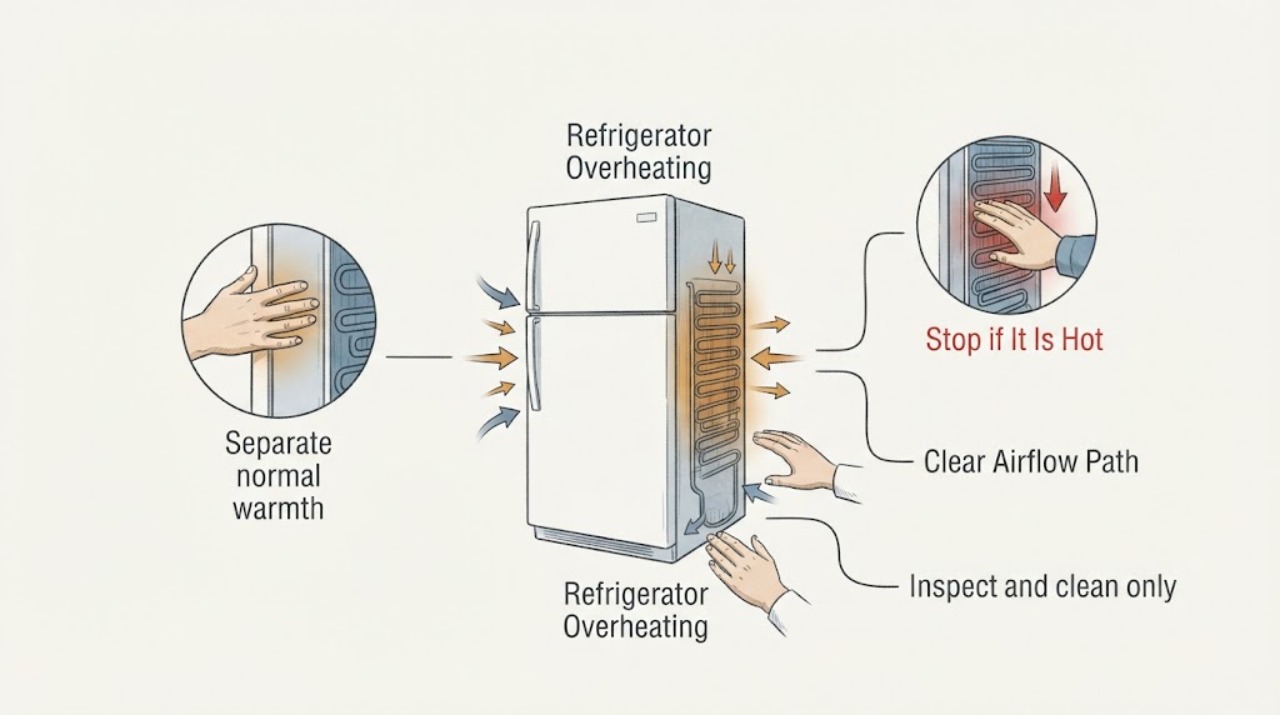
A Whirlpool refrigerator cabinet can feel warm during normal heat transfer, especially at the mullion and after startup. If it stays unusually hot while cooling is weak, check airflow and condenser condition from the safe access points; persistent overheating with poor cooling needs service.
Work through in order
Diagnostic checks
Use only checks that match the exact appliance or system and its official guide.
-
Check 1
Separate normal warmth from a cooling fault.
Expected result: Feel the mullion, side, and rear only from outside and record whether food temperatures or frost changed.
Next step: If cooling is stable, monitor it; if cooling is weak, continue with airflow and condenser checks.
Why this matters
Why: Warmth at the mullion with stable cooling can be normal; heat that is persistent with rising interior temperature is a fault pattern.
-
Check 2
Check the installation airflow.
Expected result: Look for a blocked base grille, cabinet door, wall contact, or heavy dust around accessible ventilation openings.
Next step: Clear only external obstructions and follow the model manual for required clearance; do not move water lines or remove sealed panels.
Why this matters
Why: Restricted airflow makes heat removal harder and can raise exterior and condenser temperature.
-
Check 3
Inspect and clean only an approved condenser area.
Expected result: Unplug the refrigerator before checking the model manual’s coil location; use a soft brush or vacuum only if Whirlpool permits access on that model.
Next step: Restore the grille and power after the approved cleaning; arrange service when the coils are inaccessible or the temperature remains abnormal.
Why this matters
Why: Whirlpool says some models do not require owner coil cleaning and some require a certified technician.
-
Check 4
Compare cooling behavior after a full door and gasket check.
Expected result: Observe whether doors seal, vents remain clear, the compressor/fan runs, and compartments recover temperature.
Next step: Keep doors closed and move food to a safe cold-storage location if temperature continues to rise; request qualified service.
Why this matters
Why: A sealing or airflow problem can explain heat and weak cooling; no improvement points toward a control, fan, compressor, or sealed-system issue that cannot be identified safely from outside.
Use your observations
Decision map
Find the observation that best matches what you see, then follow the next safe action.
-
PATH 01Next step
What you see
The cabinet is warm at the mullion but food temperatures are stable and there is no alarm.
Do this next
Keep the vents and door seals clear and monitor normal operation.
Why this path and its safety boundary
Why it matters: This matches the heat-loop behavior Whirlpool describes as normal.
-
PATH 02Next step
What you see
The exterior stays very hot while cooling is weak, airflow is blocked, or condenser dirt is visible.
Do this next
Correct only the accessible airflow issue or approved coil cleaning, then seek service if cooling does not recover.
Why this path and its safety boundary
Why it matters: Heat rejection is impaired or the refrigerator is running under an abnormal load.
-
PATH 03Next step
What you see
The refrigerator is overheating with a burning smell, smoke, damaged cord, repeated breaker trips, or rapidly warming food.
Do this next
Stop using it, isolate power only if safely accessible, protect food, and call qualified appliance service.
Why this path and its safety boundary
Why it matters: The symptom has crossed the safe user-check boundary and may involve an electrical or sealed-system failure.
Helpful context
Understand the symptom
What the heat means
Whirlpool identifies warmth at cabinet flanges or the mullion as heat-loop operation that helps prevent moisture. A warm cabinet alone does not prove a failed compressor. A continually hot exterior together with weak cooling shifts the check toward blocked airflow, condenser dirt, door sealing, or an internal cooling fault.
When checks do not resolve it
Need a professional?
Use qualified Whirlpool service when the refrigerator remains hot with weak cooling after approved airflow checks, or when the fan, compressor, controls, wiring, or sealed system may be involved.
Common questions
FAQ
Is a warm Whirlpool refrigerator side always a failure?
No. Whirlpool describes heat at the mullion and cabinet flanges as a heat loop that helps prevent moisture. Judge it with interior temperature and cooling performance.
Can I clean every Whirlpool refrigerator condenser myself?
No. Whirlpool says access and cleaning requirements vary by model; some coils need no routine cleaning and some require a certified technician. Use the exact Owner’s Manual.
Read the exact guide
Official sources
- Mullion is Warm/Hot - Side by Side Refrigerator - Product HelpWhirlpool Corporation · This is official manufacturer support; exact model-specific behavior and parts remain limited to the named product or manual.
- How and When to Safely Clean the Condenser CoilsWhirlpool Corporation · This is official manufacturer support; exact model-specific behavior and parts remain limited to the named product or manual.
Community feedback
Share a repair observation
Share a plain-text repair observation. Accepted observations are published automatically; this page may take a moment to update.